The Moon’s far side has kept a cleaner record of ancient violence than the hemisphere facing Earth. Tiny fragments returned by China’s Chang’e-6 mission now suggest asteroid impacts faded gradually, challenging the idea of one catastrophic spike 3.9 billion years ago.
The research traces impact events across more than three billion years, from about 4.33 billion to 1.13 billion years ago. Its strongest evidence comes from rocks collected inside the Apollo basin, within the enormous South Pole-Aitken basin.
The study was led by researchers at Curtin University, the State Key Laboratory of Deep Earth Processes and Resources at the Guangzhou Institute of Geochemistry, and the Chinese Academy of Sciences.
Co-author Dr Fred Jourdan, from Curtin’s School of Earth and Planetary Sciences, said lunar rocks preserve evidence Earth has lost through erosion, volcanic activity and shifting tectonic plates.
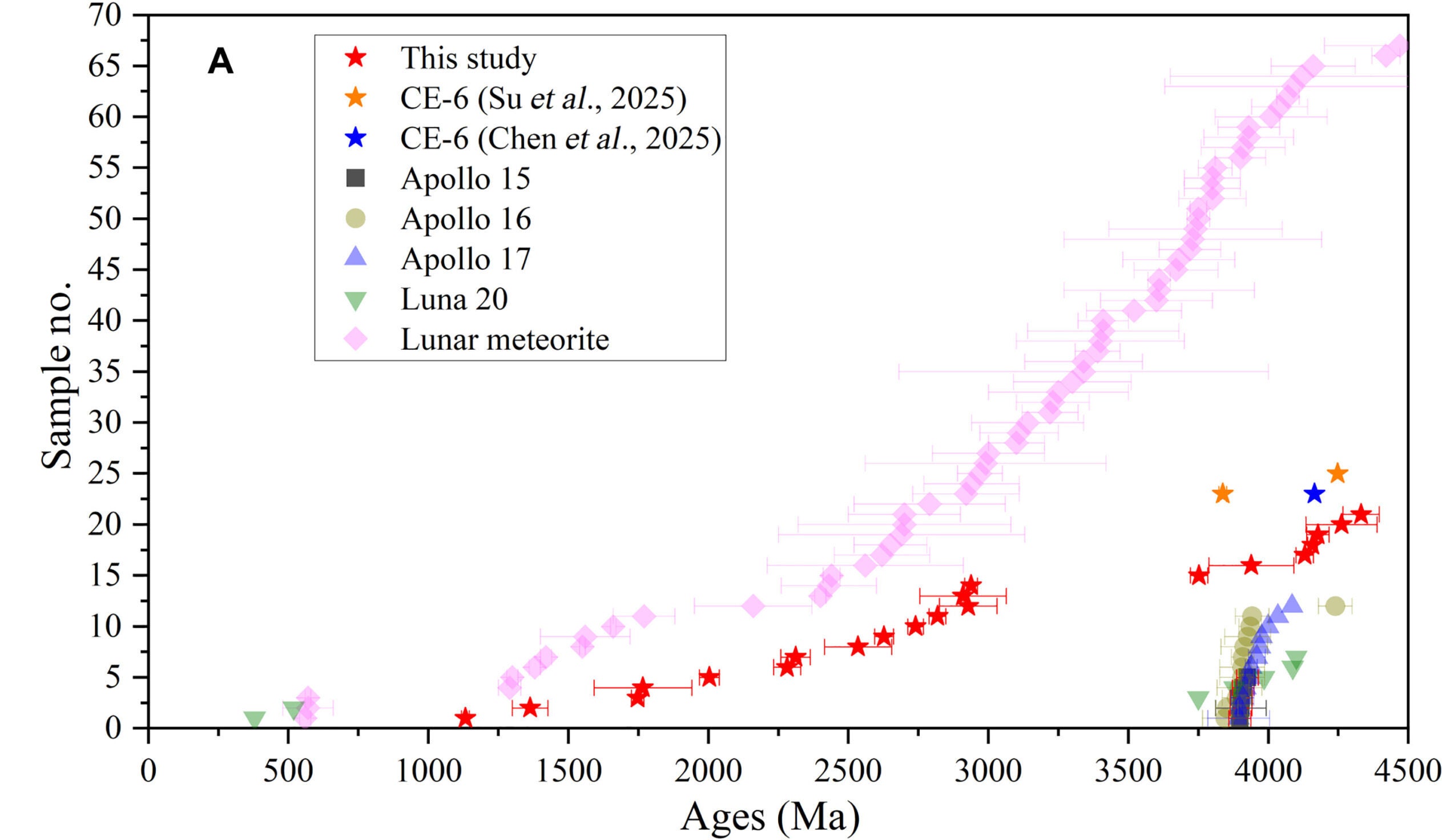
For decades, many scientists viewed lunar rock ages near 3.9 billion years as evidence for a short, violent episode of impacts. The idea became known as the terminal lunar cataclysm, or Late Heavy Bombardment.
That interpretation came largely from Apollo and Luna samples. Their similar isotopic disturbances suggested several large basins formed during a window lasting roughly 150 million to 200 million years.
Later work raised doubts. Most Apollo sites were on the Moon’s near side, where debris from the Imbrium basin spread widely. That impact occurred about 3.92 billion years ago and may have overwhelmed older signals.
A review of 259 Apollo breccia fragments found only 29 reliable geological ages. Twenty-four pointed to a single event around 3.916 billion years ago, probably the Imbrium impact.
Lunar meteorites also lacked a clear peak near 3.9 billion years. Was the bombardment spike real, or did near-side sampling create it?
China’s Chang’e-6 mission returned 1,935.3 grams of far-side material on June 25, 2024. It sampled regolith from Apollo at the southern margin of South Pole-Aitken.
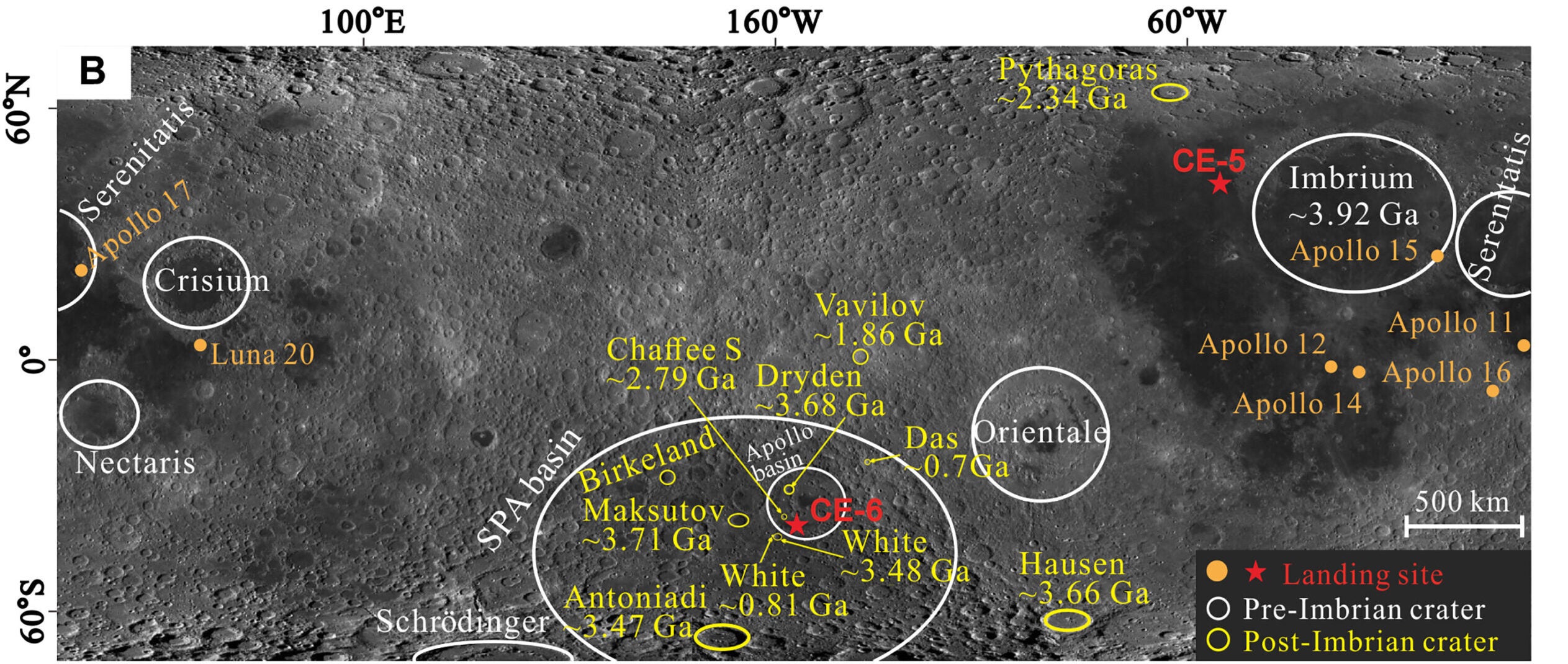
South Pole-Aitken spans about 2,500 kilometers, while Apollo measures about 492 kilometers. The region preserves the Moon’s early basin-forming era and escaped the later Imbrium overprint.
“Samples collected from the Moon’s far side are particularly significant because they allow us to compare two very different parts of the Moon for the first time. Until now, almost everything we knew came from the side facing Earth,” Jourdan said.
The team examined more than 100 particles from a two-gram soil sample. It identified 28 clasts, or small rock fragments, with impact-melt textures.
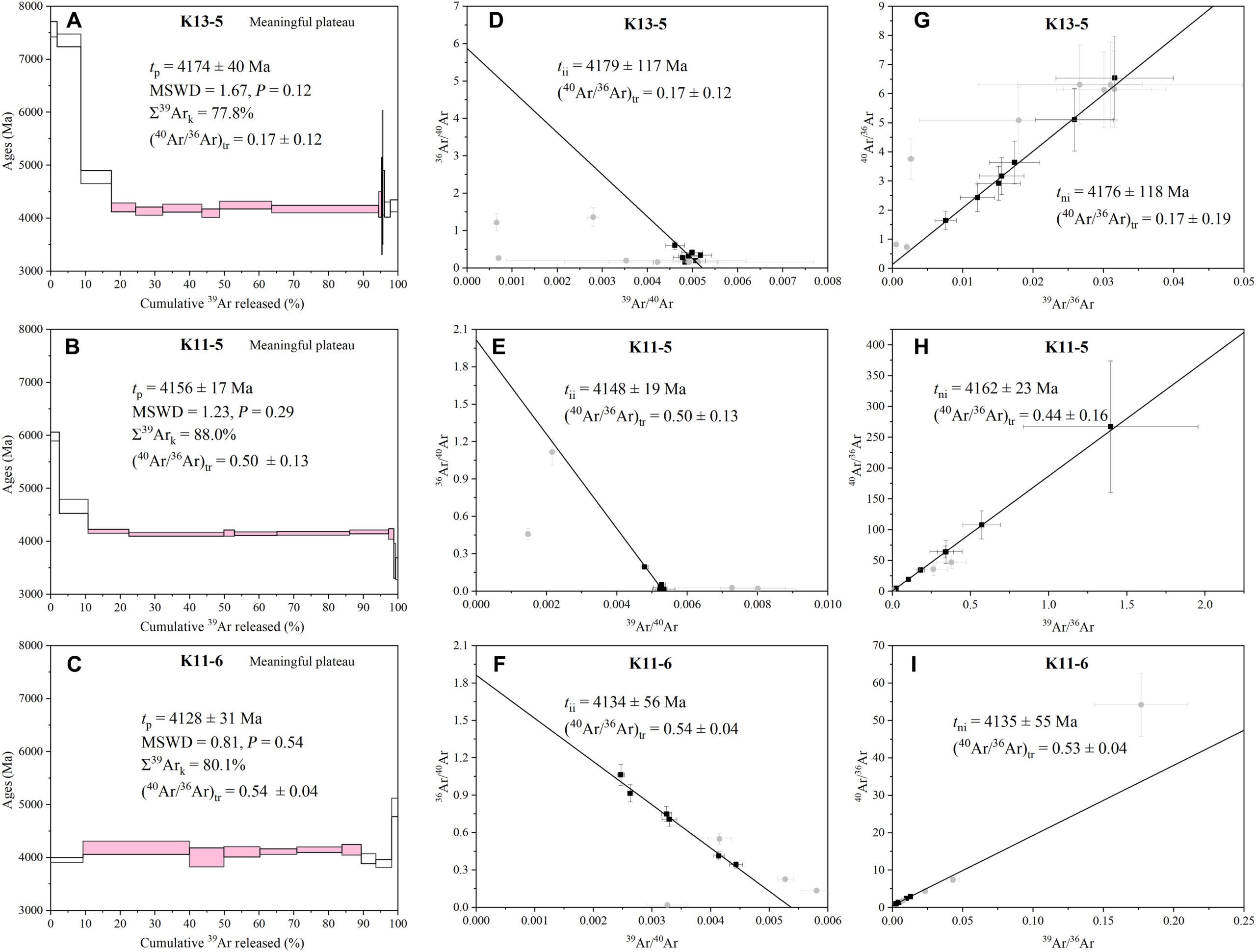
Scientists used laser stepwise heating and argon-argon dating. The method estimates when impact heat reset a rock’s isotopic clock.
Twenty-one fragments produced meaningful ages, ranging from 4.330 billion years to 1.130 billion years. Their reported uncertainties were 65 million and 14 million years, respectively.
Chemical tests supported an impact origin. Most fragments contained unusually high iridium, averaging 89.2 parts per billion. Typical lunar concentrations range from 0.1 to 10 parts per billion.
Three fragments grouped at 4.153 billion years, with an uncertainty of 14 million years. Those results matched a previously reported lead-lead age of 4.165 billion years from other impact fragments.
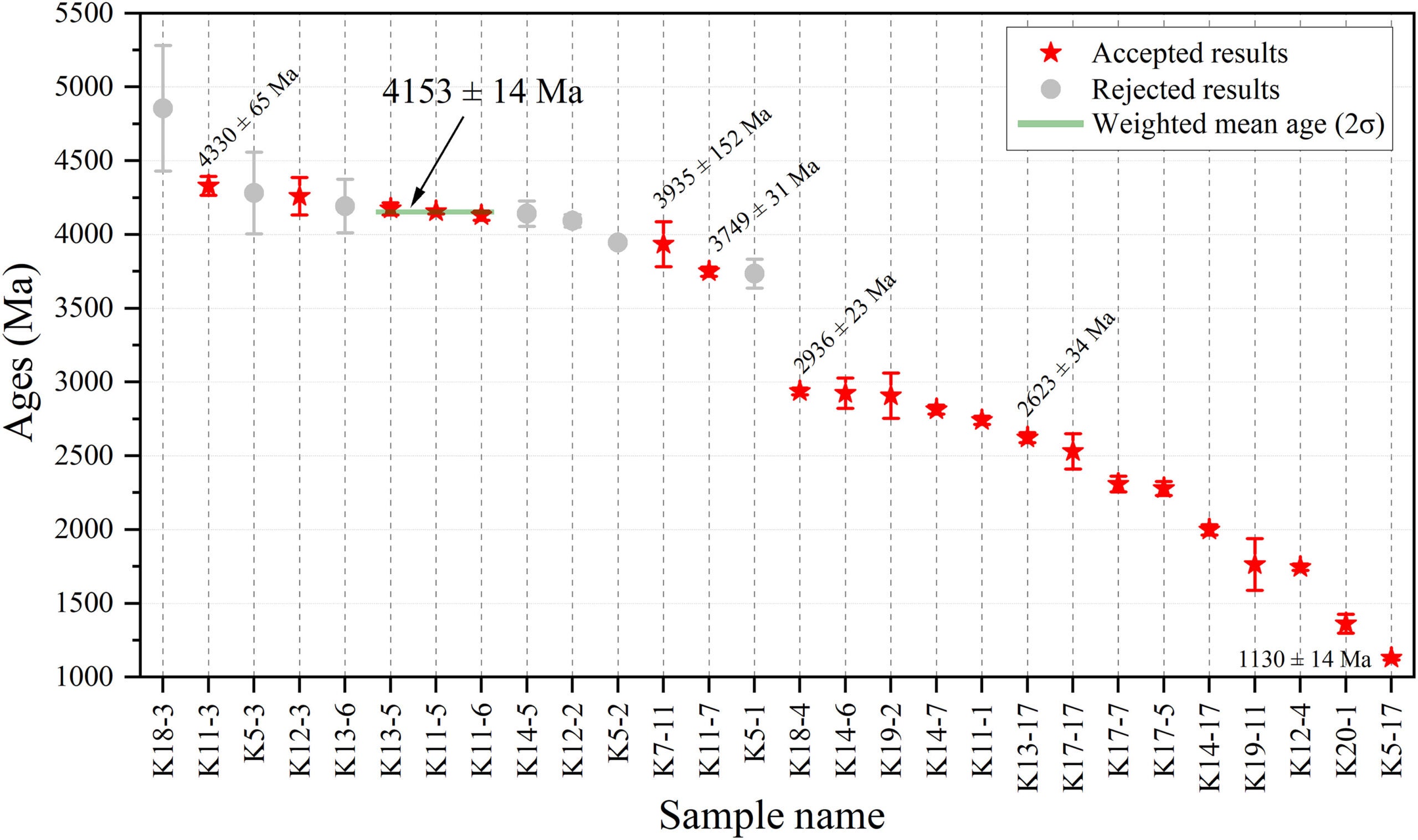
Together, the two isotopic systems place Apollo’s formation at about 4.16 billion years ago. That pushes a major basin-forming event well before the proposed 3.9-billion-year cataclysm.
One fragment yielded an older age of 4.330 billion years. Its chemistry pointed to material associated with magnesium-rich and KREEP rock types, rather than common highland crust or low-titanium volcanic rock.
That age may mark South Pole-Aitken’s formation. It could also record another large impact whose crater was later erased. The team could not distinguish between those possibilities.
Other evidence places South Pole-Aitken near either 4.33 billion or 4.25 billion years old. Another fragment produced an age of 4.260 billion years, but its uncertainty prevented a firm conclusion.
The sample set contained only two reliable ages between 4.0 billion and 3.7 billion years. None appeared between 3.7 billion and 3.0 billion years, although the record resumed from about 2.9 billion to 1.1 billion years ago.
That gap may reflect later impacts erasing local evidence, but the sample remains small. Materials from craters formed during the missing interval also appear scarce near the landing site.
The near absence of 3.9-billion-year ages sharply contrasts with Apollo collections. Among 21 meaningful Chang’e-6 ages, only two fell near that period, and one carried a large uncertainty.
Instead of a narrow surge, the record supports a smooth decline in impact activity. Large collisions began more than 4.3 billion years ago, continued through the basin-forming era and became less frequent.
“These samples are helping us rewrite parts of the Moon’s history and suggest the early Solar System experienced a long decline in asteroid impacts rather than a single catastrophic bombardment,” Jourdan said.
Uncertainties remain. Some isotopic systems were partly reset, the collection is limited and South Pole-Aitken’s exact age remains unsettled. Still, these rocks provide the first direct far-side argon-argon record from returned lunar material.
A better lunar impact timeline gives scientists a stronger reference for dating events across the inner Solar System. The Moon preserves collisions that Earth’s active geology has removed, recording conditions shared by both worlds.
“Because the Earth and Moon formed together, every major impact recorded on the Moon tells us something about the conditions experienced by the young Earth,” Jourdan said.
That record can help researchers examine how repeated impacts influenced early planetary environments and conditions that may have affected life’s emergence on Earth. It also supports future sampling across more far-side locations.
Chang’e-6 has exposed how strongly one near-side event shaped earlier interpretations. More far-side rocks could test missing intervals, refine South Pole-Aitken’s age and show whether this gradual decline represents the wider Solar System.
Research findings are available online in the journal Cell.
The original story “Chang’e-6 moon rocks reveal a 3.9-billion-year decline in asteroid impacts on the dark side of the Moon” is published in The Brighter Side of News.
Like these kind of feel good stories? Get The Brighter Side of News’ newsletter.
The post Chang’e-6 moon rocks reveal a 3.9-billion-year decline in asteroid impacts on the dark side of the Moon appeared first on The Brighter Side of News.