The search for alien radio signals has spent decades listening in a familiar part of the spectrum. A first-of-its-kind survey now suggests that unexplored higher frequencies could widen the hunt, while revealing how many stars may already have been examined without anyone realizing it.
Most radio searches for extraterrestrial intelligence, or SETI, concentrate between 1.42 and 1.66 gigahertz. This quiet region is called the “water hole” because it lies between natural radio emissions from hydrogen and hydroxyl, the components of water.
Astronomers have long considered it a logical meeting place for technologically advanced civilizations. Another society might recognize the same chemical landmarks and choose to transmit or listen there.
Louisa Mason, a doctoral researcher at the University of Manchester, looked somewhere very different.
Using archived observations from the Atacama Large Millimeter/submillimeter Array in Chile, Mason conducted the first SETI survey with ALMA. The work was presented at the Royal Astronomical Society’s National Astronomy Meeting in Birmingham.
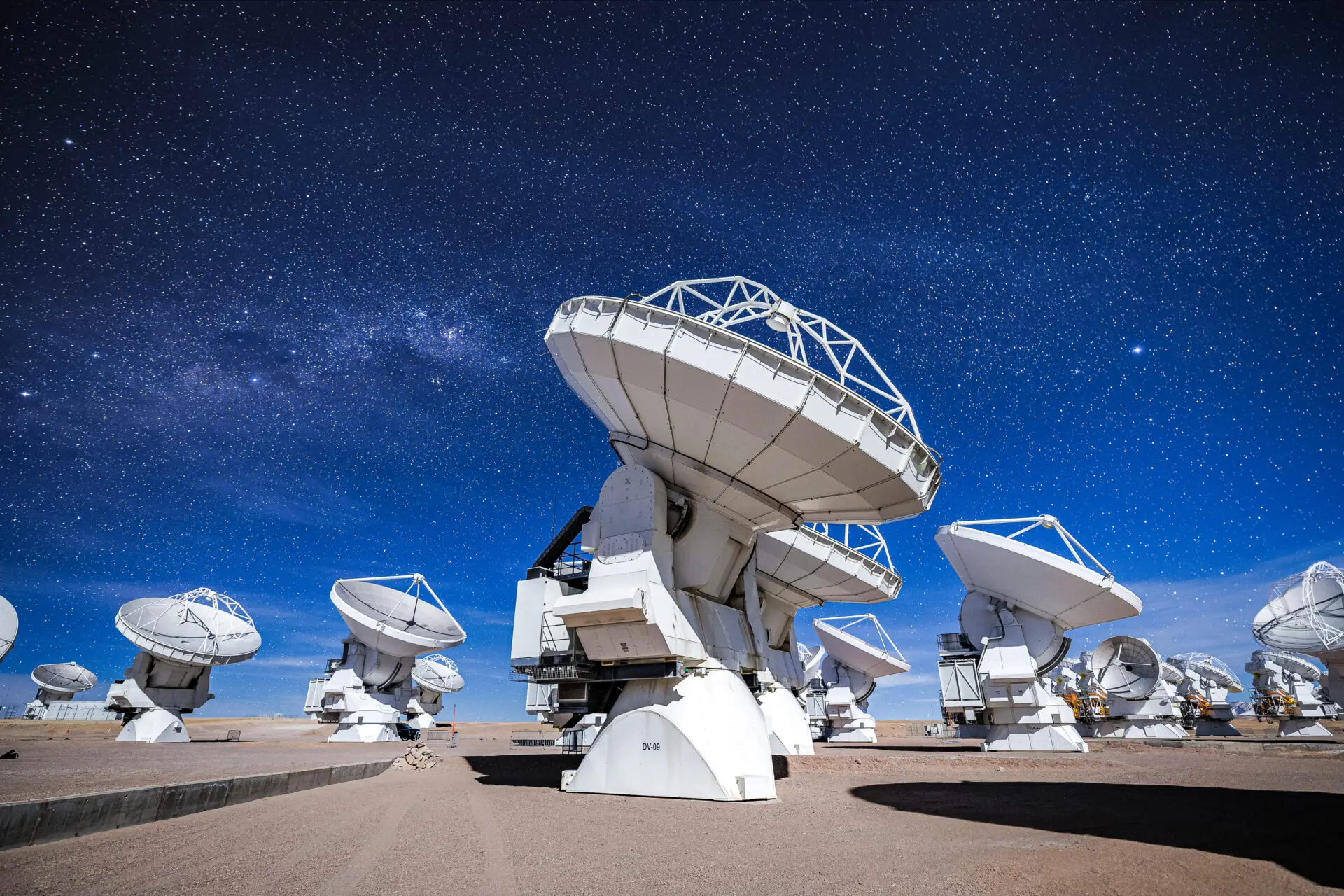
ALMA observes millimeter and submillimeter wavelengths, which correspond to much higher frequencies than those usually searched for artificial radio transmissions.
“For decades, SETI searches have concentrated on a relatively small part of the radio spectrum. We wanted to ask what might happen if we looked somewhere very different,” Mason said.
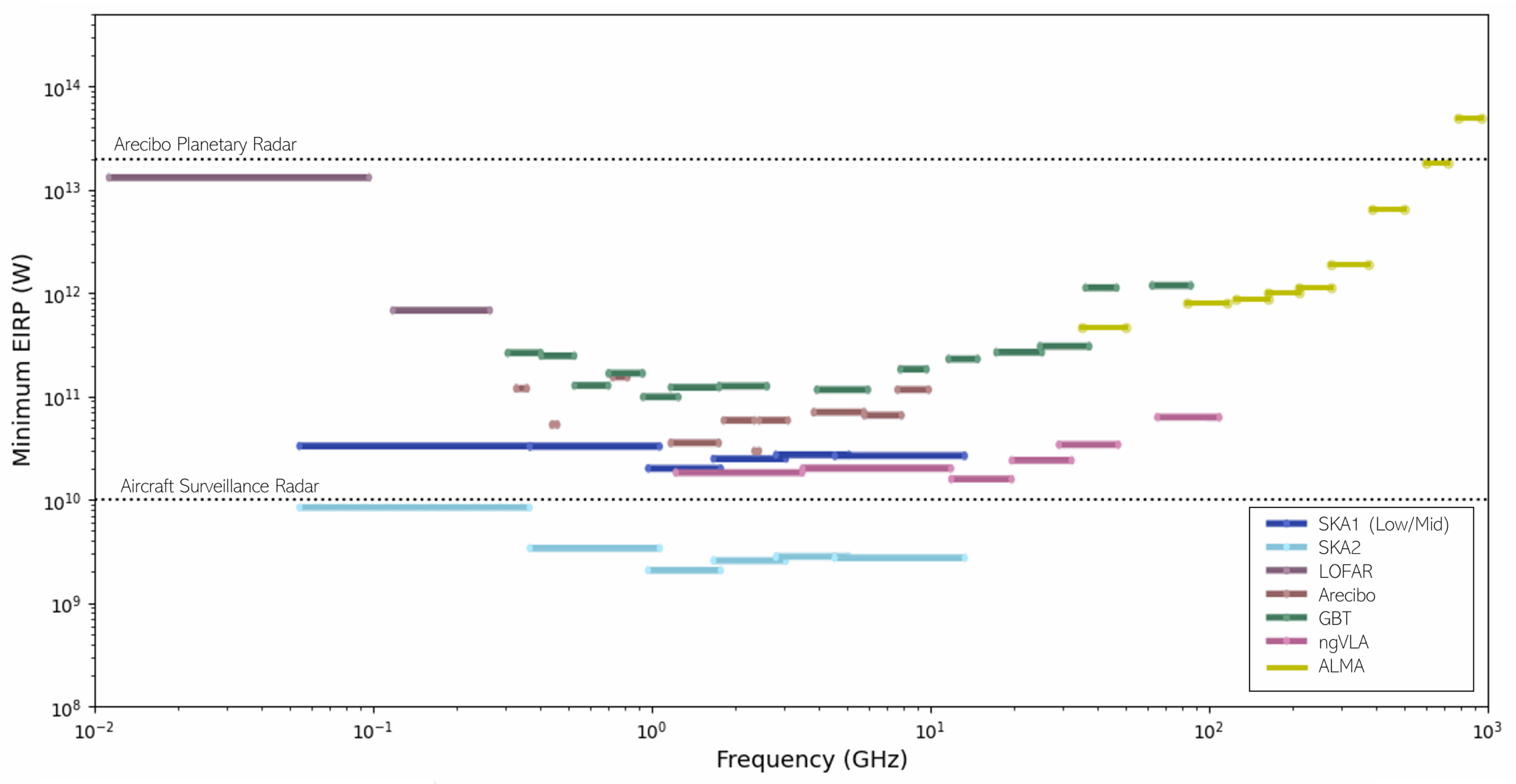
“The millimetre and submillimetre radio bands remain almost completely unexplored for SETI, so this is really about opening up a new area of parameter space to search.”
Mason did not request new telescope time. She examined four archived ALMA observations originally collected for other astronomical purposes.
Within two small frequency windows in ALMA’s Band 3, she searched for narrowband radio signals. Such signals can be possible technosignatures because natural astrophysical sources do not usually concentrate radio energy within extremely narrow frequency ranges.
No candidate signals appeared above the survey’s detection thresholds.
That result does not rule out intelligent life. It means only that no qualifying signal appeared within the limited observations, frequencies and sensitivity examined.
The small survey instead served as a demonstration. ALMA and other high-frequency telescopes could extend SETI into parts of the radio spectrum that remain largely untested.
The work also examined a second problem in SETI: astronomers may underestimate how many stars their surveys cover.
A single-dish radio telescope may point toward one chosen target, but its beam captures a wider patch of sky. Other stars in the foreground or background fall inside that field of view.
Those unintended targets form what researchers call “stellar bycatch.”
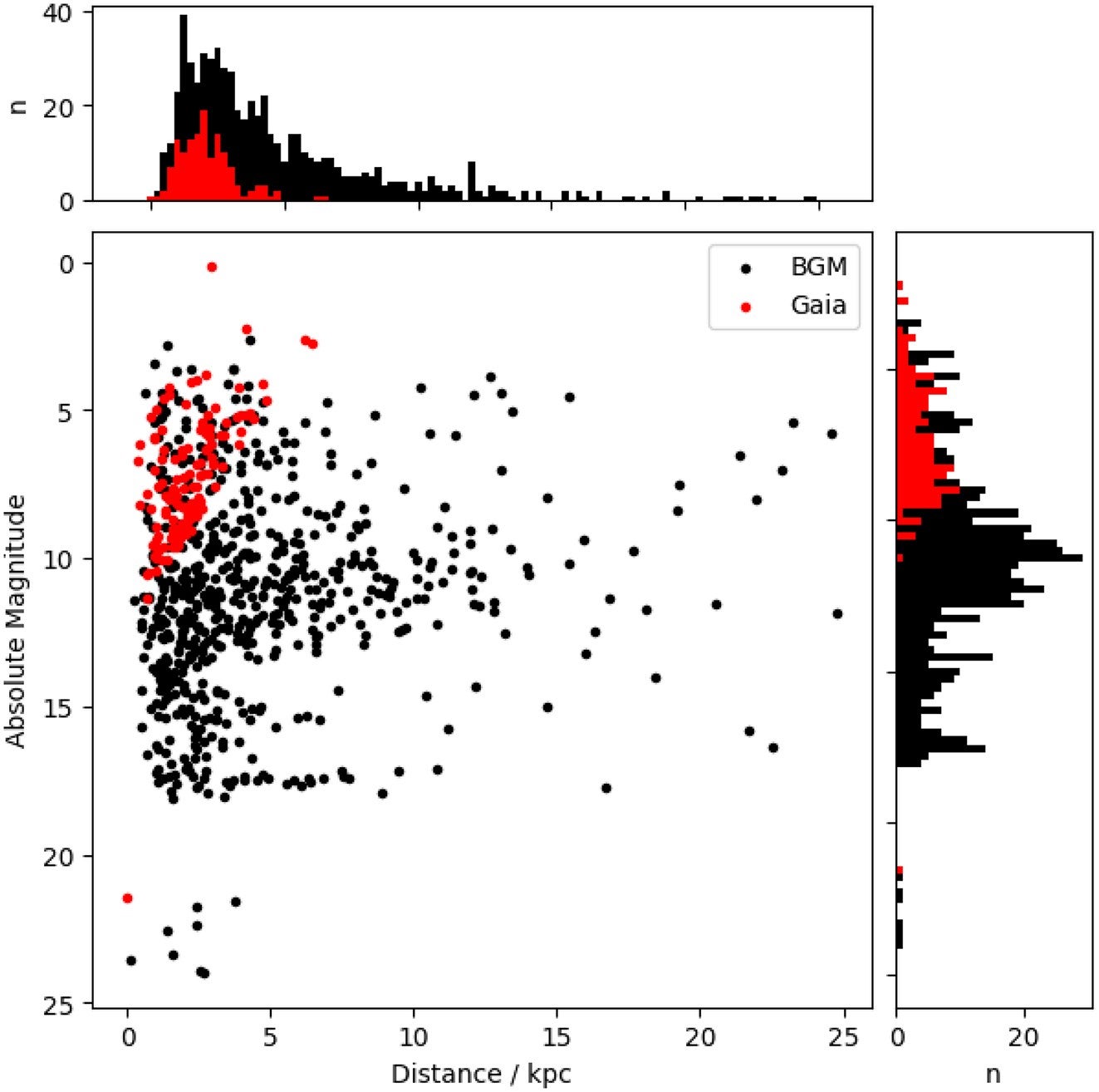
Traditional estimates often rely on the European Space Agency’s Gaia star catalogue. Gaia has transformed the mapping of the Milky Way, but it cannot provide a complete count in every direction.
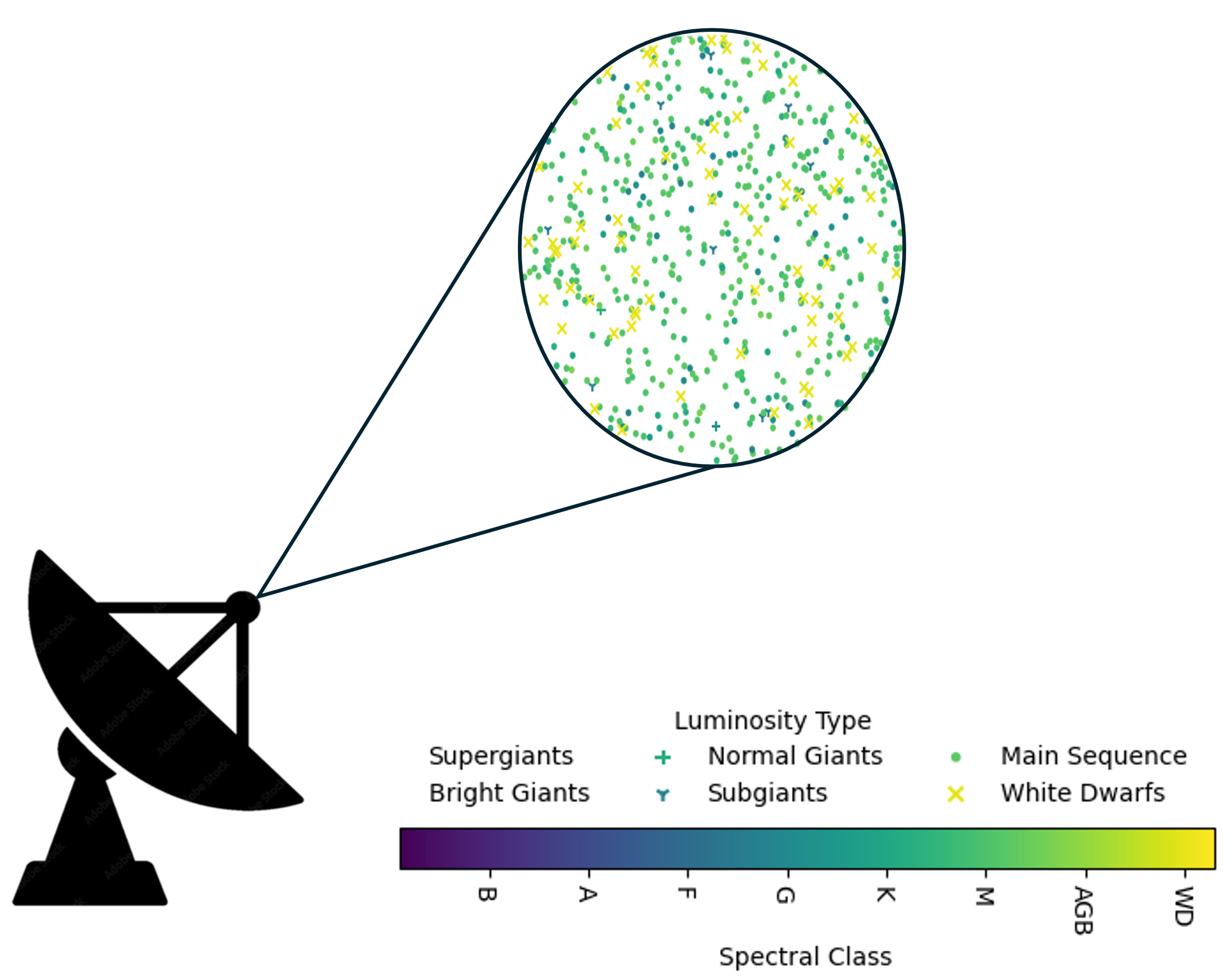
Faint stars may fall below its detection limits. Distance measurements become less reliable for remote objects, while crowded areas can confuse observations and classifications.
Mason instead used the Besançon Galactic Model, a computer simulation of the Milky Way’s stellar population. It represents the thin disc, thick disc, central bulge and stellar halo, while estimating the locations, distances and types of stars along a line of sight.
The model can include stars too faint, distant or crowded to appear reliably in observational catalogues.
“One of the most exciting things about this work is realising that we’ve surveyed many more stars than initially thought,” Mason said.
“Even a very small observation can contain a huge number and diversity of stars that we might never have intended to study. By combining high-frequency observations with galactic simulations, we can better understand exactly what we’ve searched and where we should look next.”
The team applied the Galactic model to an earlier SETI survey conducted with the Green Bank Telescope and the Parkes radio telescope.
That survey included 1,327 telescope pointings. A previous analysis using Gaia identified about 288,000 stars within the telescope beams.
The Besançon model produced a dramatically larger estimate.
Across 1,229 unique pointings that could be simulated, it counted more than 6.18 million stars extending to distances of 25 kiloparsecs. Two extremely dense fields toward the Galactic Centre were excluded because they took too long to simulate through the model’s online system.
The increase does not mean the telescopes could detect equally weak transmitters around every simulated star. Greater distances require much more powerful signals to reach Earth at detectable strength.
Still, the calculation changes how astronomers interpret a search that finds nothing. A null result across millions of stars can place tighter limits on the prevalence of continuous, powerful transmitters than a result based only on catalogued objects.
The Galactic model proved less accurate on the smallest scales. For nearby stars, it sometimes predicted fewer objects than Gaia had directly observed.
At greater distances, however, the simulation captured large populations that Gaia missed because of faintness, crowding or uncertain distance measurements.
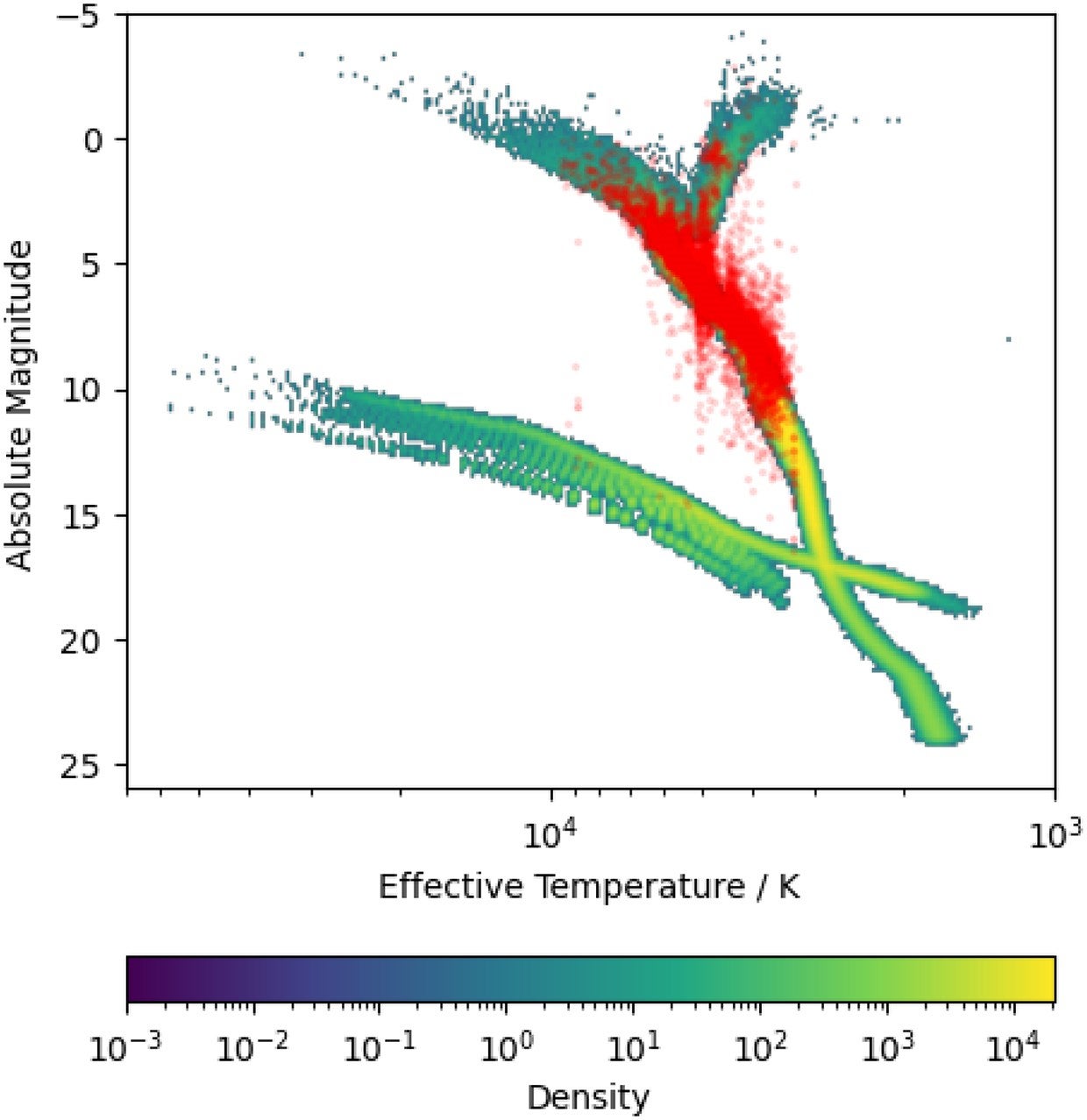
The modelling also showed that telescope beams contain a broader range of stars than the nominal target lists suggest.
A survey aimed at nearby Sun-like stars may also include red dwarfs, giant stars, white dwarfs and other stellar populations in the same beam.
That diversity matters because astronomers do not know which environments might support technological civilizations.
The densest and most varied fields appeared near the Galactic plane and toward the inner Milky Way. These regions may therefore offer large numbers of potential stellar systems within a single pointing, although the work did not claim they are necessarily more favorable for life.
The team also developed a public calculator for future surveys. Users can enter a telescope pointing, field of view, sensitivity and other observing details.
The tool then estimates the stellar population within the beam, groups stars by type and distance, and calculates the transmitter power that a survey could detect.
It can also account for sensitivity losses caused by Doppler smearing, which occurs when a signal’s frequency shifts across several channels during an observation.
Expanding SETI into millimeter and submillimeter frequencies gives astronomers another way to test whether artificial transmitters occupy regions beyond the traditional water hole.
Archived telescope observations provide a practical starting point because they allow researchers to search new frequencies without requiring additional observing time. The ALMA analysis shows how data collected for ordinary astronomy can also support technosignature searches.
Galactic simulations can improve the interpretation of those searches by estimating the millions of uncatalogued stars that may lie inside telescope beams. More realistic star counts strengthen limits on the prevalence of powerful, continuous transmitters when no signal appears.
The method can also guide future surveys toward frequencies, sky positions and telescope settings that cover the greatest number and variety of stars. No alien signal emerged from this initial ALMA search, but the work identifies a larger radio landscape and a much larger stellar audience still waiting to be examined.
Research findings are available online in the journal Monthly Notices of the Royal Astronomical Society.
The original story “First ALMA SETI survey searches new frequencies for signals from alien civilizations” is published in The Brighter Side of News.
Like these kind of feel good stories? Get The Brighter Side of News’ newsletter.
The post First ALMA SETI survey searches new frequencies for signals from alien civilizations appeared first on The Brighter Side of News.

