A jaw tip worn down by nearly a tenth does not sound like much until you picture what it means. Chipping, cracking, scratches and polish do not appear on their own. Something was hitting back.
That is the clue driving a striking new view of early octopus history. Fossil jaws from the Late Cretaceous suggest that some of the earliest known octopuses were not modest, lurking hunters. They were enormous predators, active enough and strong enough to sit near the top of the marine food web, sharing that space with the great vertebrate hunters of their time.
The work, led by researchers at Hokkaido University, centers on an awkward problem in octopus evolution. Octopuses are soft-bodied, which means their bodies rarely survive in the fossil record. Bones and shells tell long, readable stories. Octopuses mostly do not.
So the team turned to the part most likely to last: the jaws.
Using high-resolution grinding tomography and an artificial intelligence model, the researchers found fossil jaws preserved inside rock samples from Japan and Vancouver Island. The material came from calm seafloor sediments laid down between about 100 million and 72 million years ago, conditions that helped preserve fine details.
Those details mattered. The jaws still carried signs of use, including wear patterns that let the team ask not just what these animals were, but how they fed.
The fossils belonged to extinct finned octopuses in the suborder Cirrata. After revising earlier classifications, the researchers reorganized several Cretaceous jaw fossils into two species, Nanaimoteuthis jeletzkyi and Nanaimoteuthis haggarti. They also concluded that this genus belonged with finned octopuses rather than vampire squids, where it had once been placed.
That taxonomic reshuffling did more than rename old material. It extended the known history of finned octopuses by roughly 15 million years and pushed the broader octopus record back by about 5 million years, to around 100 million years ago.
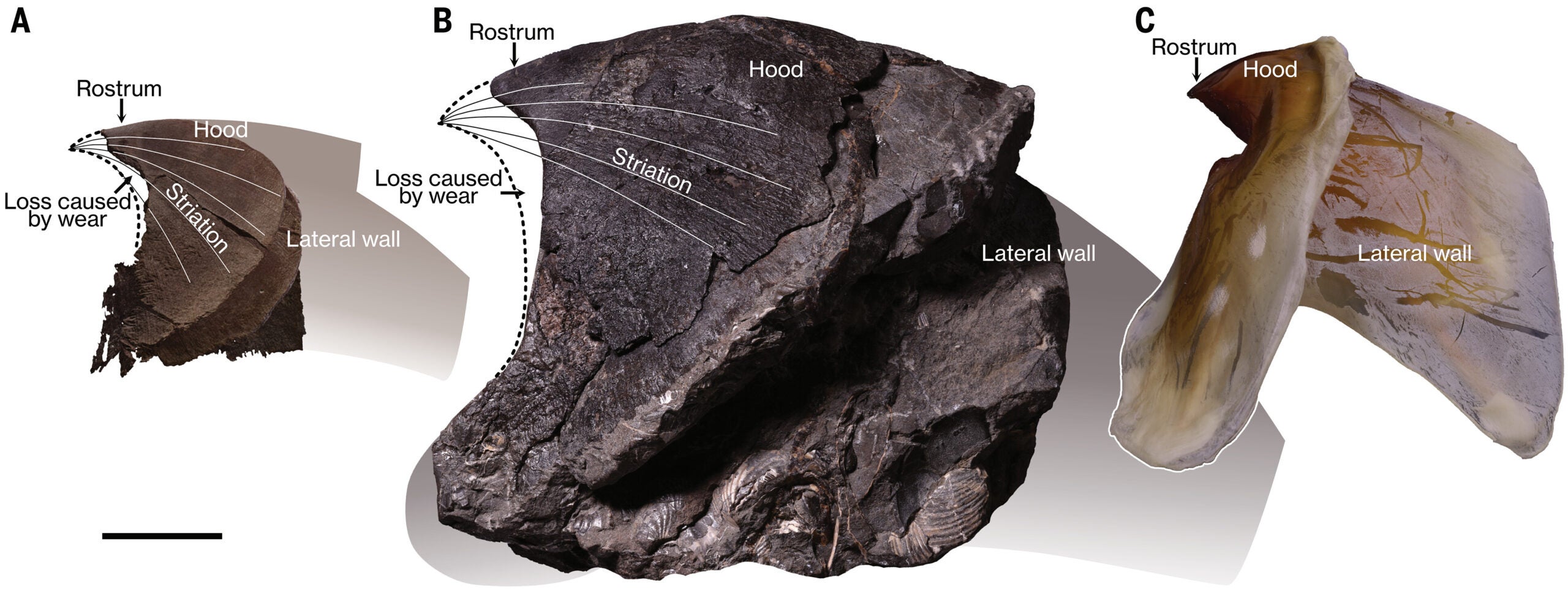
The strongest evidence came from the jaws themselves. In the largest specimens, the tips had been ground down, the edges rounded off, and the surfaces scarred by chips, cracks and scratches. In both species, the lost material at the tip amounted to about 10% of the total jaw length.
Professor Yasuhiro Iba of Hokkaido University said the scale of that wear stood out. “The most surprising finding perhaps was the extent of wear on the jaws,” he said.
That kind of damage fits a predator that repeatedly crushed hard prey. Modern cephalopods that tackle hard-shelled animals also wear down their jaws, but the Cretaceous specimens appear even more heavily used. The researchers found signs of strong shear stress, including chips larger than 1 millimeter and cracks up to 5 millimeters long.
“In well-grown specimens, up to 10% of the jaw tip relative to the total jaw length had been worn away, which is larger than that seen in modern cephalopods that feed on hard-shelled prey,” Iba said. “This indicates repeated, forceful interactions with their prey, revealing an unexpectedly aggressive feeding strategy.”
Juvenile jaws did not show the same kind of wear. Nor did fossil squid jaws found alongside them. That contrast helped narrow the interpretation: these giant finned octopuses were likely active carnivores that regularly crushed shells and bones.
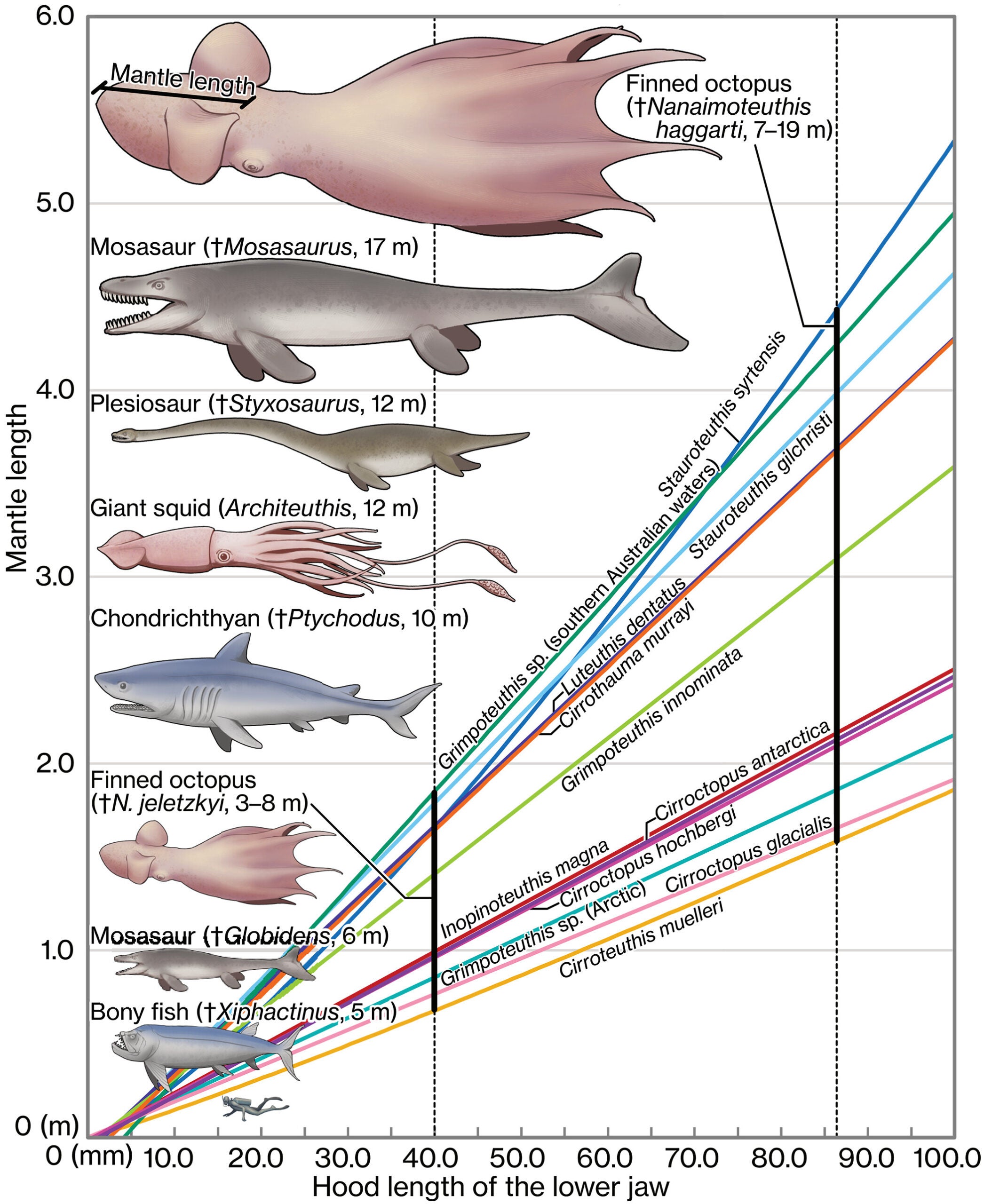
The study also points to a startling body size. By comparing jaw size with body proportions in living long-bodied finned octopuses, the researchers estimated mantle length and total length for the fossil species.
For N. jeletzkyi, the team calculated a mantle length of about 0.67 to 1.84 meters, which translates to a total length of around 2.8 to 7.7 meters. N. haggarti was far larger, with an estimated mantle length of 1.58 to 4.43 meters and a total length of about 6.6 to 18.6 meters.
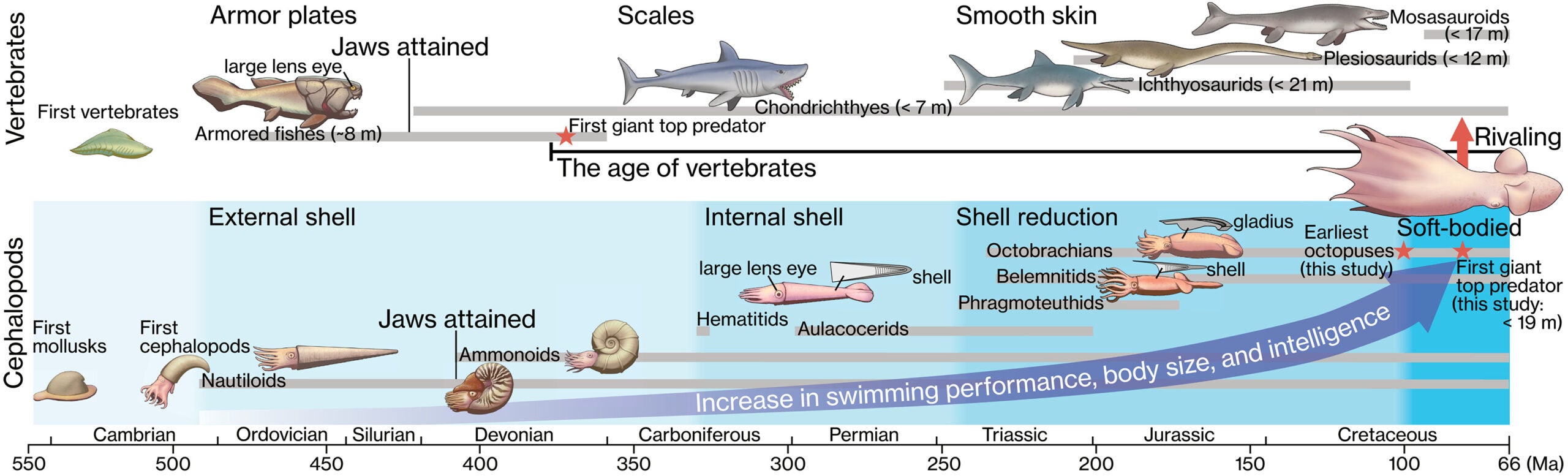
That upper range puts the larger species in rare company. It rivals some of the biggest marine predators known from the Cretaceous, including large fish, sharks, plesiosaurs and mosasaurs. Its jaw also exceeded that of the modern giant squid, which has the largest jaw among living cephalopods.
Iba summed up the scale bluntly: “Our findings suggest that the earliest octopuses were gigantic predators that occupied the top of the marine food chain in the Cretaceous.”
He added, “Based on exceptionally well-preserved fossil jaws, we show that these animals reached total lengths of up to nearly 20 meters, which may have surpassed the size of large marine reptiles of the same age.”
That does not mean these octopuses bit like a mosasaur. Their jaws were smaller than those of the biggest vertebrate predators around them. But octopuses had something else: long, flexible arms that could seize and manage large prey before the jaws went to work.
One sentence in the study carries real weight here: these animals probably used both arms and jaws together to fill the role of top predators.
One of the more intriguing observations was asymmetrical wear. In both species, one side of the biting surface was more worn than the other.
That suggests lateralization, a tendency to favor one side during feeding. In living animals, lateralized behavior is often linked to advanced neural processing. Modern octopuses show this kind of asymmetry, and they are already famous for problem-solving and behavioral flexibility.
The fossil jaws do not let anyone watch these animals hunt. Still, the pattern raises the possibility that complex behavior appeared early in octopus history, much earlier than the fossil record has been able to show clearly.
The broader ecological message may be even more disruptive. For decades, ancient marine ecosystems have usually been pictured as worlds ruled at the top by vertebrates, while invertebrates occupied lower tiers and evolved defenses against being eaten. This study argues that giant finned octopuses broke that rule.
“This study provides the first direct evidence that invertebrates could evolve into giant, intelligent apex predators in ecosystems that have been dominated by vertebrates for about 400 million years,” Iba said. “Our findings show that powerful jaws and the loss of superficial skeletons, common characteristics of octopuses and marine vertebrates, were essential to becoming huge, intelligent marine predators.”
This work changes more than the silhouette of one ancient animal. It reshapes how you might picture Cretaceous seas, not as ecosystems divided neatly between vertebrate rulers and invertebrate prey, but as more complicated places where a soft-bodied hunter could rise to the top.
It also shows how much fossil history may still be hidden in plain sight. By combining digital fossil-mining with AI, researchers were able to find jaws that would have been easy to miss inside rock. That opens the possibility of reconstructing ancient ecosystems with far more detail than older methods allowed.
For octopus evolution, the study suggests that gigantism, forceful predation and perhaps even behavior linked to intelligence emerged early. For paleontology more broadly, it is a reminder that the absence of bones does not always mean the absence of evidence. Sometimes the story survives in the damage left behind.
Research findings are available online in the journal Science.
The original story “Giant octopuses were the ocean’s apex predators 100 million years ago” is published in The Brighter Side of News.
Like these kind of feel good stories? Get The Brighter Side of News’ newsletter.
The post Giant octopuses were the ocean’s apex predators 100 million years ago appeared first on The Brighter Side of News.

