Io’s surface may look like a frozen snapshot of volcanic chaos, but just a few feet below, the temperature rises sharply. NASA’s Juno spacecraft has now measured that hidden heat directly, exposing how energy moves through Jupiter’s most volcanic moon.
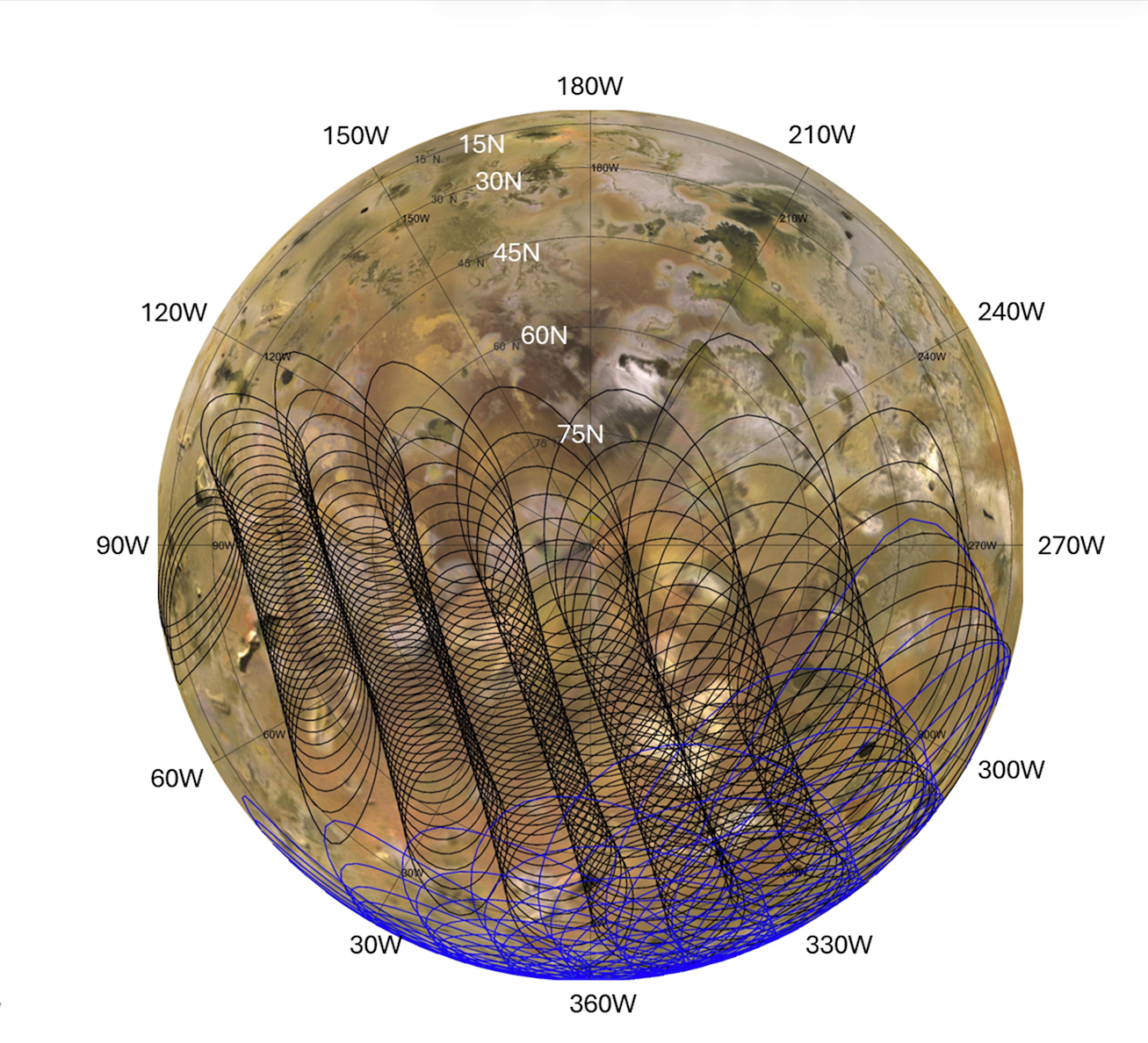
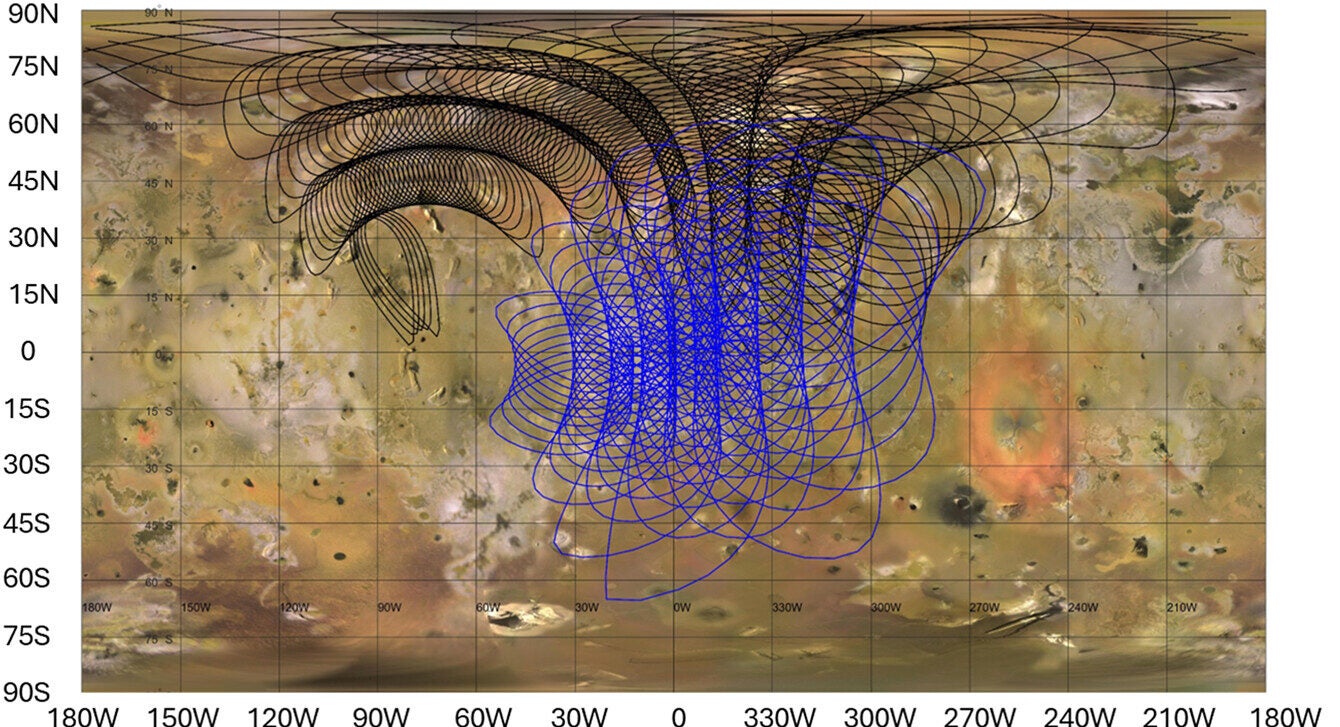
The readings came from Juno’s Microwave Radiometer during close flybys on Dec. 30, 2023, and Feb. 3, 2024. The spacecraft passed within about 930 miles of Io’s surface both times.
Published in the Journal of Geophysical Research: Planets, the work marks the first direct measurement of thermal emission from beneath Io’s surface. It also points to a landscape that is smoother and less dense than its rugged mountains suggest.
“The Juno Microwave Radiometer directly observed Io’s heat output by looking below the surface,” said Scott Bolton, study coauthor and Juno’s principal investigator at Southwest Research Institute in San Antonio. “The surprising discovery that we could see below a rocky moon’s surface has important implications for studying Earth’s volcanoes.”
Io’s volcanic activity comes from tidal heating. Jupiter’s gravity repeatedly stretches and squeezes the moon as it follows a slightly elliptical orbit. That deformation generates immense internal heat.
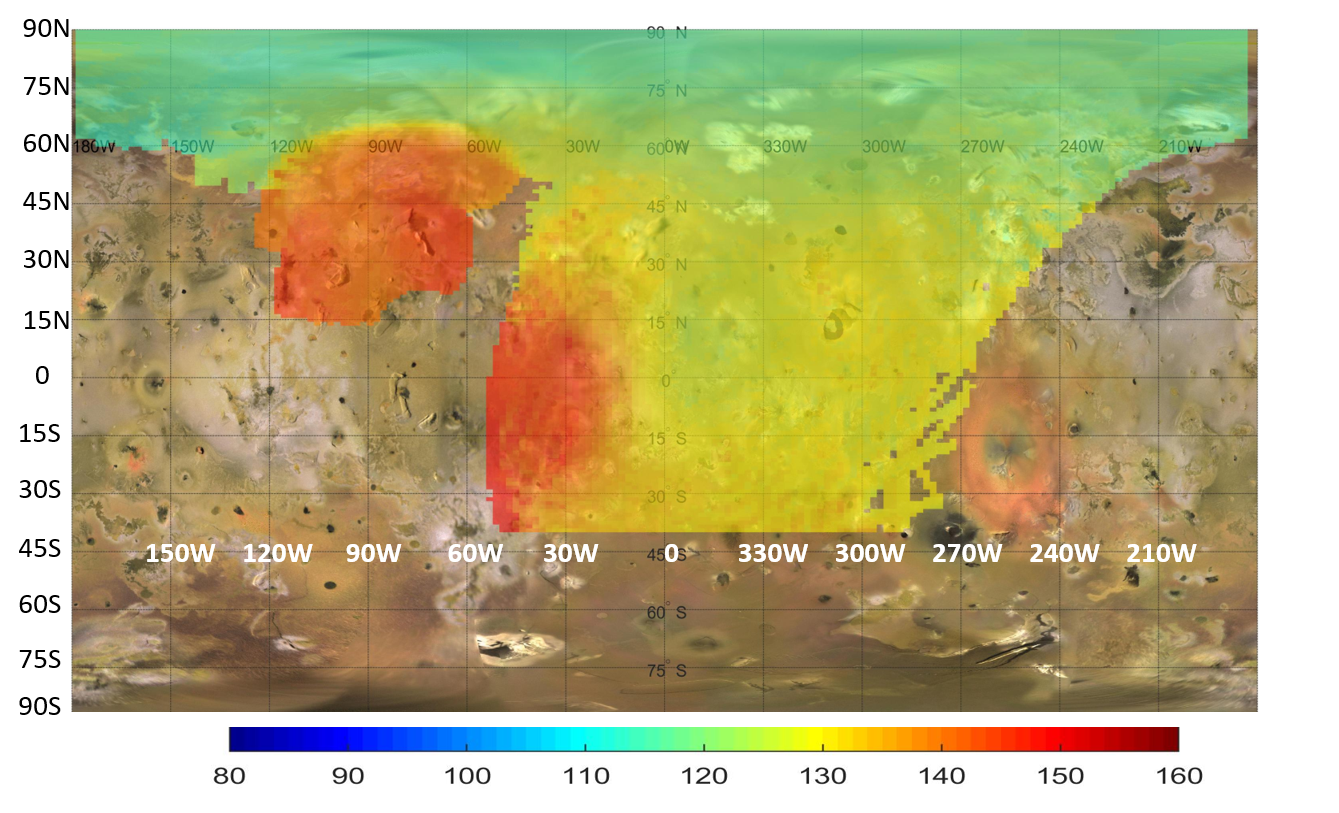
Earlier infrared observations measured only the uppermost surface. Juno’s radiometer instead sampled microwave emission from depths ranging from a few inches to tens of feet.
“The instrument measured Io’s thermal emission at depths ranging from a few inches down to tens of feet,” said lead author Shannon Brown of NASA’s Jet Propulsion Laboratory. “Everywhere we looked, we found the temperature rising by more than 40 degrees Fahrenheit just several feet into the surface.”
Solar heating alone cannot explain that steep increase.
The team considered two possible explanations. Heat may be moving steadily upward through a conductive crust. Under that model, the local heat flow measures about 1 to 3 watts per square meter.
That sounds modest, roughly comparable to a small nightlight beneath each square yard. Across Io, however, it represents energy release up to 30 times Earth’s average surface heat flow.
A second possibility involves recent lava flows. About 10 percent of Io’s surface may be covered at any time by cooling flows capped with roughly 30 to 35 feet of solidified crust.
Juno’s Microwave Radiometer was built to probe beneath Jupiter’s clouds. Its six antennas detect wavelengths from about half an inch to 20 inches, allowing each channel to sample a different depth.
The instrument later observed Ganymede, Europa and Io during Juno’s extended mission. At the icy moons, it probed tens of miles beneath the surface under assumptions about mostly pure water ice.
Io presented a different challenge. Its surface contains volcanic rock, sulfur compounds and porous material. The team did not expect microwave signals to penetrate so effectively.
“The technique is novel in that each wavelength explores different depths,” Bolton said. “At Ganymede and Europa, we explored tens of miles below the surface, assuming their ice shells were mostly pure water, but the ability to probe into the volcanic rock at Io was an unexpected discovery.”
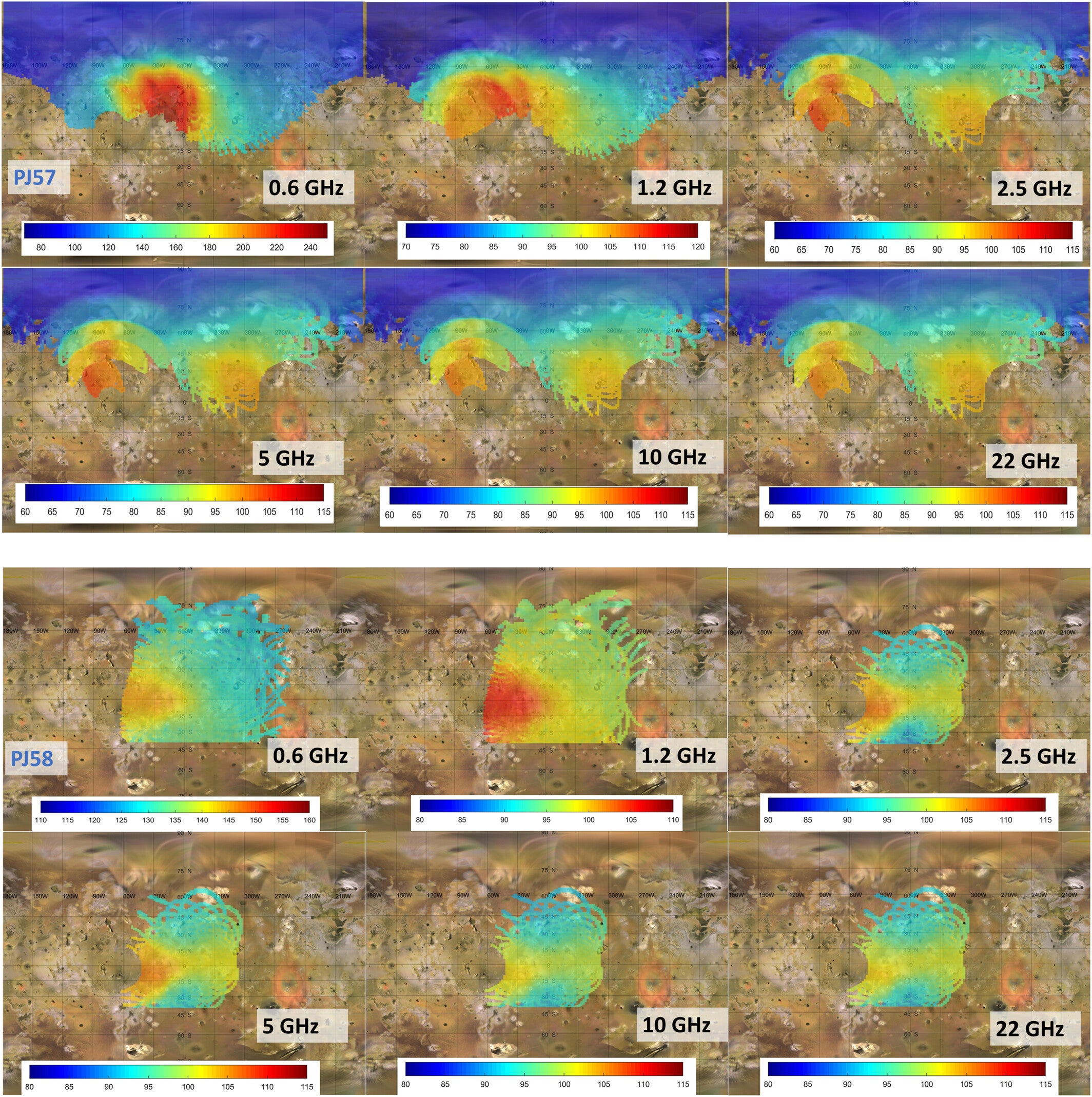
The radiometer recorded a strong increase in brightness temperature at the lowest frequencies, which penetrate deepest. That pattern indicates warmer material below a cooler near-surface layer.
The deepest channel sensed the upper several meters, with some signal coming from the upper tens of meters. The shallower channels showed weaker temperature changes.
The flybys also revealed unusual surface properties.
Io is known for mountains taller than 6 miles, yet most areas away from that topography reflected microwaves like a smooth surface. Some smooth regions may extend for 60 miles or more.
Juno observed overlapping areas from different angles. The changing reflection pattern allowed the team to distinguish between a rough surface, which scatters radiation broadly, and a smooth one, which reflects it in favored directions.
The result favored mostly specular reflection, similar to the way sunlight flashes from an ocean or polished land surface at certain angles.
“Away from its mountains, the surface is more like the Great Plains of North America,” Brown said. “And even though Io is a rocky body, the surface material has a very low density, more like pumice or a fluffy volcanic ash than solid rock.”
The inferred density ranges from about 0.7 to 1.1 grams per cubic centimeter. That is consistent with porous volcanic ash, pumice or scoria rather than dense rock.
The upper layer may also sit above denser material several meters down. Lower microwave frequencies appeared to encounter a higher effective dielectric constant, which the team interpreted as a possible sign of increasing density with depth.
These measurements give scientists a new way to study how heat escapes from a world shaped by tidal forces. Until now, observations mainly tracked eruptions or heat leaving the visible surface.
Microwave measurements can instead follow the temperature gradient below that surface. They may help determine whether Io loses heat through broad conductive regions, repeated lava resurfacing, or both.
“Io provides a unique window into learning how tidal heating works throughout the cosmos,” Bolton said. The same process also supplies energy to subsurface oceans on moons such as Europa and Ganymede.
The technique could guide future missions to rocky moons and ocean worlds. A higher-resolution radiometer with more frequencies and dual polarization could map heat flow and shallow structure in greater detail.
The approach may also inform studies closer to home. Bolton said a similar instrument near an Earth volcano could detect subsurface temperature changes and provide new evidence about how volcanic systems move heat before it reaches the surface.
Research findings are available online in the journal JGR Planets.
The original story “Jupiter’s volcanic moon, Io, hides intense heat beneath its porous crust” is published in The Brighter Side of News.
Like these kind of feel good stories? Get The Brighter Side of News’ newsletter.
The post Jupiter’s volcanic moon, Io, hides intense heat beneath its porous crust appeared first on The Brighter Side of News.