Beta Pictoris d spent years concealed inside one of the brightest debris disks astronomers know. NASA’s James Webb Space Telescope found it not as a clean point of light, but through the chemical barcode of its atmosphere.
The giant exoplanet orbits Beta Pictoris, a young star 63 light-years from Earth. The system already contained two known planets, Beta Pictoris b and c. Adding a third makes it only the second planetary system known to contain at least three directly imaged planets.
The discovery appeared in The Astrophysical Journal Letters. The team included researchers from the University of California, San Diego, who were using Webb to examine Beta Pictoris b when an unexpected signal appeared elsewhere.
“This discovery adds another piece to an already fascinating planetary system,” said lead author Aidan Gibbs, a UC San Diego postdoctoral researcher. “Beta Pictoris has long served as a laboratory for understanding how planetary systems form and evolve, and now we have another planet helping us tell that story.”
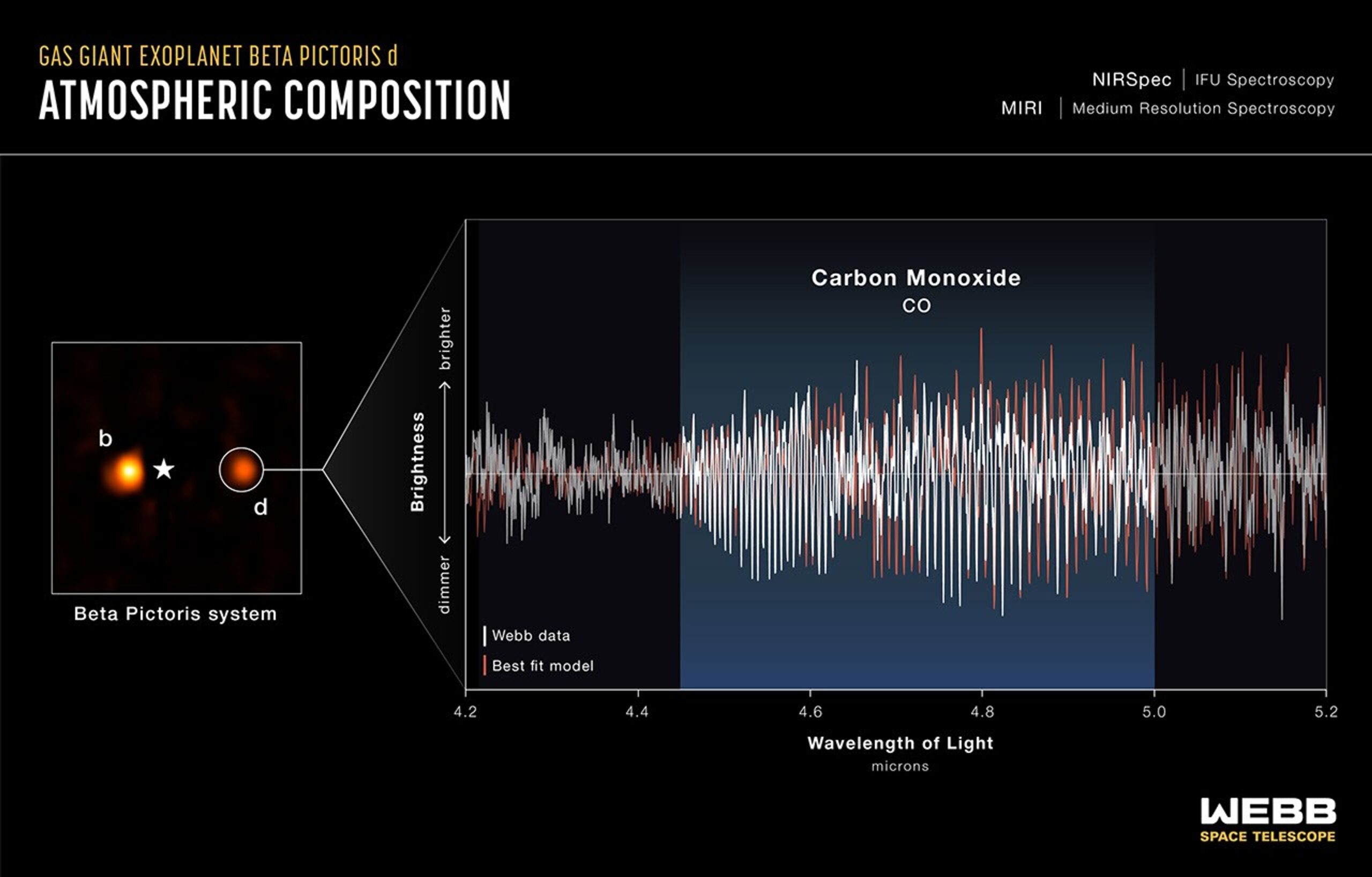
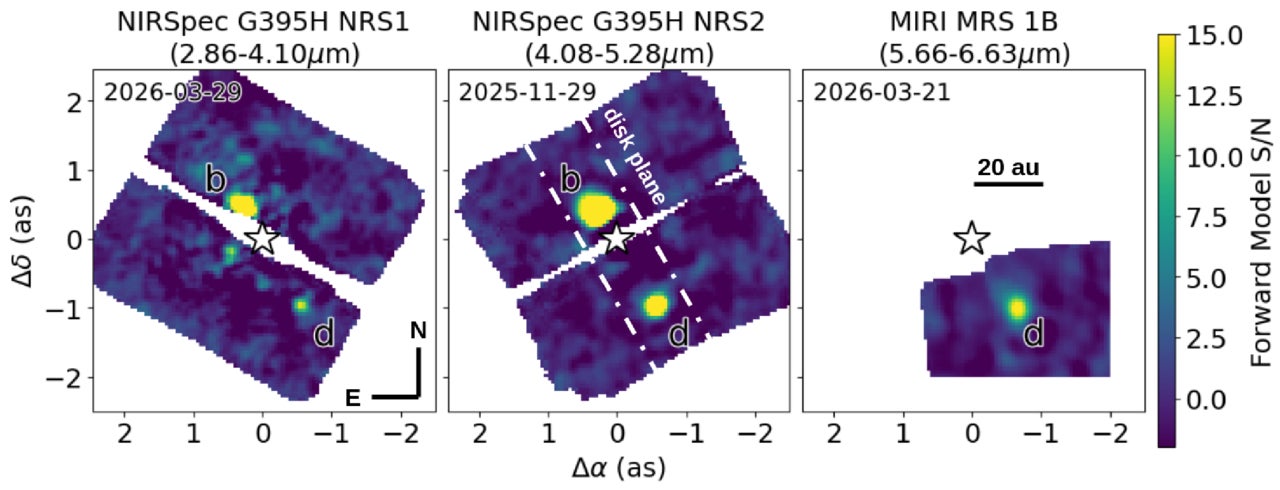
The team was not searching for a new world. Webb’s Near-Infrared Spectrograph, or NIRSpec, was collecting images and spectra of Beta Pictoris b through its Integral Field Unit.
“We weren’t looking for a new planet,” Gibbs said. “We were trying to understand one we already knew existed. Then, this telltale signal appeared in the data where we didn’t expect it.”
Instead of a smooth spectrum from starlight scattered by dust, the researchers saw a repeating pattern of peaks and troughs. Evenly spaced carbon monoxide absorption lines stretched across the data like a barcode.
Those lines matched the atmosphere of a gaseous planet. They also supplied information about the object’s motion, allowing the team to estimate its radial velocity, position and alignment.
The measurements placed the source within Beta Pictoris’ nearly edge-on disk. Its velocity was consistent with an object orbiting the star on the opposite side from Beta Pictoris b.
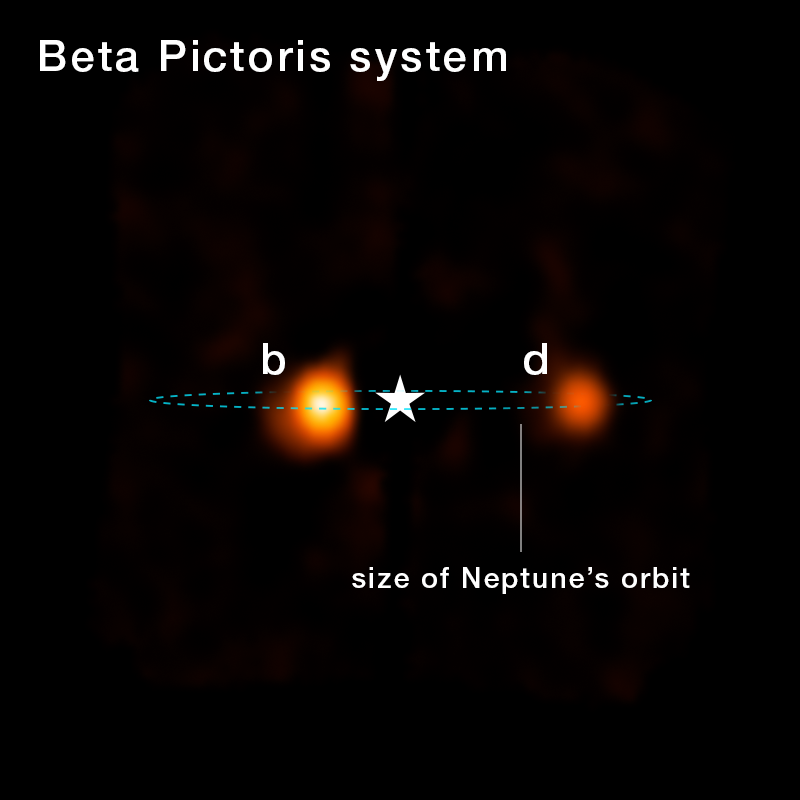
A chance alignment with an unrelated brown dwarf remained technically possible. The team estimated the probability at less than one in 10 million before considering radial velocity. Researchers concluded that the object was bound to Beta Pictoris and named it Beta Pictoris d.
Beta Pictoris is about 23 million years old and remains surrounded by debris from planet formation. Its disk contains warps, clumps, asymmetries, comets and planetesimals.
That bright material helped hide the new planet. Scattered starlight can create structures resembling faint companions, while instrumental effects can produce bright spots that are not real objects.
“There was an unexpected bright source of light within the Integral Field Unit imaging, but we’ve learned not to trust bright blobs in images,” said Jean-Baptiste Ruffio, a UC San Diego research scientist and principal investigator of the first Webb observations. “They can be instrumental artifacts or other structures in the debris disk. By obtaining a spectrum at the same time as the image, we were able to quickly confirm our suspicions.”
Follow-up observations with Webb’s Mid-Infrared Instrument, or MIRI, detected water vapor and methane. NIRSpec also revealed carbon monoxide and methane, strengthening the conclusion that the source was a planet.
A separate investigation using the European Southern Observatory’s Very Large Telescope and Webb’s Near-Infrared Camera independently confirmed its existence.
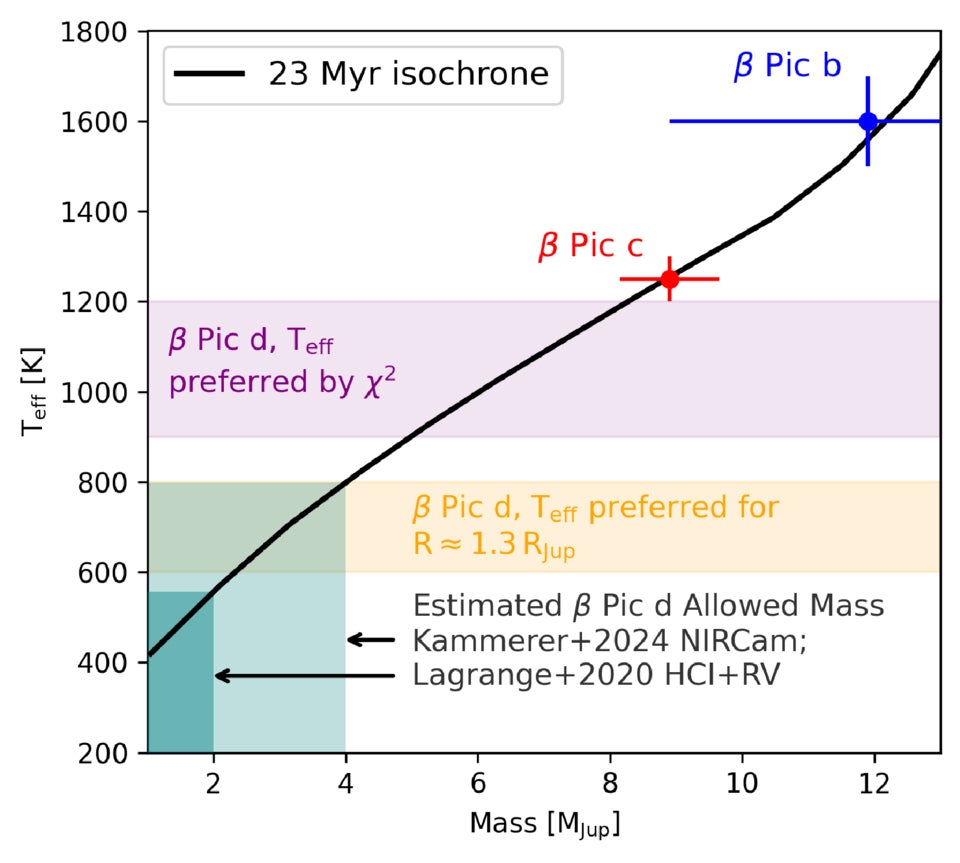
The team estimates that Beta Pictoris d has roughly two to four times Jupiter’s mass. That would make it the smallest of the system’s three known giant planets.
Its exact properties remain uncertain because the method removed much of the planet’s continuum, the broad shape of its emitted light. Atmospheric lines can depend on temperature, composition, clouds and chemical mixing, creating several possible interpretations.
Models based only on the continuum-subtracted spectrum favored temperatures from 900 to 1,200 kelvins, but also produced unrealistically small radii. The researchers consider 600 to 800 kelvins more likely because that range better matches expected radii and earlier detection limits.
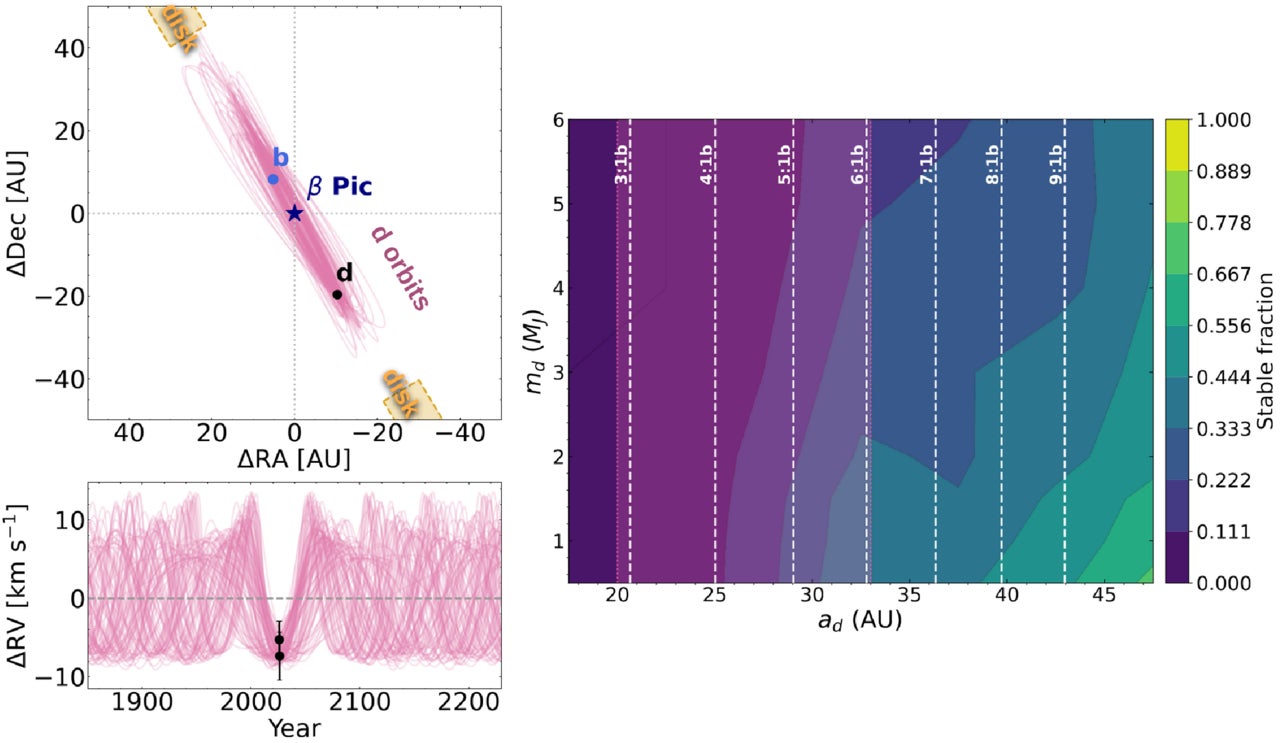
The limited orbital measurements leave room for several possible paths. Initial modeling placed the orbit between 10 and 50 astronomical units from the star. Dynamical simulations favored stable orbits beyond 30 astronomical units, near Neptune’s region in our solar system.
That location would put Beta Pictoris d outside Beta Pictoris b but inside the debris disk’s inner edge, which begins near 50 astronomical units.
Astronomers had already proposed that another planet might orbit beyond Beta Pictoris b. The two known worlds could not fully explain the disk’s sharply defined inner gap or several unusual structures.
Beta Pictoris d could help carve that inner edge. Its gravity may also influence inclined debris, infalling comets, disk asymmetry or a carbon monoxide clump on the system’s southwest side.
Those possibilities remain unconfirmed. Researchers need better measurements of the planet’s mass and orbit before deciding how much of the disk’s behavior it can explain.
The discovery also changes how astronomers may search crowded systems. Traditional imaging depends on separating a faint point source from bright starlight and surrounding dust. Moderate-resolution spectroscopy instead searches for narrow molecular patterns that dust cannot easily reproduce.
“A spectrum contains an incredible amount of information,” Ruffio said. “You don’t just learn that something is a planet; you immediately begin learning about its temperature, chemistry, and motion.”
Beta Pictoris d demonstrates that spectroscopy can uncover planets buried within bright debris disks, where conventional imaging reaches its limits. The same observation can provide confirmation and early atmospheric measurements without a separate campaign.
That approach could improve searches for lower-mass planets around young stars and worlds obscured by exozodiacal dust. It may also guide future observatory design, including the planned Habitable Worlds Observatory.
Continued Webb observations can refine Beta Pictoris d’s temperature, chemistry, mass and orbit. Those measurements will test whether the planet shaped the disk that once concealed it and help astronomers reconstruct how three giant worlds formed within one young system.
Research findings are available online in The Astrophysical Journal Letters.
The original story “NASA’s Webb telescope detects a third giant planet orbiting Beta Pictoris” is published in The Brighter Side of News.
Like these kind of feel good stories? Get The Brighter Side of News’ newsletter.
The post NASA’s Webb telescope detects a third giant planet orbiting Beta Pictoris appeared first on The Brighter Side of News.