Two humanoid robots stood beside an operating table and completed tasks once reserved for specialized surgical machines. Their successful gallbladder procedures in pigs mark a first, but they also exposed how far the technology remains from human operating rooms.
Engineers and surgeons at the University of California San Diego developed the teleoperated system and reported the work in Nature. In one procedure, a humanoid robot worked with a human surgical assistant. In another, two humanoids briefly operated side by side, with one controlling instruments and the other helping with the camera and tissue retraction.
Both gallbladder removals were completed without switching to conventional laparoscopy or open surgery. The procedures involved two female pigs under general anesthesia.
The experiments provide an early demonstration that general-purpose humanoid machines can manipulate standard surgical tools inside a living body. They do not establish that the system is ready for human patients.

Conventional robotic surgery platforms are highly specialized. They often use three or four large arms, proprietary instruments and dedicated software. Some systems weigh about 1,800 pounds and require operating rooms to be modified around them.
The humanoid robots used in the trial, nicknamed Surgie, stood about 5 feet tall and weighed roughly 60 pounds. Their human-like shape allowed them to work in a space already designed for surgeons, assistants and familiar equipment.
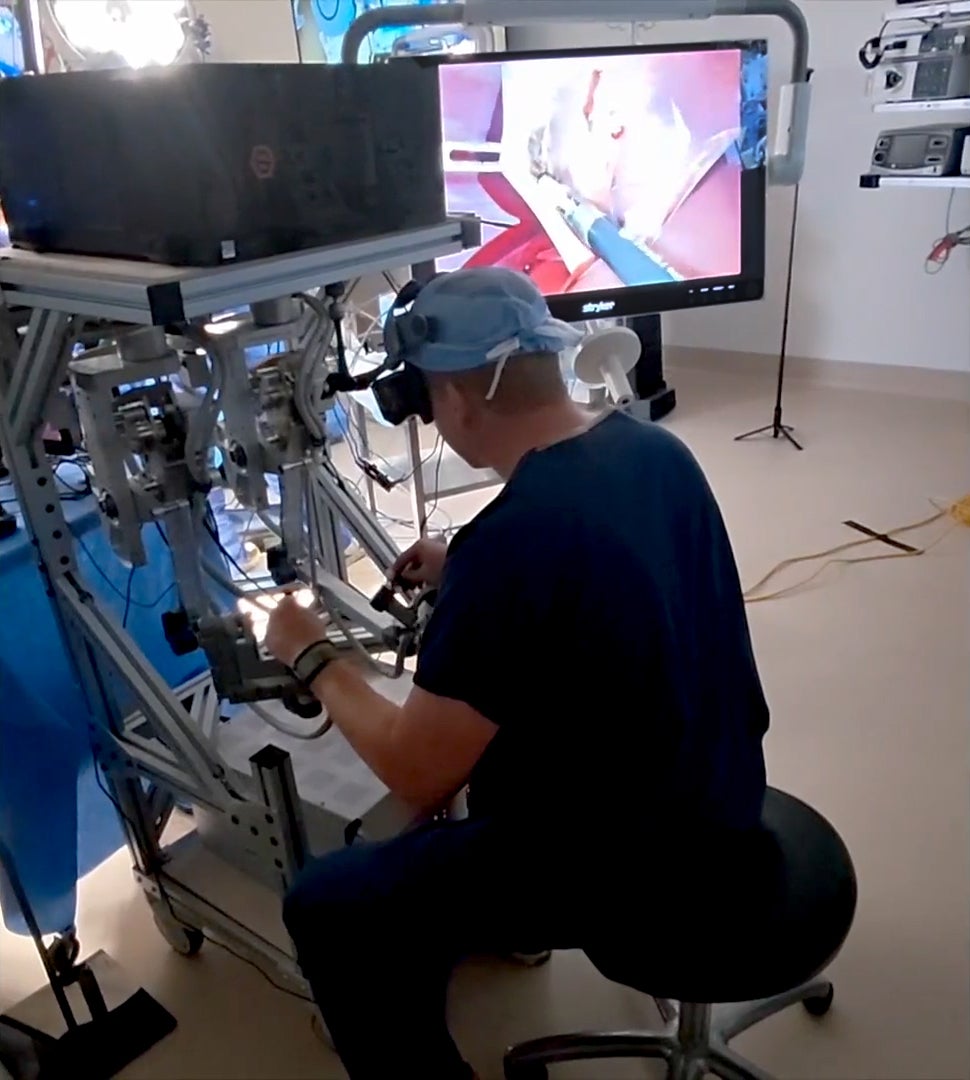
Researchers added custom adapters so the robots could hold manually operated, wristed laparoscopic instruments. A surgeon controlled the machines from a console using hand controllers, a stereo headset and a foot pedal.
“It’s a fraction of the cost and it takes a fraction of the space in an operating room. So it’s easy to deploy, anywhere from rural areas, to the battlefield, and even to space,” said Dr. Shanglei Liu, an assistant professor of surgery at UC San Diego.
That flexibility could matter where hospitals lack specialists and expensive equipment.
Before attempting surgery, the team tested the platform on laboratory tasks. These included moving rubber rings and transferring pegs with laparoscopic tools.
The humanoid system generally performed better than manual laparoscopy but remained behind the da Vinci Xi surgical robot. In the peg-transfer test, it produced a higher score and fewer errors than manual operation, yet the commercial robot finished faster and more accurately.
Straight tool movements reached millimeter-scale precision. Across three trials, the system recorded an average deviation of 1.30 millimeters during line tracking. Circular motions were less accurate, with an average radial deviation of 10.40 millimeters.
The control system also introduced delay. About 156 milliseconds passed between the operator’s hand movement and the robot’s response. Surgical robotics research generally considers delays below 150 milliseconds desirable.
Trocar placement created another constraint. Laparoscopic tools enter the body through narrow ports and pivot around fixed points. The humanoid could reach a workspace comparable to a research surgical robot only from some port positions, meaning surgeons would need to adjust placement around the machine’s limited reach.
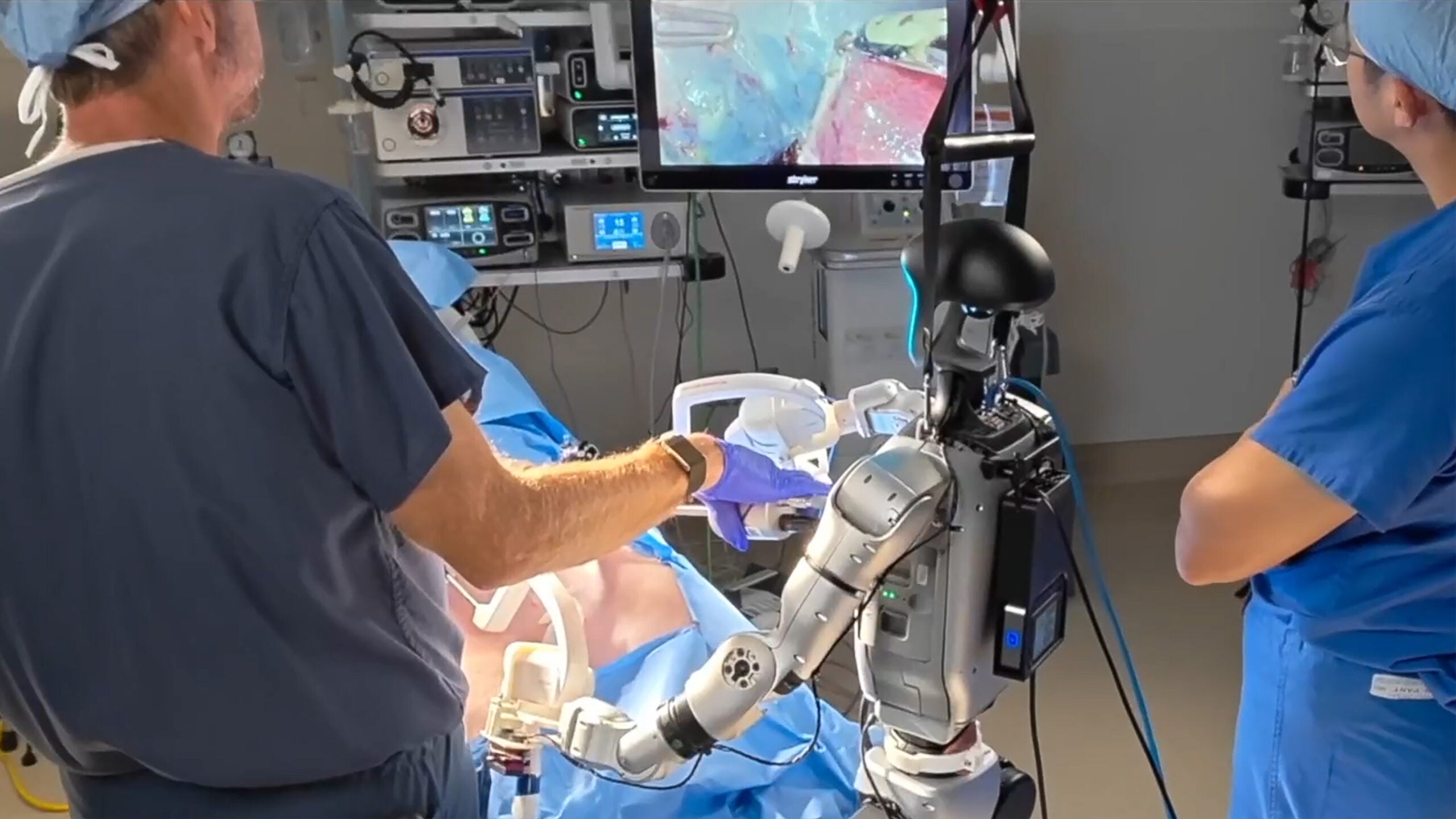
Participants found the robot less responsive and intuitive than established systems. Its compact arms also restricted movement.
A senior surgeon controlled the humanoid during both gallbladder removals. A bedside assistant handled camera control, exposure, tissue retraction and equipment adjustments during most of the procedures.
The robot completed important steps, including tissue dissection, obtaining the critical view of safety, clipping the cystic duct and separating the gallbladder from the liver bed.
The first operation ended without major complications. During the second, minor bile leakage and bleeding from the liver bed occurred. The team managed both with suction and electrocautery.
Neither case met the predefined conditions for conversion, including unstable vital signs, poor visualization or technical failure.
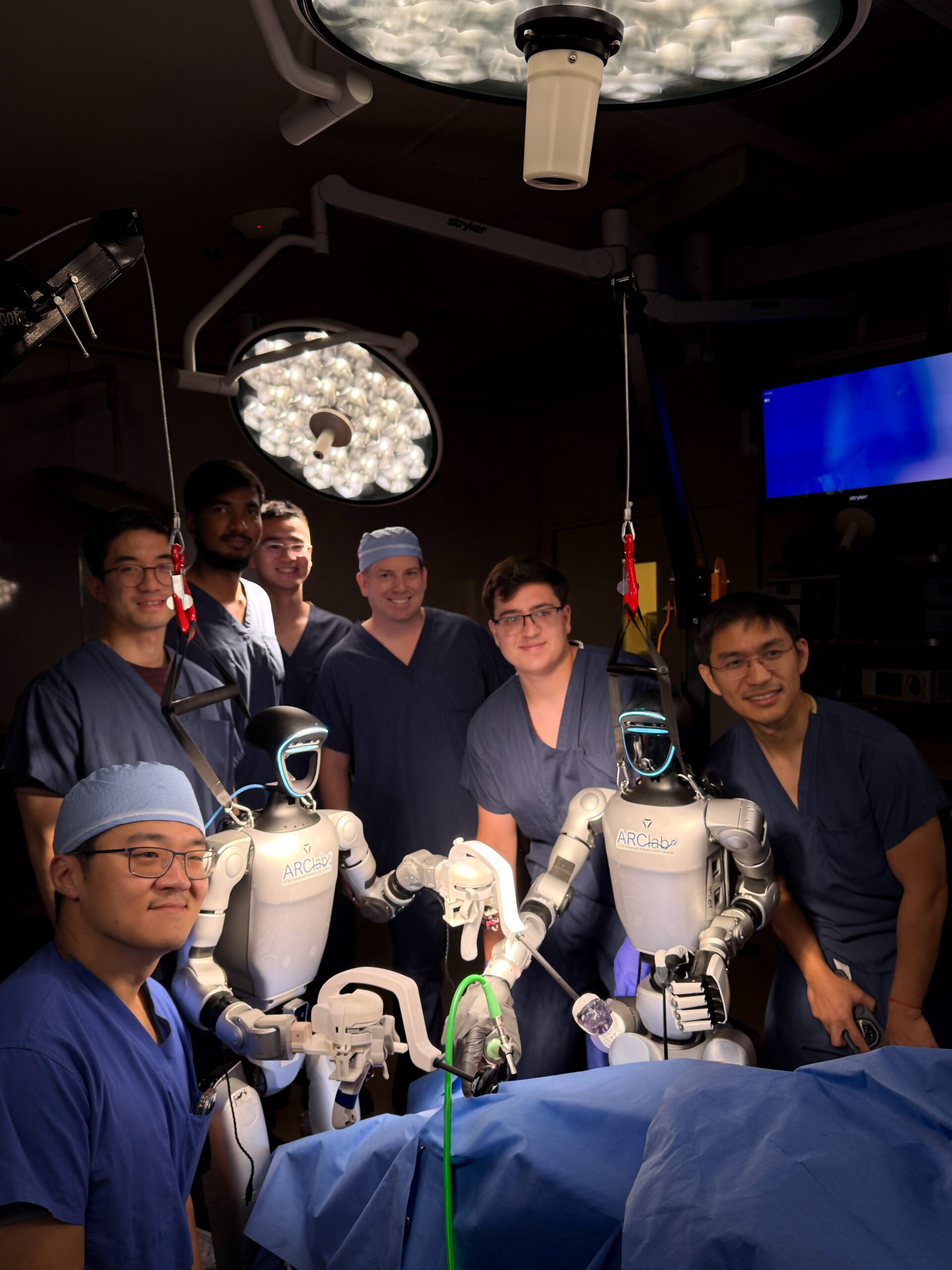
The machines did require repeated recalibration and repositioning. Interruptions lasting more than three minutes occurred when the team redeployed the robot, adjusted its base or realigned its arms with the surgical ports.
Users also reported intermittent overheating, limited strength and restricted range of motion. Those issues increased the surgeon’s workload and interrupted the flow of the operations.
Sterility presents another unresolved barrier. Researchers covered the robot’s arms with gloves, but that approach does not meet the full standards required for human surgery.
Current commercial humanoids lack components that can be sterilized in an autoclave. Future systems will need protective draping and sterile interfaces that do not interfere with sensors, movement or calibration.
The study also involved only two animal operations, both performed in a controlled simulation center by an experienced surgeon. Most bedside assistance still came from humans, and the robot-robot arrangement was used only briefly during the first case.
Michael Yip, a UC San Diego engineering professor and senior author, said a mobile humanoid could support many tasks and move between clinical roles.
“One of our goals is to develop the autonomous surgical assistant,” Yip said. “Many communities struggle with adequate staffing on the surgical team, which means patients are not being treated.”
The work establishes a measurable starting point for humanoid surgery. It shows that a compact, general-purpose robot can use familiar laparoscopic tools and complete essential surgical steps under human control.
The next advances must reduce latency, improve curved-motion accuracy, expand reach and prevent calibration drift. Engineers will also need better tool specifications, more reliable port tracking and systems built for sterile environments.
Further studies must test longer procedures, more animals and a wider range of operations. Researchers also plan to explore greater autonomy, although the present system remained teleoperated.
If those problems can be solved, humanoid robots could offer hospitals a more adaptable alternative to large, single-purpose machines. Their greatest value may emerge in rural hospitals, disaster zones and other places where surgical expertise and equipment remain difficult to access.
Research findings are available online in the journal Nature.
The original story “Surgical First: Humanoid robots perform gallbladder surgery in living animals” is published in The Brighter Side of News.
Like these kind of feel good stories? Get The Brighter Side of News’ newsletter.
The post Surgical First: Humanoid robots perform gallbladder surgery in living animals appeared first on The Brighter Side of News.