Tunas did not become large, fast and warm-blooded simply because an asteroid cleared the oceans of competing predators. Their defining traits appeared separately over tens of millions of years, complicating a familiar story about life after mass extinction.
The asteroid impact 66 million years ago erased non-avian dinosaurs and many large marine predators. One long-held explanation proposed that tunas and other powerful fishes quickly expanded into the empty ecological roles.
A new analysis from Yale University challenges that idea. By combining genetic evidence with fossils, researchers built the most complete time-calibrated evolutionary tree yet for Scombridae, the family that includes tunas, mackerels, bonitos and related fishes.
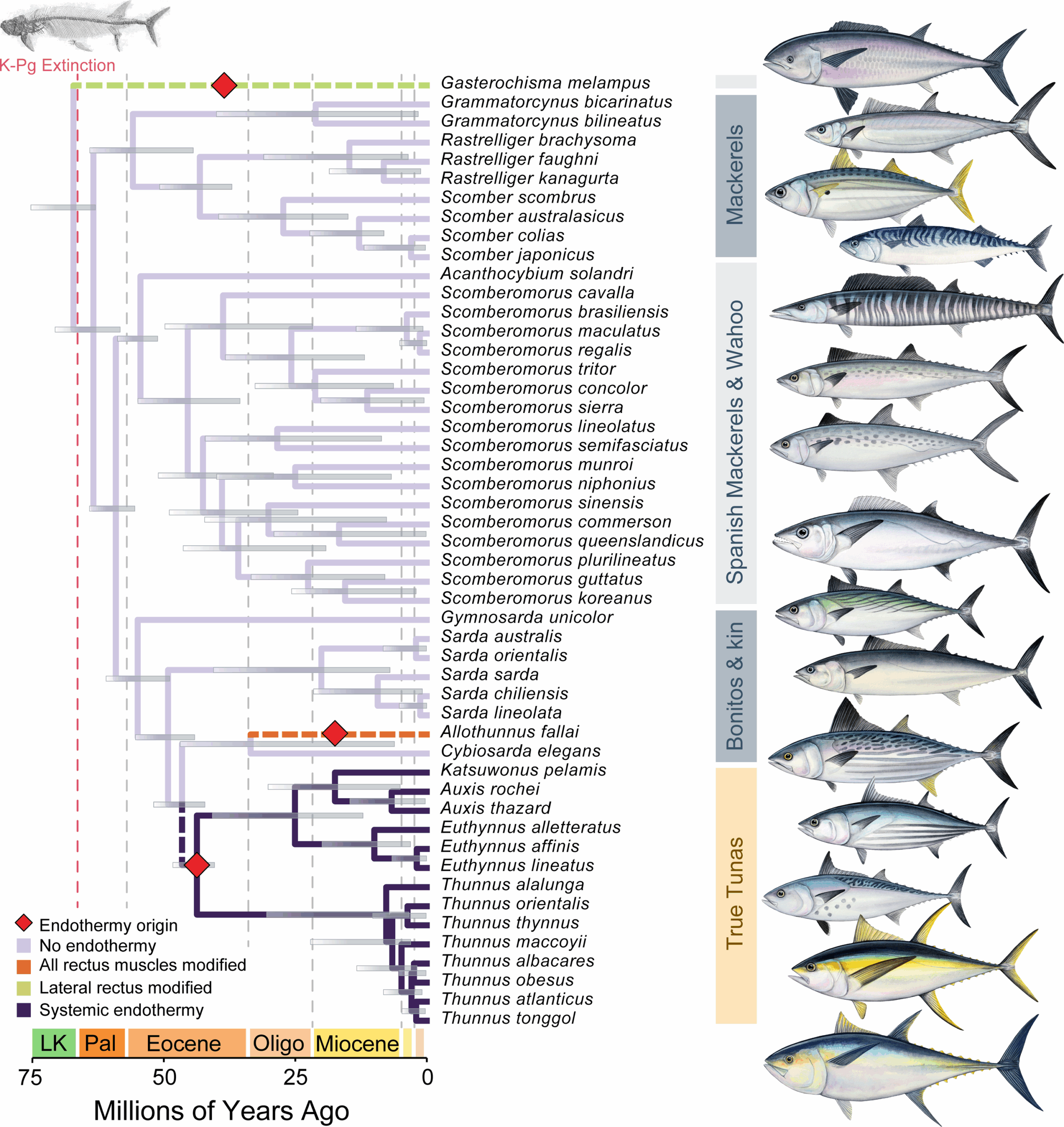
The tree places the family’s origin near the Cretaceous-Paleogene extinction. Yet the traits that make modern tunas exceptional did not appear together or immediately afterward.
“Our results demonstrate the K-Pg extinction did not trigger the evolution of tunas and related large, endothermic predators,” said lead author Chase Brownstein, a Yale graduate student in ecology and evolutionary biology. “We show that the body plans of these predators evolved over tens of millions of years and that there is no connection between the origins of endothermy and large body sizes in these lineages. More broadly, this paper highlights the need to be cautious when interpreting the evolution of species’ body plans directly from evolutionary trees.”
The study appeared in Proceedings of the Royal Society B. Thomas Near, a Yale professor of ecology and evolutionary biology, served as senior author.
Endothermy allows an animal to regulate internal temperature through metabolic activity. In fishes, it can warm the whole body or specific regions, including muscles near the eyes and brain.
That ability can help predators maintain swimming performance, enter colder waters and expand their feeding range. It also carries high energy costs and remains rare among aquatic vertebrates.
The Yale-led team found that endothermy evolved independently three times within Scombridae. Systemic endothermy appeared in the lineage that includes true tunas, skipjack and close relatives. Other forms emerged separately in slender tuna and butterfly kingfish.
At least two of those three origins occurred 10 to 15 million years after the family began diversifying around the extinction boundary. The timing of the third remains difficult to constrain because it lies along a long evolutionary branch.
This pattern weakens the argument that endothermy was an immediate response to the empty niches left by extinct marine predators.
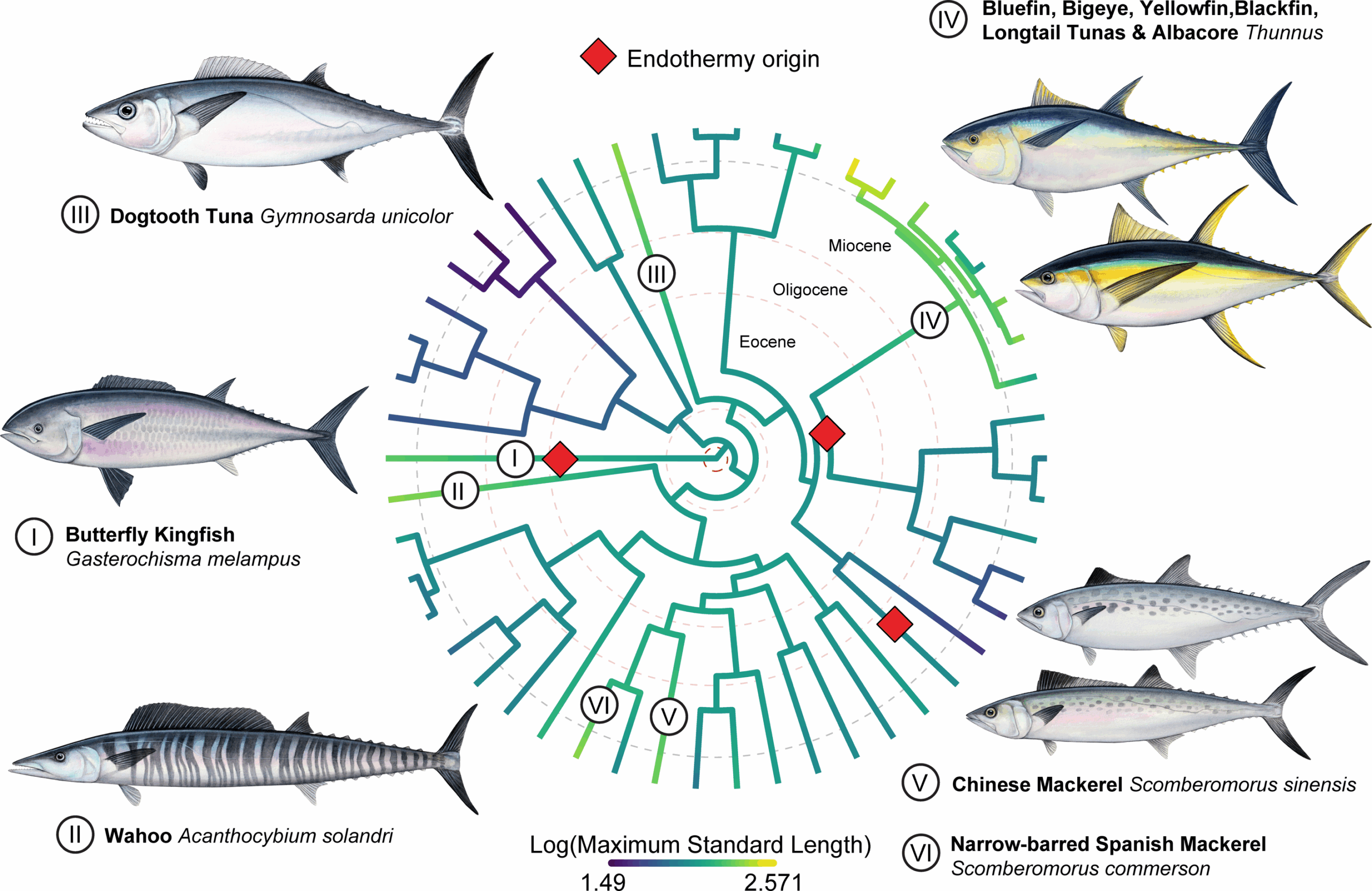
The researchers also found little support for a close link between warm-blooded physiology and giant body size. Large bodies evolved several times across the family, but usually much later.
Species exceeding two meters evolved independently in true tunas, wahoo, dogtooth tuna and Spanish mackerels during the past 25 million years.
The strongest increase occurred in the lineage containing market tunas in the genus Thunnus. These fishes include bluefin, yellowfin, bigeye and other commercially important species.
Yet the branch separating the origin of systemic endothermy from the rise of giant body size in Thunnus spans more than 20 million years. That delay indicates the two traits did not arise as one coordinated package.
Slender tuna offers another contrast. It possesses regional endothermy but remains smaller than many other members of the family.
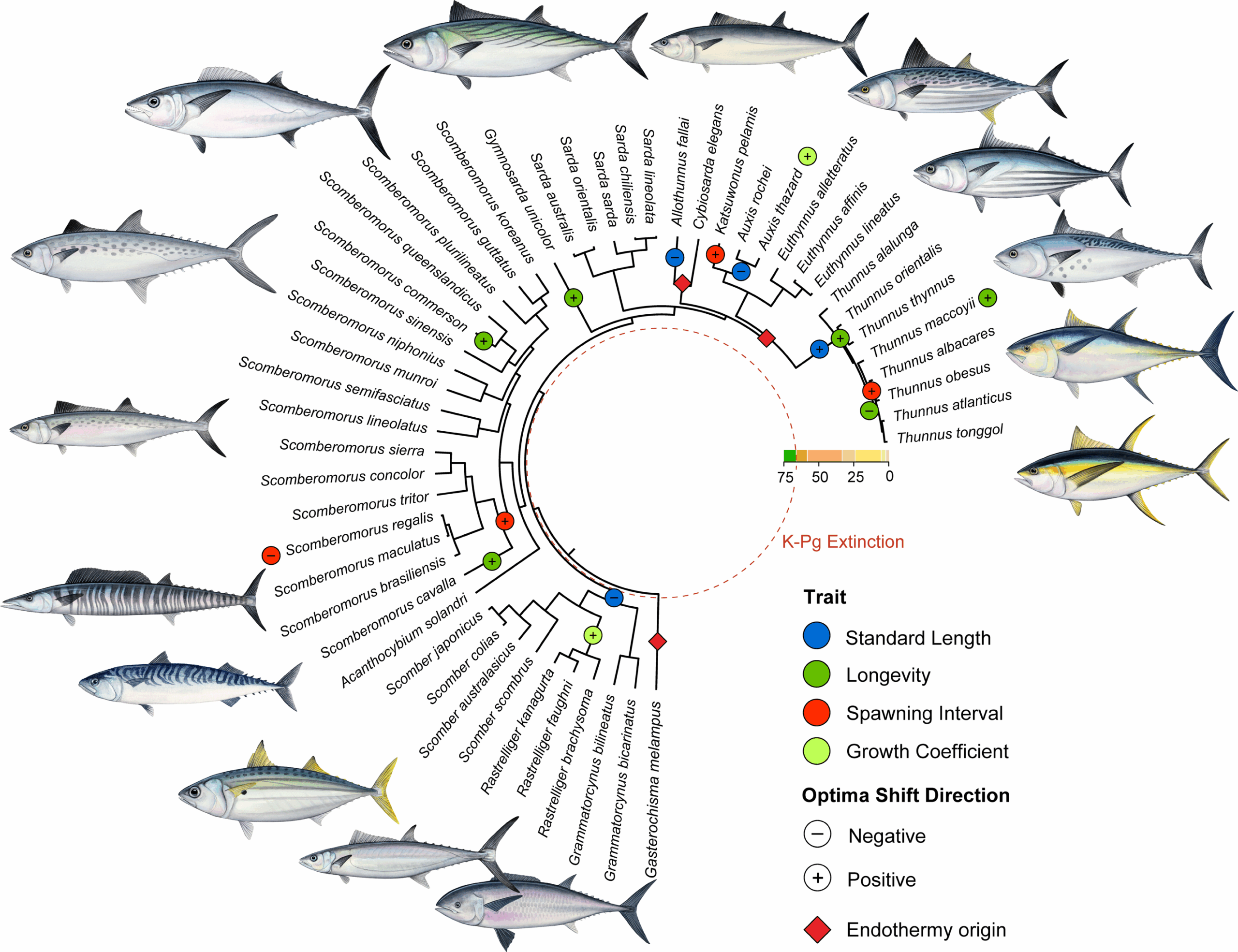
Across Scombridae, increases in size appeared sporadically. The analysis found no significant association between endothermy, body length, longevity, spawning interval or growth rate.
Instead, the familiar tuna body plan assembled in stages across roughly 50 million years.
The dataset included 50 species and 14 of the family’s 15 genera. Researchers used hundreds of ultraconserved genetic regions, mitochondrial genes and fossil calibration points to estimate when major lineages separated.
Samples came from several institutions, including the Yale Peabody Museum. The team generated new sequence data for 15 species and combined it with previously available genomic records.
The results challenge a direct comparison between tuna evolution and the rise of mammals after the dinosaurs disappeared.
Scombridae did begin diversifying near the extinction event, but its most striking predatory traits appeared much later. Endothermy, large body size and rapid diversification followed separate timelines.
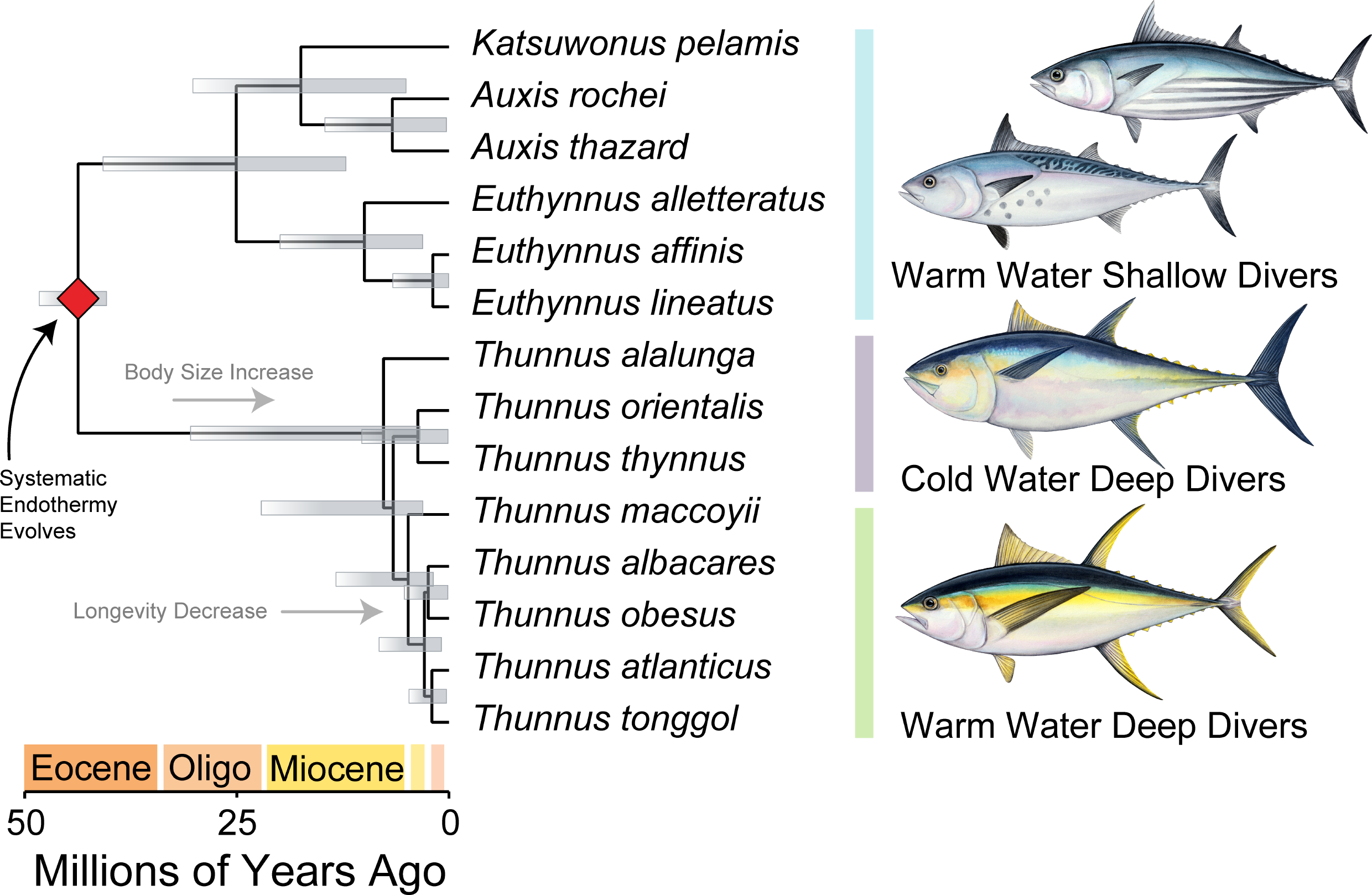
True tunas underwent a comparatively recent burst of diversification during the past 10 million years. Their large size may relate to seasonal migration, long-distance feeding and longer lifespans, although those connections vary among species.
The study also raises doubts about another proposal, that warm-blooded predatory fishes evolved in response to competition from early whales. The timing does not neatly support that explanation because large size and endothermy remained separated in scombrid history.
Similar patterns may occur in billfishes and opahs, the other major groups of endothermic ray-finned marine fishes. Their oldest fossils suggest smaller ancestors, while giant forms appeared later.
The evolutionary tree still cannot pinpoint every origin precisely. Two endothermic traits occur along long branches, leaving broad windows in which they could have appeared. That limitation makes it difficult to connect them to a single climate shift or ecological event.
The findings give scientists a firmer timeline for studying how large marine predators developed their metabolism, size and movement patterns.
That history matters for conservation because tunas support major fisheries and provide food worldwide. Atlantic bluefin tuna populations, for example, have declined dramatically over recent decades because of overfishing.
A clearer evolutionary framework can help researchers compare species, identify which traits arose together and avoid assuming that similar body forms share the same origin.
The work may also guide research into metabolism and temperature regulation. Near noted that these systems relate broadly to biological processes involved in obesity, diabetes and metabolic syndrome, although the study found no direct medical connection.
“Understanding that endothermy independently evolved multiple times in tunas and mackerels provides insight into the fundamental machinery underlying metabolism and thermoregulation,” Near said. “These are systems that are central to disease and health conditions in humans, such as obesity, diabetes, and metabolic syndrome. To be clear, there is no explicit connection here, but studying how our biodiversity has dealt with similar challenges over the long sweep of time is relevant to better understanding human health.”
Most importantly, the analysis shows that major evolutionary events do not always produce complete modern body plans at once. In tunas and mackerels, speed, size and thermal control emerged gradually through separate changes spread across tens of millions of years.
Research findings are available online in the journal Proceedings of the Royal Society B.
The original story “Tunas became large, warm-blooded predators long after the dinosaur extinction” is published in The Brighter Side of News.
Like these kind of feel good stories? Get The Brighter Side of News’ newsletter.
The post Tunas became large, warm-blooded predators long after the dinosaur extinction appeared first on The Brighter Side of News.

