3I/ATLAS arrived fast, bright, and strange. When astronomers spotted it on July 1, 2025, they knew almost immediately this was no ordinary comet. It was moving too quickly to belong here, and that speed hinted that the object carried a story older than the solar system itself.
Now that story has sharpened. In a paper published in Nature, a team led by Martin Cordiner of Goddard Space Flight Center – NASA reports that 3I/ATLAS carries an isotopic makeup unlike anything yet measured in a solar system comet. The results point to an origin in a very cold, distant environment, and suggest the object may have formed roughly 12 billion years ago, long before Earth existed.
That would make 3I/ATLAS not just a visitor from another star, but a preserved fragment of a far earlier chapter in the Milky Way.
Interstellar objects are the castoffs of planetary systems. As planets form, they leave behind swarms of smaller icy and rocky bodies. Many of those objects wind up on unstable paths and are eventually flung into interstellar space by the gravity of giant planets. Most drift forever between the stars. A tiny number pass through another system closely enough to be seen.

So far, astronomers have confirmed only three such visitors: 1I/‘Oumuamua, 2I/Borisov, and now 3I/ATLAS. Each has looked different. Each has raised new questions about how planetary systems form and how much they vary across the galaxy.
3I/ATLAS stood out right away because of its speed. At closest approach to the Sun, it was traveling at more than 68 kilometers per second. Even before the Sun’s gravity accelerated it, the comet was already moving faster than 58 kilometers per second.
That alone suggested an unusual past. Based on its motion through the galaxy, astronomers had already suspected it might have come from the Milky Way’s thick disk, a population of older stars that formed long before the Sun. But orbital calculations can only go so far. Tracing an object like this backward through millions of years of galactic motion is difficult, and chaotic gravitational encounters muddy the picture.
The more promising clue lay in its chemistry.
To probe that chemistry, the team used the James Webb Space Telescope and the Atacama Compact Array to study gases streaming from the comet as it moved away from the Sun. Webb observed the object in infrared wavelengths, while the Atacama array provided complementary measurements at microwave wavelengths. Together, the data let the scientists examine the comet’s isotopes, different versions of the same elements that carry different numbers of neutrons.
Those isotopes turned out to be the key.
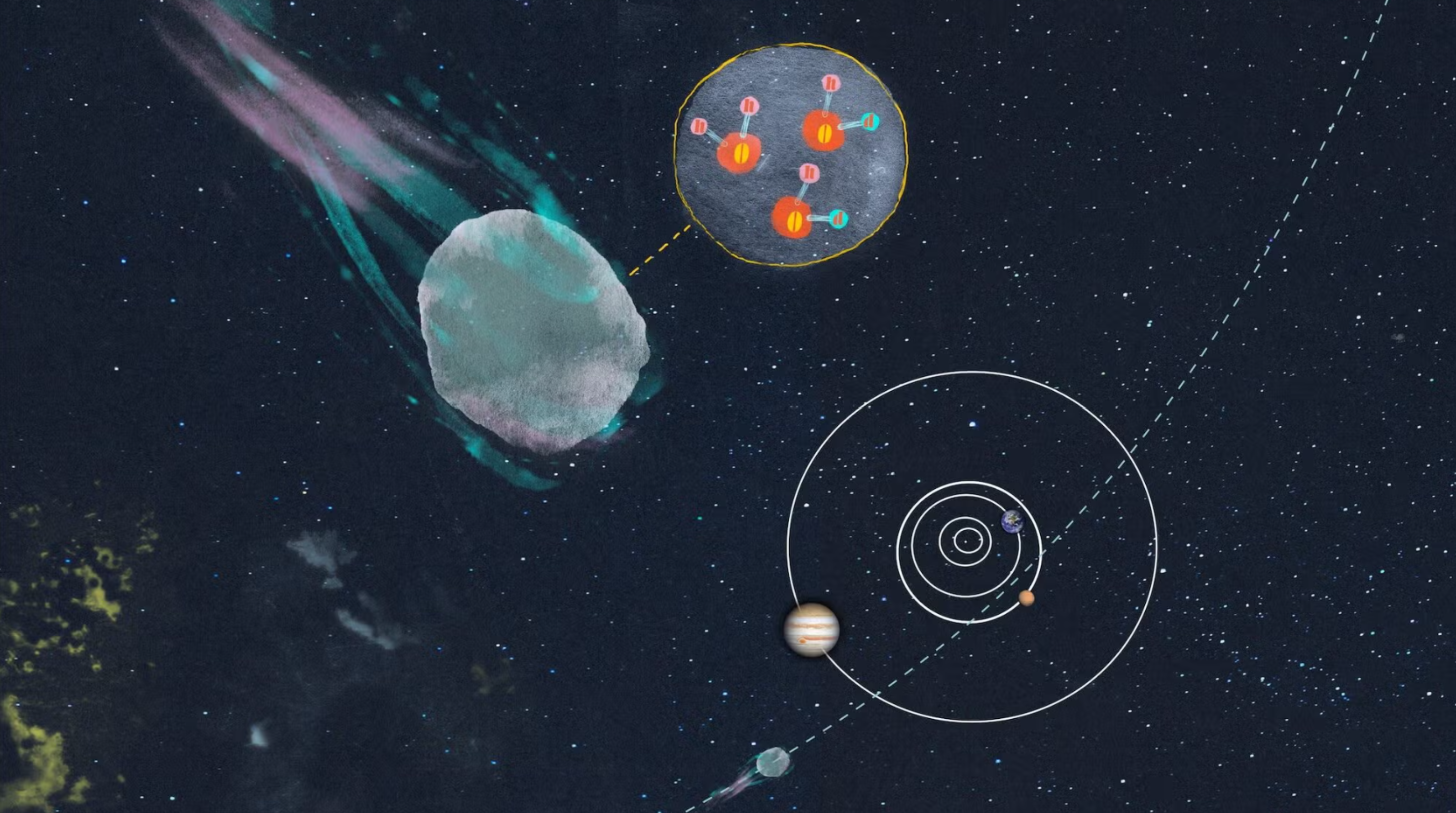
The researchers found that water in 3I/ATLAS is highly enriched in deuterium, a heavier form of hydrogen. The measured D/H ratio was (0.98 ± 0.06)%, more than an order of magnitude higher than in known comets from the solar system.
The comet also showed unusually high ratios of carbon-12 to carbon-13. The team reported 12C/13C values of 141 to 191 for carbon dioxide and 123 to 172 for carbon monoxide. In the solar system, volatile carbon usually clusters much closer to terrestrial and solar values.
That makes 3I/ATLAS stand apart. According to the paper, its isotopic ratios are “completely distinct” from materials measured in the solar system.
The deuterium result matters because water ice tends to become enriched in deuterium under very cold conditions. The paper concludes that most of the comet’s water must have formed at temperatures no higher than about 30 kelvin, or roughly minus 243 degrees Celsius. The object also appears to have avoided the kind of later heating and reprocessing that can erase those early chemical signatures.
Its carbon offers a second clock.
Carbon-13 has grown more common in the galaxy over time as generations of stars lived, fused elements, and died. That means the balance between carbon-12 and carbon-13 can preserve a rough record of when and where material formed.
Because 3I/ATLAS contains so little carbon-13 compared with carbon-12, the team argues that it likely formed when the galaxy was younger and less chemically enriched. Their modeling places its isotopic age in the range of about 11 to 12 billion years, though the authors note that such estimates still carry uncertainties tied to galactic evolution models and to carbon gradients across the Milky Way.
Even with those caveats, the picture is striking. The comet appears to have formed in a relatively metal-poor environment, in intense early star-forming conditions, then survived for billions of years before being thrown out of its home system and eventually crossing ours.
In that sense, 3I/ATLAS is less like a typical comet and more like a fossil, one that has spent most of cosmic history in deep freeze.
That makes it especially valuable. Unlike distant observations of exoplanets or disks around young stars, an interstellar object can be sampled directly with modern instruments as it passes by. It offers a physical record of another planetary system, preserved in ice and gas.
Astronomers have long expected interstellar space to be full of such debris. The problem has never been whether these objects exist, but whether telescopes could catch them in time.
That is beginning to change. The Vera C. Rubin Observatory in Chile is expected to find many more fast-moving interstellar visitors in the years ahead, possibly dozens over the next decade. Earlier discoveries will give astronomers more time to observe them before they fade back into darkness.
For now, though, the sample remains tiny. ‘Oumuamua was puzzling and inactive. Borisov looked more like a familiar comet, though still chemically unusual. 3I/ATLAS now adds a third type, one that seems to preserve conditions from the galaxy’s youth.
That variety is the point. The more of these objects astronomers find, the less they will look like oddball one-offs and the more they will start to reveal the true range of planetary building blocks across the Milky Way.
This study pushes interstellar objects beyond curiosity and into the realm of galactic history. By showing that a passing comet can preserve chemical evidence from another star system, and perhaps from the early Milky Way itself, the work gives astronomers a new way to study how planets and icy bodies formed across cosmic time.
It also raises the stakes for future surveys. Finding more objects like 3I/ATLAS, and finding them earlier, could let scientists compare them as a population instead of as isolated surprises. That would offer a clearer view of how common different planetary environments are, and how the chemistry of star and planet formation changed as the galaxy aged.
Research findings are available online in the journal Nature.
The original story “12 billion years old interstellar comet 3I/ATLAS may be older than the solar system” is published in The Brighter Side of News.
Like these kind of feel good stories? Get The Brighter Side of News’ newsletter.
The post 12 billion years old interstellar comet 3I/ATLAS may be older than the solar system appeared first on The Brighter Side of News.

