Sticky hairs covering an alpine flower in southwestern China do more than snag passing insects. They help Saxifraga candelabrum obtain nutrients from its prey, placing the plant among the world’s confirmed carnivorous species.
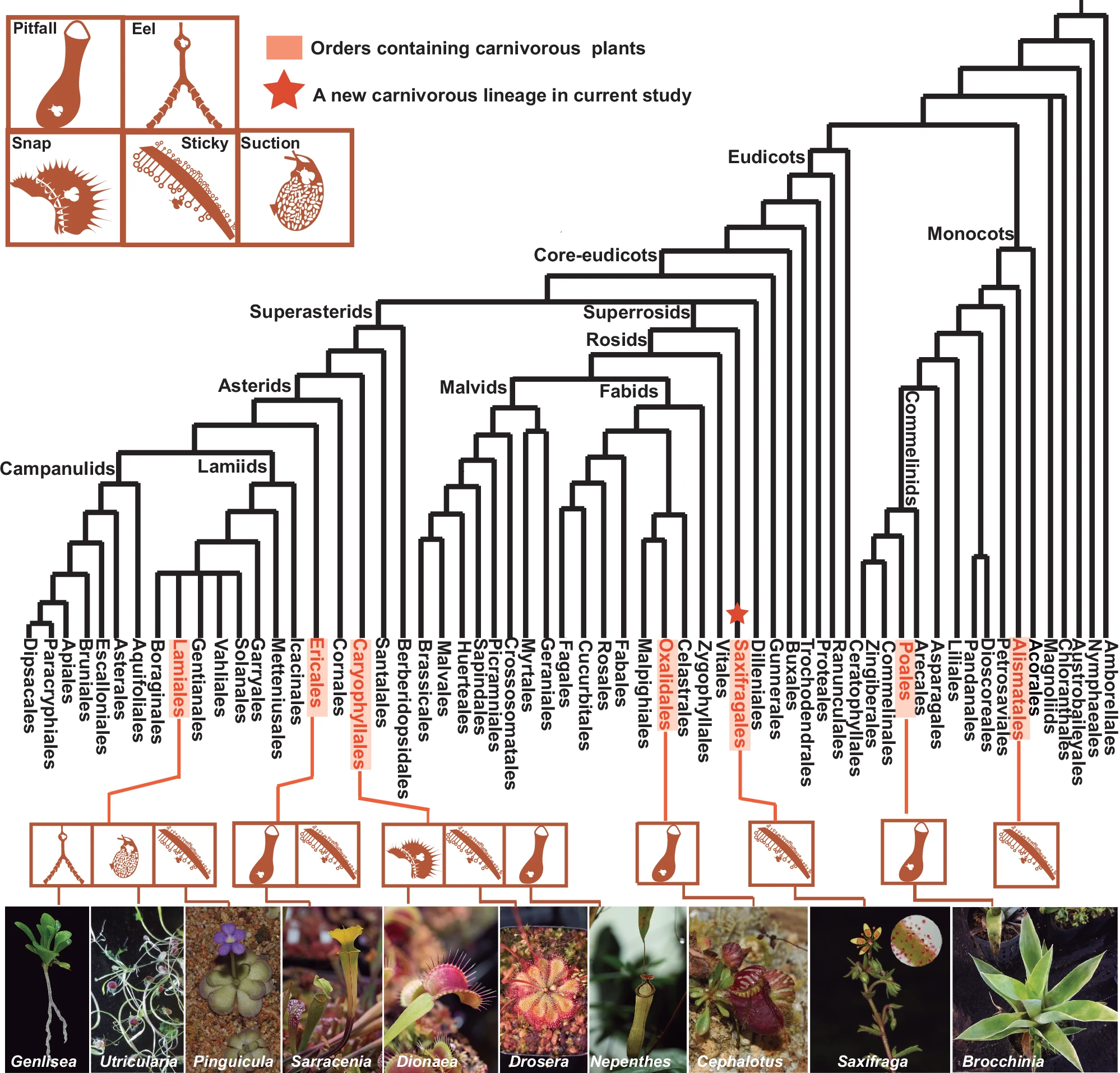
The finding adds both Saxifraga and the broader plant order Saxifragales to the known diversity of carnivorous plants.
The conclusion required more than observing insects stuck to a plant. To qualify as carnivorous, a species must show adaptations for attracting and capturing prey, digesting it, and absorbing nutrients from it.
S. candelabrum met each part of that test.
The work also returns to a question Charles Darwin raised in 1875. He suspected that some Saxifraga species might be carnivorous because their glandular hairs could trap insects. His own feeding experiments, however, never produced decisive evidence.
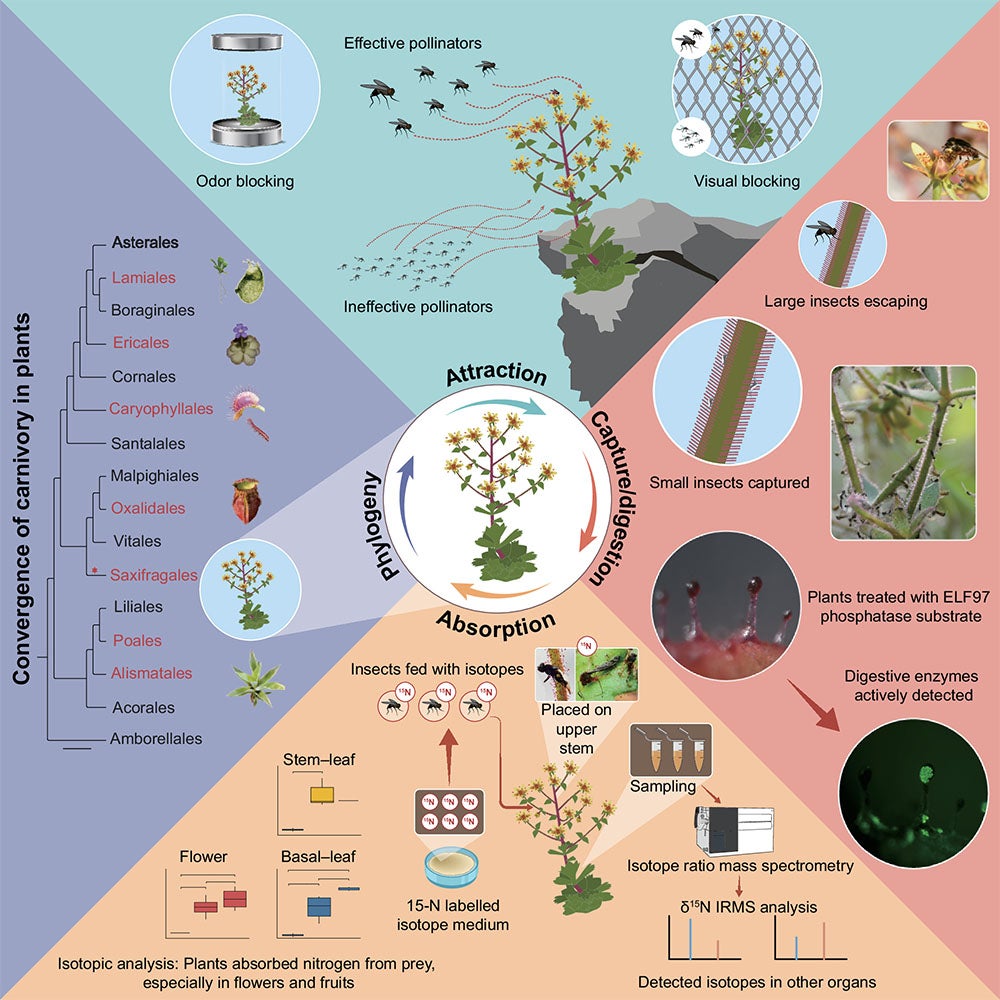
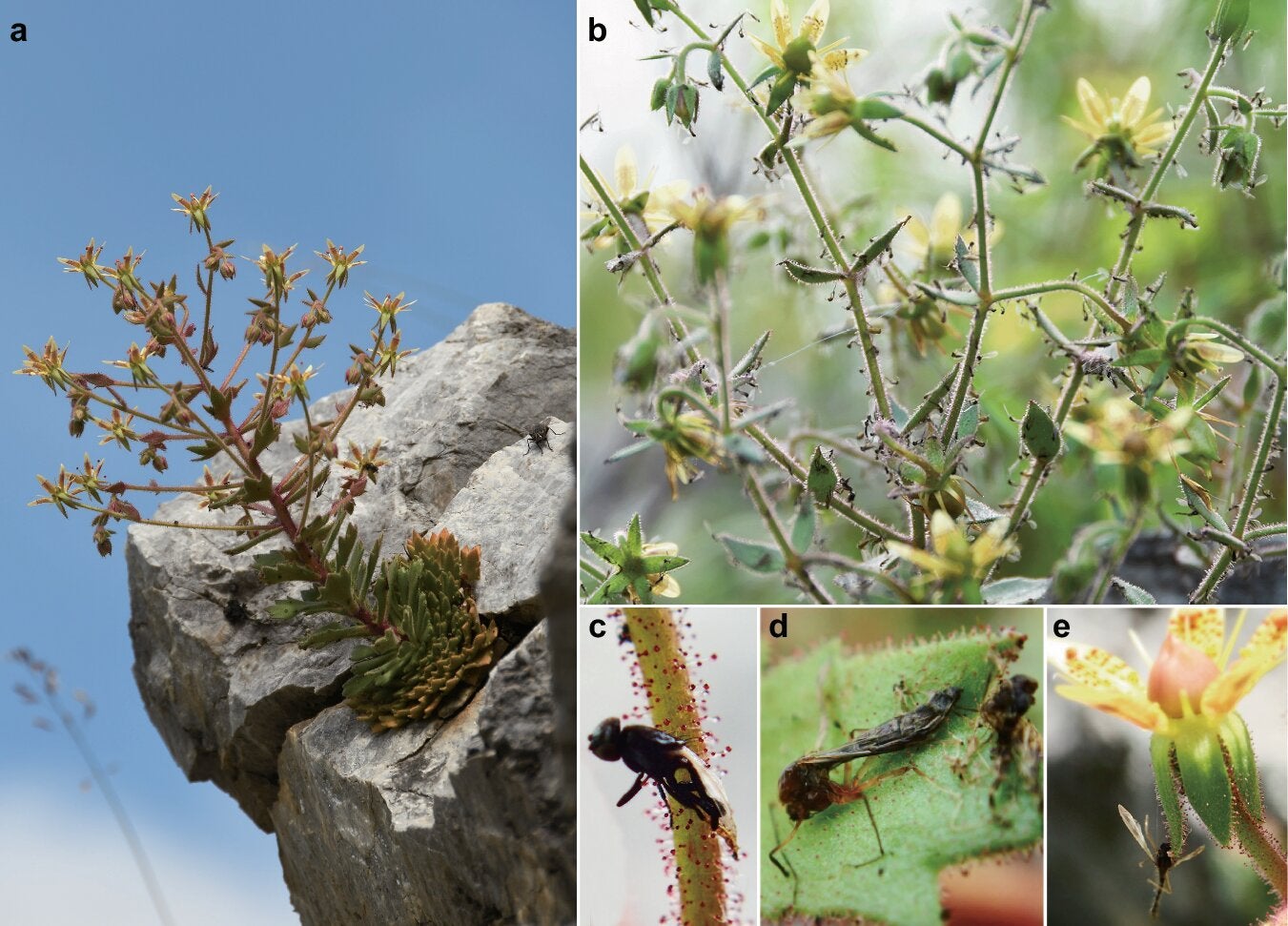
Saxifraga candelabrum grows in alpine parts of the Qinghai-Tibet Plateau-Hengduan Mountains region. It occurs in central and northern Yunnan and southwestern Sichuan, often in nutrient-poor rocky crevices.
Its stems and flowering branches carry glandular hairs coated with sticky secretions.
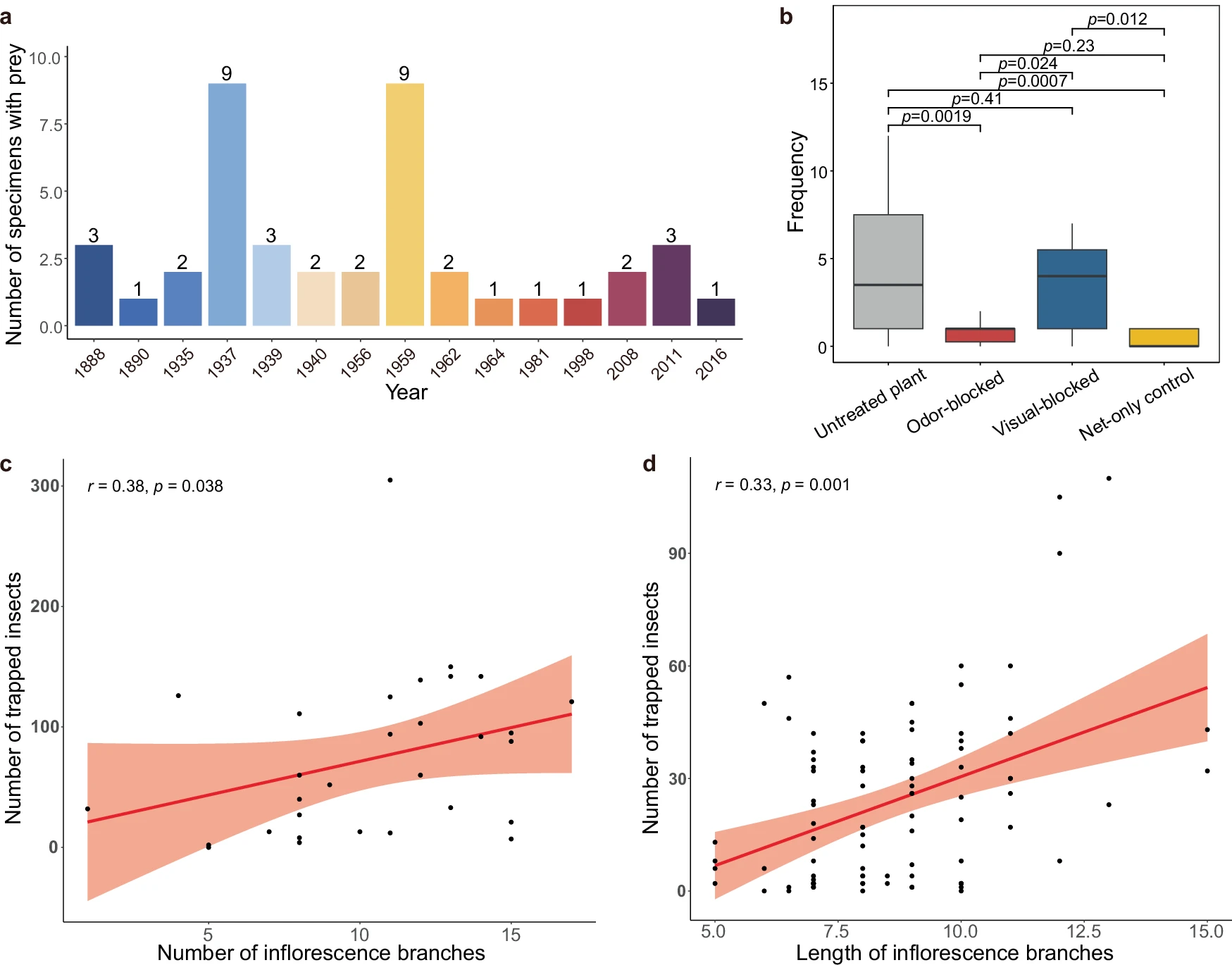
Field observations showed that mature plants trapped an average of 71 insects. Small gnats from the Chironomidae family made up much of the prey.
Researchers also examined 45 flowering herbarium specimens collected between 1888 and 2016. Insects remained attached to the glandular hairs on 43 of those specimens.
That century-spanning record suggested that prey capture was not an unusual event caused by a single location or season.
The amount of captured prey also increased with the size of flowering branches. Juvenile plants with relatively few branches trapped few insects or none at all.
The team then tested whether insects merely collided with the sticky plant or were attracted to it.
Some flowering plants were enclosed in transparent glass, which preserved their appearance but blocked their odor. Others were surrounded by breathable white netting that concealed their appearance while allowing scent to escape.
Insects visited untreated plants and visually hidden plants more often than odor-blocked plants and controls. Visitation to visually concealed plants was significantly higher than to plants whose scent had been blocked.
The result pointed to floral odor as one contributor to attraction.
Chemical analysis detected multiple volatile compounds, including β-myrcene and eucalyptol, which could contribute to insect attraction.
The plant also appeared to avoid trapping many of the insects useful for pollination.
Most trapped prey were small insects, particularly Chironomidae. Larger insects from groups including Calliphoridae, Halictidae, Muscidae, Syrphidae, and Tachinidae served as effective pollinators and were rarely caught.
That separation allows the same flowering structures to serve two roles, capturing small insects while leaving larger pollinators largely unharmed.
Trapping prey still did not prove that S. candelabrum could digest it.
Researchers therefore searched for phosphatase activity. This enzyme helps release nutrients and commonly appears in studies of carnivorous plants.
Fluorescence tests showed phosphatase activity in glandular hairs on the plant’s leaves, stems, and sepals.
The same signal appeared in Pinguicula primuliflora, a known carnivorous plant used as a positive control. A closely related noncarnivorous species, Saxifraga filicaulis, showed no detectable fluorescence under the same conditions.
The experiment was repeated three times with similar results.
Those findings provided evidence that the sticky hairs do more than immobilize insects. They also possess digestive activity capable of helping break prey down.
The strongest test followed nutrients directly from insects into plant tissue.
Researchers raised more than 1,000 fruit flies for about two months on food containing nitrogen enriched with the stable isotope ¹⁵N. Another 500 flies were raised normally.
Field experiments included 60 S. candelabrum plants from three sites in Shangri-La, Yunnan. Another 20 plants underwent laboratory tests.
The researchers also included a known carnivorous species, Drosera peltata, and two noncarnivorous controls.
Plants generally received 10 labeled fruit flies.
After feeding, both S. candelabrum and D. peltata showed significant increases in labeled nitrogen. The two noncarnivorous species did not.
Soil near treated S. candelabrum plants remained low in ¹⁵N. That helped rule out the possibility that labeled material entered the soil first and reached the plants through their roots.
Researchers also excluded tissues that had directly contacted the flies to reduce the chance that surface contamination could explain the result.
Inside S. candelabrum, flowers showed the greatest nitrogen enrichment, followed by stem leaves and basal leaves.
The pattern indicated that prey-derived nutrients moved beyond the original trapping surface and entered other tissues.
Genetic evidence added another layer to the case.
The team assembled a chromosome-scale genome for S. candelabrum, estimated at about 2.24 billion base pairs.
Comparisons with other carnivorous plants uncovered gene families connected with prey attraction, digestion, and nutrient absorption. Researchers also detected examples of convergent genetic change among independently evolved carnivorous lineages.
When the comparison expanded across carnivorous plants with different trapping systems, some shared genetic patterns remained while others differed.
That combination suggests that carnivory evolved independently several times, sometimes using similar genetic solutions but following different evolutionary paths.
Confirming S. candelabrum as carnivorous expands the known range of plant groups that obtain nutrients from animal prey.
It also gives researchers a new system for studying how carnivory evolves in flowering plants, particularly outside the wet environments often associated with carnivorous species.
Other members of Saxifraga also possess sticky glandular hairs. The new results raise the possibility that some of them may deserve closer testing for digestion and nutrient absorption.
The work also shows why trapping insects alone cannot establish carnivory. Combining field observations, enzyme tests, isotope tracing, and genomic analysis provided a much stronger case.
More than 150 years after Darwin questioned whether Saxifraga could cross the line from passive plant to active predator, S. candelabrum provides a clear example.
Research findings are available online in the journal Nature Communications.
The original story “150-year-old Darwin mystery solved by a carnivorous alpine flower” is published in The Brighter Side of News.
Like these kind of feel good stories? Get The Brighter Side of News’ newsletter.
The post 150-year-old Darwin mystery solved by a carnivorous alpine flower appeared first on The Brighter Side of News.


Leave a comment
You must be logged in to post a comment.