Nearly three decades after exploding stars revealed that the universe is expanding faster and faster, those same stellar explosions are raising a more unsettling possibility: the force behind that acceleration may not be constant.
An international team led by researchers at the University of Queensland has assembled the most comprehensive Type Ia supernova distance catalog yet. Called Unite, it contains 2,884 likely Type Ia supernovae analyzed within a common framework.
The researchers rebuilt older observations using techniques developed through newer surveys, attempting to remove inconsistencies caused by different telescopes, calibrations and analysis methods. When they combined the resulting supernova distances with measurements of relic radiation from the early universe and the distribution of galaxies, the standard cosmological model was not always the preferred explanation.
Instead, the results strengthen previous hints that dark energy could evolve with time.
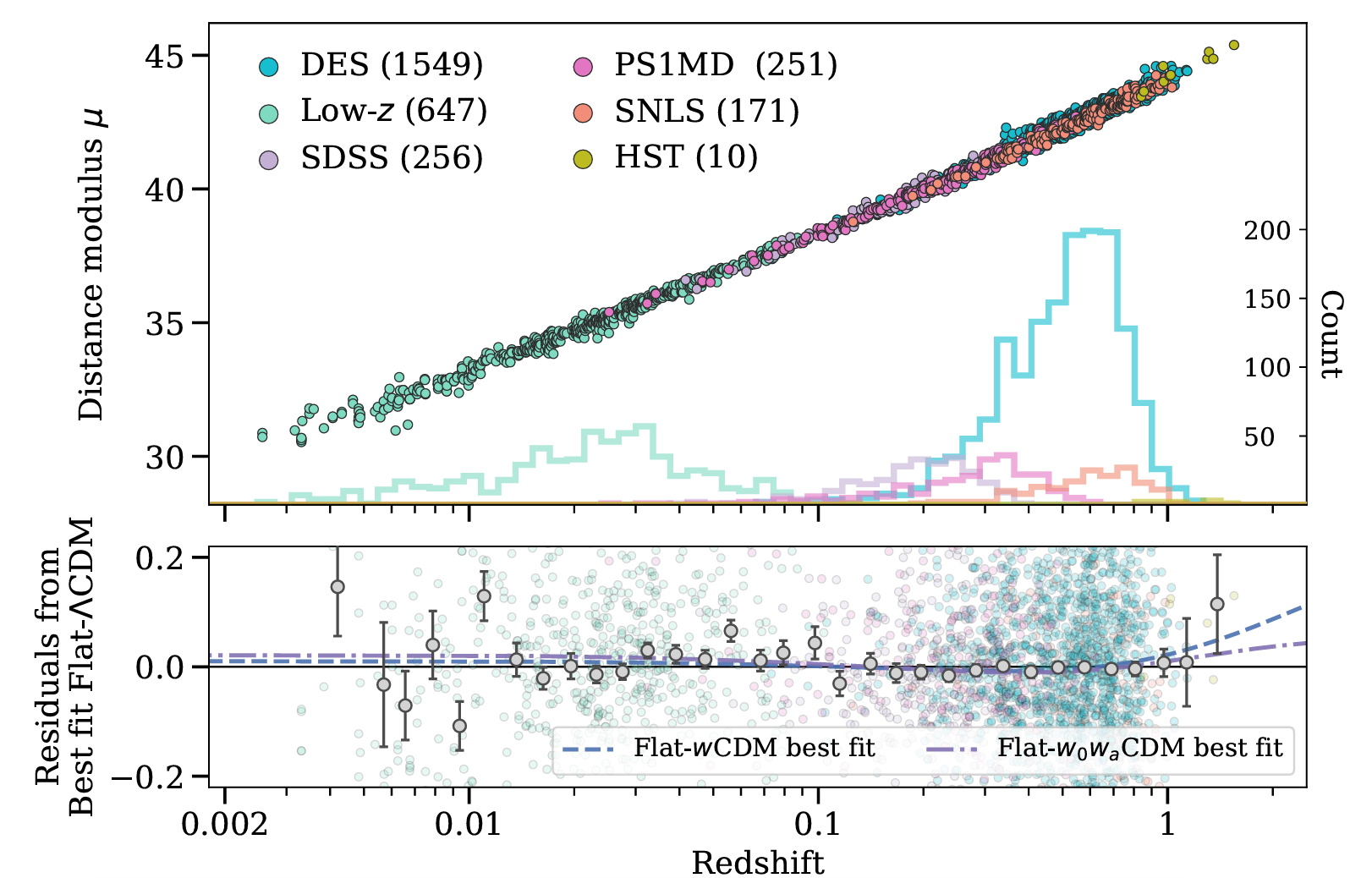
“We’ve rebuilt three decades of astronomical observations into a single, consistent framework,” said University of Queensland Ph.D. candidate Ryan Camilleri.
Type Ia supernovae occur when white dwarf stars undergo catastrophic thermonuclear explosions. Because astronomers can standardize their brightness, they serve as powerful distance indicators across enormous stretches of the universe.
Measurements of these supernovae helped reveal in the late 1990s that cosmic expansion is accelerating. The discovery led astronomers to introduce dark energy as the name for whatever is driving that acceleration.
The simplest explanation treats dark energy as a cosmological constant, represented by the Greek letter lambda. In the standard flat Lambda cold dark matter model, or ΛCDM, dark energy maintains the same density as the universe expands.
The possibility that it changes over time would require a more complicated picture.
Testing that possibility demands extraordinary control over tiny observational effects because cosmologists are looking for subtle differences in the relationship between distance and redshift. Unite was designed to put decades of supernova measurements onto a more uniform footing.
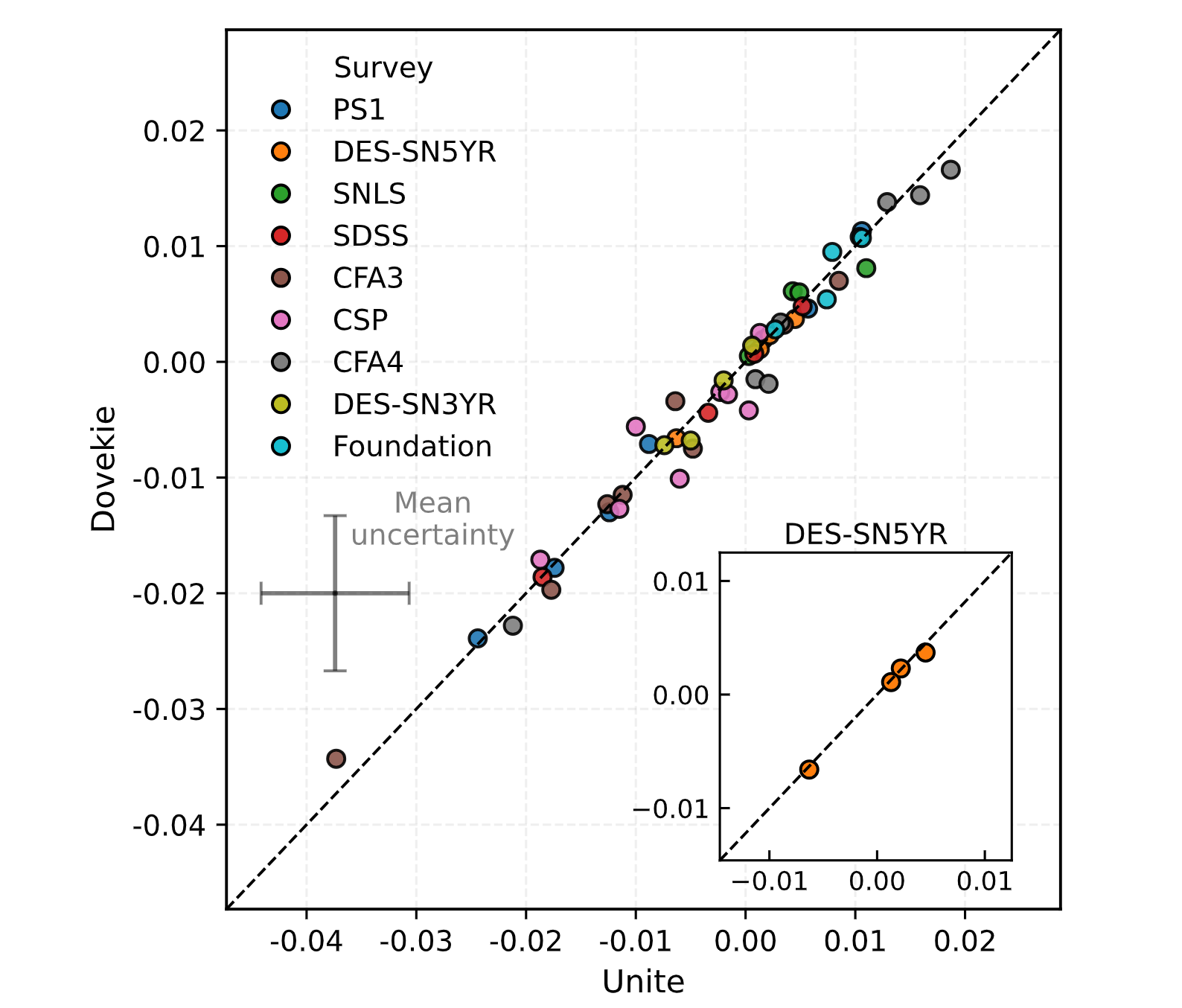
The compilation combines the Pantheon+ dataset with the five-year Dark Energy Survey supernova sample and incorporates subsequent methodological improvements.
Bringing older and newer supernova surveys together involves much more than placing their measurements in the same spreadsheet.
Different telescopes use different detectors and filters, while calibrations have improved over time. Astronomers have also learned more about the relationship between supernova brightness and properties of the host galaxy.
The Unite analysis recalibrated surveys, updated the models used to fit supernova light curves and recomputed stellar masses for more than 98% of host galaxies using a consistent framework.
The researchers also modeled selection effects, intrinsic differences among supernovae and dust in their host galaxies. Another correction considers gravitational lensing, in which intervening matter bends and magnifies light traveling from a distant explosion.
Unite is the first such compilation to include a delensing correction by default. For supernovae above a redshift of 0.5, that adjustment reduced scatter in the Hubble diagram by about 5%.
After a series of quality cuts, the cosmology sample contained 2,884 likely Type Ia supernovae.
The team tested the dataset against several versions of cosmology.
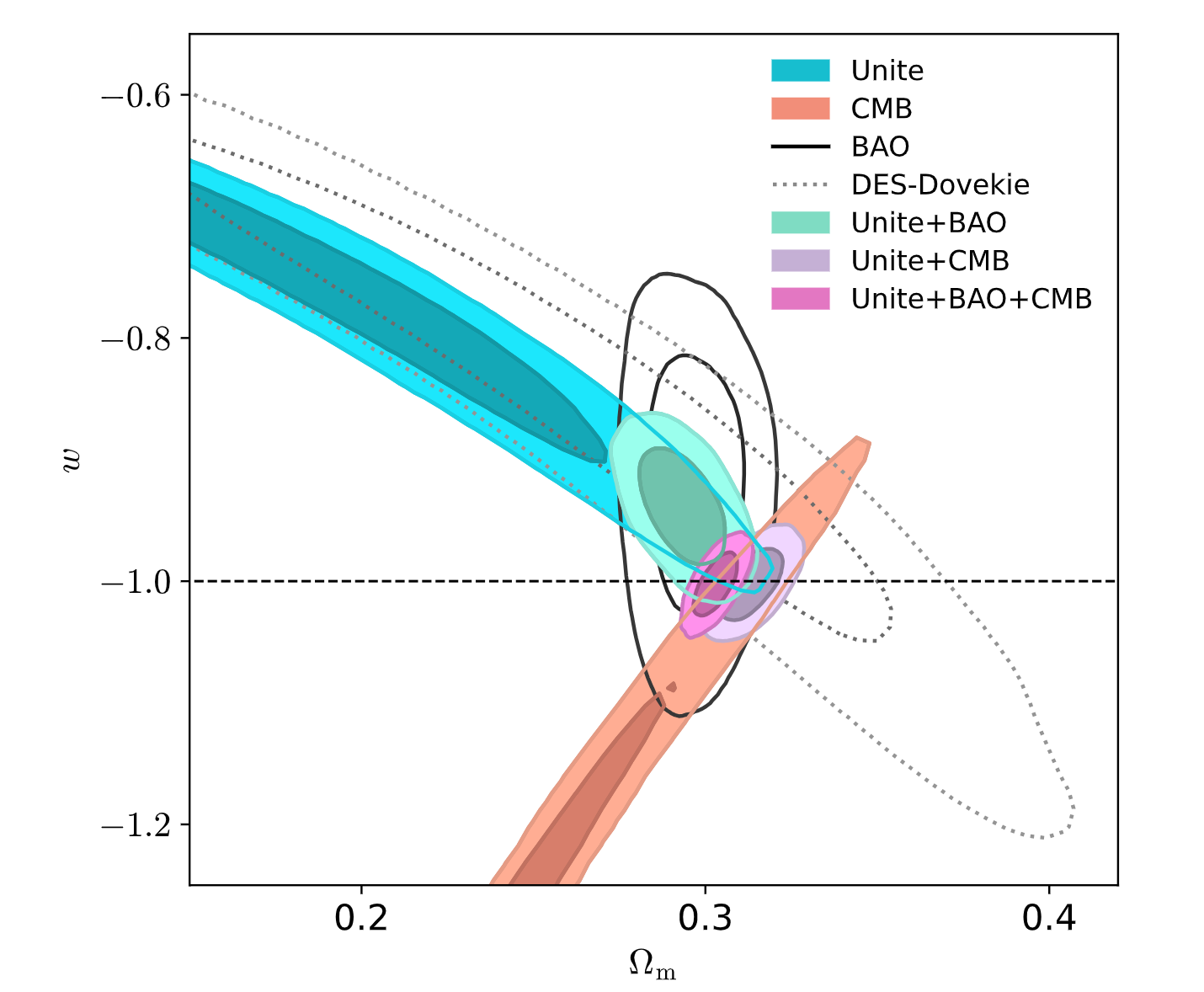
One extension of the standard model allows the dark energy equation-of-state parameter, known as w, to differ from its cosmological-constant value of -1 while remaining constant through time.
Using Unite alone, the researchers obtained w = -0.764, with uncertainties that place the result roughly two standard deviations from -1.
The team also tested a model in which dark energy can evolve. This uses two parameters, w₀ and wₐ, to describe its present behavior and how it changes as the universe expands.
Unite alone remained compatible with no time evolution in wₐ. However, its preferred present-day value of w₀ remained about two standard deviations from the cosmological-constant expectation.
The picture changes when other ways of measuring cosmic expansion are included.
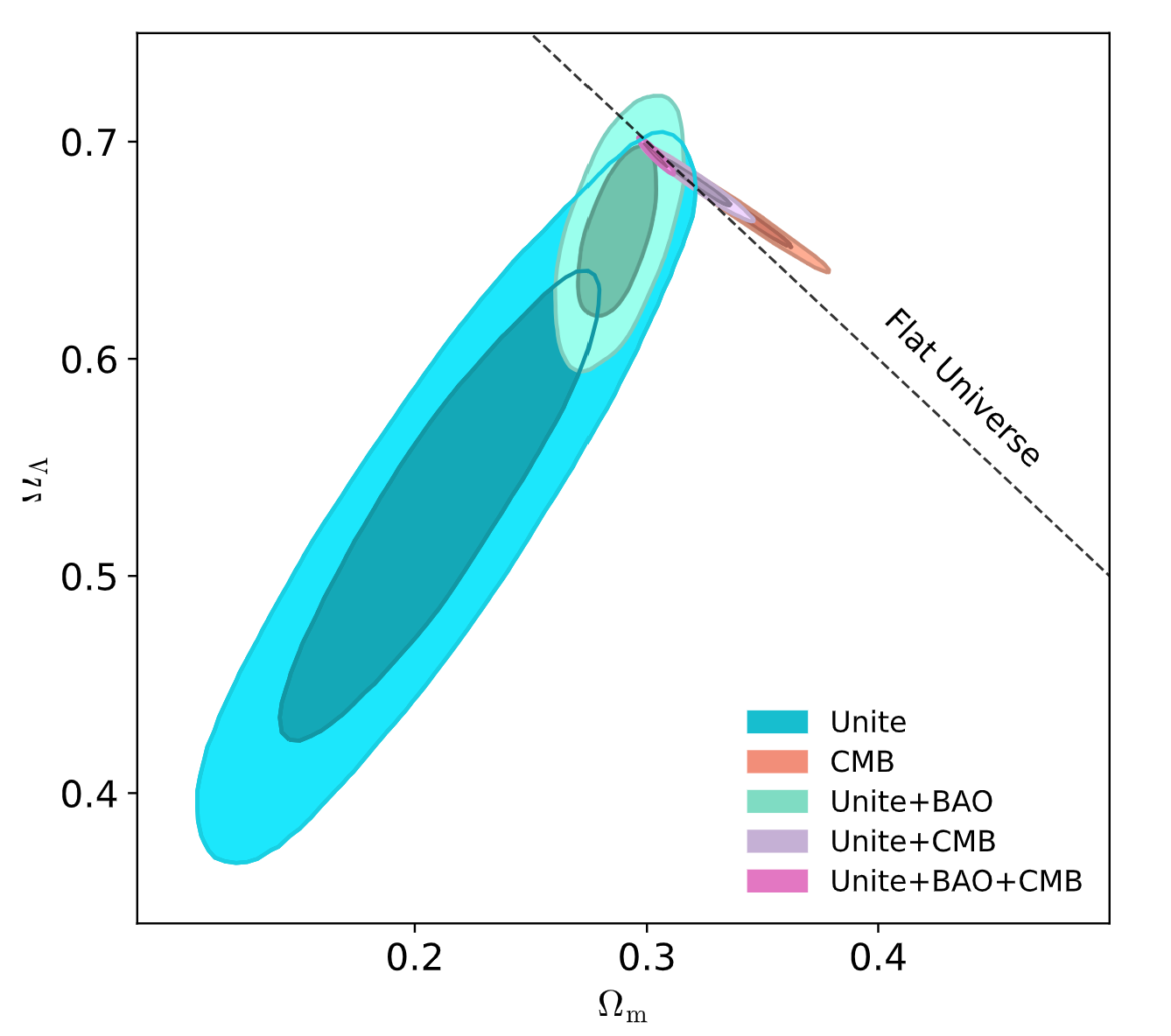
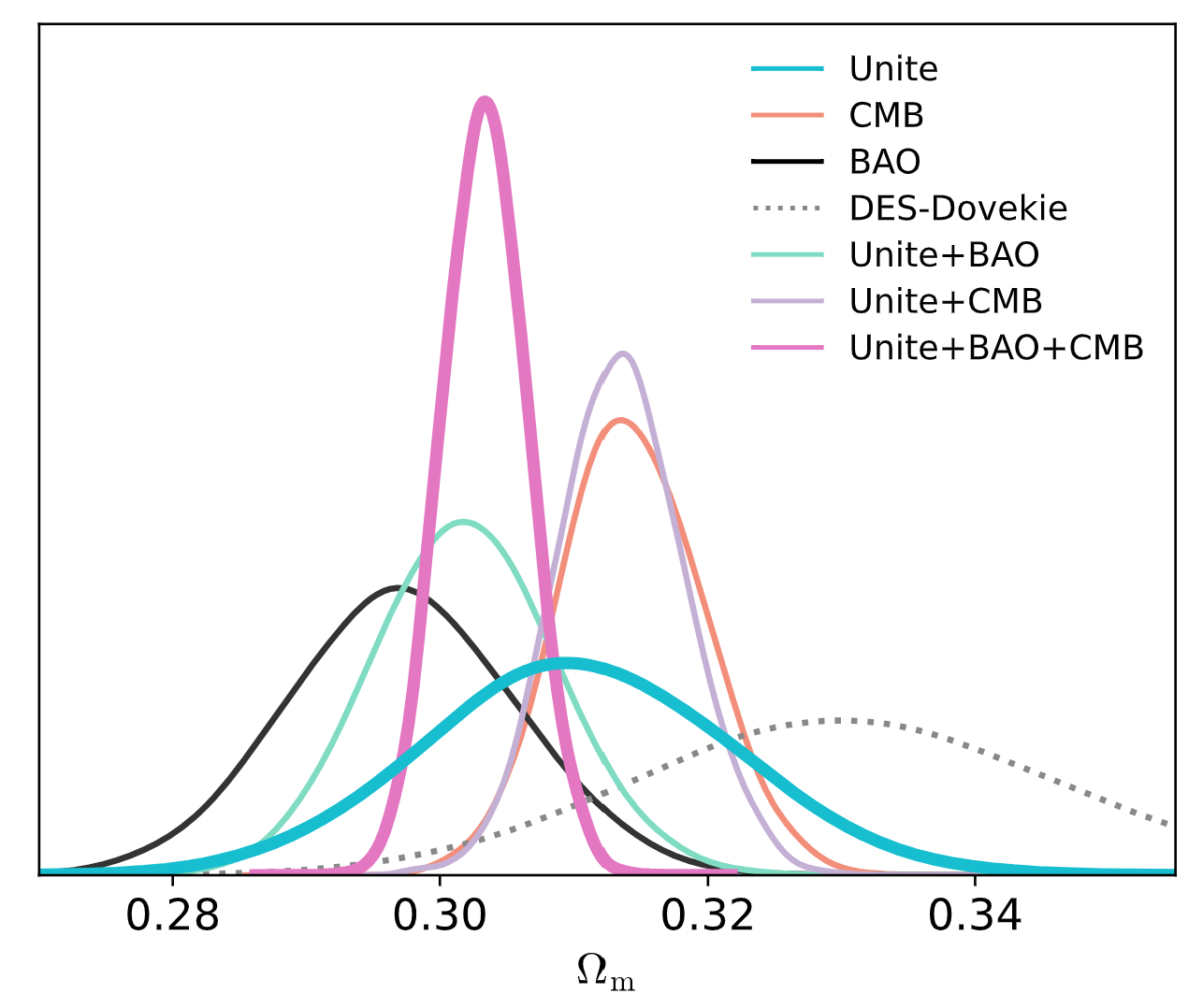
Supernovae measure the universe differently from baryon acoustic oscillations, or BAO, and the cosmic microwave background, or CMB.
BAO measurements use a characteristic scale left in the distribution of matter by sound waves in the early universe. CMB observations examine radiation released when the universe was only a small fraction of its current age.
Because the techniques have different parameter degeneracies, combining them can dramatically tighten cosmological constraints.
When Unite was combined with BAO and CMB datasets, the preferred time-varying model gave w₀ of about -0.861 and wₐ of about -0.60. The negative wₐ value points toward dark energy changing with cosmic time.
The combined measurements produced the tightest constraints yet in the w₀-wₐ parameter space, according to the researchers. Their figure of merit reached 315, corresponding to about a 30% reduction in the confidence-region area compared with a previous highly constraining combination.
Astrophysicist Tamara Davis said the independent hints are particularly interesting because supernovae and large-scale galaxy measurements probe the problem differently.
The statistical interpretation requires considerable caution.
Using frequentist model comparisons, evolving dark energy was preferred over flat ΛCDM at about 3.3 sigma using maximum posterior probability and 3.1 sigma using maximum likelihood.
Those values are interesting but fall below the roughly 5 sigma threshold traditionally associated with a discovery in physics.
Bayesian model comparison was even more cautious, finding only weak evidence in favor of evolving dark energy.
The researchers also stress that roughly half of the error budget in modern supernova analyses comes from systematic uncertainties. Different reasonable choices about calibration, supernova modeling and host galaxies can shift the best-fitting cosmological parameters.
Several modern supernova compilations, including Pantheon+, DES and Union, remain mutually consistent within one standard deviation despite producing somewhat different best-fit cosmologies.
That means the latest result should not be interpreted as proof that ΛCDM has failed. It instead adds another carefully constructed dataset to a growing collection of measurements that deserve further testing.
Future supernova surveys should make the picture clearer.
The Dark Energy Bedrock All-Sky Supernova program is finding hundreds of relatively nearby Type Ia supernovae that can improve the low-redshift foundation of the cosmic distance scale. Future surveys can then be incorporated into the Unite framework.
If the preference for evolving dark energy survives larger samples, improved calibration and independent analysis methods, the consequences would be profound. A changing form of dark energy would require physicists to rethink one of the central ingredients of the standard cosmological model.
For now, the largest supernova compilation ever assembled has not overturned that model. It has made one of its biggest mysteries harder to ignore.
These studies provide the major observational foundations for modern supernova cosmology and the recent debate over whether dark energy changes through cosmic history.
The Pantheon+ Analysis: Cosmological Constraints: Uses 1,550 distinct Type Ia supernovae to place precise constraints on cosmic expansion and provides one of the two major supernova compilations incorporated into Unite. (The Astrophysical Journal, 2022)
The Dark Energy Survey: Cosmology Results With ~1500 New High-redshift Type Ia Supernovae Using The Full 5-year Dataset: Presents the five-year DES supernova cosmology sample that greatly expanded the number of high-redshift Type Ia supernovae available for measuring expansion. (The Astrophysical Journal Letters, 2024)
DESI 2024 VI: Cosmological Constraints from the Measurements of Baryon Acoustic Oscillations: Shows how DESI baryon acoustic oscillation measurements, when combined with supernovae and CMB data, produced some of the first prominent recent hints of evolving dark energy. (Journal of Cosmology and Astroparticle Physics, 2025)
DESI DR2 Results II: Measurements of Baryon Acoustic Oscillations and Cosmological Constraints: Uses more than 14 million galaxies and quasars to improve BAO measurements and tighten tests of the standard cosmological model and evolving dark energy. (DESI Collaboration, 2025)
Union through UNITY: Cosmology with 2000 SNe Using a Unified Bayesian Framework: Provides an independent large Type Ia supernova compilation and Bayesian analysis framework useful for testing whether dark-energy results depend on sample construction or methodology. (The Astrophysical Journal, 2025)
Research findings are available online in the journal arXiv.
The original story “2,884 exploding stars deepen the mystery of dark energy” is published in The Brighter Side of News.
Like these kind of feel good stories? Get The Brighter Side of News’ newsletter.
The post 2,884 exploding stars deepen the mystery of dark energy appeared first on The Brighter Side of News.


Leave a comment
You must be logged in to post a comment.