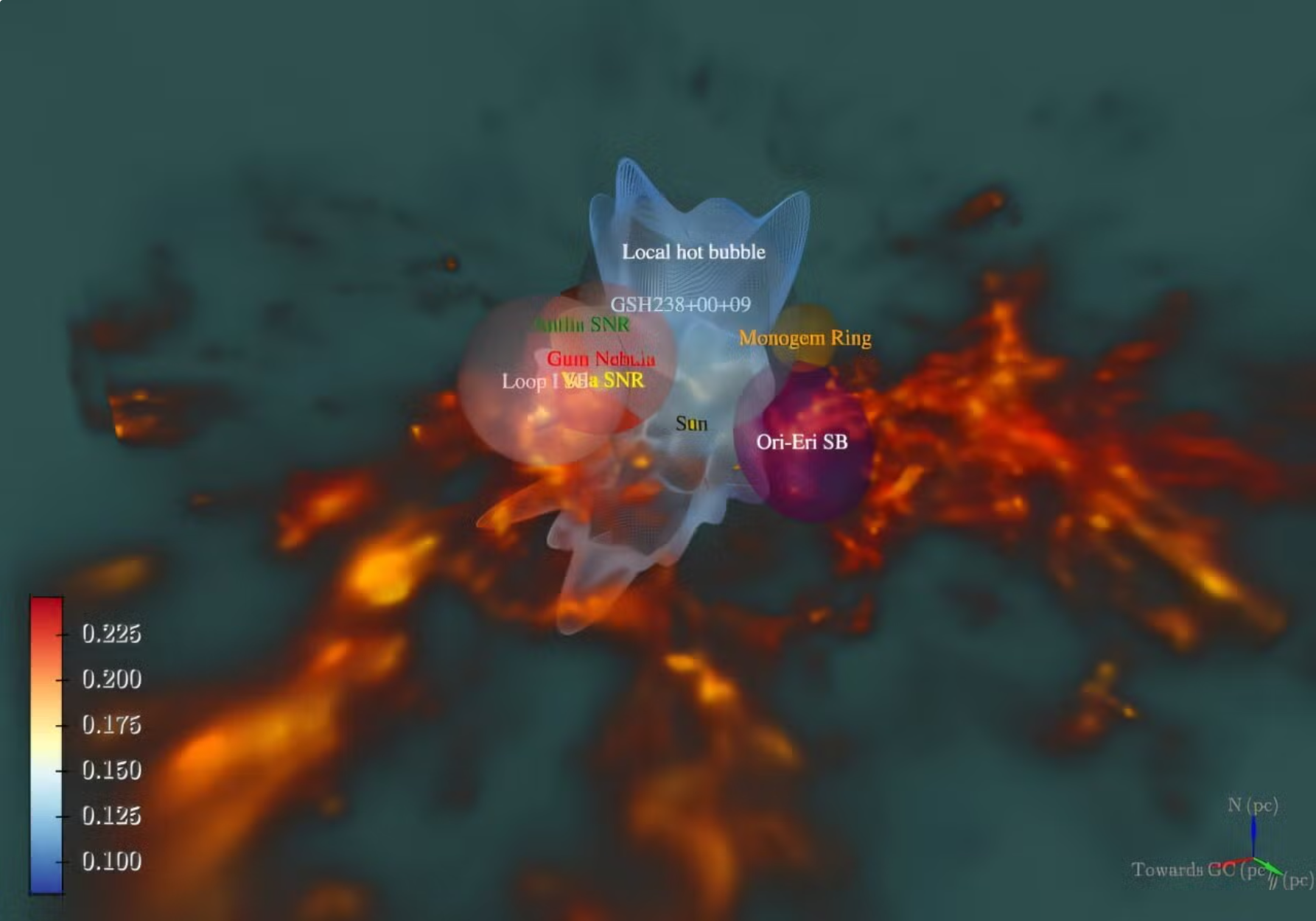
The solar system sits inside a vast pocket of hot, thin gas. However, that nearby structure has never looked especially simple. Fresh X-ray mapping now suggests the Local Hot Bubble is rough-edged and stretched. It is also still carrying signs of the violent events that built it.
Using data from the eROSITA telescope, researchers produced one of the clearest large-scale views yet of the soft X-ray glow that surrounds the Sun. Their analysis points to a local cavity that is not a neat sphere at all. Rather, it is a lopsided, jagged region that opens more easily away from the Milky Way’s crowded mid-plane. In fact, it may connect to neighboring cavities through narrow channels.
The work also strengthens the case that this soft X-ray glow is truly local. For years, astronomers have had to sort it from another source of similar radiation, solar wind charge exchange. This process can create X-rays when particles from the Sun interact with surrounding neutral atoms. Because eROSITA observed during solar minimum and from the Sun-Earth L2 point, about 1.5 million kilometers from Earth, it was in a strong position to reduce that interference.
“In other words, the eRASS1 data released to the public this year provides the cleanest view of the X-ray sky to date, making it the perfect instrument for studying the LHB,” lead researcher Michael Yeung told The Brighter Side of News.
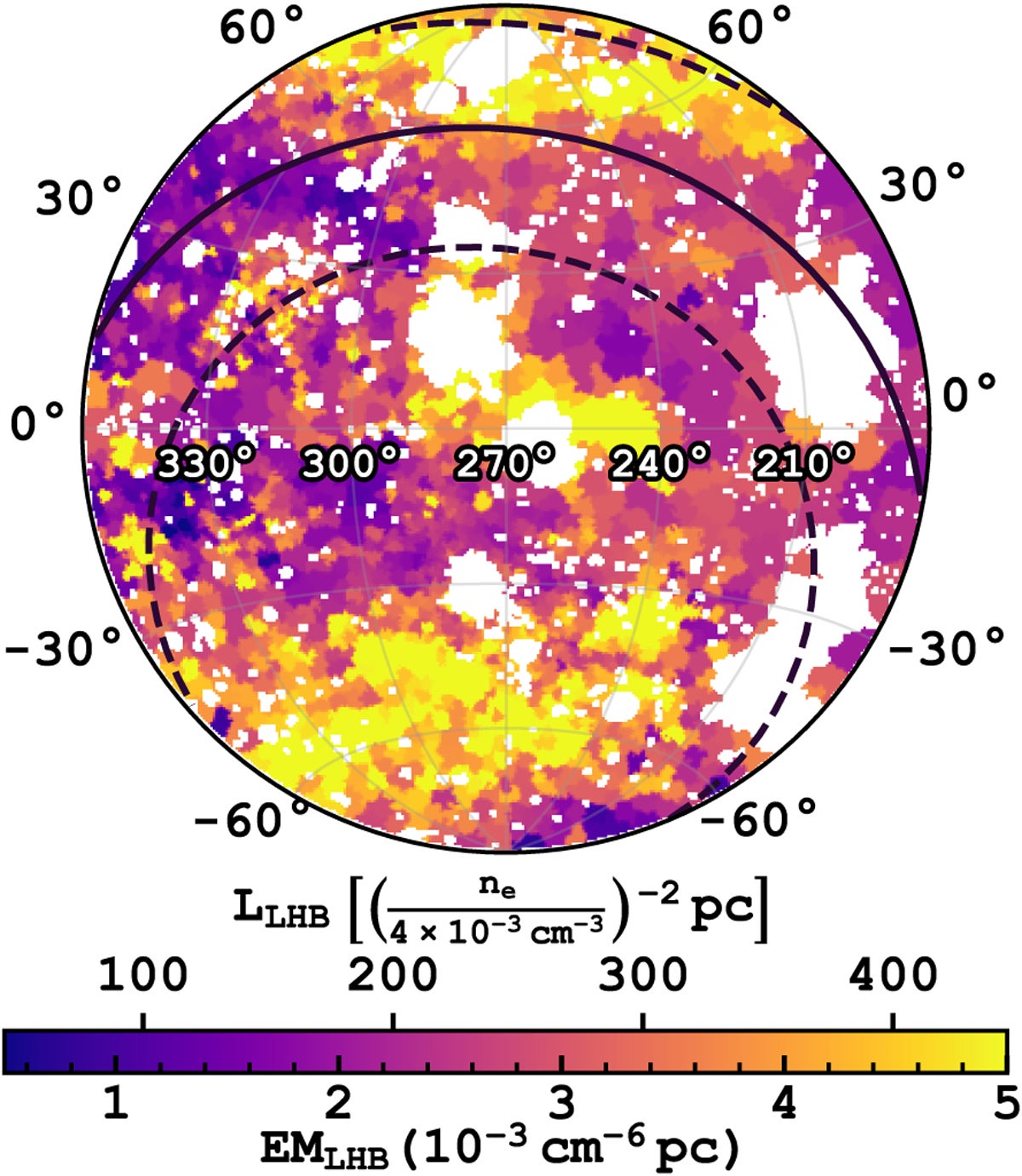
The team, led by the Max Planck Institute for Extraterrestrial Physics, divided the western Galactic hemisphere into about 2,000 regions and fit spectra for each one. That let them tease apart several overlapping contributors to the diffuse soft X-ray background. These include the Local Hot Bubble, the Milky Way’s circumgalactic medium, the cosmic X-ray background, and, in some directions, the eROSITA bubbles.
What emerged was not the picture of a smooth cocoon.
The Local Hot Bubble appears more extended toward high Galactic latitudes, where it can expand away from the dense material packed along the Galactic plane. In that sense, the shape fits a long-standing expectation. Hot gas moves more easily where there is less resistance. However, the structure also looks irregular, with protrusions, indentations, and asymmetries that hint at a messy history.
“It’s spikier and bumpier,” said Michael Freyberg, a co-author on the study.
That roughness matters because the Local Hot Bubble is widely thought to be the product of multiple supernova explosions over millions of years. The new map fits that broad picture. Rather than tracing a single clean blast, it suggests repeated stellar violence and overlapping shock waves. It shows a local interstellar medium shaped by feedback from dying stars.
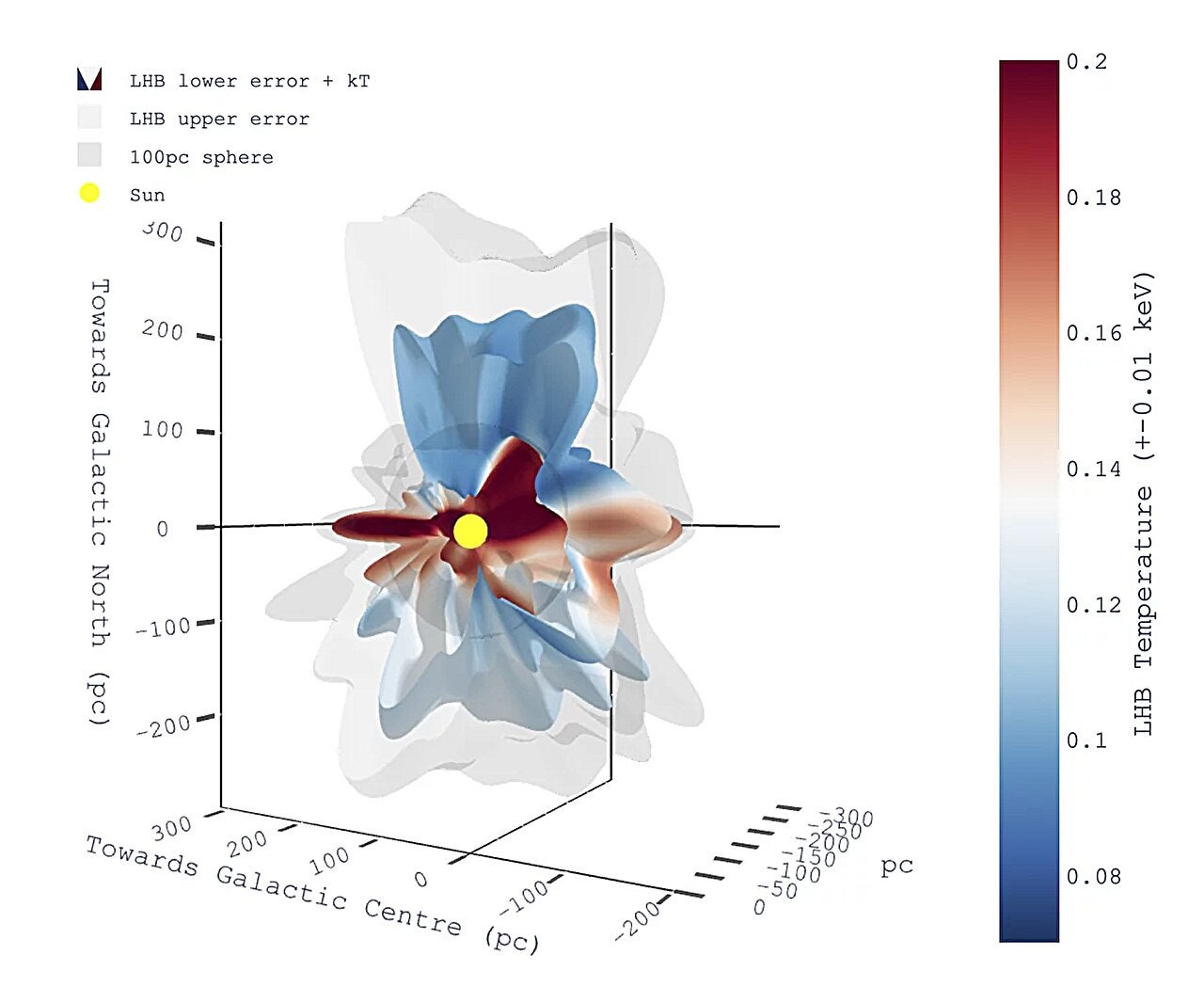
The team estimated a median Local Hot Bubble temperature of 0.111 keV, but that average hides one of the study’s most striking results. At high Galactic latitudes, the northern side appears cooler than the southern side. The analysis found mean temperatures of about 100.8 electronvolts in the north and 121.8 electronvolts in the south. This is a difference large enough that the authors say it is very unlikely to be a statistical fluke.
That temperature split gives the bubble a more dynamic feel. Instead of being a quiet leftover feature, it may still be reflecting newer heating events.
The authors suggest that relatively recent, off-center supernova explosions could help explain the pattern, especially if shocks inside the cavity heated some regions more than others. They also note another possibility. Pressure from the surrounding interstellar medium, especially closer to the Galactic plane, helps shape the temperature profile.
Either way, the Local Hot Bubble no longer looks uniform. It looks like a nearby structure with memory.
The study also revisits an old problem in X-ray astronomy: how to separate local emission from background sources. Earlier all-sky work often relied on broad energy bands alone. This made it harder to untangle different components. By combining eROSITA spectra with ROSAT data at lower energies, the team was able to better break the degeneracy between local and background emission in many parts of the sky.
That matters because some earlier debates had cast doubt on how much of the soft X-ray background was truly coming from the Local Hot Bubble at all. The new work does not erase every uncertainty. However, it does make the local component much harder to dismiss.
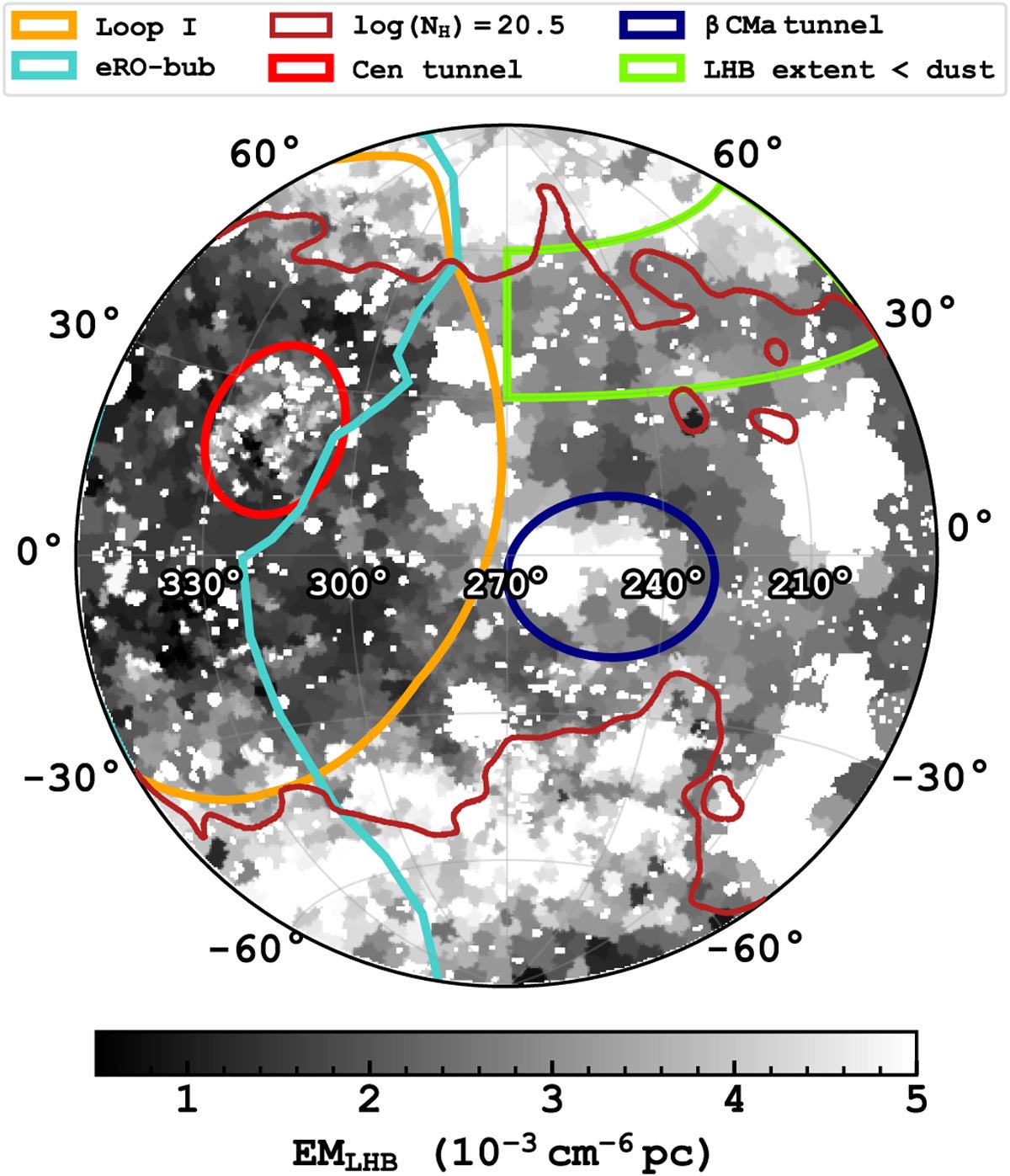
The map turned up another surprise, a possible tunnel of hot gas in the direction of Centaurus.
“What we didn’t know was the existence of an interstellar tunnel towards Centaurus, which carves a gap in the cooler interstellar medium,” Freyberg explained.
The researchers argue that this feature may be another channel linking the Local Hot Bubble to a neighboring superbubble, possibly Loop I. They also found support for hot gas in the better known beta Canis Majoris tunnel. This is a low-density channel long discussed in studies of the local interstellar medium.
Taken together, those features strengthen an older idea that the Milky Way may contain a broader tunnel network, cavities and channels carved by stellar explosions and later filled with hot plasma. In that view, the region around the Sun is not an isolated bubble. Instead, it is part of a connected, shifting architecture.
The 3D reconstruction in the study also showed a strong anti-correlation between the bubble’s emission measure and nearby dust. Where the local dust column is low, the bubble often appears more extended. That is broadly consistent with the classic displacement picture. In this model, hot plasma fills cavities where colder, denser material is sparse.
“Another interesting fact is that the sun must have entered the LHB a few million years ago, a short time compared to the age of the sun [4.6 billion years],” co-author Gabriele Ponti said.
That point adds perspective. The Sun’s current position near the bubble’s center is not evidence of special placement, the authors argue. Instead, it is likely a temporary overlap as the solar system continues its orbit through the galaxy.
Superbubbles are vast cavities filled with hot, low-density gas created by multiple supernova explosions and strong stellar winds from massive stars. The Local Hot Bubble (LHB) is the closest known superbubble to Earth. The next nearest superbubbles are as follows:
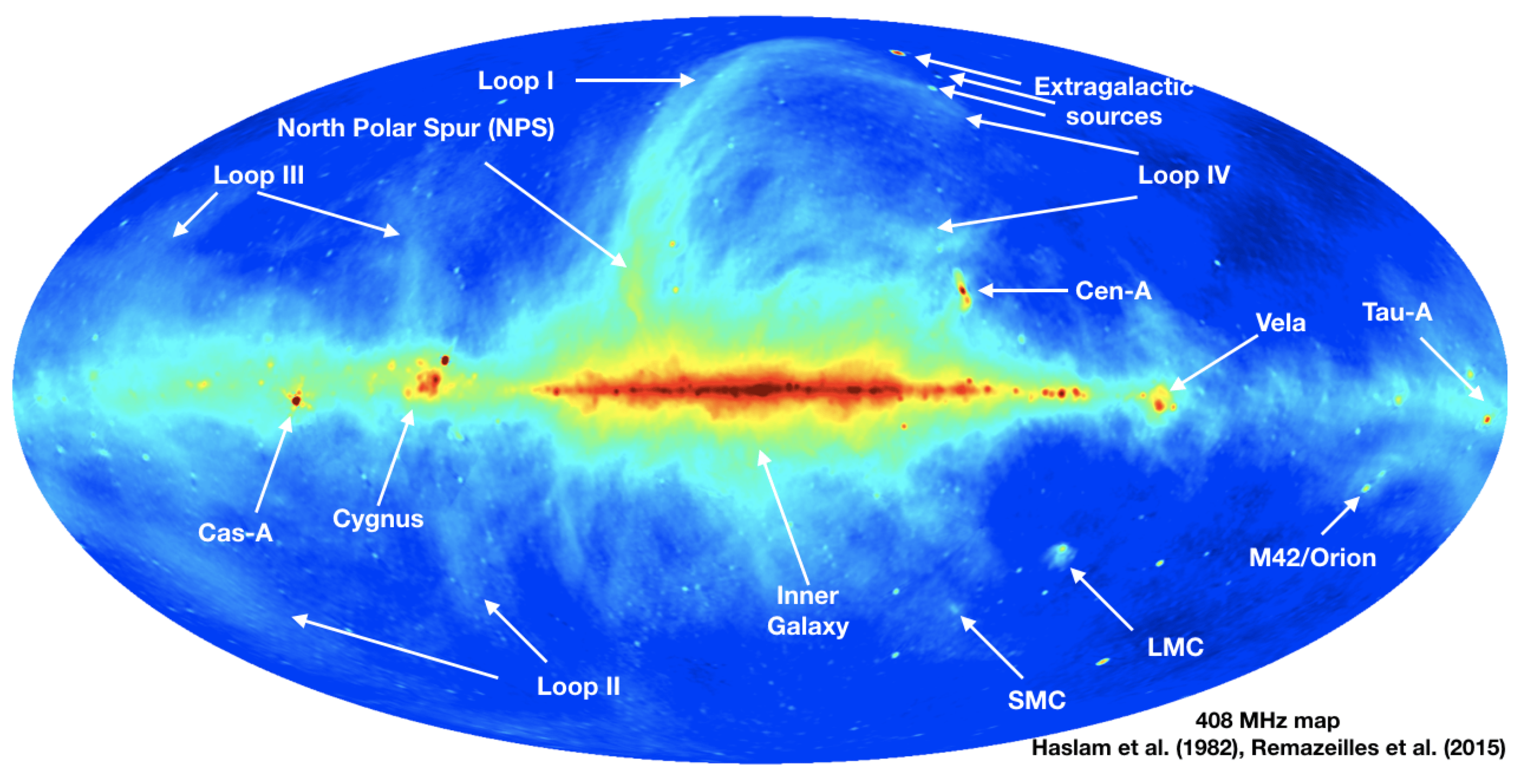
These superbubbles play a crucial role in shaping the Milky Way. They do so by influencing the movement of interstellar gas and triggering new generations of star formation.
Research findings are available online in the journal Astronomy & Astrophysics.
The original story “A cosmic gateway near Earth may connect us to other distant worlds” is published in The Brighter Side of News.
Like these kind of feel good stories? Get The Brighter Side of News’ newsletter.
The post A cosmic gateway near Earth may connect us to other distant worlds appeared first on The Brighter Side of News.

