A sprawling network of young galaxies seen more than 11 billion years in the past may represent the earliest known ancestor of one of the universe’s largest structures.
The enormous formation, called COSMOS-z3.1-A, existed when the universe was only about 2.1 billion years old. Rather than resembling a mature galaxy cluster, it contains numerous dense clumps woven together by filaments of galaxies and matter.
Astronomers now classify it as a proto-supercluster, an exceptionally early predecessor of a future collection of galaxy clusters. Its estimated mass is roughly 5,000 times that of the Milky Way.
The discovery comes from an international team led by Vandana Ramakrishnan, then a graduate student at Purdue University. Published in The Astrophysical Journal, the work combines observations from the ODIN survey with extensive spectroscopy to reconstruct two distant structures in three dimensions.
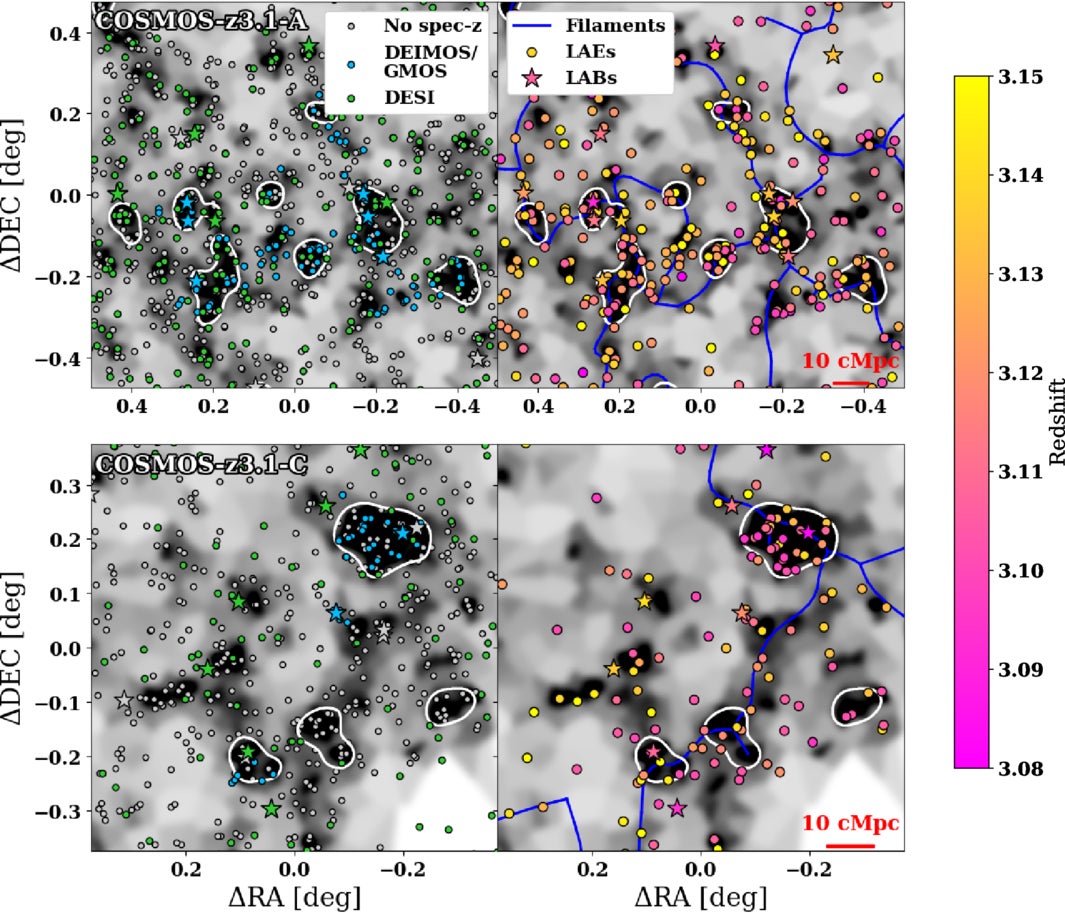
“With this project, we’re hoping to understand the growth of massive structures in the universe and how they influence the evolution of galaxies within them,” Ramakrishnan said. “We also hope to get a better sense of how these protoclusters are connected to the larger cosmic web.”
Galaxy clusters are among the most massive gravitationally bound structures in the universe. Hundreds or even thousands of galaxies can occupy a cluster containing enormous quantities of dark matter and hot gas.
The clusters astronomers see nearby are comparatively mature. Their distant ancestors looked very different.
Protoclusters consist of galaxies and dark matter that have not yet collapsed into one stable, gravitationally bound structure. At high redshift, they can stretch across enormous regions and contain several separate concentrations that will eventually evolve into massive clusters.
The ODIN survey, short for One-hundred-deg² DECam Imaging in Narrowbands, is designed to find these early structures. It uses the 570-megapixel Dark Energy Camera on the Víctor M. Blanco 4-meter Telescope in Chile to locate galaxies emitting strongly at the hydrogen Lyman-alpha wavelength.
Earlier ODIN observations identified about 150 protocluster candidates at redshifts of 2.4 and 3.1. The researchers concentrated on two particularly striking systems at redshift 3.1, COSMOS-z3.1-A and COSMOS-z3.1-C.
Images can show where galaxies appear across the sky, but that provides only two dimensions. Galaxies that seem close together could actually sit millions of light-years apart along our line of sight.
The team therefore added spectroscopic measurements capable of determining much more precise galaxy redshifts and distances.
Most of the spectroscopy came from the Dark Energy Spectroscopic Instrument, or DESI, which can collect spectra from as many as roughly 5,000 objects in a single pointing. Additional measurements came from the DEIMOS instrument on the Keck II telescope in Hawaii and the Gemini Multi-Object Spectrograph on Gemini South in Chile.
For COSMOS-z3.1-A, dedicated Keck observations confirmed 111 of 161 targeted Lyman-alpha-emitting galaxies and seven of eight targeted Lyman-alpha blobs. Gemini observations confirmed another 27 of 38 targeted emitters around COSMOS-z3.1-C.
The researchers combined those measurements with the larger photometric sample using a probabilistic reconstruction technique. They divided space into three-dimensional cells and repeatedly assigned probable distances to galaxies lacking spectroscopy, producing 500 realizations before averaging them into a final map.
Tests against simulated galaxy populations showed that this method reproduced the underlying matter distribution more accurately than spectroscopy alone.
The resulting view transformed COSMOS-z3.1-A from a projected galaxy overdensity into a complex three-dimensional structure.
It contains about 400 Lyman-alpha-emitting galaxies and 17 Lyman-alpha blobs, with spectroscopy confirming 249 of the emitters and 13 blobs. The reconstruction identified 10 distinct high-density peaks.
Those peaks are not isolated. Long structures extend between and away from them, consistent with cosmic filaments feeding matter into the developing system.
Each major peak is expected to evolve into a cluster-sized dark matter halo. Taken together, the researchers conclude that COSMOS-z3.1-A is the progenitor of an exceptionally massive system, with the combined descendant mass of its principal components estimated at roughly twice that of the Coma Cluster.
That makes it more than an ordinary protocluster.
The team identifies COSMOS-z3.1-A as a proto-supercluster comparable to Hyperion, a previously discovered seven-component structure seen at redshift 2.45. COSMOS-z3.1-A appears at redshift 3.1, meaning astronomers are seeing it at an earlier point in cosmic history.
The two systems occupy similarly enormous comoving volumes of roughly 100,000 cubic megaparsecs, although their orientation relative to Earth differs substantially.
COSMOS-z3.1-C also proved highly structured. Its three-dimensional map revealed four major density peaks connected through lower-density regions.
Both systems show elongated shapes, extended tails and multiple separate concentrations. These features resemble the filamentary structures predicted by cosmological simulations.
That architecture supports the hierarchical, or bottom-up, theory of structure formation. In this picture, small concentrations of matter form first. Gravity gradually draws them together while additional gas and dark matter flow in through the cosmic web.
Over billions of years, separate clumps merge and collapse into the smoother, more centrally concentrated galaxy clusters seen closer to Earth today.
The observations also provided an intriguing clue about Lyman-alpha blobs, enormous clouds of glowing hydrogen associated with intense activity in the early universe. Their surface density around the two structures was about four times the average, yet none of the confirmed blobs occupied the densest cores.
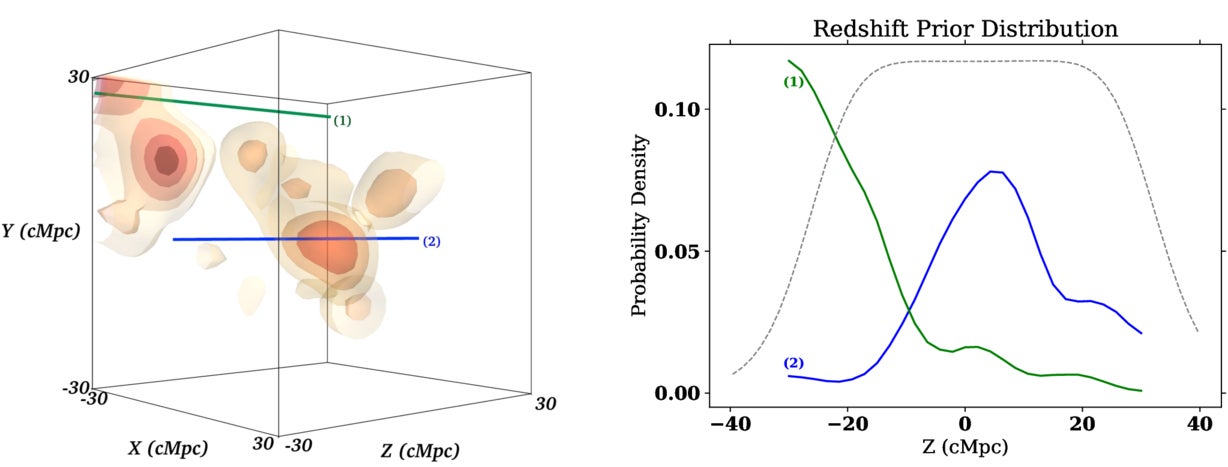
Instead, their median distance from the nearest density peak was about 17 comoving megaparsecs. That places them mainly around cluster outskirts or filaments, strengthening evidence that their formation is connected to the broader cosmic environment.
COSMOS-z3.1-A appears extraordinarily unusual even by protocluster standards.
The researchers estimate that structures like it have a number density no higher than about five per 100 million cubic comoving megaparsecs. Comparable objects were absent from the cosmological simulation volume the team used for testing.
Orientation creates another challenge. The three-dimensional maps show that the same structure can appear compact, elongated or broken into separate objects depending on the observer’s viewing angle.
That means some enormous structures could be difficult to recognize using images alone. Combining wide-field imaging with spectroscopy may therefore be essential for finding the most extreme structures in the early universe.
ODIN should continue expanding that search. The Vera C. Rubin Observatory will add an even wider view of the southern sky, allowing astronomers to connect deep observations with enormous cosmic volumes.
For COSMOS-z3.1-A, the result is already a remarkable snapshot. Astronomers are not seeing a finished supercluster, but its construction site, filled with separate clumps and filaments more than 11 billion years ago.
These resources explore how astronomers find early galaxy-cluster ancestors, trace them with Lyman-alpha emission and connect their evolution to the universe’s filamentary large-scale structure.
The progeny of a cosmic titan: a massive multi-component proto-supercluster in formation at z = 2.45 in VUDS: Describes Hyperion, the seven-component proto-supercluster that provides an important comparison for the newly mapped COSMOS-z3.1-A structure. (Astronomy & Astrophysics, 2018)
ODIN: High Clustering Strength of Protoclusters at Cosmic Noon: Examines 150 ODIN protocluster candidates and shows that their clustering is consistent with their evolution into massive present-day galaxy clusters. (The Astrophysical Journal, 2025)
cosmic web in Lyman-alpha emission: Models Lyman-alpha emitters, halos, blobs and filaments to investigate how glowing hydrogen can trace the otherwise faint cosmic web. (Monthly Notices of the Royal Astronomical Society, 2023)
Research findings are available online in The Astrophysical Journal.
The original story “A cosmic giant 5,000 times the Milky Way’s mass emerges from the early Universe” is published in The Brighter Side of News.
Like these kind of feel good stories? Get The Brighter Side of News’ newsletter.
The post A cosmic giant 5,000 times the Milky Way’s mass emerges from the early Universe appeared first on The Brighter Side of News.


Leave a comment
You must be logged in to post a comment.