A cloud of ultracold atoms has provided a new experimental connection between two theories that physicists still cannot fully reconcile.
Researchers have directly measured the quantum phase acquired by a freely falling matter wave relative to one held stationary on Earth. The effect was predicted nearly a century ago, but the particular free-fall phase had never been measured directly.
The experiment was led by researchers at Ben-Gurion University of the Negev, with collaborators from institutions including Ulm University and the University of Oxford. The findings are available in Science Advances.
The result does not provide a theory of quantum gravity. Instead, it shows that Einstein’s equivalence principle can be applied consistently to the quantum behavior measured in the experiment.
The distinction matters because quantum mechanics describes matter as waves and superpositions, while Einstein’s gravitational theory describes gravity through the geometry of spacetime.
Einstein’s equivalence principle says that gravity locally disappears for an observer in free fall.
A person falling inside a sealed elevator would experience weightlessness. Locally, that situation should be indistinguishable from floating in an elevator far from gravitational forces.
Applying that idea to a quantum object introduces an unusual complication. A quantum wave can exist in a superposition, allowing different parts of it to follow different paths before being recombined.
Theory predicts that a freely falling wave packet viewed from a laboratory fixed to Earth should accumulate a specific quantum phase. The same phase emerges when physicists start from the equivalence principle and transform between the laboratory frame and the freely falling frame.
That mathematical agreement has helped quantum mechanics and the equivalence principle coexist theoretically. Yet the explicit free-fall phase itself had remained unmeasured.
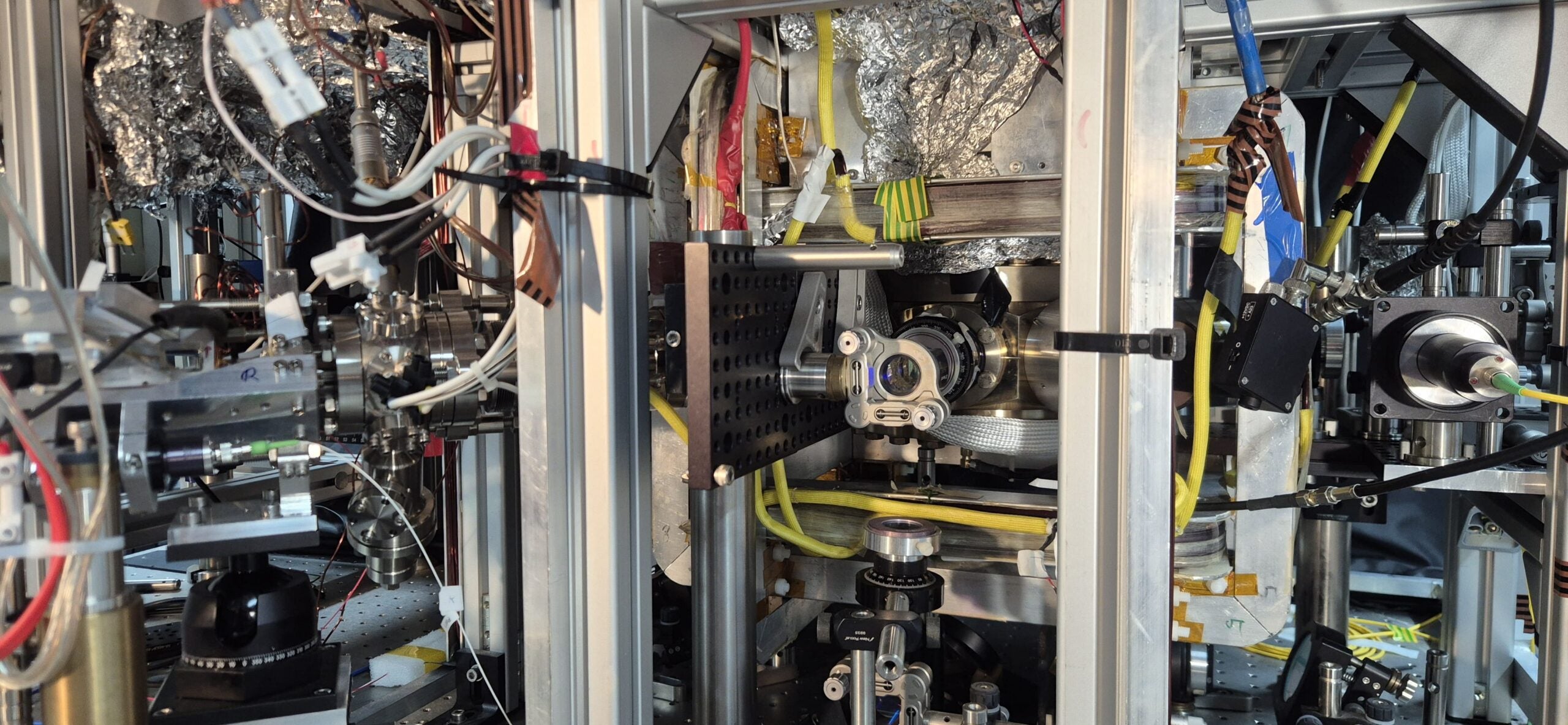
To isolate it, the team built what it calls the Quantum Galileo Interferometer, or QGI.
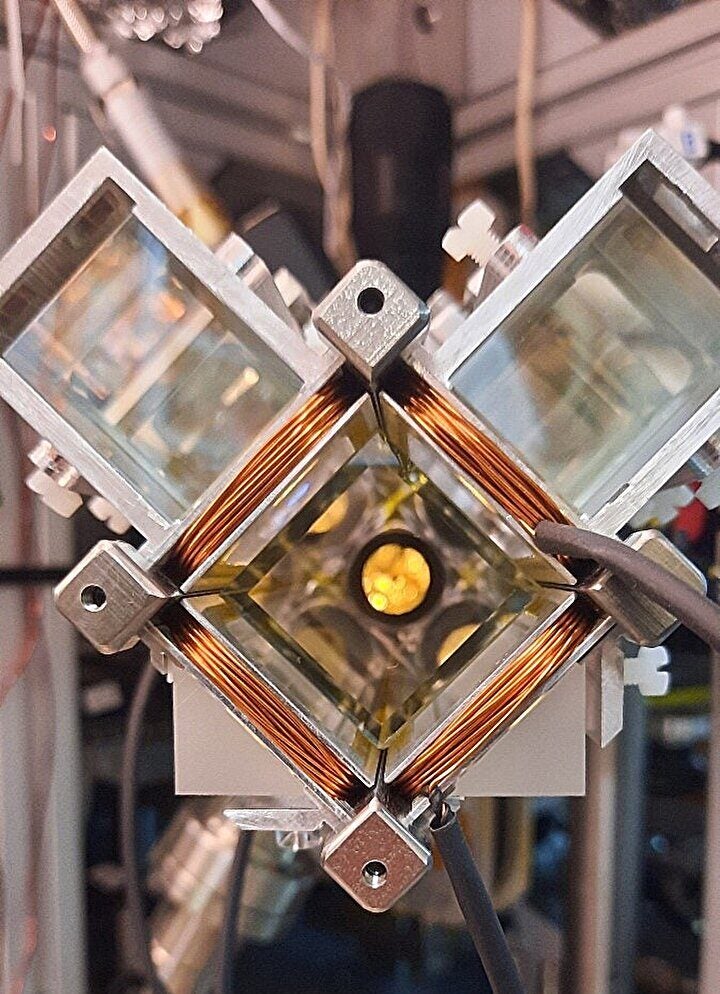
Unlike conventional atom interferometers, its two branches experience radically different conditions. One atomic wave packet remains stationary relative to Earth. The other follows a genuinely ballistic trajectory under gravity.
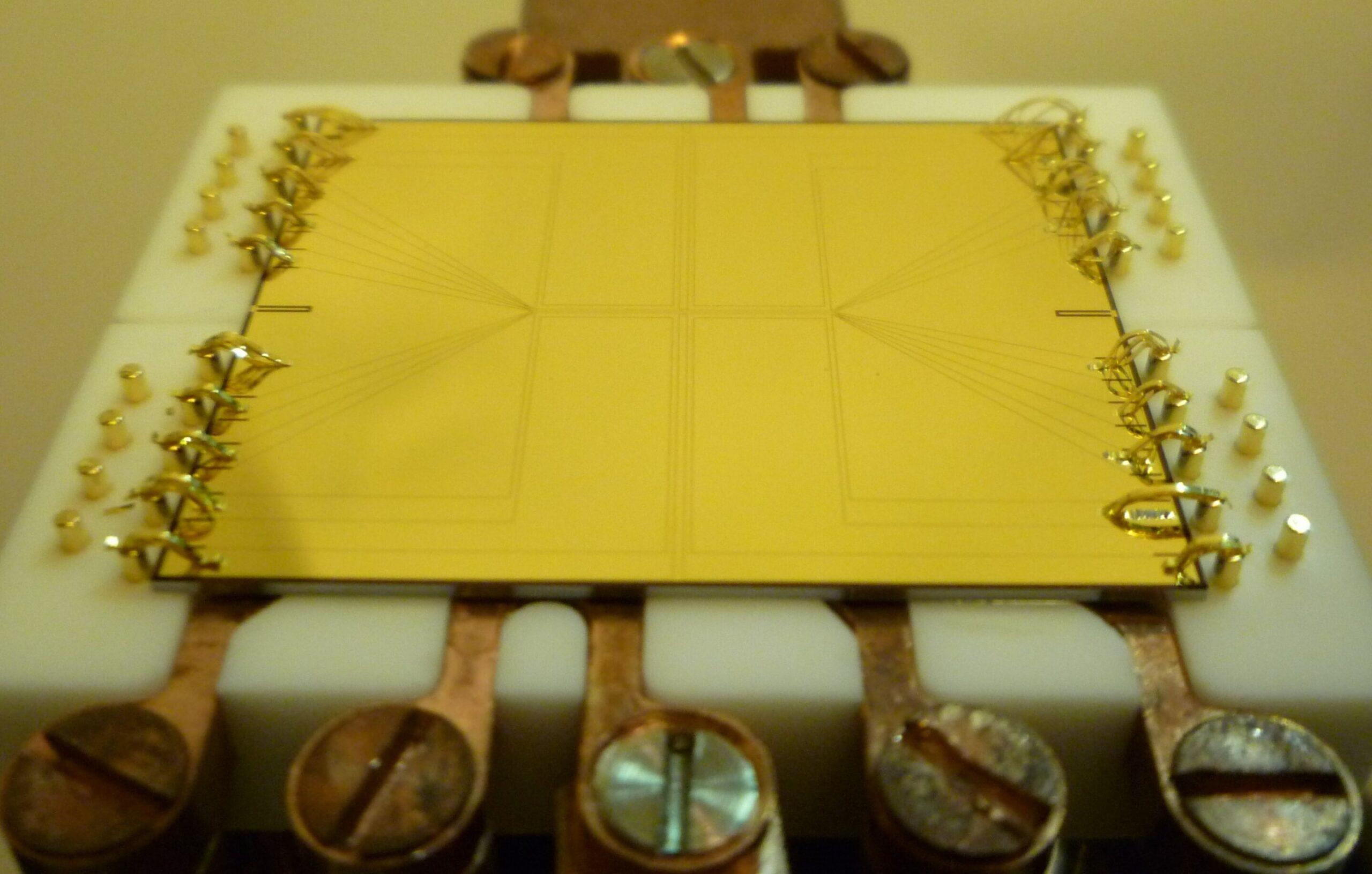
The experiment used rubidium-87 atoms cooled into a Bose-Einstein condensate near an atom chip.
Researchers initially prepared roughly 20,000 atoms and used microwave pulses to place them into a quantum superposition of two internal states. Each state could then be manipulated differently using magnetic fields generated by microscopic wires on the chip.
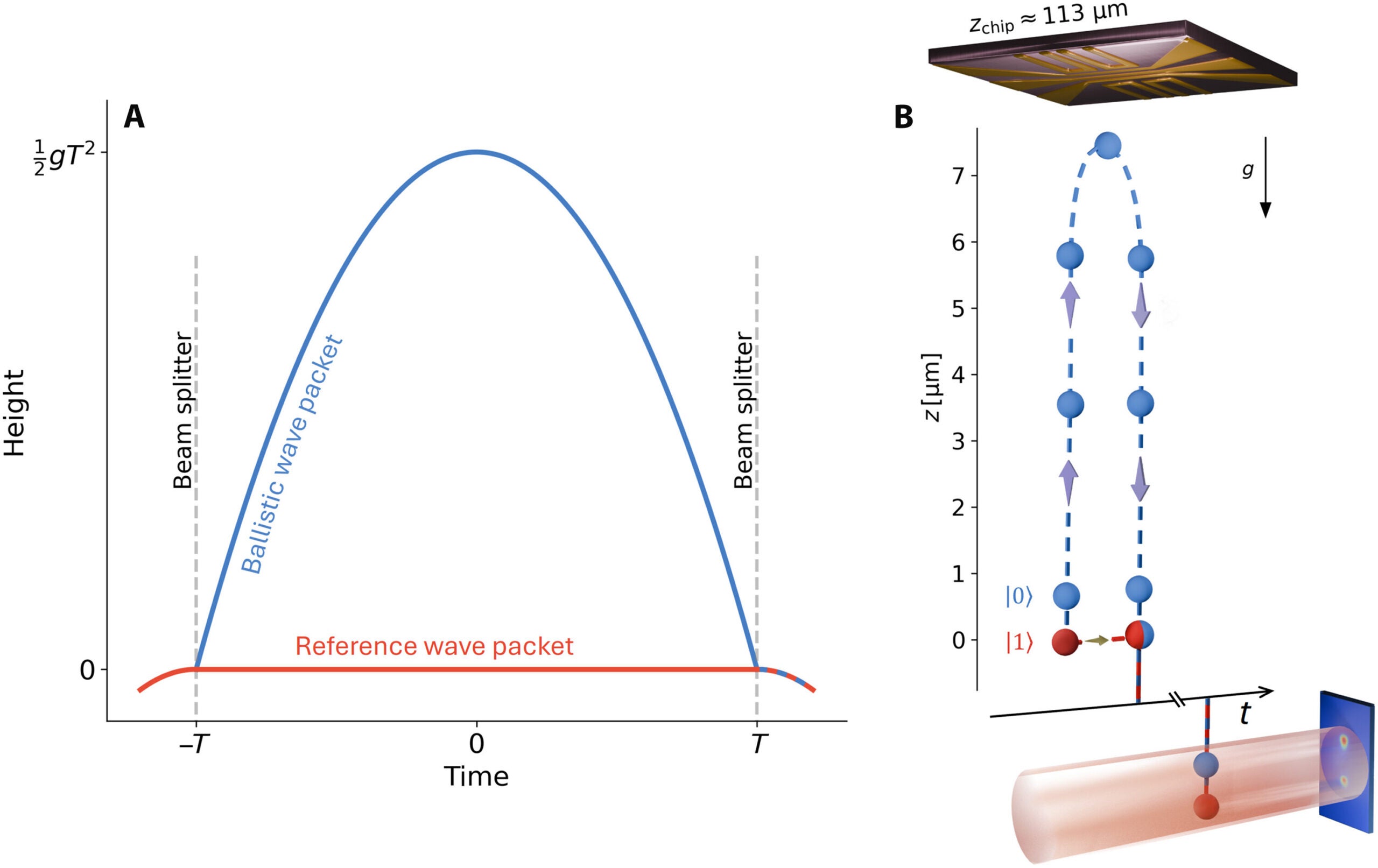
One portion became the reference wave packet.
Magnetic forces pushed upward with just enough acceleration to counter Earth’s gravity, leaving that part nearly stationary relative to the laboratory.
The other wave packet received an upward magnetic kick. Researchers then changed its internal state so it became almost insensitive to the magnetic gradient.
It rose briefly and then fell freely, following a ballistic trajectory much like a thrown ball.
A final sequence reversed the process and brought the two matter waves back together. Their interference pattern revealed the relative quantum phase accumulated during the experiment.
The geometry was essential. Previous matter-wave experiments had measured gravitational accelerations and gravitationally induced phases, but they did not directly compare one wave packet stationary in Earth’s frame with another undergoing free fall.
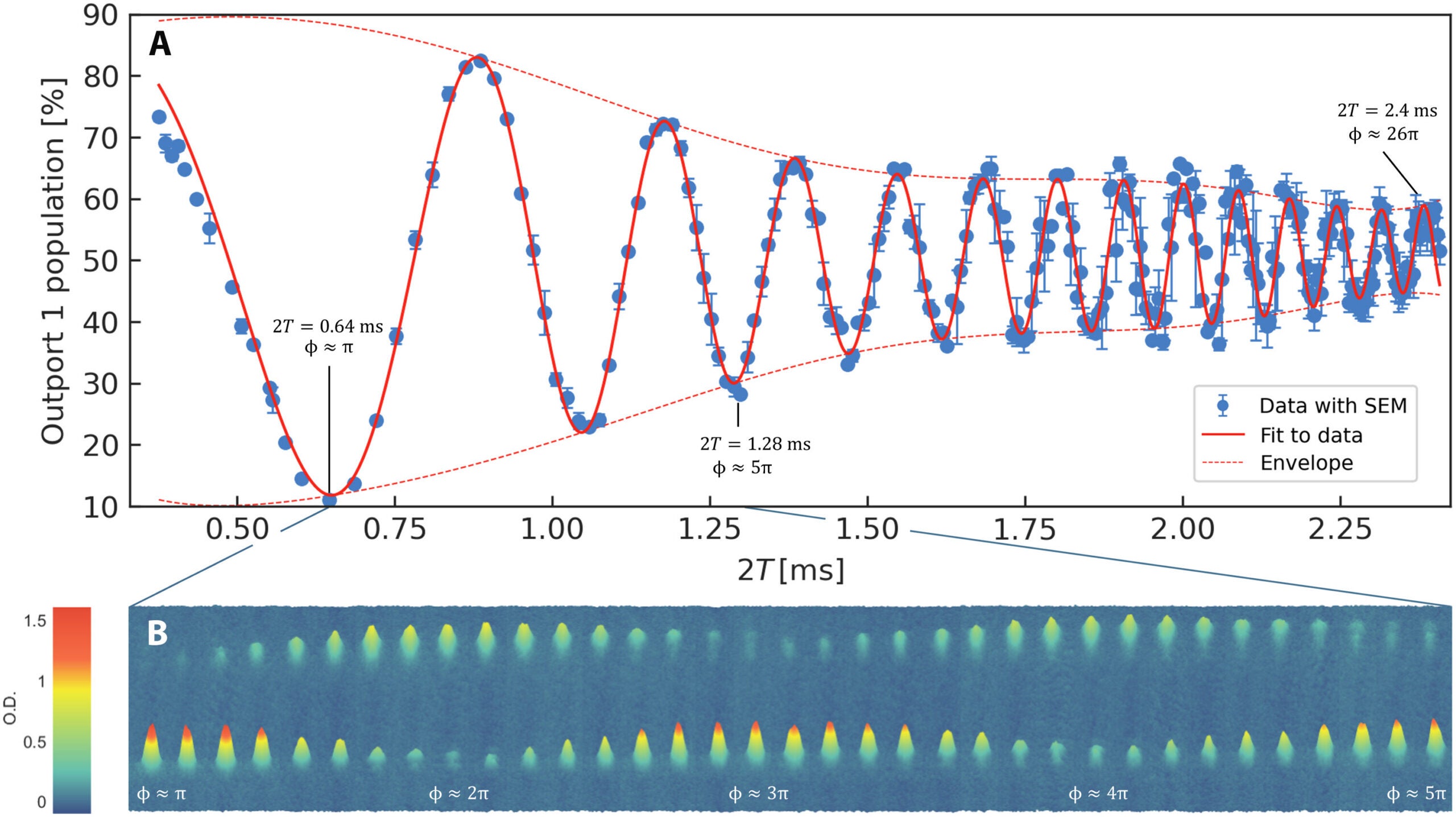
The researchers observed about 13 full interference oscillations corresponding to roughly 80 radians of accumulated phase during more than five hours of measurements.
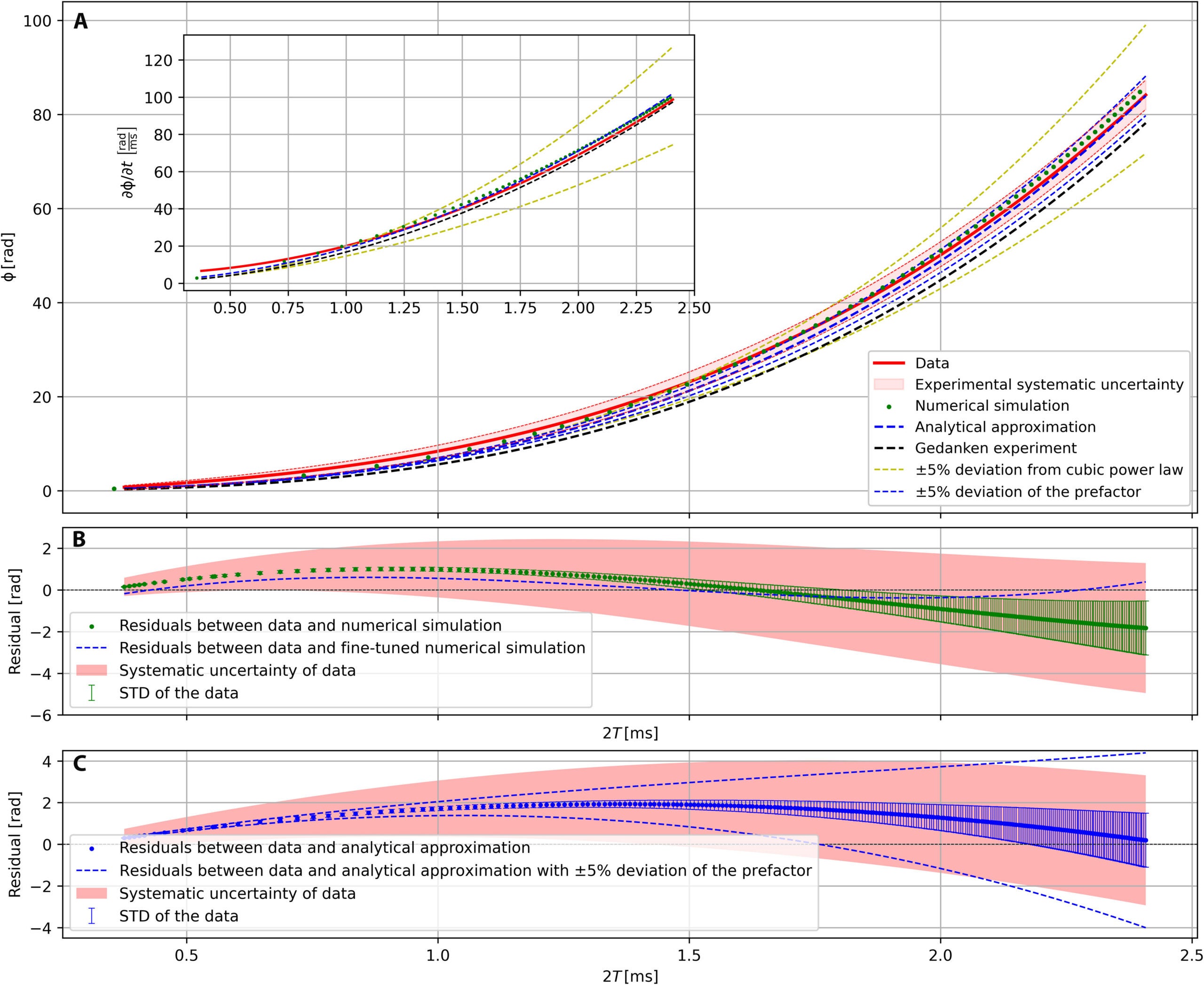
The phase followed the predicted cubic dependence on free-fall time. Numerical simulations that included the three-dimensional motion and shape evolution of the wave packets agreed with the experimental phase to within the stated uncertainties. Residual differences were roughly 2.5%.
The team also tested whether the measurements could accommodate deviations from the expected relationship. Changes of about 5% in the predicted power dependence or theoretical prefactor were inconsistent with the observations.
That agreement allowed the researchers to conclude that they had directly observed the expected phase of a freely falling quantum object.
“This experiment pushes quantum mechanics into one of its most intriguing frontiers, gravity, and shows that, once again, its predictions hold,” said University of Oxford physicist Vlatko Vedral.
The experiment supports compatibility rather than unification. It does not establish that spacetime or gravity has quantum properties.
That caution is especially important because several very different questions are often grouped under “quantum gravity.”
Physicists already use quantum objects to measure gravitational fields with extraordinary precision. Atom interferometers have tested the equivalence principle, measured Earth’s gravitational acceleration and detected attraction from laboratory masses.
Those experiments do not demonstrate that gravity itself exists in quantum superpositions.
The new QGI result also leaves that question unanswered.
Instead, it experimentally verifies a specific phase relationship that should exist if ordinary quantum mechanics and the equivalence principle apply together to the system.
The authors themselves note that other theories violating some formulation of the equivalence principle might still reproduce the same measured phase. The experiment therefore does not eliminate every alternative gravitational model.
It also does not test Penrose’s proposal that sufficiently massive objects might undergo gravity-related collapse of quantum superpositions. The rubidium atoms were far too light and remained in superposition for too little time to reach that regime.
The next experiments could move into much less familiar territory.
The QGI allows researchers to control spatial, velocity and acceleration differences between matter-wave paths in ways that standard interferometers cannot. That flexibility could enable tests involving quantum clocks and other formulations of the equivalence principle.
The group is also working toward interferometers containing nanodiamonds instead of individual atoms.
Such objects would be vastly more massive than rubidium atoms and could place quantum superpositions into regimes where proposed modifications of quantum mechanics become experimentally relevant.
The authors specifically identify the Diósi-Penrose idea of gravitationally induced collapse as one possible target.
For now, gravity has not revealed a contradiction.
A quantum wave was allowed to fall while another part remained tied to Earth. When the two reunited, their phase difference behaved as the century-old equations predicted.
The experiment has not joined quantum theory and gravity into one framework. It has instead shown, with a new kind of interferometer, that the boundary between them remains experimentally consistent in one more carefully tested regime.
These five studies examine quantum tests of the equivalence principle, large matter-wave superpositions and new techniques for probing gravity with atoms.
Quantum test of the equivalence principle for atoms in coherent superposition of internal energy states: Rubidium atoms prepared in different internal states and coherent superpositions were used to test quantum aspects of the weak equivalence principle with precision reaching the billionth level. (Nature Communications, 2017)
Measuring gravitational attraction with a lattice atom interferometer: A suspended atom interferometer measured the gravitational pull of a small laboratory source mass and placed strong limits on possible deviations from Newtonian gravity at short distances. (Nature, 2024)
Atom interferometry in an Einstein Elevator: Researchers operated an atom interferometer on a laboratory platform that repeatedly mimicked free fall, demonstrating a compact route toward precision quantum experiments in microgravity. (Nature Communications, 2025)
General formalism of the quantum equivalence principle: This theoretical study develops a broader formulation of the quantum equivalence principle that applies beyond nonrelativistic particles and weak gravitational fields. (Communications Physics, 2023)
Quantum superposition at the half-metre scale: Atom interferometry produced coherent matter-wave paths separated by as much as 54 centimeters, showing how increasingly large superpositions can strengthen future tests of gravity and quantum mechanics. (Nature, 2015)
Main story title:
A falling quantum object just passed a century-old test of Einstein’s gravity
Focus keyphrase:
Meta description:
Story excerpt:
Broader internal keyword:
Quantum gravity
SEO tags:
, Science Advances
Research findings are available online in the journal Science Advances.
The original story “A falling quantum object just passed a century-old test of Einstein’s gravity” is published in The Brighter Side of News.
Like these kind of feel good stories? Get The Brighter Side of News’ newsletter.
The post A falling quantum object just passed a century-old test of Einstein’s gravity appeared first on The Brighter Side of News.



Leave a comment
You must be logged in to post a comment.