A planet already found around a distant star may offer clues about another world still hidden nearby. Its mass and orbit can carry traces of how the entire planetary system formed, including planets too small or faint for telescopes to detect.
That possibility underpins an artificial intelligence model developed at the University of Bern and Switzerland’s National Centre of Competence in Research PlanetS. In a study published in Astronomy & Astrophysics, the team identified 44 known systems that could harbor undiscovered Earth-like planets.
The model reached precision scores of up to 99% when tested on simulated planetary systems. That result measures performance within a computer-generated population. The predicted worlds around actual stars remain unconfirmed, and the method’s value will depend on follow-up observations.
Planets form together within disks of gas and solid material surrounding young stars. As they grow, migrate and interact, their shared history leaves patterns in their masses and orbital spacing. Known planets can therefore provide information about companions that remain out of sight.
Some systems contain planets with similar sizes and spacing, a pattern often called “peas in a pod.” Other systems have more varied arrangements. The Bern team investigated whether those differences could help distinguish systems containing small, temperate planets from systems without them.
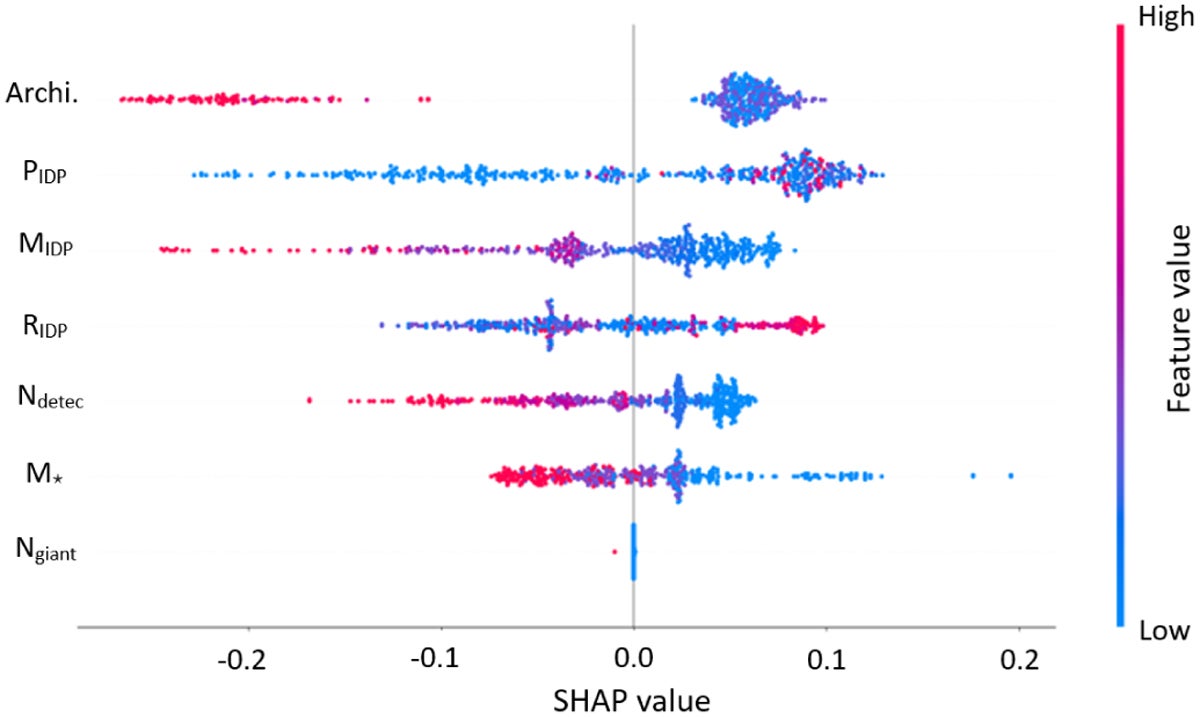
Earlier work had connected the presence of Earth-like planets with planetary architecture and the properties of the innermost detectable planet. Jeanne Davoult developed the machine-learning algorithm during her doctoral research at Bern, alongside coauthors Romain Eltschinger and Yann Alibert.
The strongest clues proved to be the system’s observable architecture and that inner planet’s mass and orbital period. “Detectable” matters here: an unseen planet could orbit even closer to the star. The algorithm works with the portion of a system that observations can reveal.
Training directly on observed systems posed a problem. Astronomers rarely know every planet around a star, and small planets on longer orbits are particularly difficult to find. Their faint signals leave an incomplete picture of each system.
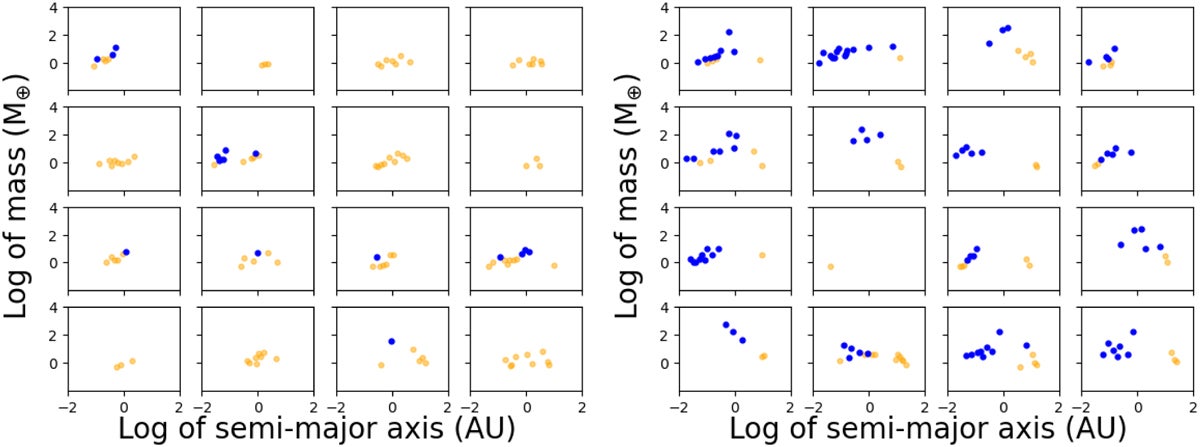
The team instead used the Bern Model of Planet Formation and Evolution to generate tens of thousands of synthetic systems. These simulated populations surrounded stars with masses equal to the Sun’s, half its mass and one-fifth its mass. Every simulated planet was known, including those an observer would miss.
The calculations began with planetary embryos embedded in disks of gas and smaller solid bodies. They followed growth, migration and gravitational interactions over 20 million years. Later calculations tracked cooling, contraction, atmospheric escape and tidal migration over 10 billion years.
Before training, the researchers hid planets whose gravitational effects on their stars fell below a selected detection threshold. This approximated the limits of radial-velocity observations, which measure stellar motion caused by orbiting planets. The remaining planets supplied the observable features used for prediction.
The classifier used a random forest, an ensemble of 500 decision trees. Each tree voted on whether a system contained an Earth-like planet. The researchers used 80% of the synthetic data for training and reserved 20% for testing.
They prioritized precision: among systems classified as containing an Earth-like planet, how many actually contained one? Requiring more trees to agree reduced false positives. However, stricter thresholds also missed more systems that genuinely contained qualifying planets.
At voting thresholds above 90%, precision reached 99% for the models trained on the two larger stellar-mass populations. The model for the lowest-mass stars reached 94%. Those figures describe tests on simulated systems, rather than a demonstrated success rate for discovering real planets.
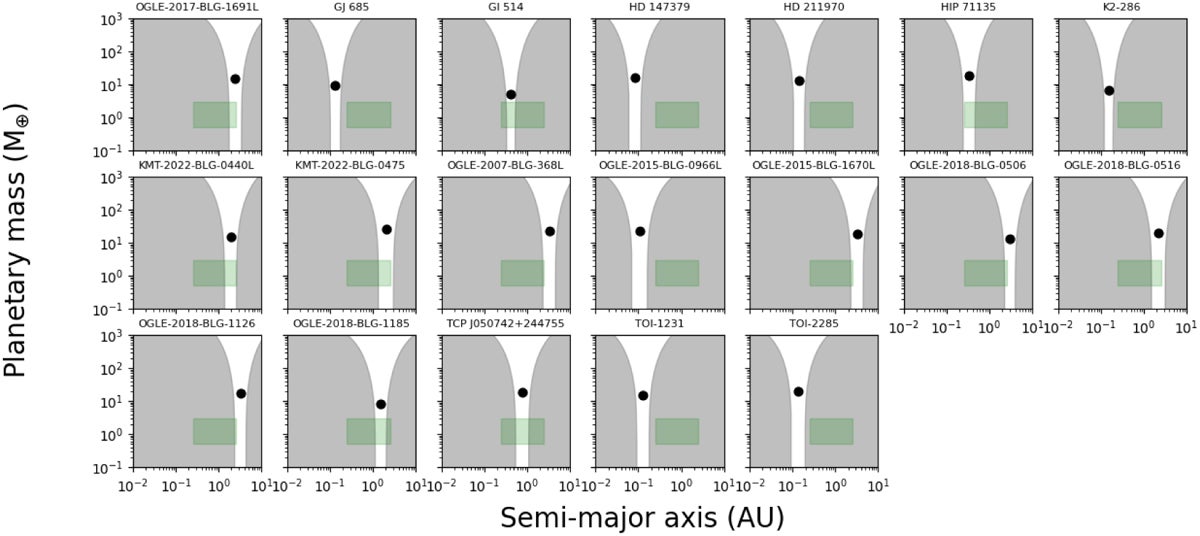
The study also used a broad definition of “Earth-like.” Qualifying terrestrial planets had between half and three times Earth’s mass, with calculated equilibrium temperatures between 160 and 510 kelvin. That temperate zone extends beyond the conventional habitable zone, and those temperatures do not establish actual surface conditions or the presence of life.
The researchers applied the trained models to 1,567 observed planetary systems around G-, K- and M-type stars. Each system had at least one known planet with a measured mass. The sample included Sun-like stars and smaller, cooler stars.
Initially, 51 systems received positive votes from more than 90% of the decision trees. Seven binary-star systems were excluded because the training simulations contained single stars. The remaining 44 formed the proposed target list.
That voting rate expresses agreement among the trees, rather than a measured probability that a real system contains a planet. The team then checked whether the known planets left orbital space for an additional qualifying world.
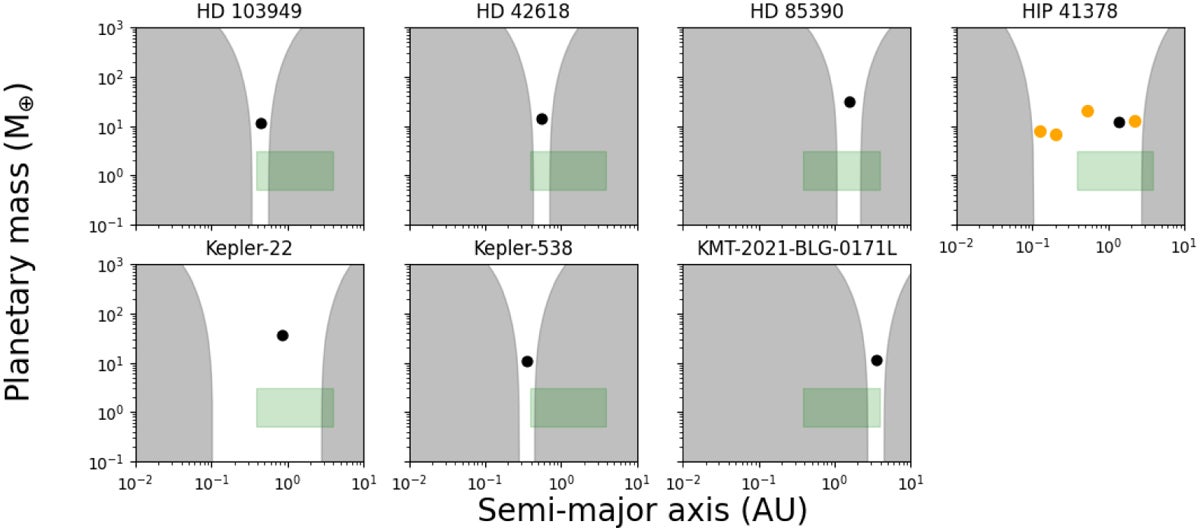
A preliminary stability assessment found suitable space in 42 of the 44 systems, or 95.5%. HIP 41378 and GJ 273 were the exceptions under that assessment. The calculation supports the possibility of additional planets; it does not demonstrate that they exist or guarantee their long-term stability.
The approach depends on how faithfully the Bern Model represents real systems. Its synthetic populations reproduce several broad patterns, but they also produce too many planets and place them closer to their stars than observations suggest. Some relationships between inner small planets and outer giants are weaker than those observed.
The detection filter introduces another limitation. It does not fully account for stellar activity, observing schedules or other factors that influence whether astronomers can find a planet. More realistic simulations and independent formation models could help test the predictions.
For planet searches associated with PLATO and the proposed LIFE mission concept, the target list offers a possible way to prioritize observations. Finding a small planet on a long orbit can require substantial observing time. Follow-up searches could reveal new worlds or show where the formation model needs improvement.
These resources explore planetary architecture, formation models and the missions designed to find small planets around other stars.
A transformer-based generative model for planetary systems: A later study uses a generative model to reproduce relationships among planets and explore partially observed systems. (Astronomy & Astrophysics, 2025)
Earth-like-planet-hosting systems: Architecture and properties: The precursor study examines how planetary arrangements and the innermost detectable planet relate to the presence of Earth-like worlds. (Astronomy & Astrophysics, 2024)
The PLATO mission: This mission overview explains the scientific objectives and observing approach for finding and characterizing exoplanets. (Experimental Astronomy, 2025)
Large Interferometer For Exoplanets (LIFE) – I. Improved exoplanet detection yield estimates for a large mid-infrared space-interferometer mission: This analysis estimates the planets that a proposed infrared interferometer could detect, including temperate terrestrial worlds. (Astronomy & Astrophysics, 2022)
The New Generation Planetary Population Synthesis (NGPPS) – I. Bern global model of planet formation and evolution, model tests, and emerging planetary systems: The foundational paper describes the physical processes and tests behind the simulations used to train the predictor. (Astronomy & Astrophysics, 2021)
Research findings are available online in the journal Astronomy & Astrophysics.
The original story “AI finds 44 star systems that could hide Earth-like planets” is published in The Brighter Side of News.
Like these kind of feel good stories? Get The Brighter Side of News’ newsletter.
The post AI finds 44 star systems that could hide Earth-like planets appeared first on The Brighter Side of News.


Leave a comment
You must be logged in to post a comment.