A new generation of robots is beginning to move through the world with a level of independence once limited to animals. Researchers at the Korea Advanced Institute of Science and Technology, known as KAIST, have developed a four-legged robot that can decide for itself how to move across complex terrain. The system allows the machine to walk, run, or jump as conditions change, without switching between separate control programs.
The advance, led by Professor Hae-Won Park of the Department of Mechanical Engineering, marks a shift in how robots interact with real environments. Instead of following fixed movement rules, the robot adapts in real time, choosing the most effective way to move.
“We expect this to become a foundational technology that expands the potential uses of physical-AI-based walking robots in rugged environments such as disaster sites, defense missions, and industrial facility inspections,” Park said.
Four-legged robots already hold advantages over wheeled machines. They can step over obstacles, climb uneven ground, and navigate spaces that would stop traditional vehicles. Yet real-world environments present a constant mix of challenges.
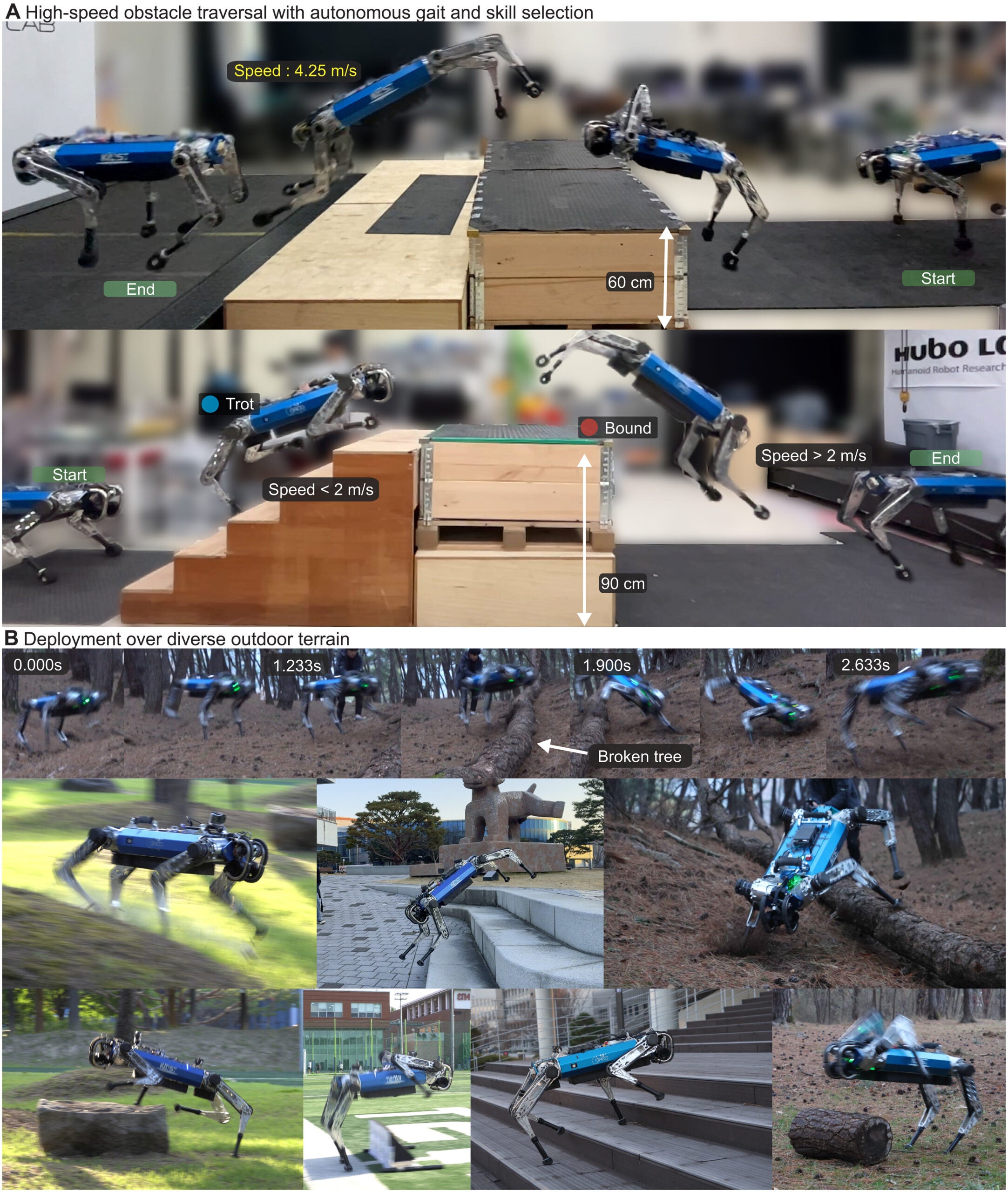
A robot may face stairs, loose soil, gaps, and fallen debris within seconds. Each obstacle requires a different type of movement. Traditional systems struggle because each motion, such as walking or jumping, is controlled separately.
This separation creates delays and instability. Robots often hesitate when switching between movements. In fast-changing environments, that hesitation can lead to failure.
The KAIST team focused on solving this problem. Their goal was to create a single system that handles multiple movements seamlessly.
The researchers developed a learning-based control system called Action Pretrained Transformer-based Reinforcement Learning, or APT-RL. The system allows the robot to learn multiple movement skills and combine them as needed.
Instead of treating walking, running, and jumping as separate tasks, the system blends them into a unified framework. The robot can shift between these motions naturally, similar to how animals move.
This approach removes the need for manual switching. The robot reacts to its surroundings and chooses its movement in real time.
Teaching robots to move has traditionally required large amounts of real-world data. Engineers often rely on motion capture systems that record animal or human movement. These methods are slow and expensive.
The KAIST team used a different approach. They generated training data entirely through computer simulations. In just eight minutes, they created 15.5 hours of movement data covering a wide range of gaits.
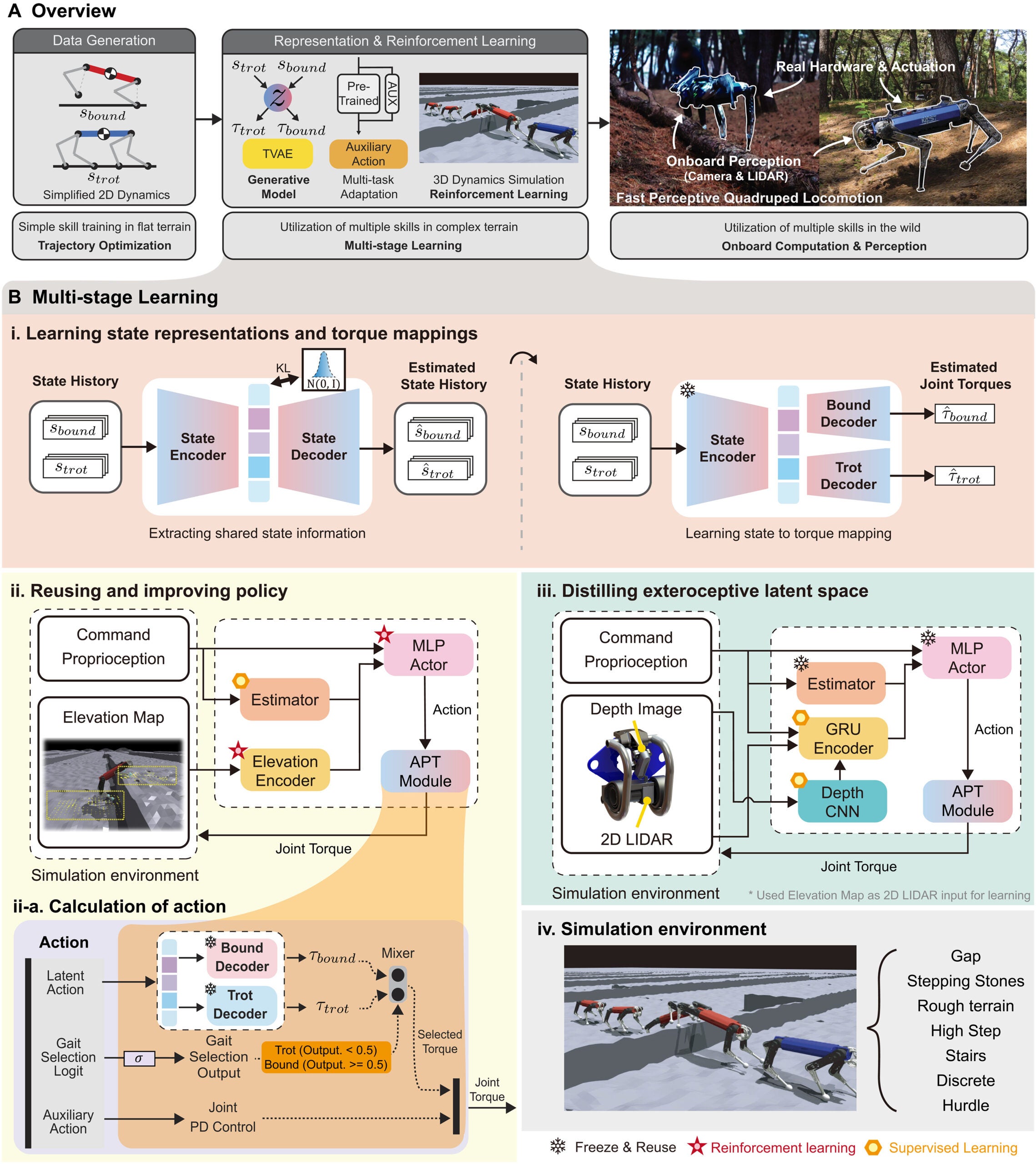
This simulated dataset included patterns for walking, running, and jumping. It also captured how the robot’s body responds to different forces and motions.
By using mathematical models of motion and efficient path planning, the system learned how to move without ever observing a real animal.
After building its base knowledge, the robot improved through reinforcement learning. This method allows it to learn by trial and error.
The robot explores different actions and receives feedback based on its success. Over time, it learns which movements work best in different situations.
This process gives the robot flexibility. It can handle conditions that were not part of its initial training.
To move effectively, the robot must understand its environment. The system combines two types of sensors to achieve this.
A depth camera provides detailed information about nearby objects. It measures distances and builds a three-dimensional view of the surroundings.
At the same time, LiDAR sensors scan the environment using laser pulses. They detect shapes and obstacles over longer distances.
Together, these sensors allow the robot to map its surroundings and adjust its movement in real time.
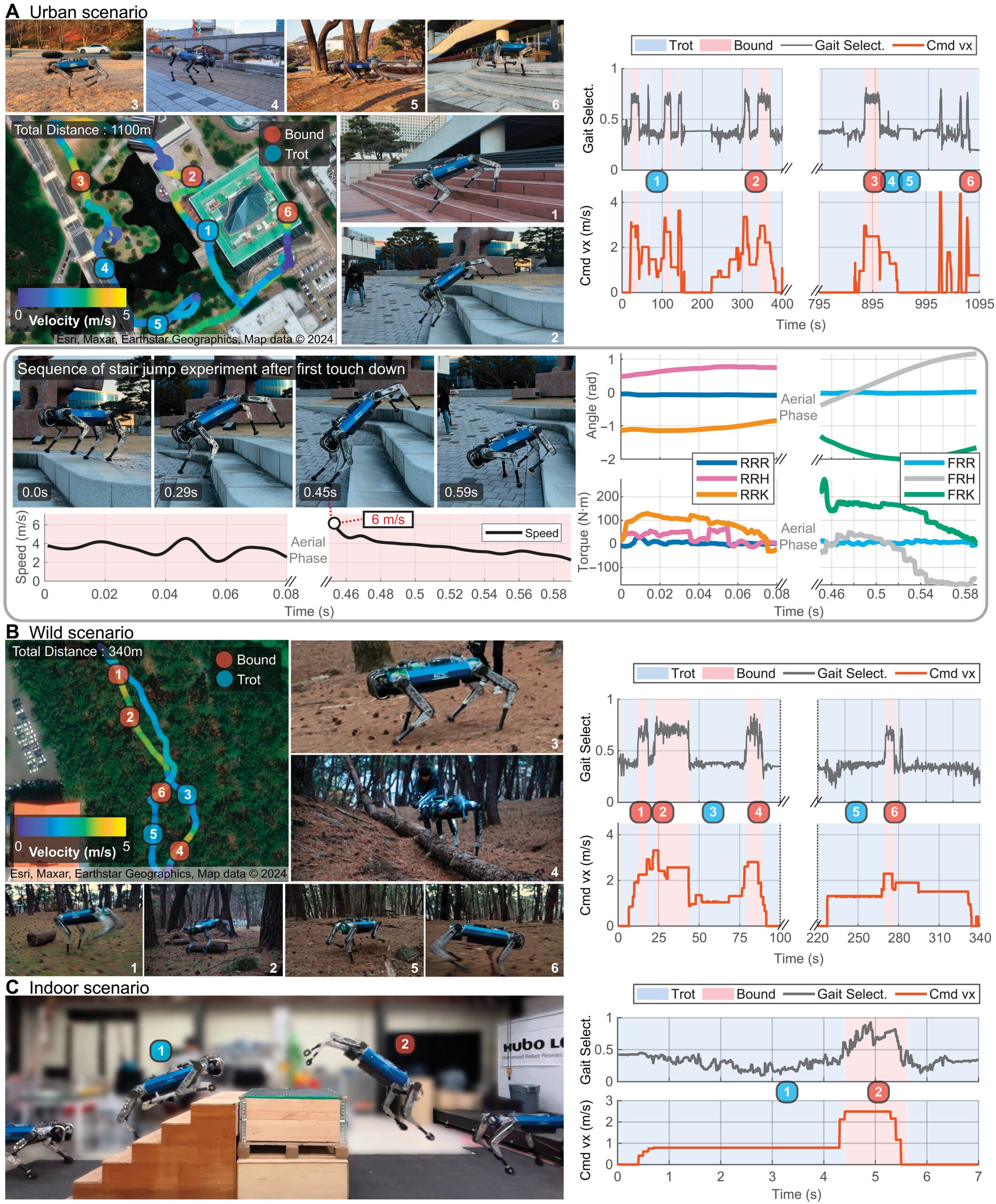
The research team tested their system on a robot named KAIST HOUND. They placed it in a range of environments, both indoors and outdoors.
On campus grounds, the robot moved across grass, stairs, and slopes. In forest trails, it navigated uneven terrain, fallen branches, and exposed roots.
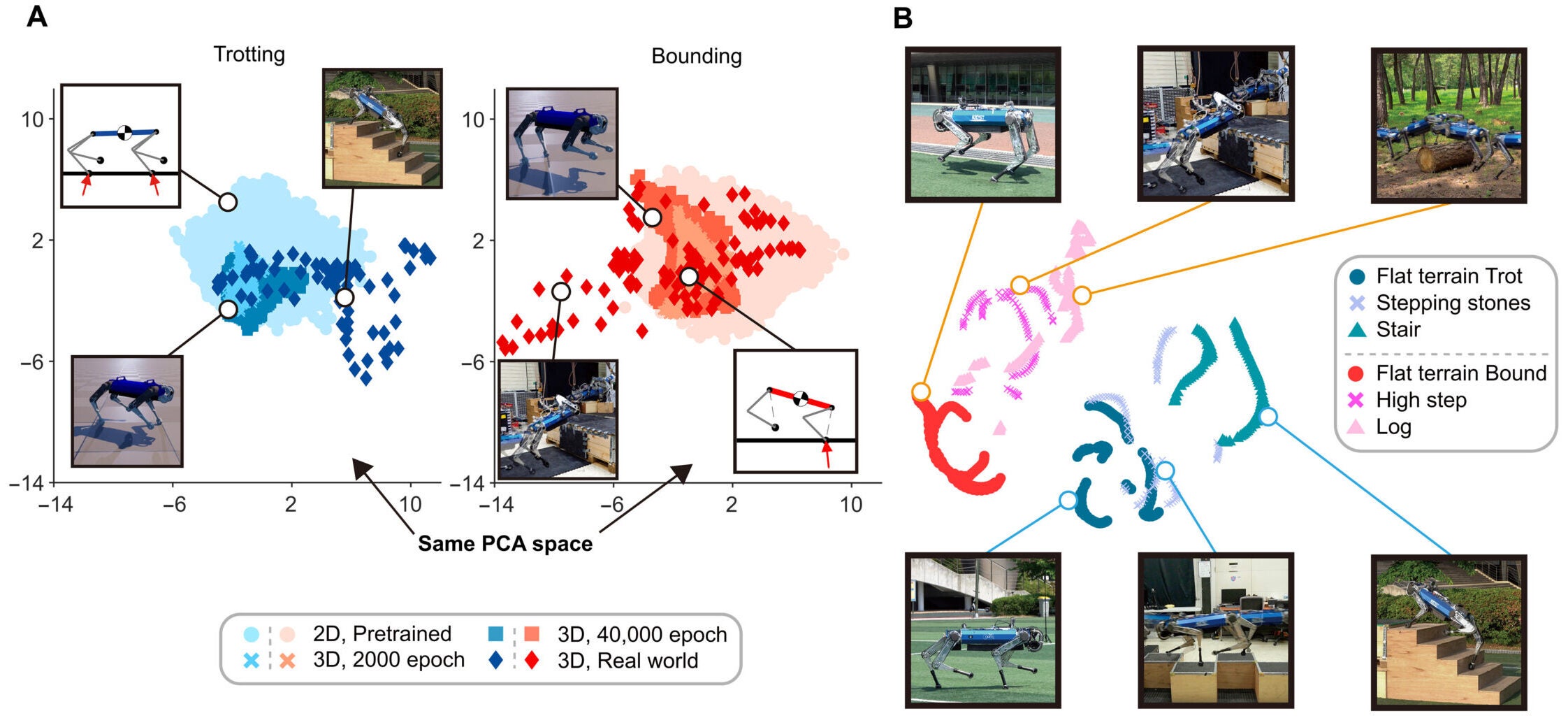
The robot adjusted its gait as needed. It switched between trotting and bounding depending on the terrain and speed.
Trotting uses alternating diagonal legs and provides stability. Bounding involves leaping forward with paired legs and allows faster movement.
The robot made these decisions on its own, without human input.
One of the most notable results is the robot’s speed. In challenging terrain, it reached a peak speed of six meters per second. This equals about 22 kilometers per hour.
Achieving this speed while maintaining balance is a major milestone. Most robots sacrifice stability when moving quickly. Others move slowly to remain steady.
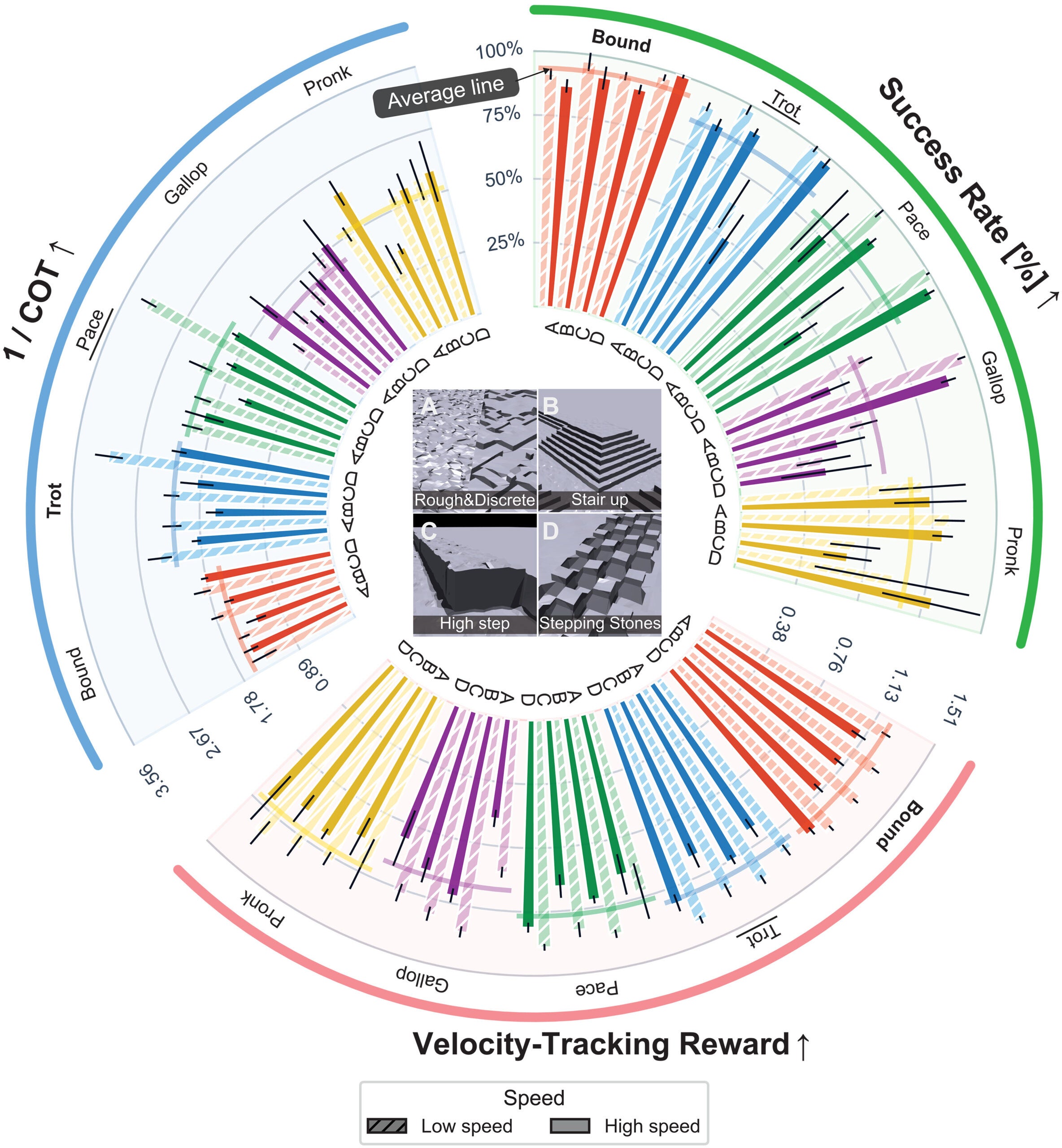
This system manages both. It moves quickly while maintaining control, even on irregular surfaces.
The robot also demonstrated the ability to handle multiple obstacles in sequence. It climbed stairs, crossed gaps, and stepped over barriers without stopping.
In one sequence, it moved from flat ground to a raised ledge, then onto uneven terrain. Each transition required a different movement style.
The robot adjusted its behavior smoothly, without pausing or recalculating from scratch.
This continuous adaptation sets it apart from earlier systems.
Animals move with fluidity because they do not rely on rigid instructions. They respond to their surroundings instinctively, adjusting their gait without conscious effort.
The KAIST system brings robots closer to that level of adaptability. By combining learned motion patterns with real-time decision-making, it creates movement that appears more natural.
The robot does not simply follow commands. It interprets its environment and responds accordingly.
The implications of this technology extend beyond research labs. Robots that can move reliably in complex environments could assist in many fields.
Search and rescue operations could benefit from machines that navigate debris and unstable ground. Industrial inspections could use robots to access hard-to-reach areas. Military and defense applications may also find value in such systems.
The ability to move independently in unpredictable terrain opens new possibilities for robotics.
This research advances the development of robots that can operate in real-world environments without constant human control. By enabling machines to choose their own movement strategies, it reduces the need for preprogrammed instructions and manual oversight.
The technology could improve safety in dangerous situations. Robots may take on tasks in disaster zones, reducing risks for human responders. They could also inspect infrastructure in hazardous areas, identifying problems before they escalate.
In industry, adaptable robots may increase efficiency by working in environments that are too complex for traditional machines. This could include construction sites, forests, or remote locations.
For research, the system provides a new framework for studying movement and control. It may inspire similar approaches in other types of robots, including humanoid systems.
Overall, the findings bring robotics closer to a future where machines move with the flexibility and awareness seen in living organisms.
Research findings are available online in the journal Science Robotics.
The original story “AI-Powered robot learns to walk, run, and jump on its own” is published in The Brighter Side of News.
Like these kind of feel good stories? Get The Brighter Side of News’ newsletter.
The post AI-Powered robot learns to walk, run, and jump on its own appeared first on The Brighter Side of News.


Leave a comment
You must be logged in to post a comment.