The first four-legged vertebrates did not grow up like tadpoles after all.
That idea has shaped the story of life on land for decades. Early tetrapods, the ancient animals that gave rise to mammals, birds, reptiles, and amphibians, were widely thought to begin life much like modern amphibians. They were believed to hatch into a larval stage and later transform into adult bodies through metamorphosis. But newly described fossils of baby tetrapods suggest that picture is wrong.
Writing in Science, researchers report that some of the earliest known hatchlings from the fish-to-tetrapod transition lacked the hallmark features of amphibian larvae, especially external gills. Instead of passing through a frog-like tadpole stage, these animals appear to have developed more directly.
“When a lot of us were in high school, we were taught this simplified story of evolution: that some fish evolved into amphibians, and some of those amphibians evolved into reptiles, and some of those reptiles evolved into mammals. And our study shows that this basic underlying premise, that the first four-legged vertebrates grew up like amphibians, is wrong,” says Jason Pardo, a research associate at the Field Museum and the study’s co-lead author.
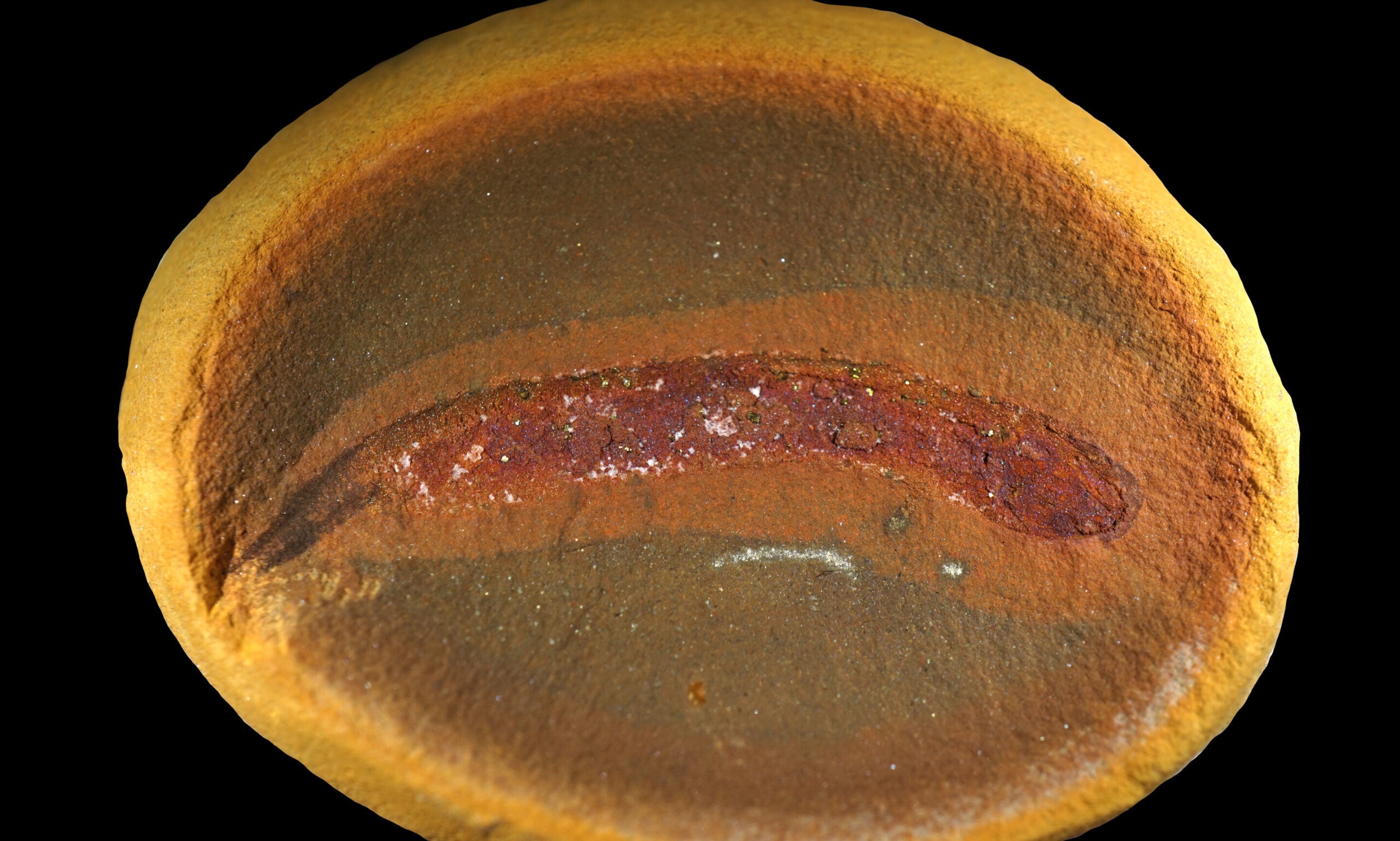
The fossils come from Mazon Creek in Illinois, a site southwest of Chicago that has long been famous for preserving delicate ancient life in unusual detail. In this case, that detail included baby animals only a few centimeters long. These animals were small enough to capture a stage of life that almost never survives in the fossil record.
“This is the first time we’ve had these early, early hatchling animals. This discovery is really a testament to the power of Mazon Creek, the site where these fossils came from,” says Arjan Mann, the Field Museum’s Assistant Curator of Early Tetrapods and the study’s other co-lead author. “It’s an hour’s drive southwest of Chicago, and it’s one of the best fossil sites in the world, especially for soft tissues and delicate little fossils like these baby tetrapods. Mazon Creek fossils are time capsules that capture the impossible.”
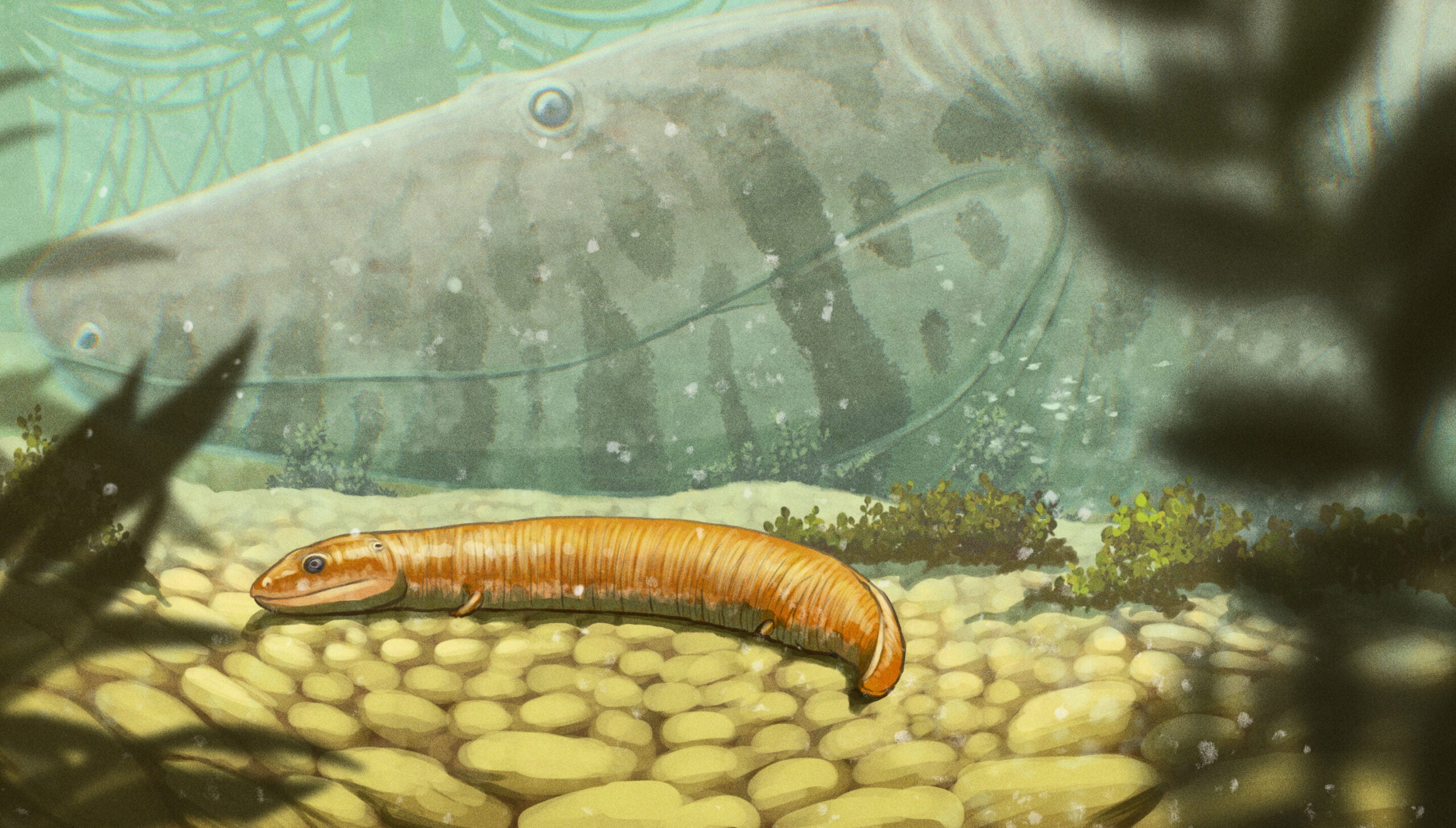
The centerpiece fossils are babies of an animal called an embolomere, a crocodile-like early tetrapod that lived in rivers, lakes, and swamps roughly 350 million to 280 million years ago. Adults could grow longer than 10 feet. These newly analyzed juveniles were just a few centimeters long.
One specimen had been sitting in the Field Museum’s collections for years before its identity became clear.
“I first saw the baby embolomere fossil about ten years ago, when I was working on my PhD,” says Mann. “It’s in the collections at the Field Museum, and the curator of tetrapods at the time, John Bolt, pulled it out of a drawer and showed it to me when I was visiting. At the time, it hadn’t yet been identified as an embolomere, but I was really drawn to it, and John loaned me the fossil to study.”
Mann and Pardo spent years trying to figure out exactly what they had. Eventually, scanning electron microscopy at the Canadian Museum of Nature helped confirm that the fossil belonged to an embolomere. Even then, the bigger surprise was still waiting in the anatomy.
“We had so many conversations over the past decade about what the heck this thing was,” says Mann. “Every night, we’d go back and forth saying, what’s this feature? What could this thing be?”
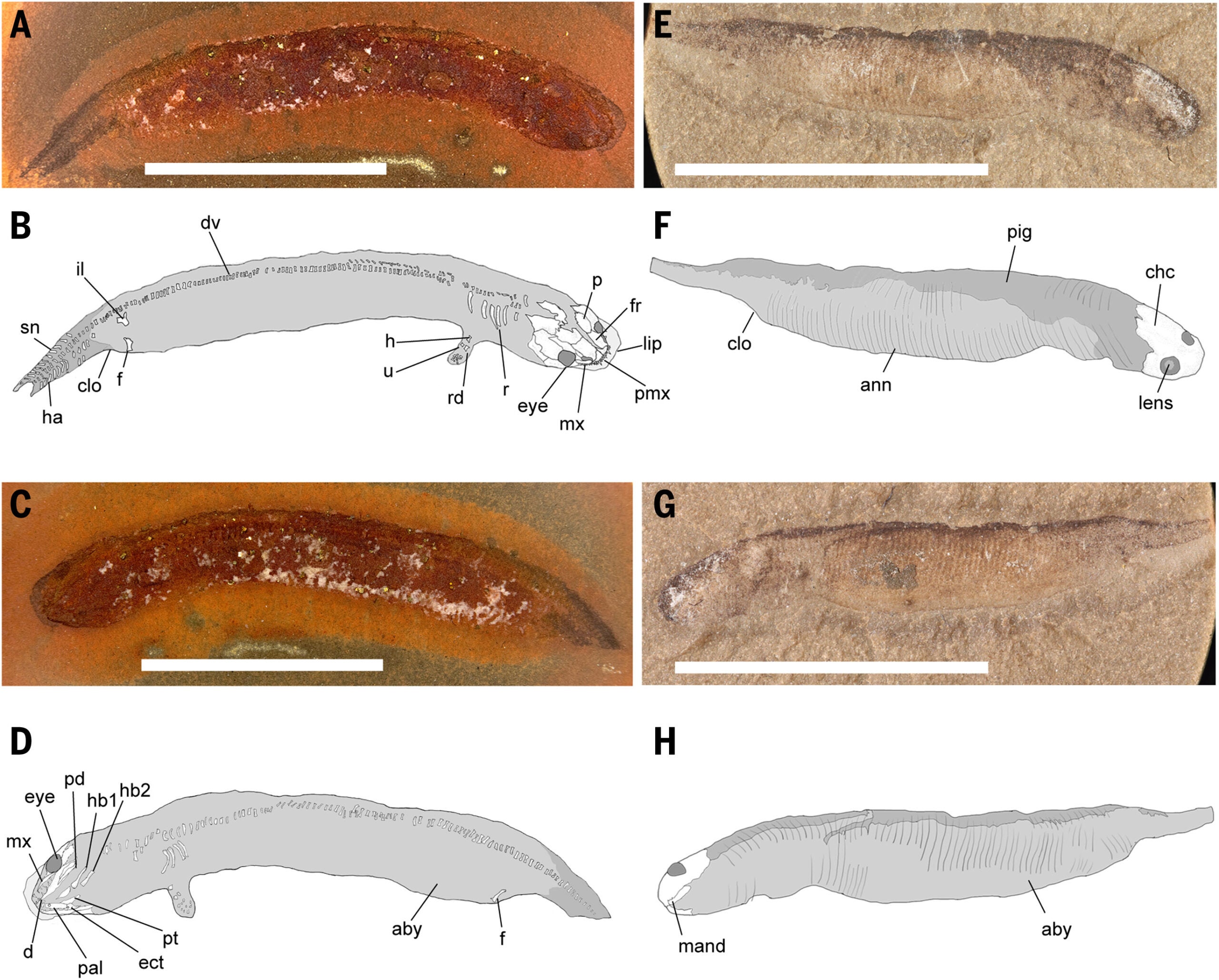
The answer mattered because the specimen preserved not just bones, but traces of soft tissue and a body outline. That meant the team could look for structures expected in a true amphibian-style larva.
They did not find them.
The young embolomeres had developing limbs, and one still appears to have carried yolk in its abdomen. This suggests it died very early in life. But neither of the baby embolomeres showed external gills, one of the clearest markers of a tadpole-like larval stage. The same pattern turned up in other early tetrapod relatives examined by the team. For example, a hatchling aïstopod and several finned tetrapodomorphs from Mazon Creek had this pattern, too.
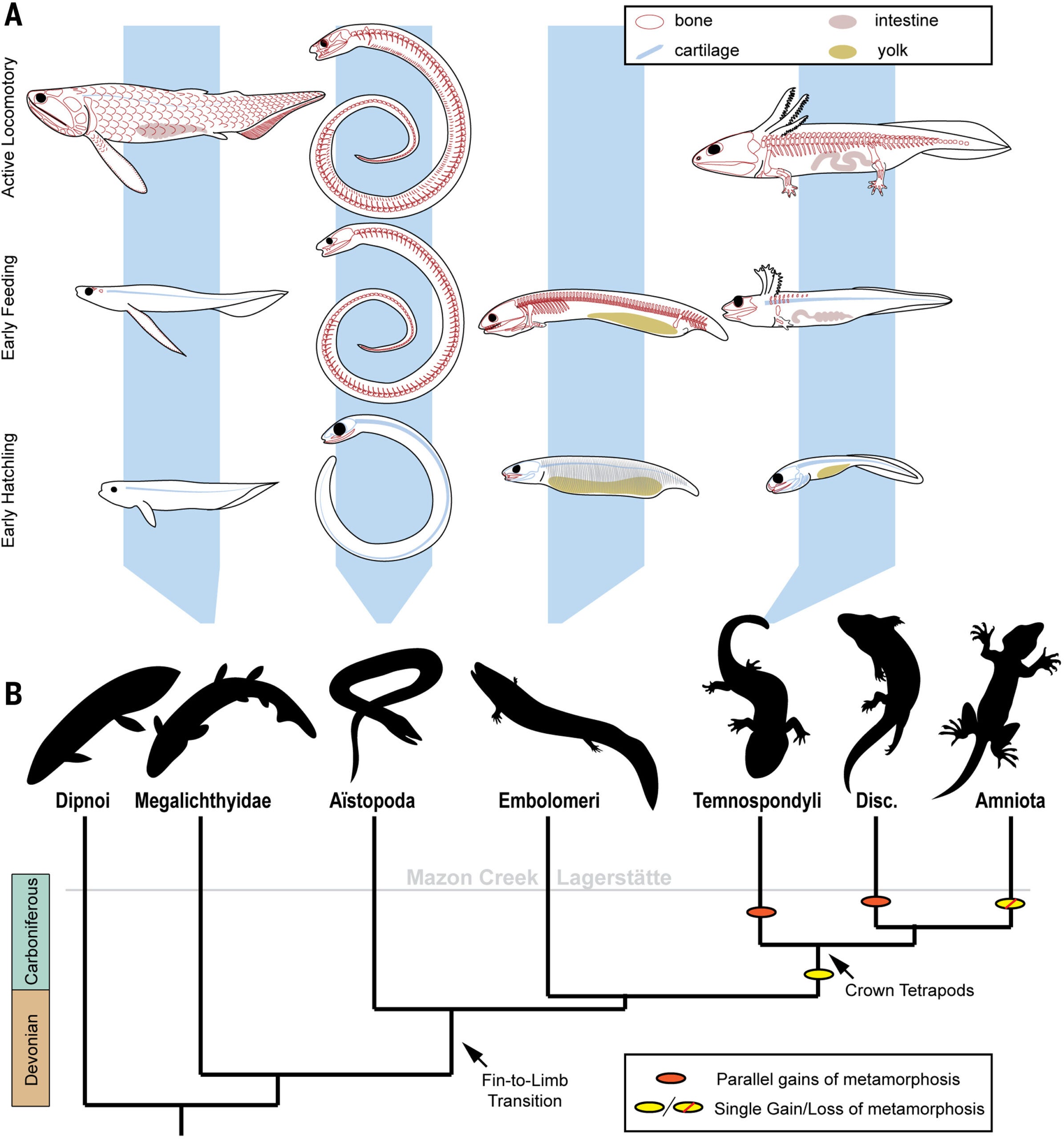
“We looked at a number of different species that represent different lineages in the transition from fish to tetrapods, and what we found is that none of them have anything that looks remotely like a tadpole. And if you don’t have a tadpole, then you don’t have a metamorphosis,” says Pardo. “These early tetrapods’ life cycles are more like ours, or like those of fish, than they are like amphibians.”
That is a direct challenge to a long-standing idea in vertebrate evolution. One influential hypothesis held that metamorphosis helped make the move onto land possible by allowing early animals to live first as aquatic larvae, then later remodel their bodies for adult life on land. The new fossils argue against that scenario. At least for the earliest tetrapods in the study, the evidence does not support it.
“The story was that metamorphosis is the tool by which animals made the transition from fossil to land. That story doesn’t work anymore, it’s dust in the wind,” says Pardo.
The broader fossil sample also pointed in the same direction. The authors found evidence that bones in the skull began ossifying relatively early, rather than after a long drawn-out larval period. They also found abdominal yolk in small megalichthyids and embolomeres. This hints that the ancestral tetrapod egg may have been relatively large.
Taken together, the fossils suggest that direct development, not amphibian-style metamorphosis, may have been the ancestral pattern near the origin of tetrapods. If that is right, then the first digited tetrapods probably stayed in similar watery environments through most or all of their life cycle. Even if they sometimes ventured onto land, they mostly remained in the water.
The study does not argue that early tetrapods were already fully terrestrial. In fact, it points the other way. Poorly developed limbs in free-living embolomere larvae fit with other evidence that complete life on land came later. This came after additional changes in limb growth, feeding mechanics, and other parts of the head and body.
The work also shifts when scientists think a true amphibian-style life history evolved. Fossil evidence for external gills is common in later temnospondyls, an amphibian branch, but rare outside that group. That suggests the familiar pattern of gilled larva followed by metamorphosis may have appeared well after tetrapods first evolved digits. In fact, it may have appeared 40 million to 60 million years later.
In other words, amphibian metamorphosis may have been a later adaptation within tetrapods, not the engine that launched them onto land in the first place.
Mann says the discovery also reflects years of shared work among museum scientists, collectors, volunteers, and citizen scientists.
“Every single specimen in this paper was a joint effort with the Earth Science Club of Northern Illinois, the Lauer Foundation for Paleontology, Science and Education, and the Field Museum. We could not have done this without the help of lots of scientists, including citizen scientists and volunteers,” says Mann. “People like Paul Demkovich, Ben Riegler, Rich Rock, and Tom Testa allowed us to study specimens that they found, and these specimens have changed the course of our understanding of how tetrapods evolved. This is a monumental discovery, and it could not have happened without citizen science.”
This study changes one of the most familiar frameworks in vertebrate evolution. Instead of treating modern amphibians as a simple model for the earliest four-legged animals, scientists may need to look more closely at a wider mix of living fishes, salamanders, caecilians, reptiles, and fossil groups when reconstructing how development changed during the move from water to land.
It also sharpens the search for the real steps that made full terrestrial life possible. If metamorphosis was not the key early solution, then later changes in limb timing, skull development, feeding, and reproduction become even more important parts of the story.
Just as importantly, the work shows how rare fossils of hatchlings can overturn assumptions built mostly from adult skeletons.
Research findings are available online in the journal Science.
The original story “Ancient crocodile-like predators rewrite current knowledge of how animals adapted to the land” is published in The Brighter Side of News.
Like these kind of feel good stories? Get The Brighter Side of News’ newsletter.
The post Ancient crocodile-like predators rewrite current knowledge of how animals adapted to the land appeared first on The Brighter Side of News.

