Earth’s atmosphere did not become oxygen-rich in one clean transition. More than 2 billion years ago, oxygen repeatedly rose and fell as climate, ocean chemistry, microbes and nutrients pushed the planet through major environmental swings. A new study suggests phosphorus played a central role in determining whether those oxygen increases lasted.
Researchers from UC Riverside, studying ancient South African rocks, found evidence that changing ocean conditions repeatedly recycled phosphorus into seawater. That nutrient could then support more photosynthetic life, leading to greater production of organic matter. When some of that carbon became buried in sediments instead of decomposing, oxygen remained behind in the atmosphere.
The study, published in Nature Communications, combines measurements of different phosphorus pools with sulfur isotopes, redox-sensitive elements and biogeochemical modeling. Together, the evidence reveals a feedback among phosphorus, sulfur, climate and oxygen during one of the most important transitions in Earth’s history.
The Great Oxidation Event began roughly 2.43 billion years ago, when oxygen started accumulating more substantially in the atmosphere. Photosynthetic microbes had already been producing oxygen before then, but much of it reacted with iron, volcanic gases and other reduced materials before it could build up.
Geochemical evidence now suggests that atmospheric oxygenation stretched across hundreds of millions of years. Oxygen levels rose during some intervals, then fell again, with more persistent oxygenation developing later. These changes coincided with major climate disturbances, including widespread glaciations that may have covered large portions of the planet.
Scientists have long debated what allowed biological oxygen production to become strong enough to change the atmosphere. Phosphorus is one possible answer because it is an essential nutrient and can limit biological productivity over geological timescales.
“Living things cannot grow or function properly without phosphorus,” UC Riverside geologist Andrey Bekker said. “Once more of it became available in the oceans, it allowed more organic carbon to be buried. A side effect of that process is that more oxygen continued to be released into the atmosphere.”
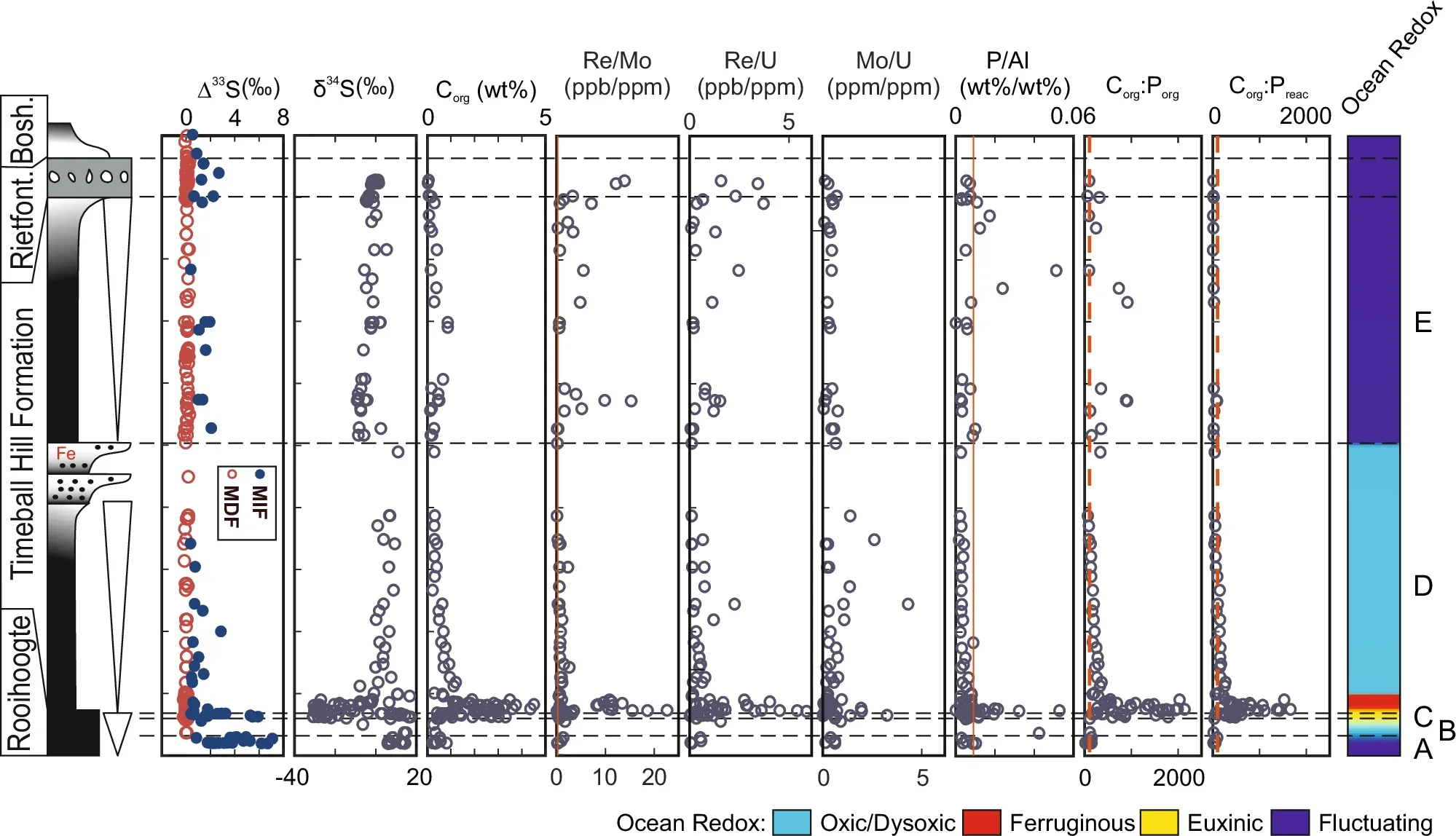
The researchers examined rocks about 2.32 billion to 2.25 billion years old from the Rooihoogte and Timeball Hill formations in South Africa’s Transvaal Supergroup. These sediments formed in a shallow marine environment connected to the wider ocean and preserve major changes that followed widespread Paleoproterozoic glaciation.
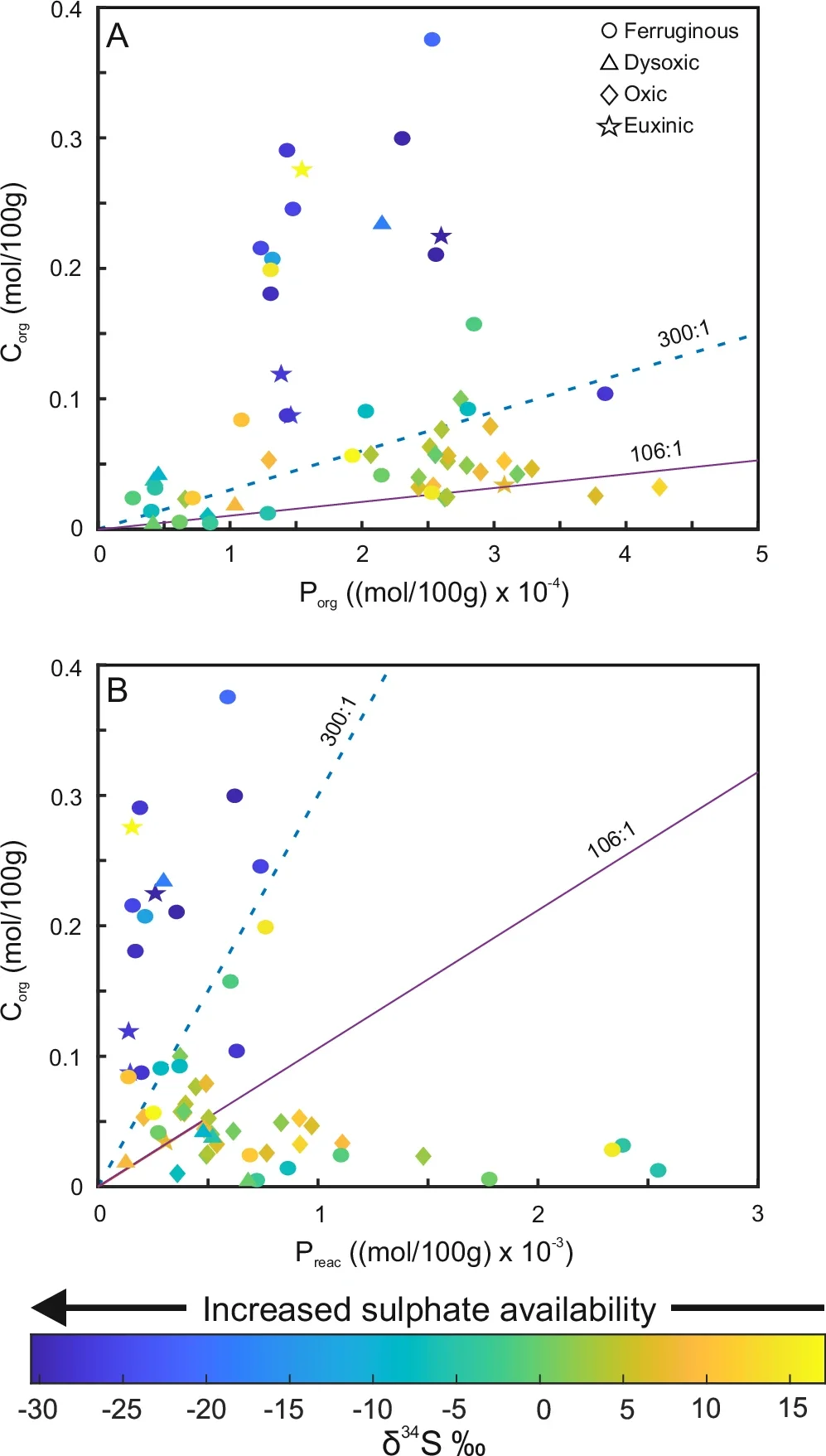
Instead of measuring only total phosphorus, the team separated phosphorus associated with different mineral phases. That distinction allowed the researchers to estimate how much phosphorus remained potentially available to organisms and how much became locked into sediments.
“We can now separate the phosphorus that was available to organisms from phosphorus that was essentially locked away,” Bekker said. “That gives us a much clearer picture of nutrient levels in ancient oceans than we had before.”
The team also analyzed sulfur isotopes and elements including rhenium, uranium and molybdenum. These chemical indicators respond differently under oxygen-rich, oxygen-poor and sulfide-rich conditions, giving researchers a way to reconstruct ancient seawater chemistry.
The researchers propose that deglaciation triggered a major influx of phosphorus and sulfate from weathered continental rocks into the ocean. More phosphorus would have supported increased biological productivity, while greater burial of organic carbon would have allowed atmospheric oxygen to rise.
That oxygen then accelerated oxidative weathering on land, delivering still more sulfate to the ocean. Sulfate-reducing microbes could use that sulfate while breaking down organic material, generating sulfide within sediments and water.
Those reactions affected iron minerals that normally bind phosphorus. As sulfide altered or dissolved the iron-bearing phases, phosphorus could escape back into seawater rather than remain buried. The recycled phosphorus then became available for another round of biological growth.
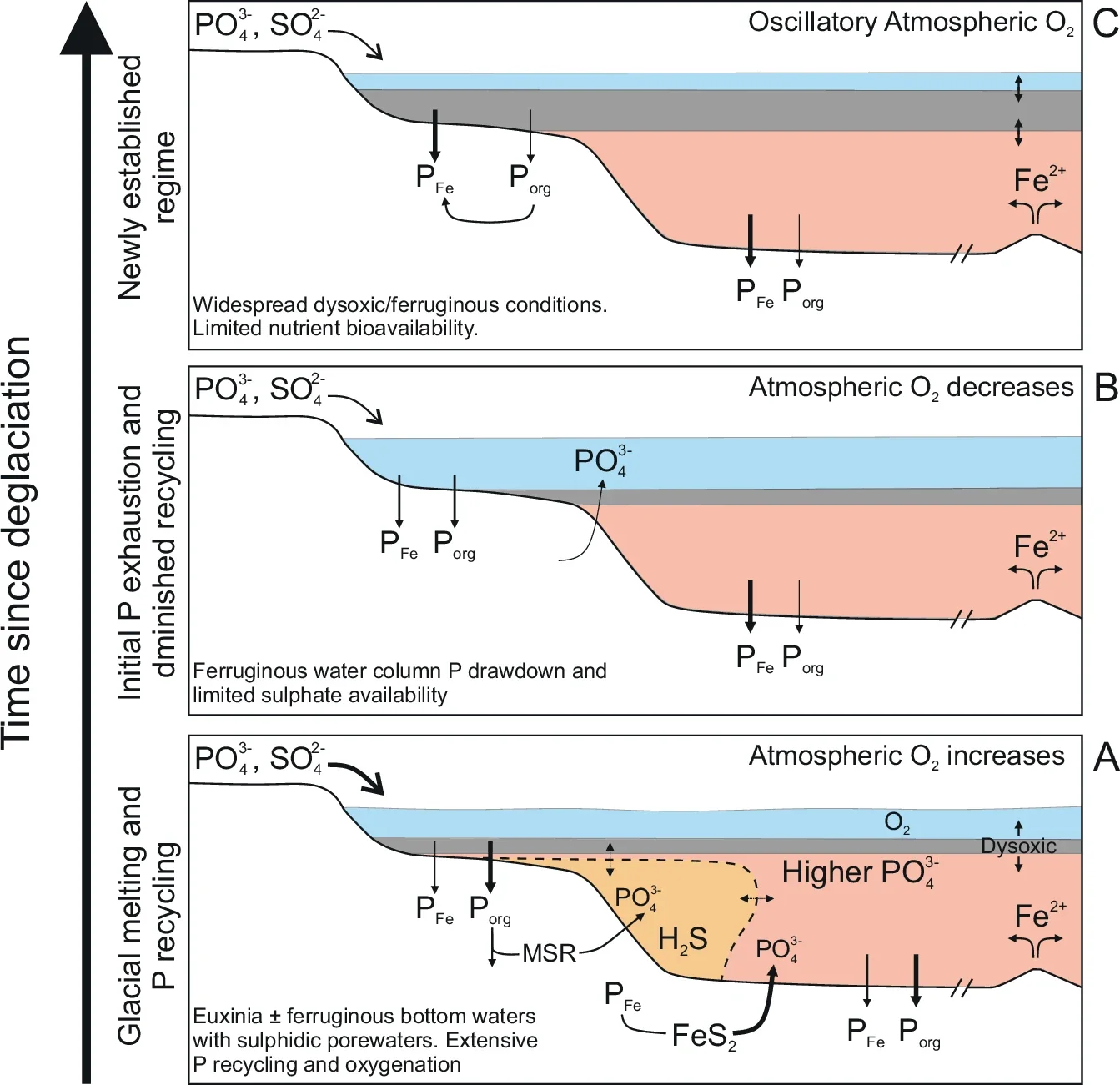
The result was a positive feedback. More phosphorus supported more organic matter production, more carbon burial allowed additional oxygen to accumulate, and rising oxygen altered continental weathering in ways that changed ocean chemistry again.
The same mechanism could not continue indefinitely. Sulfate-reducing microbes consumed sulfate, while the intense post-glacial supply of phosphorus gradually declined as weathering returned toward a new baseline.
Ocean conditions also shifted away from sulfide-rich waters and back toward iron-rich environments. Under those conditions, iron minerals once again became effective at trapping phosphorus in sediments.
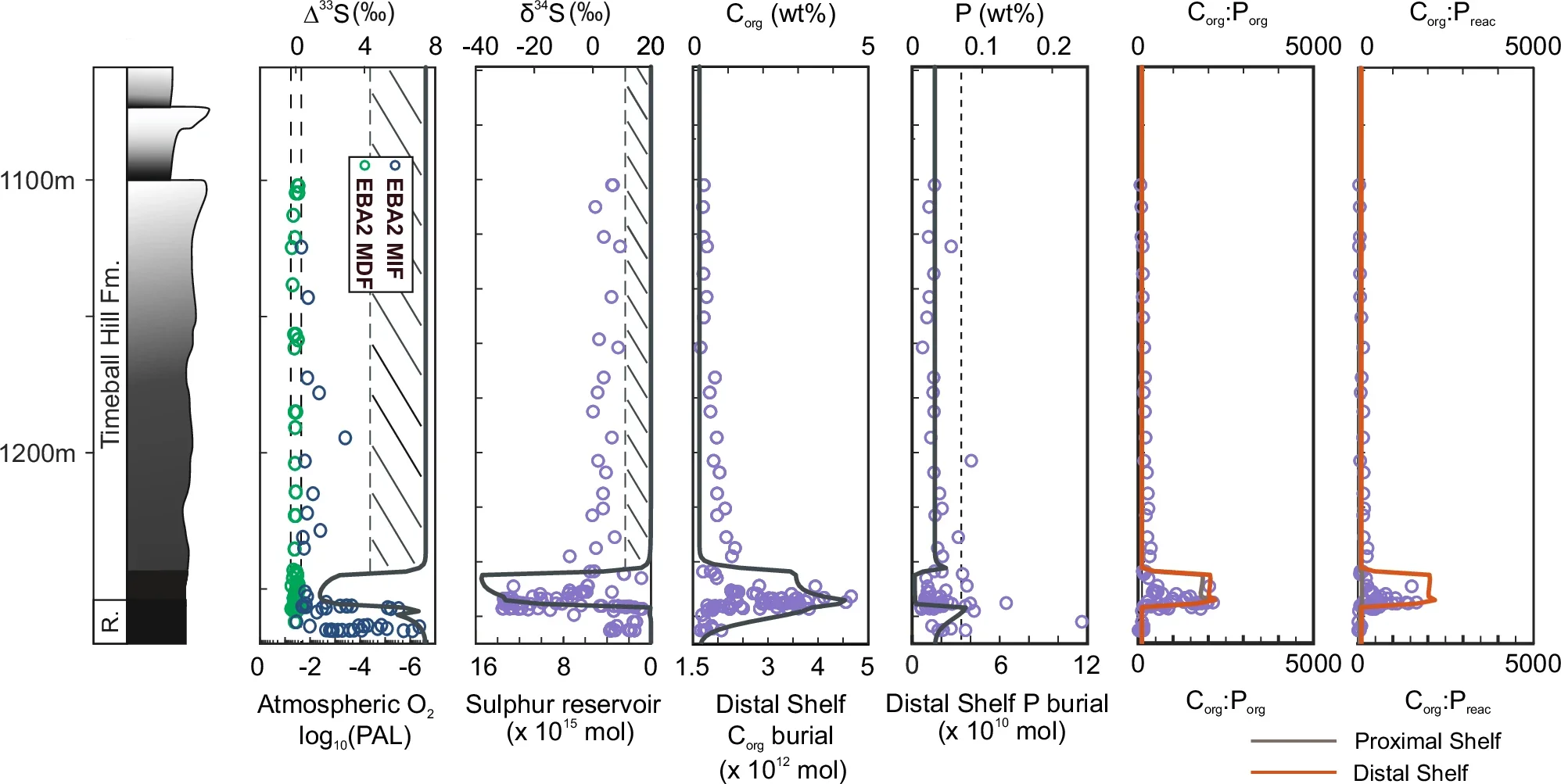
That reduced the amount of the nutrient returning to seawater. Biological productivity weakened, placing limits on organic carbon burial and oxygen production. The researchers’ biogeochemical model reproduced much of this broad behavior when phosphorus, sulfur, carbon and oxygen cycling were linked together.
The resulting picture is more complex than an irreversible jump from an oxygen-poor world to an oxygen-rich one. Instead, the Great Oxidation Event appears to have involved repeated feedbacks that could strengthen oxygen production during one interval and weaken it during another.
The findings also affect ideas about why complex life emerged so slowly after oxygen first became established in the atmosphere. If oxygen remained available for meaningful stretches of time, then low oxygen alone may not explain the long delay before larger and more complex organisms appeared.
Nutrient availability, environmental instability and biological innovation may also have constrained evolution. The study does not suggest that atmospheric oxygen approached modern concentrations, and much of the deep ocean remained oxygen-poor during this era.
Still, even relatively small increases in oxygen could reshape continental weathering, marine chemistry and microbial ecosystems. Those interactions may have determined whether oxygen remained temporarily elevated or declined again.
The work also has implications beyond early Earth. Scientists searching for habitable planets increasingly recognize that oxygen alone does not tell the whole story. A planet may also require nutrient cycles capable of sustaining biological productivity over long periods.
Earth’s history suggests habitability emerged from a complicated partnership among rocks, climate, oceans and life. Oxygen changed nutrient cycling, while nutrient cycling helped determine how much oxygen the biosphere could sustain.
These studies provide recent and directly relevant context on the nutrient, ocean and biological processes that transformed Earth into an oxygenated planet.
The rise of free oxygen may have initiated on marine mud: This perspective combines biological and geochemical evidence suggesting oxygenated seafloors may have existed roughly 200 million years before the Great Oxidation Event. (Nature Geoscience, 2025)
Archaean oxygen oases driven by pulses of enhanced phosphorus recycling in the ocean: Phosphorus measurements from 2.93-billion-year-old rocks show that nutrient recycling may have fueled localized oxygen accumulation hundreds of millions of years before the GOE. (Nature Geoscience, 2025)
Onset of coupled atmosphere–ocean oxygenation 2.3 billion years ago: Thallium isotopes and redox-sensitive elements show that widespread ocean oxygenation tracked atmospheric oxygen fluctuations during the Great Oxidation Event. (Nature, 2024)
Phosphorus availability on the early Earth and the impacts of life: This review examines the sources, sinks and biological processing of phosphorus that controlled nutrient availability on early Earth. (Nature Geoscience, 2023)
Earth’s Great Oxidation Event facilitated by the rise of sedimentary phosphorus recycling: This earlier work showed how sulfur-driven phosphorus recycling could have pushed oxygen production past a critical threshold before persistent atmospheric oxygenation. (Nature Geoscience, 2022)
Research findings are available online in the journal Nature Communications.
The original story “Ancient ocean chemistry may explain how Earth kept its oxygen” is published in The Brighter Side of News.
Like these kind of feel good stories? Get The Brighter Side of News’ newsletter.
The post Ancient ocean chemistry may explain how Earth kept its oxygen appeared first on The Brighter Side of News.


Leave a comment
You must be logged in to post a comment.