Two fragments excavated in northern China nearly half a century ago have helped put recognizable anatomy around an elusive human relative. Ancient proteins identify the pieces as Denisovan. That connection allows researchers to examine a much larger collection of skull, jaw and tooth remains for clues to how these extinct people looked.
The study, published in Nature, combines protein analysis with anatomical comparisons. A team including Qiaomei Fu and colleagues at the Chinese Academy of Sciences examined fossils from Xujiayao in the Nihewan Basin. Their results connect previously disputed remains to a lineage first recognized through ancient DNA from Siberia.
This is not the first substantial skull linked to Denisovans. Earlier molecular studies identified the Harbin cranium, adding important anatomical evidence to a once extremely fragmentary record. Xujiayao now broadens that picture and supports the idea that Denisovans included people with considerable physical variation across East Asia.
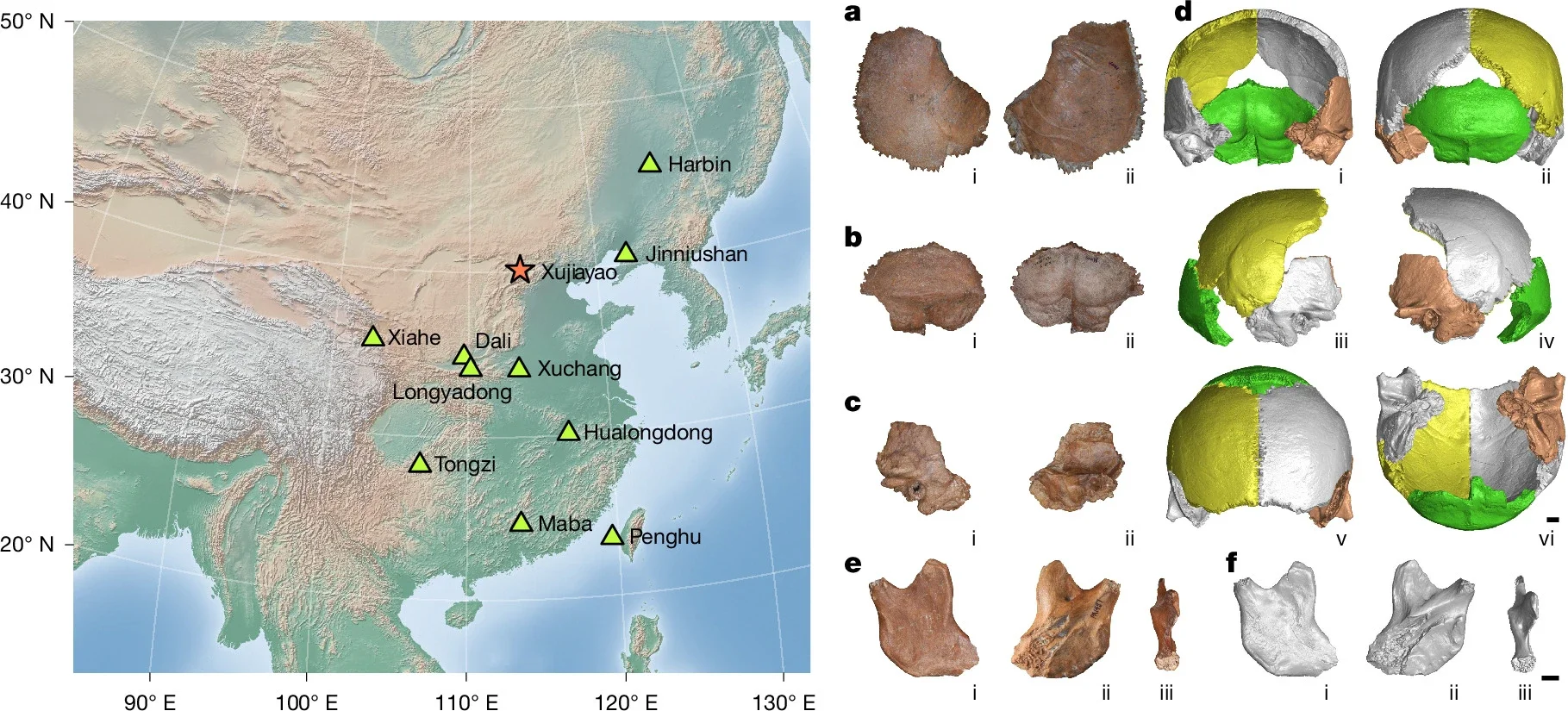
Excavations between 1976 and 1979 recovered 20 human cranial, jaw and dental fossils at Xujiayao. The assemblage also contained stone artifacts and animal remains. Its archaeological context made it valuable, but the fossils’ position on the human family tree remained contested.
Researchers had classified the remains in several ways, including as archaic modern humans or relatives of Neanderthals. More recently, Xujiayao helped underpin the proposed species name Homo juluensis. Such disagreements reflected a wider difficulty: similar-looking features can occur in different branches of human evolution.
The assemblage dates to approximately 199,000 to 138,000 years ago, based on combined uranium-series and electron-spin-resonance dating. These methods help establish the fossils’ age through radioactive and radiation-related changes. The new protein work addressed a different question: which human lineage the sampled bones belonged to.
For that analysis, the team selected a right parietal fragment, part of the skull vault, and a fragment of a lower jaw. These came from specimens designated Xujiayao 6 and Xujiayao 14. The two samples provide the direct molecular evidence supporting the study’s Denisovan identification.
Proteins consist of chains of amino acids, whose sequences can retain clues to evolutionary relationships. Studying those preserved molecules is called palaeoproteomics. Small differences between sequences can help distinguish ancient populations even when fossil shapes alone leave room for disagreement.
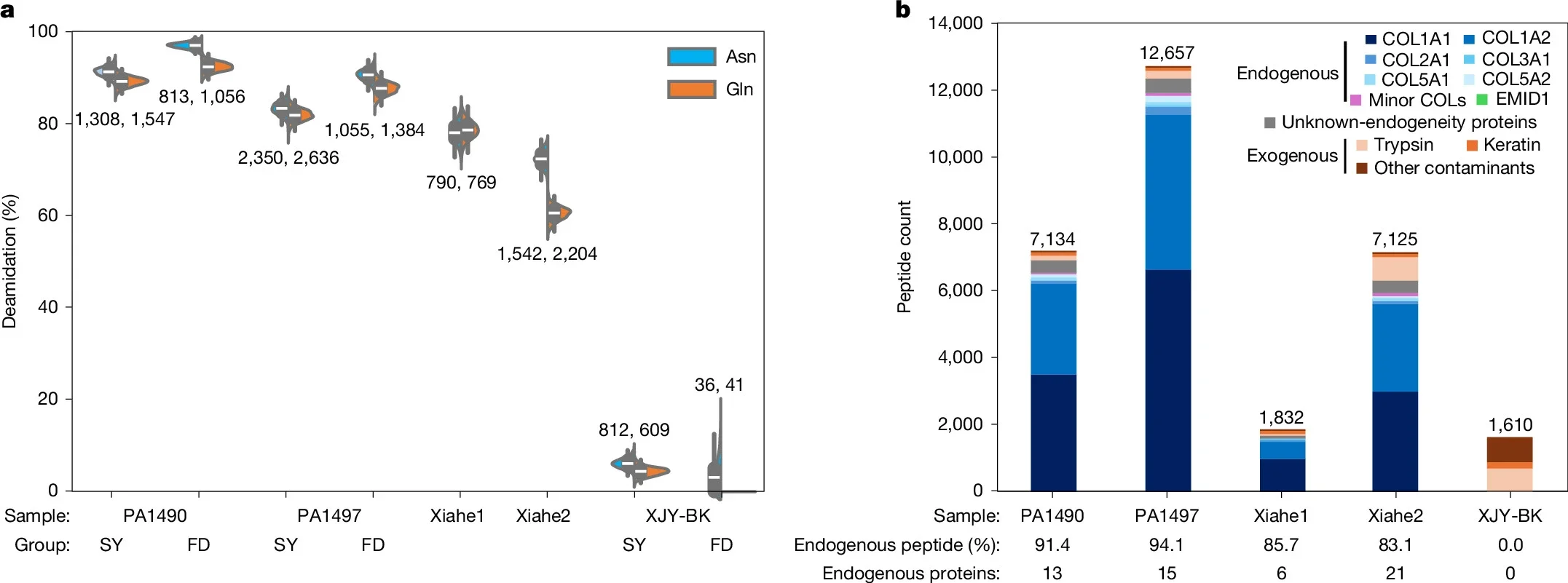
The researchers extracted proteins and analyzed their fragments using mass spectrometry. They checked the results with two software systems and compared them against sequences from ancient hominins and present-day humans. After filtering, the team retained 18 ancient proteins across the two samples for further analysis.
Authentication mattered because excavated bones can also contain modern contaminants. The researchers examined chemical alterations associated with ancient proteins and used laboratory blanks to identify unwanted background material. They excluded ambiguous fragments and results that could not be confirmed between the analytical systems.
The crucial signal was a variant in a collagen protein, labeled COL1A2-996K. At that position, the sampled fossils carried the amino acid lysine, as do Denisovans with relevant molecular data. The compared Neanderthal and modern human sequences instead carried arginine, giving the researchers a particularly useful distinguishing marker.
Researchers also reconstructed evolutionary relationships using 2,074 amino acid positions from eight proteins. The Xujiayao samples consistently grouped with Denisovans. However, the protein data could not reliably establish finer relationships among the different Denisovan individuals. Assigning a fragment to the broad lineage therefore does not show how closely its owner was related to a particular person from Siberia, Tibet or another Chinese site.
“Molecular phylogeny and shared morphological traits classify Xujiayao, initially assigned to different lineages, as Denisovan,” the authors wrote. Molecular phylogeny means reconstructing evolutionary relationships from biological sequences. Here, that identification provides an anchor for interpreting anatomical features in the broader fossil assemblage.
Researchers measured the remains and compared three-dimensional reconstructions with other ancient human fossils. Some missing portions were reconstructed by mirroring preserved parts. These models help examine proportions and relationships between bones, while retaining uncertainty where original anatomy is absent.
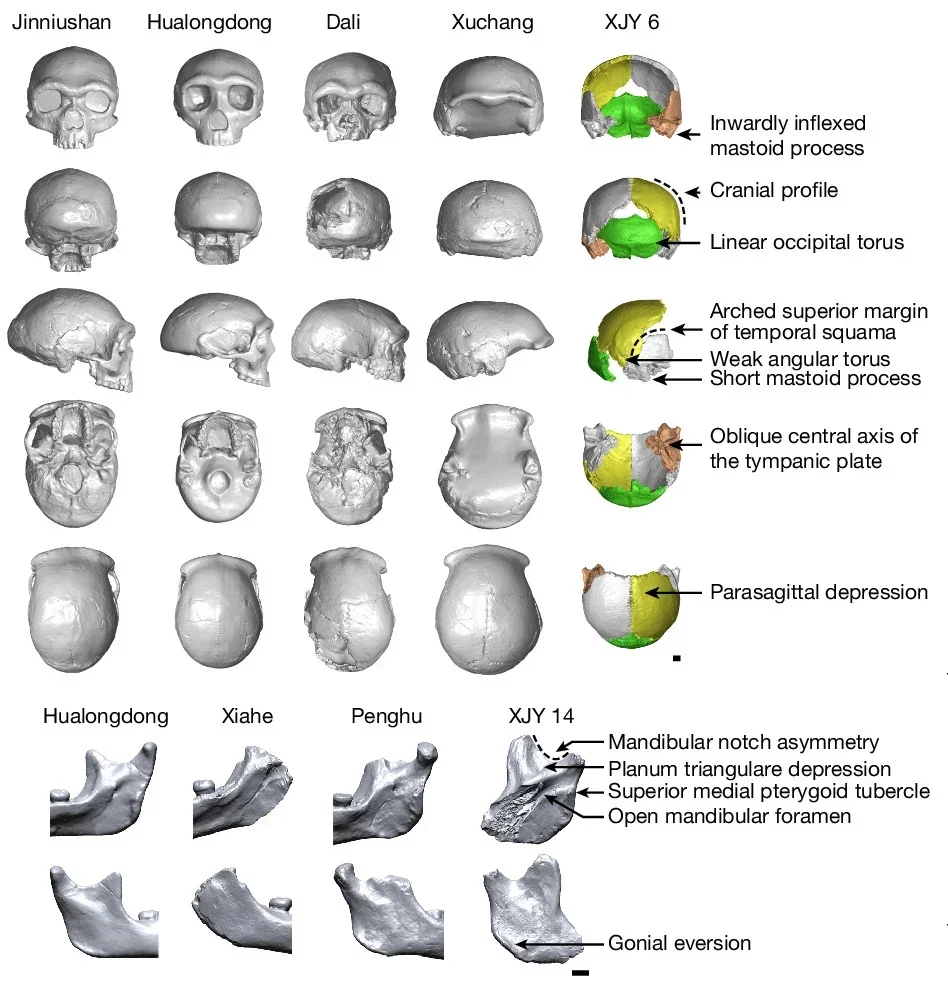
The resulting picture includes low, broad skulls with thick cranial bones and substantial brow ridges. Combined comparisons with Harbin and other specimens also suggest relatively flat facial regions and limited forward projection of the face. Those facial conclusions draw on several fossils, rather than a complete face preserved in the two protein-tested fragments.
The anatomy combines features retained from earlier humans with characteristics shared by later groups. Some resemble Homo erectus, while others overlap with Neanderthals or modern humans. The authors emphasize the combination of traits rather than one feature that identifies every Denisovan.
Comparisons with Neanderthals help explain why the classification was difficult. Some Xujiayao features resemble those of this closely related group, including aspects of the jaw and inner ear. Yet the broader East Asian sample generally lacks other characteristic Neanderthal features, such as the pronounced bulge at the back of many Neanderthal skulls. Shared ancestry can produce overlapping anatomy without making the two groups identical, so the researchers assessed several skeletal regions together.
Differences also exist between molecularly identified fossils. Xujiayao and Harbin vary in aspects of the skull’s rear and the bone projections behind the ears. Not every proposed Denisovan specimen preserves every trait, and different individuals show different combinations.
An earlier reconstruction estimated the internal volume of Xujiayao 6’s skull at roughly 1,700 milliliters. The authors argue that variation in cranial capacity need not require separate lineages, because substantial variation also occurs within other human groups. Skull volume alone does not establish intelligence or settle species boundaries.
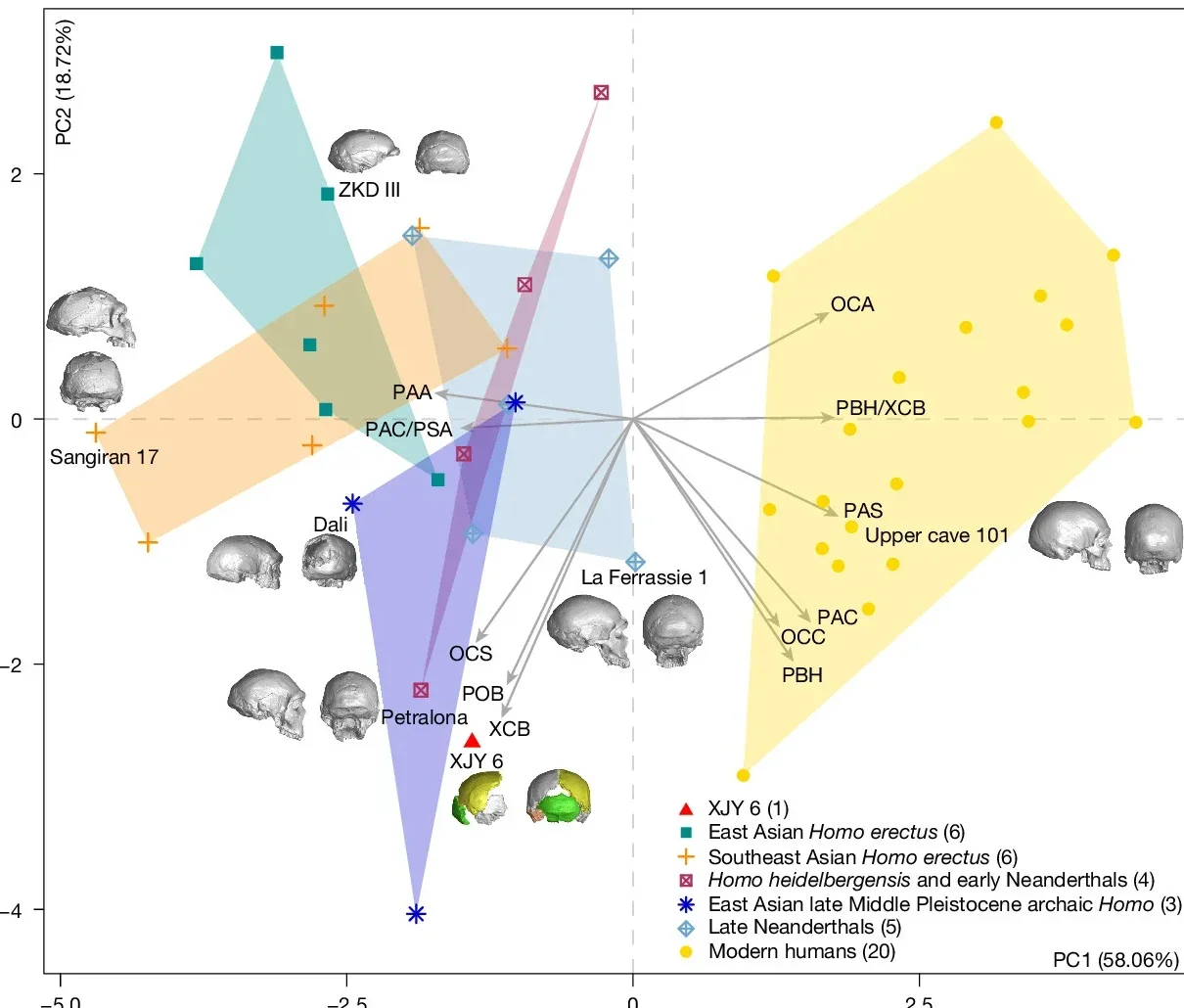
That reasoning challenges classifications that separated several East Asian fossil groups. The team proposes that remains from Jinniushan, Dali and Hualongdong also belong within the Denisovan lineage. Their inclusion rests on anatomical comparisons, so it has a different evidential basis from the protein-tested Xujiayao specimens. Further molecular identifications would provide a more direct test of those proposed relationships.
The discovery adds northern China to an increasingly substantial Denisovan fossil picture. Molecular evidence from Siberia, the Tibetan Plateau, Harbin and the Penghu jaw near Taiwan had already demonstrated a wider distribution. Xujiayao reinforces that pattern rather than establishing continental dispersal for the first time.
Including fossils assigned through anatomy, the authors propose an East Asian history extending from at least 300,000 to around 45,000 years ago. That proposed span combines different forms of evidence. It should not be read as molecular confirmation of every fossil within it or a precise date for Denisovan extinction.
The broader significance is a closer connection between ancient molecules and the physical fossil record. Denisovans increasingly appear as a geographically widespread, anatomically diverse human lineage, rather than a group understood mainly from a few Siberian fragments. Testing additional fossils for surviving proteins could reveal which proposed relatives genuinely belong together and which require a different evolutionary explanation.
These studies trace earlier molecular identifications, ecological evidence and the genetic framework behind Denisovan research.
The proteome of the late Middle Pleistocene Harbin individual
Ancient proteins connected the substantial Harbin cranium with Denisovans, providing an important anatomical comparison for Xujiayao. (Science, June 2025)
A male Denisovan mandible from Pleistocene Taiwan
Protein analysis identified the Penghu jaw as Denisovan, extending the molecular fossil record toward the southern part of East Asia. (Science, April 2025)
Middle and Late Pleistocene Denisovan subsistence at Baishiya Karst Cave
This study combines a Denisovan rib identification with evidence of animal processing and resource use on the Tibetan Plateau. (Nature, July 2024)
More than a decade of genetic research on the Denisovans
This review explains Denisovan population history, interbreeding and what ancient DNA can reveal about their relationships with other humans. (Nature Reviews Genetics, September 2023)
A late Middle Pleistocene Denisovan mandible from the Tibetan Plateau
The Xiahe jaw provided early protein-based evidence of Denisovans outside Siberia and an anatomical reference for later discoveries. (Nature, May 2019)
Research findings are available online in the journal Nature.
The original story “Ancient proteins offer new clues to what Denisovans looked like” is published in The Brighter Side of News.
Like these kind of feel good stories? Get The Brighter Side of News’ newsletter.
The post Ancient proteins offer new clues to what Denisovans looked like appeared first on The Brighter Side of News.


Leave a comment
You must be logged in to post a comment.