A black hole nearly 800 million light-years away briefly revealed something that should ordinarily have been hidden from view.
While studying powerful X-ray flares from the center of the galaxy I Zwicky 1, astronomers detected smaller flashes arriving later and at different X-ray energies. Their timing and energy shifts matched a remarkable prediction: the photons had reflected from the far side of the black hole’s accretion disk before the black hole’s gravity bent their paths around it and toward Earth.
The discovery, published in Nature, provided direct observational evidence for X-rays re-emerging from behind a supermassive black hole. Stanford University and SLAC National Accelerator Laboratory researchers led the work using observations from ESA’s XMM-Newton and NASA’s NuSTAR observatories.
“Any light that goes into that black hole doesn’t come out, so we shouldn’t be able to see anything that’s behind the black hole,” said Stanford astrophysicist Dan Wilkins.
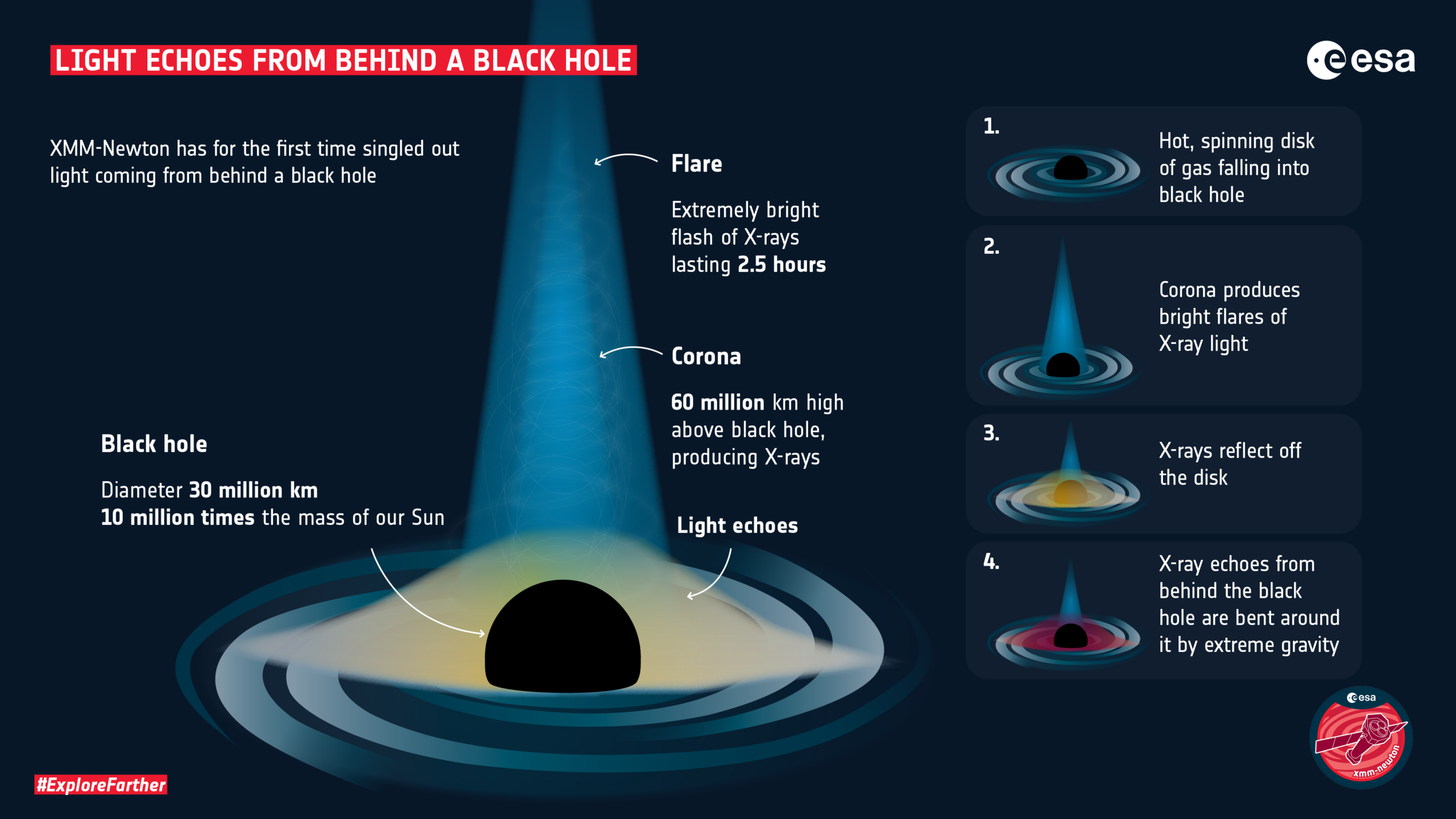
The explanation lies in a distinction that sounds subtle but is crucial. The detected light did not escape from inside the event horizon. Instead, it traveled through the severely curved spacetime surrounding the black hole, where gravity bent photons from otherwise hidden portions of the disk into the astronomers’ line of sight.
I Zwicky 1, commonly called I Zw 1, contains an actively feeding supermassive black hole surrounded by a brilliant accretion disk.
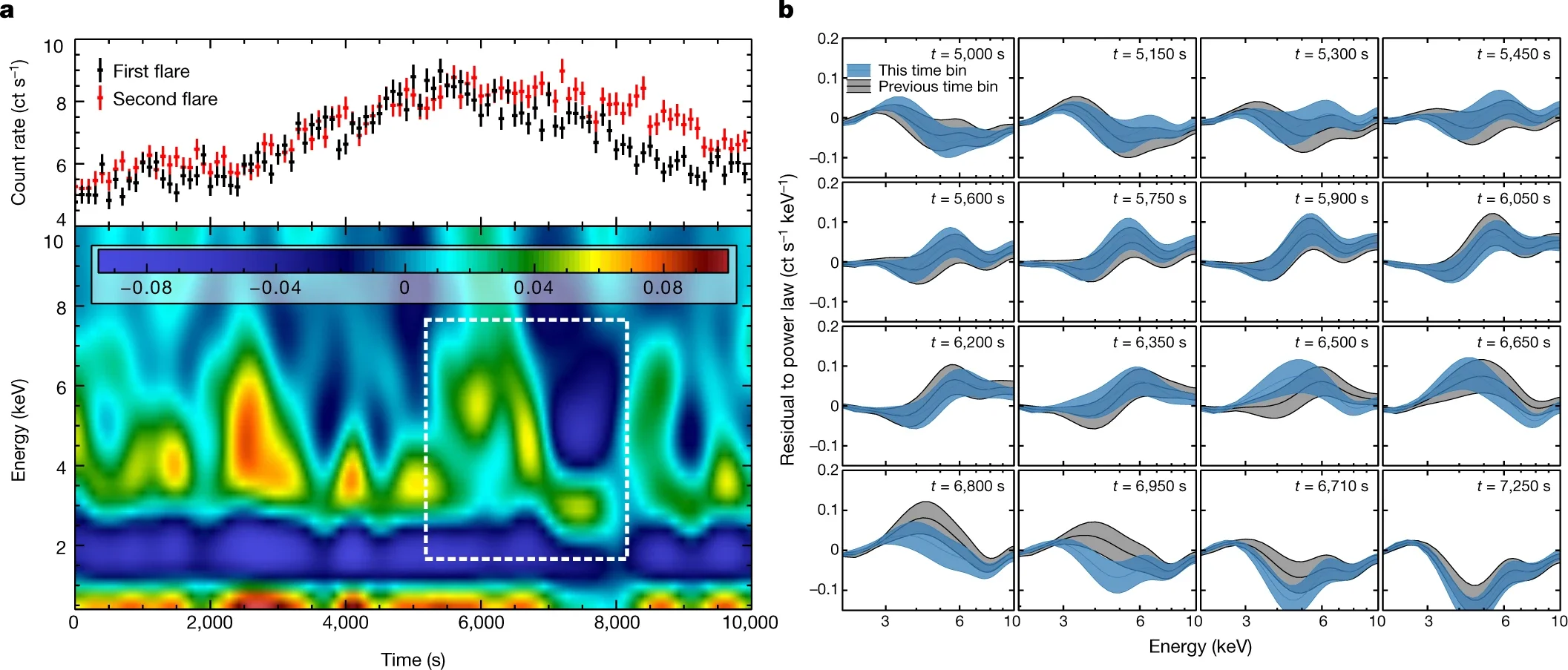
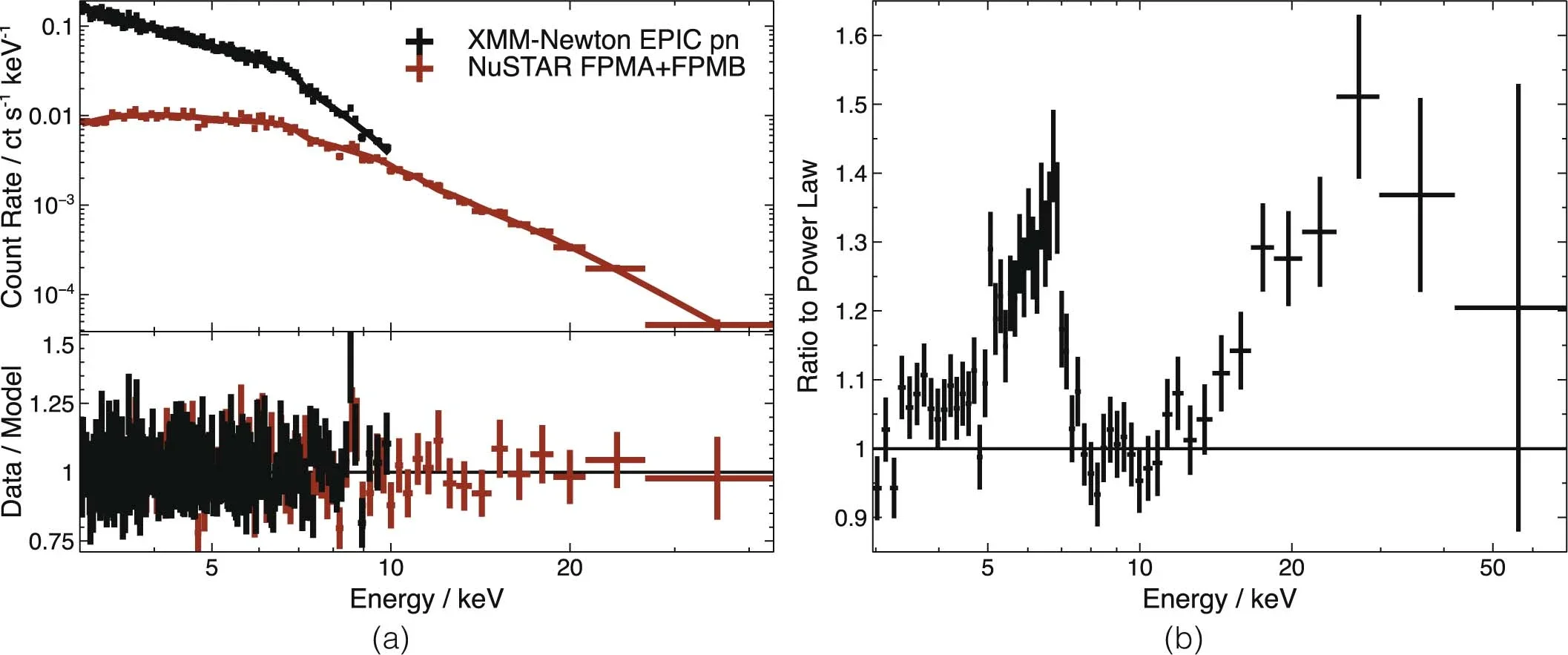
NuSTAR watched the object continuously for 5.3 days in January 2020, while XMM-Newton observed it during two long intervals. About 150,000 seconds into the campaign, the X-ray emission erupted in two flares lasting roughly 10,000 seconds each. At their peaks, the X-ray count rate reached about 2.5 times its earlier average.
Those large flares were interesting but not unprecedented. What followed caught the researchers’ attention.
As each flare declined, small peaks appeared at different times in separate X-ray energy bands. The pattern appeared first among blueshifted iron-line photons and later among redshifted photons. Statistical testing found less than a 0.01% probability that the pattern resulted from random Poisson or unrelated red-noise variations.
The sequence matched theoretical calculations for an X-ray flare echoing across an accretion disk.
“I’d already seen them in the theory I’ve been developing, so once I saw them in the telescope observations, I could figure out the connection,” Wilkins said.
Albert Einstein’s general theory of relativity describes gravity not simply as a force but as a curvature of spacetime produced by mass and energy.
Near a black hole, that curvature becomes extreme. Light normally travels along the straightest available path through spacetime, but when spacetime itself is curved, those paths can appear dramatically bent to a distant observer.
That effect allowed X-rays from the hidden far side of I Zw 1’s accretion disk to travel around the black hole rather than disappear behind it. The black hole’s gravitational field also magnified some of the radiation through gravitational lensing.
Models had predicted such a signature decades earlier. A 1999 study of iron-line reverberation calculated how X-rays reflected from different regions of an accretion disk should arrive at different times and energies in the curved spacetime around a spinning black hole.
The I Zw 1 observations finally exposed that behavior in actual flare data.
The different energies of the delayed flashes were just as important as their timing.
Material in the accretion disk races around the black hole at tremendous speeds. X-rays from the approaching side become blueshifted toward higher energies, while light from the receding side shifts lower. Gravity also stretches photons to lower energies, producing a gravitational redshift that becomes stronger closer to the black hole.
These effects distort the normally narrow iron K fluorescence line emitted around 6.4 kiloelectronvolts. By following how that line changed with time, astronomers could identify which regions of the disk were responding to a flare.
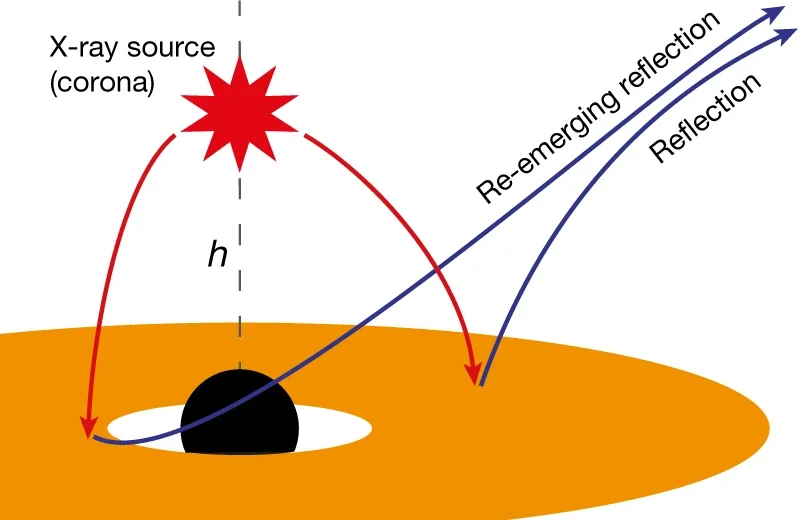
During the events, blueshifted emission arrived first. More redshifted photons followed later, matching light reflected from the rear portion of the disk and forced onto longer curved routes around the black hole.
The team also measured an average iron K reverberation delay of 746 plus or minus 157 seconds.
The researchers had originally set out to understand something else: the black hole’s corona.
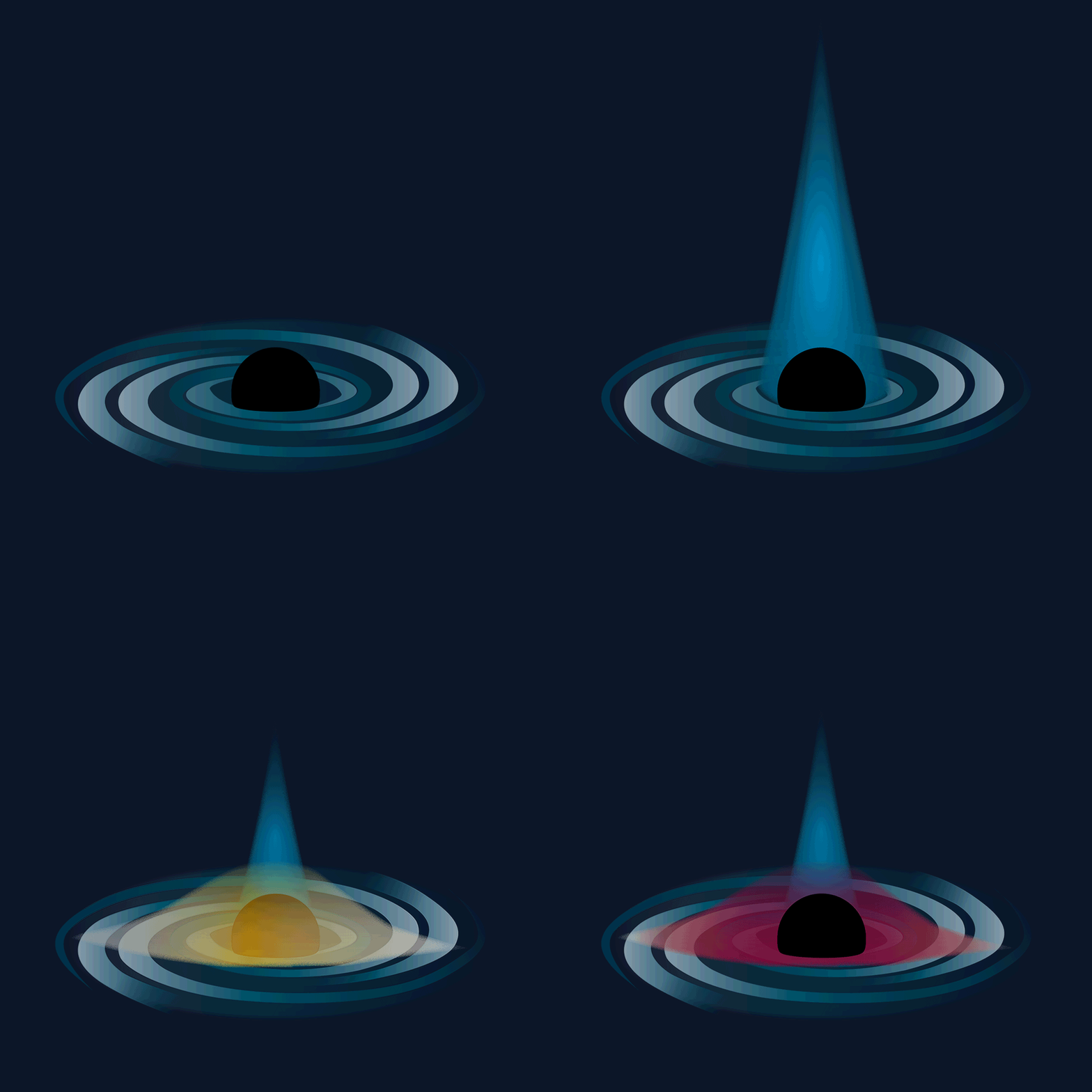
A corona is an extremely hot region of energetic particles close to a feeding black hole. Although its detailed structure remains uncertain, magnetic fields rising from the accretion disk are thought to accelerate particles and produce powerful X-rays.
Earlier observations of I Zw 1 had suggested that its corona contains a broader component spread across the inner disk and a compact, vertically extended core responsible for faster changes in brightness.
When the corona flares, some X-rays travel directly toward Earth. Others strike the accretion disk first and are reflected, creating delayed echoes. The time between direct and reflected radiation provides a way to measure structures only a few gravitational radii from the event horizon.
The 2020 observations showed that the brightest flares could illuminate the disk sharply enough for astronomers to resolve the unusual far-side echoes.
The observations do not mean scientists literally photographed the back of a black hole. They detected a time-dependent X-ray signature that matched relativistic ray-tracing predictions for radiation coming from the disk’s hidden side.
Alternative explanations involving changing absorption, disk ionization or ordinary continuum fluctuations had difficulty reproducing the shifting iron-line pattern.
The result offered an unusually direct demonstration of how strongly a black hole can reshape the paths of nearby photons.
“Fifty years ago, when astrophysicists started speculating about how the magnetic field might behave close to a black hole, they had no idea that one day we might have the techniques to observe this directly and see Einstein’s general theory of relativity in action,” said study co-author Roger Blandford.
Black holes remain dark by definition. But the light surrounding them, bent, delayed and shifted by extreme gravity, can expose structures that would otherwise remain invisible.
These resources explore the X-ray reverberation, accretion-disk reflection and coronal physics behind observations of light bent around black holes.
X-ray reverberation around accreting black holes: Reviews how time delays between direct coronal X-rays and disk-reflected radiation can map regions only a few gravitational radii from black holes. (The Astronomy and Astrophysics Review, 2014)
X-Ray Iron Line Reverberation from Black Hole Accretion Disks: Developed early theoretical predictions for the changing time and energy signatures of iron-line echoes around spinning black holes. (The Astrophysical Journal, 1999)
Revealing structure and evolution within the corona of the Seyfert galaxy I Zw 1: Earlier observations of I Zw 1 revealed evidence for multiple coronal components and established the system as a target for X-ray reverberation studies. (Monthly Notices of the Royal Astronomical Society, 2017)
Understanding X-ray reflection emissivity profiles in AGN: locating the X-ray source: Uses general-relativistic ray tracing to show how reflected X-rays can constrain the position and geometry of a black hole’s corona. (Monthly Notices of the Royal Astronomical Society, 2012)
The origin of the lag spectra observed in AGN: Reverberation and the propagation of X-ray source fluctuations: Models how gravitational delays, disk reflection and changes moving through a corona shape the observed timing of X-rays from active galaxies. (Monthly Notices of the Royal Astronomical Society, 2013)
Research findings are available online in the journal Nature.
The original story “Astronomers confirm Einstein’s gravity by viewing light from behind a supermassive black hole” is published in The Brighter Side of News.
Like these kind of feel good stories? Get The Brighter Side of News’ newsletter.
The post Astronomers confirm Einstein’s gravity by viewing light from behind a supermassive black hole appeared first on The Brighter Side of News.


Leave a comment
You must be logged in to post a comment.