A small planet circling a nearby red dwarf is moving through its planetary system in a direction that challenges the standard picture of how planets are born.
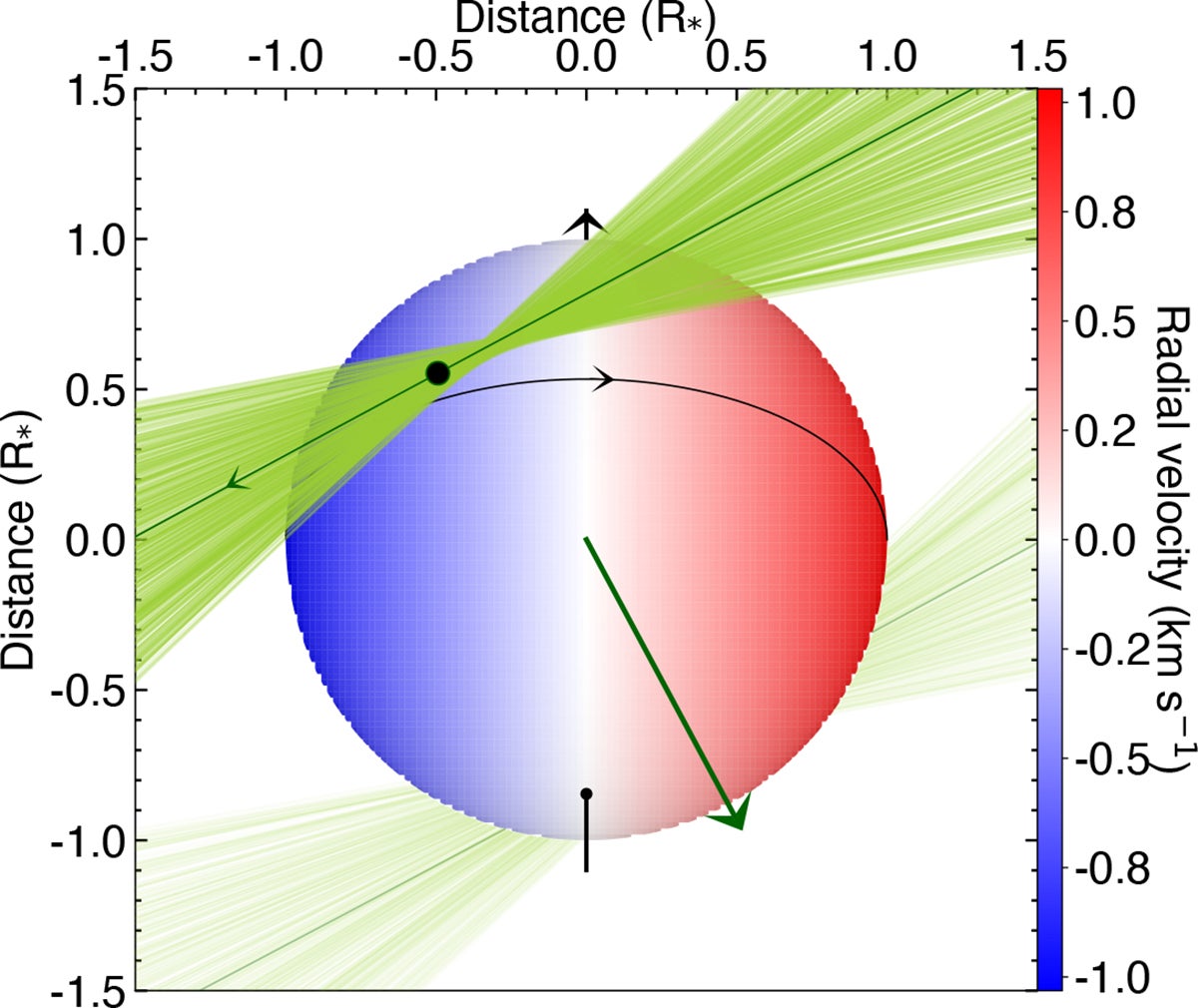
GJ 3090 b is a sub-Neptune with a radius about 2.18 times Earth’s and a mass roughly 4.52 times greater. Yet its most unusual characteristic is not its size. The planet travels around its star on a dramatically tilted, retrograde orbit, moving largely opposite the direction in which the star rotates.
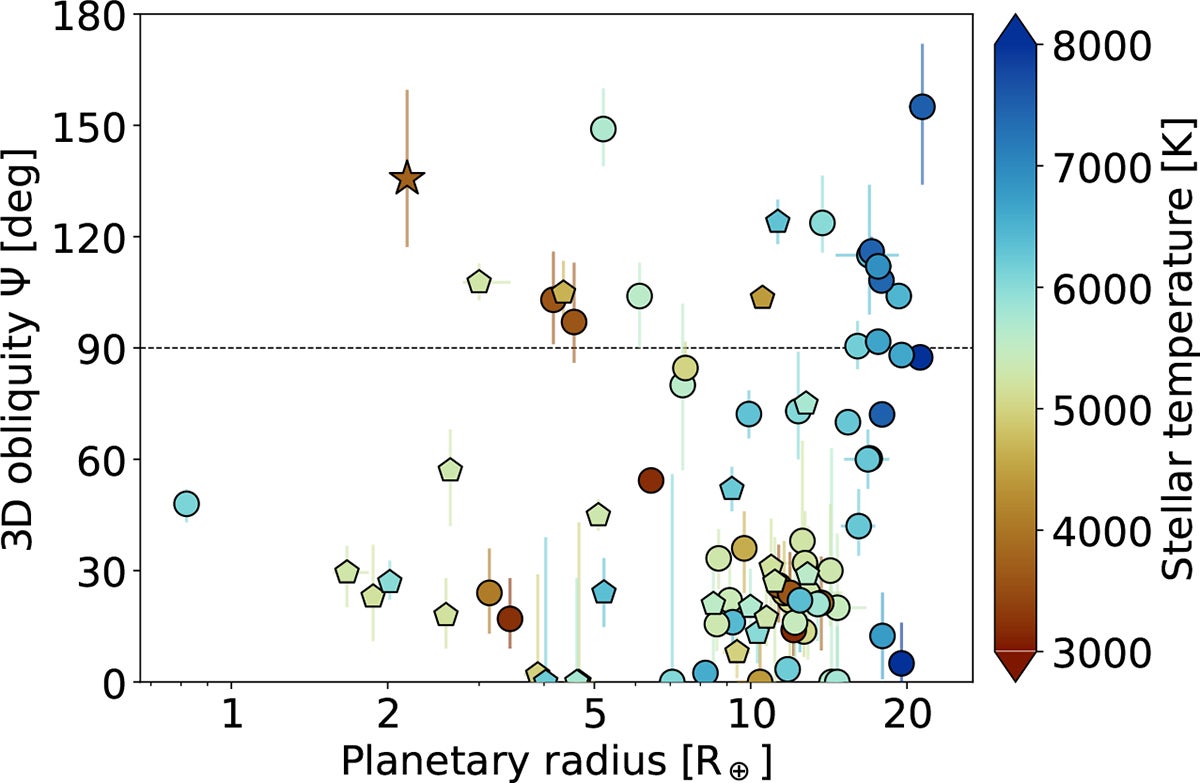
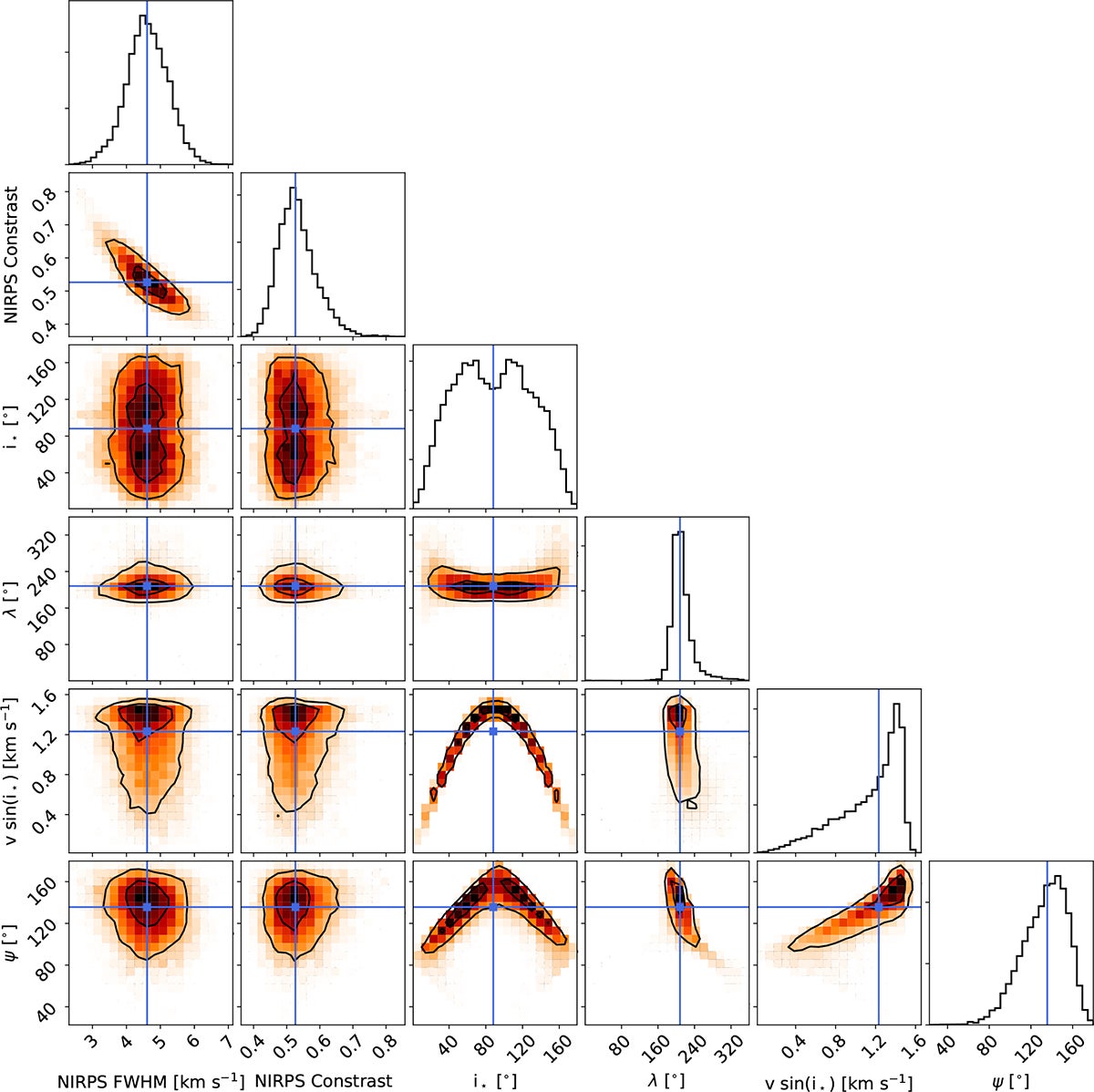
Astronomers measured a three-dimensional orbital obliquity of about 136 degrees, with significant but still clearly retrograde uncertainty. The discovery makes GJ 3090 b the first known retrograde planet around an M dwarf and the smallest planet around such a star with a three-dimensional obliquity measurement.
The international study, led by researchers at the University of Geneva, was published in Astronomy & Astrophysics under the title “Upside down: GJ 3090 b the first retrograde exoplanet around an M dwarf detected with NIRPS.”
Stars and planets generally begin with the same angular momentum.
A star forms when part of a cloud of gas and dust collapses under gravity. Material that does not immediately fall into the young star flattens into a rotating protoplanetary disk, where planets can assemble.
Under that simple picture, the star and disk rotate in related directions. Planets forming inside the disk should therefore travel in roughly the same direction as their star rotates and remain close to the star’s equatorial plane.
Even our Solar System is not perfectly aligned. The planets orbit close to the Sun’s equatorial plane but show small differences of several degrees. Earth’s orbital plane, for example, is tilted by just over 7 degrees relative to the solar equator.
GJ 3090 b is nothing like that.
“To our great surprise, not only is the planet GJ 3090 b on a highly misaligned orbit, but it also orbits retrogradely, in the opposite direction to the rotation of its star,” said first author Yann Carteret of the University of Geneva.
GJ 3090 is an M dwarf, a class of cool, relatively small stars that represents the most common type of star in the Milky Way.
GJ 3090 b was initially detected through transits, the small dips in starlight produced when a planet crosses in front of its host. The planet completes an orbit in only about 2.9 days.
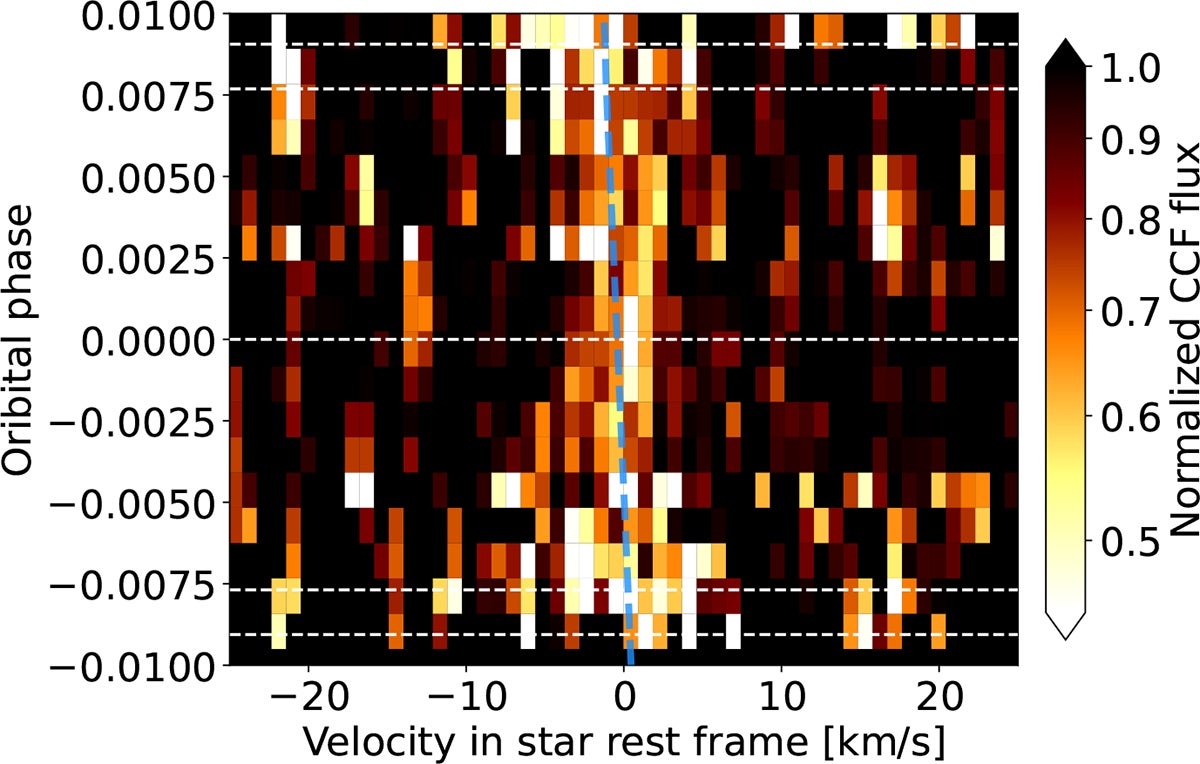
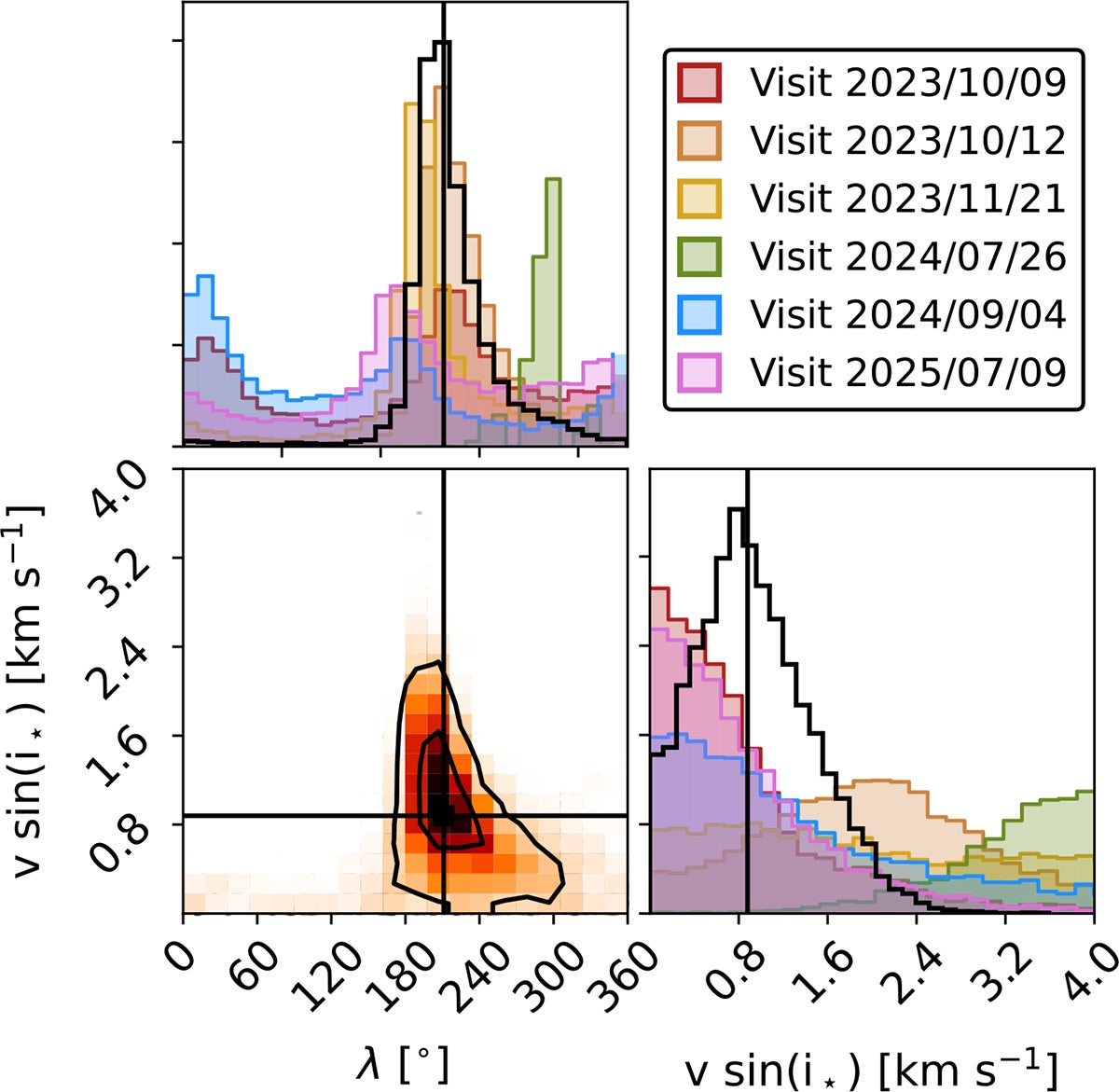
Researchers observed six of those transits with NIRPS, a high-resolution near-infrared spectrograph operating on the European Southern Observatory’s 3.6-meter telescope at La Silla in Chile. Four transits were simultaneously observed with the HARPS spectrograph.
The team collected 142 NIRPS spectra and 51 HARPS spectra during about 23 hours of observing time.
Astronomers determined the orbital geometry by tracking how the planet blocked different portions of the rotating stellar surface. One side of a rotating star moves toward Earth while the other moves away, creating measurable shifts in its spectral lines.
The combined NIRPS measurements yielded a projected spin-orbit angle near 208 degrees. After incorporating the orientation of the stellar rotation axis, researchers calculated a true three-dimensional obliquity of approximately 136 degrees.
“It is the performance of NIRPS in the infrared that made it possible to achieve the precision needed to measure the angle between the planet’s orbital plane and the star’s equatorial plane for such a small planet,” co-author Léna Parc said.
Extremely tilted exoplanets are known, but astronomers often have a plausible culprit nearby.
A massive distant planet or companion star can gravitationally disturb a planetary system over millions or billions of years. Planet-planet scattering and processes such as Kozai-Lidov oscillations can push worlds onto highly inclined or even retrograde trajectories.
Five other known multiplanet systems contain planets with three-dimensional obliquities greater than 70 degrees. All five have either a massive outer planet or a widely separated stellar companion capable of disturbing the system.
GJ 3090 appears different.
Researchers combined radial-velocity measurements, high-resolution imaging and Gaia data in a search for another large object. They found no evidence for a binary stellar companion within about 3 astronomical units.
The observations also exclude planets more massive than Jupiter within approximately 15 astronomical units, assuming an orbit roughly coplanar with GJ 3090 b. Objects above about 13 Jupiter masses are excluded within roughly 100 astronomical units under the same assumption.
That absence makes the system difficult to explain through the usual late-stage gravitational disruption.
Instead, the strange orbit may date back to the planets’ formation.
The researchers propose that GJ 3090 could have acquired additional gas after its original disk formed. If that incoming material carried angular momentum pointing in a very different direction, it could have assembled into a secondary disk rotating opposite the star.
Planets forming inside that new disk would naturally inherit its retrograde orientation.
Late infall of gas is increasingly recognized as part of the complicated environments surrounding young stars. Simulations have shown that incoming material can create strongly misaligned or even counter-rotating disks under some circumstances.
The team estimates that the system is about 1.07 billion years old, although the uncertainty is substantial. Its architecture may therefore preserve evidence of events that occurred much earlier in the star’s history.
Calculations also suggest that the star could have accumulated substantial material without its own rotation becoming fully aligned with the secondary disk. Under the researchers’ model, the allowable accreted material corresponds to a maximum dust mass of roughly 15 Earth masses.
That would require much of the available solid material to have gone into building planets rather than simply falling onto the star.
GJ 3090 b now provides an unusual test of how planetary systems can acquire radically different architectures.
Its retrograde orbit is particularly valuable because the planet is relatively small and belongs to a multiplanet system. That makes violent interactions capable of flipping a single planet harder to reconcile with the system that survived.
The second-generation disk explanation remains a hypothesis. Additional observations will be needed to determine the orientations of the system’s other planets and to search for more subtle evidence of its formation history.
If those planets share GJ 3090 b’s extreme tilt, the case for a common misaligned disk would become stronger.
For now, the system shows that the orderly picture of stars and planets emerging from one smoothly rotating disk is not universal. Sometimes the material arriving later may rewrite the architecture of an entire planetary system.
These resources explore planetary obliquity, tilted protoplanetary disks, and mechanisms capable of producing unusual orbital architectures.
The Occurrence and Architecture of Exoplanetary Systems: A broad review of exoplanet orbital architectures, including inclinations, stellar spin orientations, migration, and the processes that reshape planetary systems. (Annual Review of Astronomy and Astrophysics, 2015)
DREAM – II. The spin-orbit angle distribution of close-in exoplanets under the lens of tides: This study examines how stellar properties, orbital distance, and tidal interactions influence whether misaligned planets remain tilted or become realigned. (Astronomy & Astrophysics, 2023)
A backward-spinning star with two coplanar planets: Observations of the K2-290 system showed that an entire planetary disk can become strongly misaligned relative to its star, providing evidence for primordial orbital tilts. (Proceedings of the National Academy of Sciences, 2021)
Misaligned disks induced by infall: Simulations demonstrate that late-arriving gas can form a strongly tilted second-generation disk, including counter-rotating configurations under retrograde infall. (Astronomy & Astrophysics, 2021)
One-third of Sun-like stars are born with misaligned planet-forming disks: Observations of young star-disk systems indicate that substantial primordial misalignment can already exist before later planetary dynamics reshape the system. (Nature, 2025)
Research findings are available online in the journal Astronomy & Astrophysics.
The original story “Astronomers discover a strange planet circling its red dwarf star in the wrong direction” is published in The Brighter Side of News.
Like these kind of feel good stories? Get The Brighter Side of News’ newsletter.
The post Astronomers discover a strange planet circling its red dwarf star in the wrong direction appeared first on The Brighter Side of News.


Leave a comment
You must be logged in to post a comment.