A rocky planet about 49 light-years from Earth appears to have held onto an atmosphere, despite orbiting a red dwarf capable of stripping gases into space. The evidence comes from helium escaping high above the planet, LHS 1140 b.
The detection marks the clearest atmospheric signal yet from a rocky planet in the habitable zone of another star. That region allows temperatures that could support liquid water, although the observations do not establish that water or life exists there.
The work, led by Harvard University’s Collin Cherubim, appeared in Science. The team included astronomers from Carnegie Science and other institutions.
“This is the first time anyone has found an atmosphere on a rocky planet in the habitable zone of another star,” Cherubim said.

Atmospheres can regulate climate, shield a surface from damaging radiation and allow liquid water to persist. Yet astronomers have struggled to determine whether small, rocky planets around red dwarfs can retain them for billions of years.
LHS 1140 b circles its star every 24.7 days. It has 5.6 times Earth’s mass and a radius about 1.7 times larger than Earth’s.
Those measurements are consistent with a rocky world containing a low-density component, such as an atmosphere or a large amount of water. The planet receives 42 percent as much stellar radiation as Earth and has an estimated equilibrium temperature of 226 kelvins.
Its host is an old, relatively inactive red dwarf that is at least 3 billion years old. Red dwarfs are smaller and cooler than the Sun, making transiting planets easier to study.
“Red dwarf stars present a good opportunity for this kind of search because they are small and cool,” said Carnegie astronomer Shreyas Vissapragada.
When a planet crosses its star, some starlight filters through the planet’s atmosphere. Different gases absorb distinct wavelengths, leaving chemical fingerprints in the light.
Signals from water and carbon dioxide near a planet’s lower atmosphere are often extremely faint. The team instead searched for helium at higher altitudes, where escaping gas can create a stronger signature.
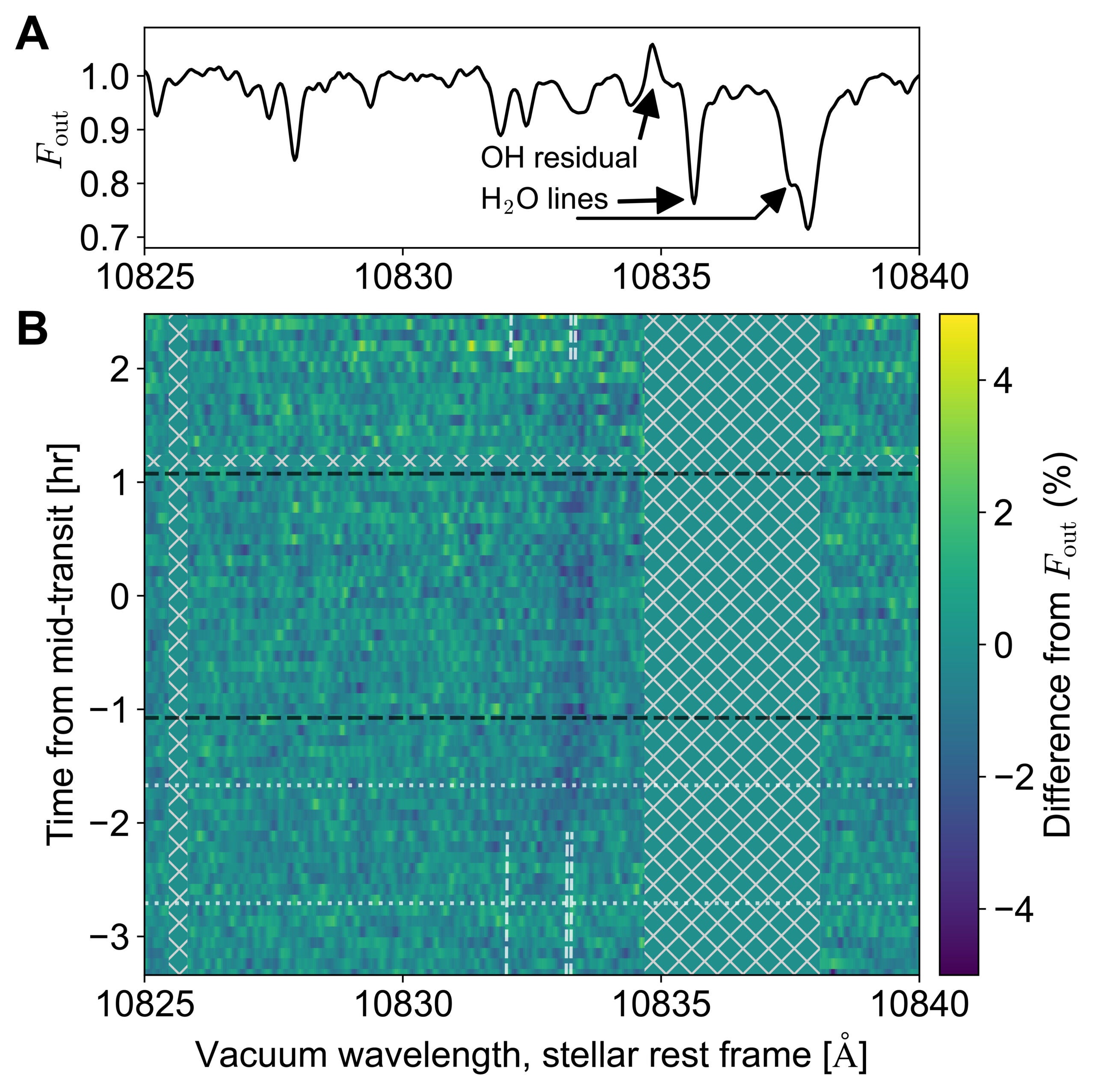
The astronomers used the WINERED spectrograph on the Magellan Clay telescope at Las Campanas Observatory in Chile. In September 2024, they observed the system for 6.5 hours.
During that session, both LHS 1140 b and a smaller neighboring planet crossed the star. The telescope collected 70 spectra, including 23 during LHS 1140 b’s transit.
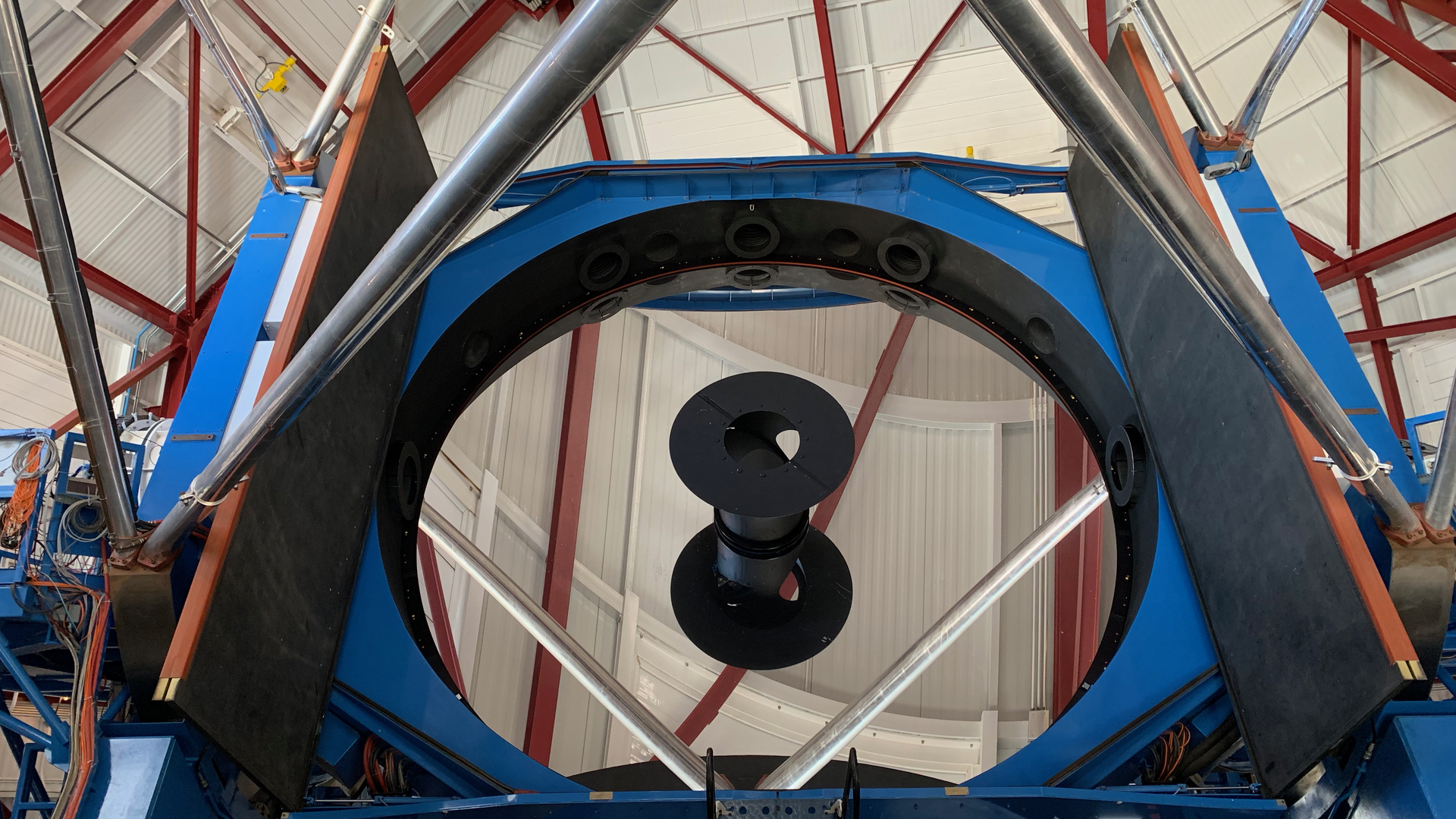
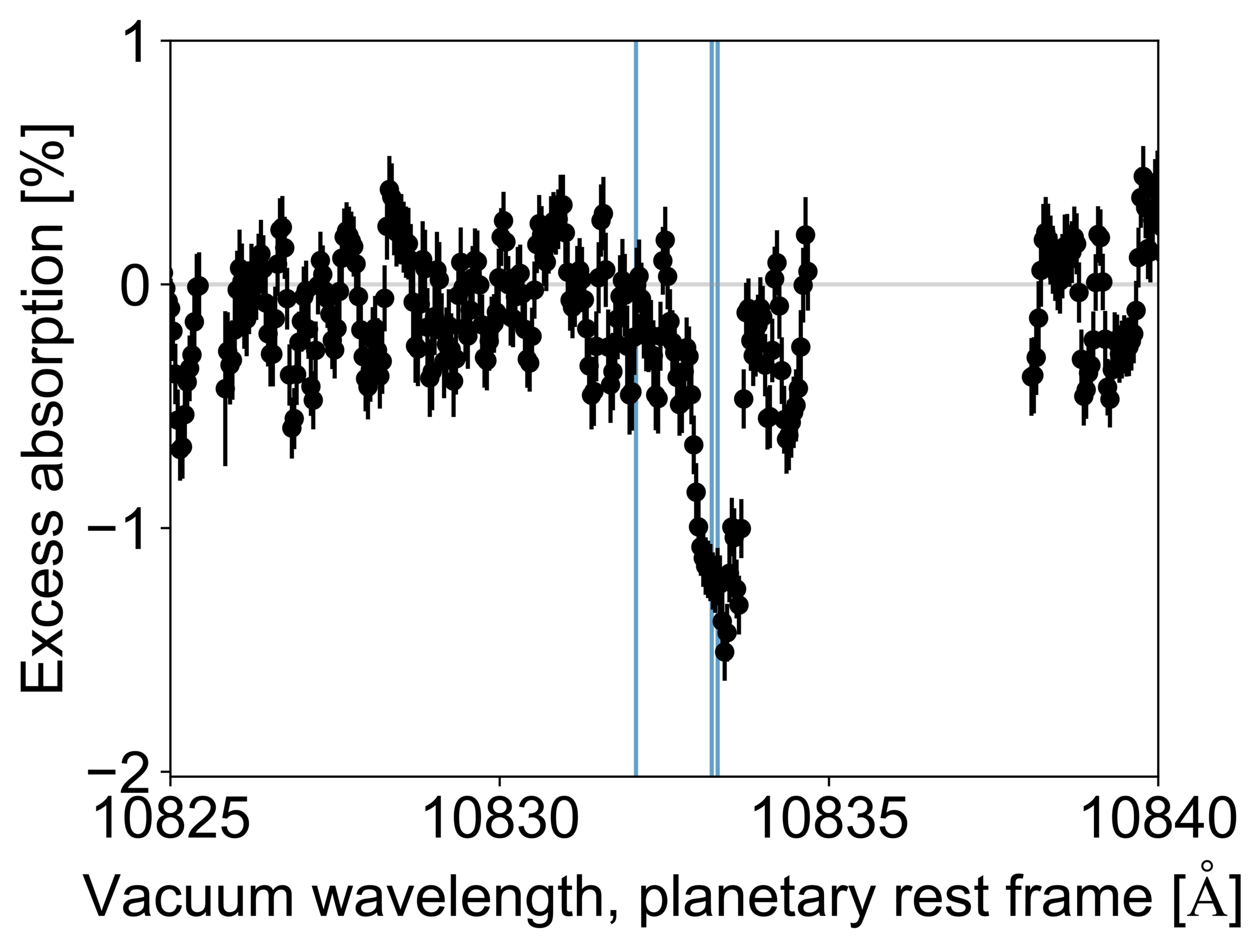
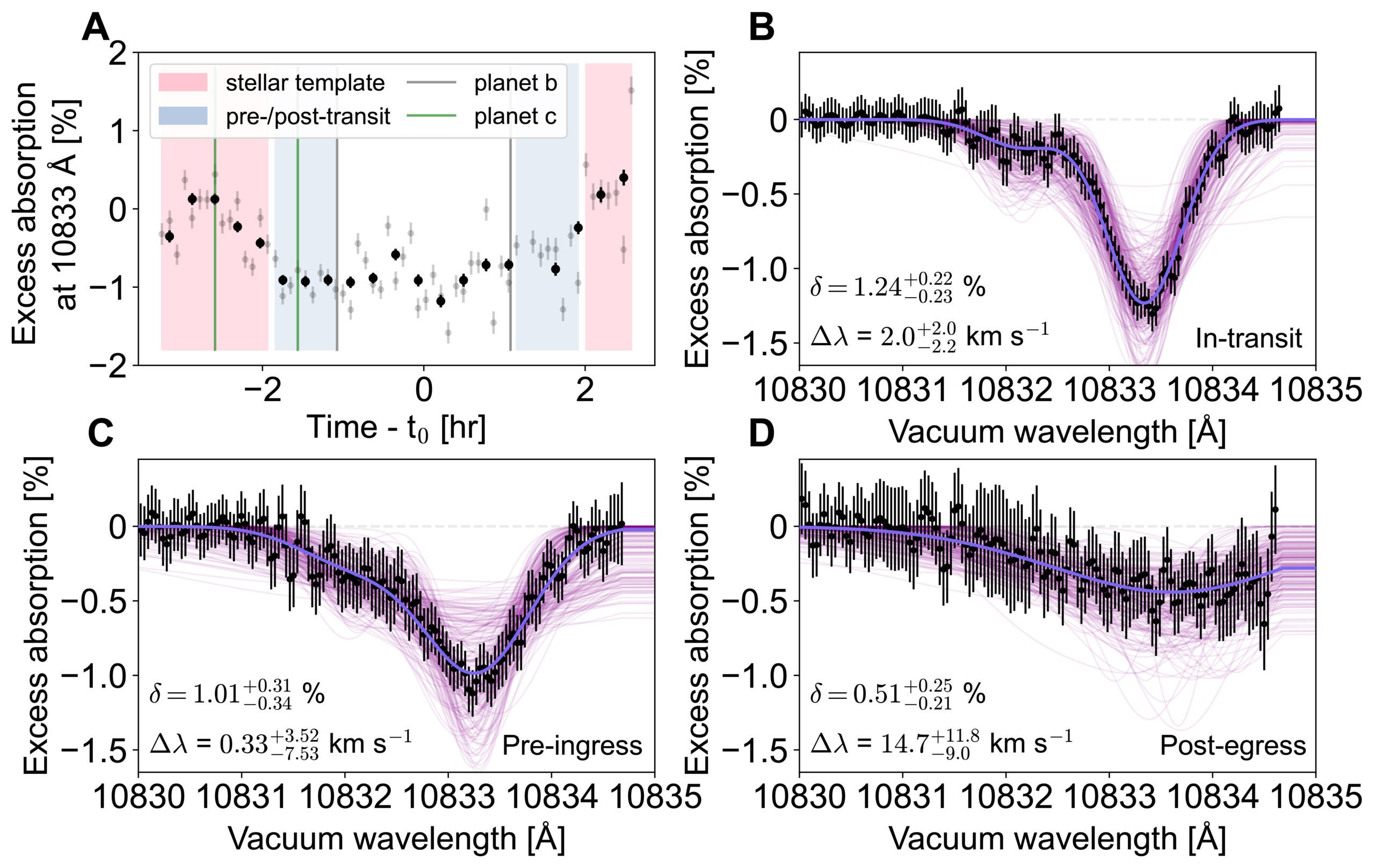
The data showed absorption near 10,833 angstroms, matching a triplet of lines produced by metastable helium. The signal appeared during the transit and before the planet began crossing the star.
That early absorption could indicate a stream of escaping helium extending ahead of the planet. The team also found tentative evidence of gas trailing behind it.
“This was clear evidence of an atmosphere on a habitable-zone exoplanet,” Vissapragada said. “It was an absolute thrill to see the transit spectra and slowly realize the implications of what we were looking at.”
The absorbing helium extended to an equivalent opaque radius 1.52 times the planet’s measured radius. Researchers examined possible interference from Earth’s atmosphere and activity on the host star but ruled out those explanations.
The team interpreted the helium as part of a hydrodynamic outflow, in which high-energy radiation heats the upper atmosphere and pushes gas into space.
Archival observations from the XMM-Newton space telescope helped estimate the star’s X-ray output. LHS 1140 b receives between 2.7 and 16 times the X-ray flux that Earth receives, depending on the Sun’s activity level used for comparison.
Models indicated that X-rays and extreme-ultraviolet radiation could explain the inferred escape rate. Core-powered mass loss, another process driven by heat remaining inside a planet, produced a much lower predicted rate.
The planet’s age makes the detection particularly important. If helium had escaped continuously at a high rate for billions of years without replacement, the original supply should have vanished.
The surviving signal therefore points to a substantial atmosphere that continues feeding helium into the escaping upper layers.
“Then we learned they’re common, and found some in the habitable zone,” said Harvard professor Robin Wordsworth, referring to rocky exoplanets. “The next question was whether any of them had managed to keep an atmosphere. Now we know at least one has.”
The observations and evolutionary models point to a helium-rich, hydrogen-poor upper atmosphere. Heavier substances, including oxygen, carbon and nitrogen, would remain at lower levels because the escaping helium lacks enough force to carry them away.
Water could also remain closer to the surface. At the planet’s low temperature, water vapor may condense before reaching the upper atmosphere, creating a cold trap.
That process could help explain the shortage of hydrogen in the escaping gas. If large amounts of water reached higher altitudes, stellar radiation could split its molecules and create hydrogen.
The findings do not reveal the full atmospheric composition. They also cannot determine whether LHS 1140 b has an Earth-like surface, a deep ocean or some other structure.
Previous observations ruled out a clear, hydrogen-dominated atmosphere. The new interpretation instead favors a layered atmosphere, with helium above and heavier molecules below.
When astronomers observed another transit in 2025, they did not detect helium.
The team repeated the analysis with a separate data-reduction method and obtained the same result. Models showed that moderate changes in the star’s high-energy output or the upper atmosphere’s temperature could push the helium signal below the telescope’s detection limit.
“After much careful analysis and consideration of the spectra, we determined that helium was escaping from LHS 1140 b’s atmosphere in 2024 due to heating from stellar X-rays and extreme ultraviolet radiation,” Vissapragada said. “However, our 2025 observations revealed no escaping helium, so the atmospheric escape appears to be variable.”
The nearby planet LHS 1140 c also showed no helium. It is smaller, completes an orbit every 3.78 days and receives about five times Earth’s stellar radiation.
Its apparent lack of air places the two worlds on opposite sides of the proposed “cosmic shoreline,” a boundary between rocky planets that retain atmospheres and those that lose them.
The helium method gives astronomers a ground-based way to identify atmospheres that are difficult to detect with broader observations. It may help select the strongest rocky planets for deeper study with space telescopes.
LHS 1140 b is already a target of a joint James Webb and Hubble program examining rocky worlds around dwarf stars. Future observations will search for water, carbon dioxide and other gases at lower altitudes.
Those measurements could distinguish a stable, layered atmosphere from occasional gas released by an otherwise bare surface. They may also reveal how atmospheric escape changes over time.
“This has been a model validation, and hopefully it’s just the first of many more observations to come,” Cherubim said.
Research findings are available online in the journal Science.
The original story “Astronomers discover the first rocky planet with an atmosphere located in the habitable zone” is published in The Brighter Side of News.
Like these kind of feel good stories? Get The Brighter Side of News’ newsletter.
The post Astronomers discover the first rocky planet with an atmosphere located in the habitable zone appeared first on The Brighter Side of News.

