Space looks empty until you try to cross it.
Far beyond Pluto, where sunlight is faint and the planets are long behind, NASA’s New Horizons spacecraft is moving through a region where the Sun’s outflow begins to lose its grip. There, a stream of charged particles called the solar wind is gradually slowing down. The new measurements help show why. The answer lies in a quiet, persistent encounter with material drifting in from interstellar space.
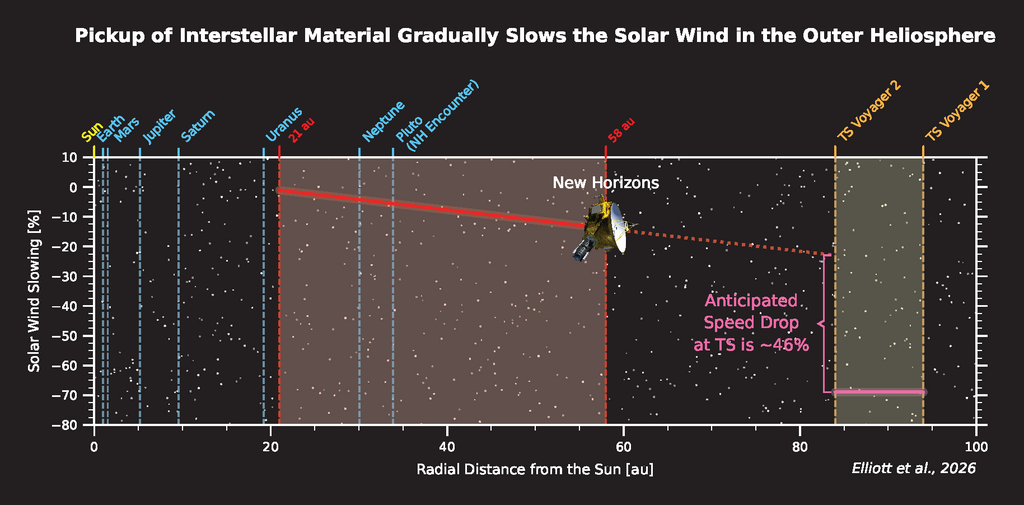
A team led by Southwest Research Institute scientist Dr. Heather Elliott found that the solar wind measured by New Horizons at 58 astronomical units from the Sun was 13% to 15% slower than the solar wind measured near Earth, at 1 astronomical unit. That extends an earlier pattern. Previous measurements between 30 and 43 astronomical units had suggested a slowdown of about 5% to 10%.
The change is not dramatic in the way a shock wave would be. But over those enormous distances, it matters.
“As the solar wind travels away from the Sun at supersonic speeds, roughly 1 million miles per hour, eventually it encounters incoming interstellar neutral gas particles entering the heliosphere,” Elliott said. “These neutral interstellar atoms become ionized via charge exchange with solar wind ions, adding mass to the solar wind by picking up interstellar material that slows the solar wind down.”

The solar wind begins at the Sun and blows outward through the heliosphere, the vast bubble carved out by solar particles and magnetic fields. Near Earth, scientists have abundant measurements. Much less is known about conditions in the outer heliosphere. That is simply because very few spacecraft have gone there, and fewer still have carried instruments able to monitor the wind along the way.
That makes New Horizons unusually valuable. The spacecraft, launched to Pluto and beyond, is now about 66 astronomical units from the Sun. Its Solar Wind Around Pluto instrument, known as SWAP, has been collecting rare measurements in a region where spacecraft traffic is almost nonexistent.
The new analysis focused on observations gathered as New Horizons moved from about 21 to 58 astronomical units. To separate true distance-related slowing from ordinary changes in solar activity, the team compared those outer-heliosphere measurements with solar wind data collected near Earth and propagated outward. They also used simulations that included, and then excluded, interstellar neutral material.
That comparison turned out to be crucial. Solar wind speed changes for more than one reason. Conditions at the Sun change over time, and those shifts ripple outward. If a spacecraft far away detects slower wind, the cause might be the changing solar source, not just the distance traveled. The researchers tried to disentangle those effects by matching outer measurements against inner-heliosphere conditions and computer models.
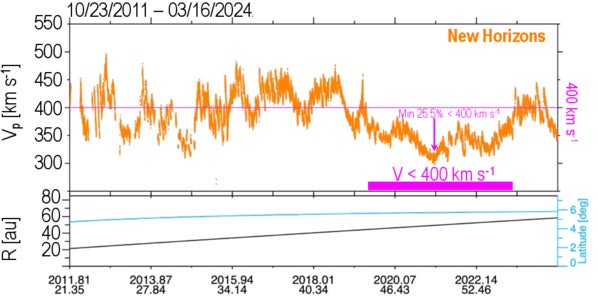
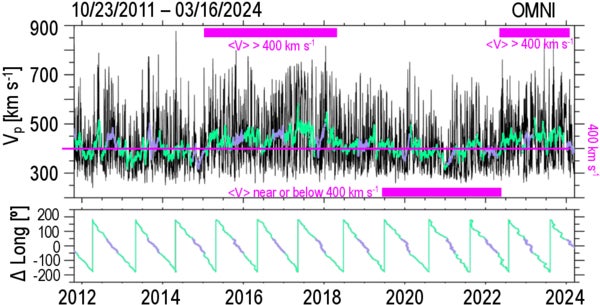
One interval stood out. From late 2018 into early 2023, New Horizons measured a prolonged stretch of unusually slow solar wind. At its minimum, the speed dropped to about 298 kilometers per second. This is well below the roughly 400 kilometers per second used as a nominal reference.
That decline was not caused by one thing alone.
The study concluded that about half of the drop could be traced to changing conditions at the Sun. During that period, solar activity was low, and the heliospheric current sheet tilt angle was also low. That meant coronal streamers, which emit slow wind, were confined to lower latitudes. Because New Horizons remains near the ecliptic plane, it was in position to receive that slow-moving flow.
The rest of the slowdown came from the longer-term effect the team was trying to measure in the first place. That is the gradual pickup of interstellar material as the wind moved outward.
In other words, New Horizons was seeing both weather and climate. It was detecting temporary changes tied to the Sun’s activity cycle. These shifts were layered on top of a broader slowing trend that builds with distance.
The simulations backed that up. When the researchers ran models without interstellar neutrals, the predicted wind speed stayed too high in the outer heliosphere. However, when they included incoming interstellar material and the pickup-ion process, the modeled speeds dropped and lined up much better with what New Horizons actually recorded.
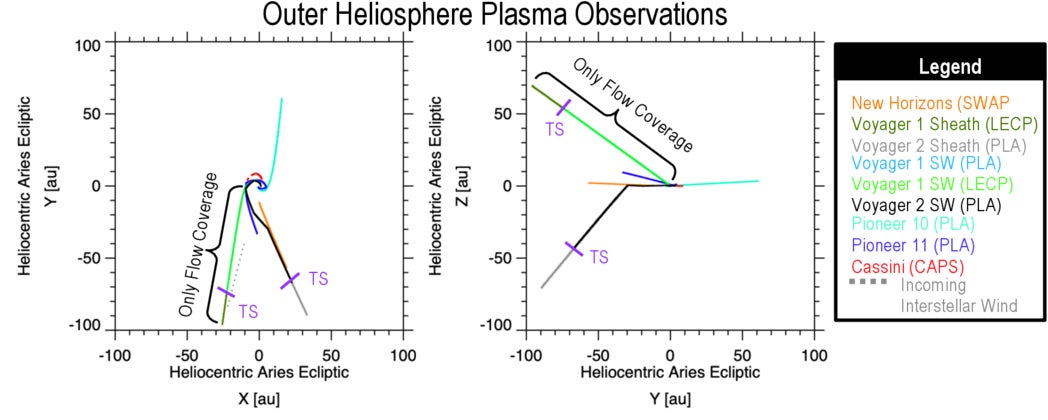
The slowdown also matters because New Horizons is heading toward one of the solar system’s most important boundaries, the termination shock. That is the region where the solar wind should abruptly slow to less than the local speed of sound in the surrounding plasma.
Voyager 2 crossed that boundary at 84 astronomical units and recorded a sharp drop in speed. In that case, the decrease was on the order of 46% at the shock, and the broader discussion in the paper notes that Voyager 2 saw a roughly 56% reduction across the crossing. By comparison, the change New Horizons sees now is much gentler.
That distinction matters because a gradual slowdown alone is not enough to prove the spacecraft is nearing the shock. Temporary changes in solar conditions can mimic part of that signal. The paper argues that New Horizons measurements need to be interpreted in context, alongside inner solar system data and simulations, if scientists want to know whether the spacecraft is truly approaching that boundary.
Still, the spacecraft is giving researchers something they have lacked for decades, continuous measurements in the Sun’s outer heliosphere.
“Eventually, the solar wind reaches the outer boundaries of the heliosphere — the sphere of influence where the solar wind affects the space environment — where it interacts with incoming interstellar material. The shape and properties of these heliospheric boundaries control the amount of Galactic Cosmic Rays (GCRs) that can enter our solar system and reach Earth,” Elliott said. “Therefore, the data from New Horizons combined with observations from other missions, such as IBEX, IMAP and Voyager will enhance our understanding of the edge of the solar system.”
That goes beyond a mapmaking exercise. Galactic cosmic rays are one of the most serious hazards for long-duration human spaceflight. They can damage electronics and raise cancer risks for astronauts beyond Earth’s protective atmosphere.
“This new data could be highly beneficial in predicting the outer boundaries of the heliosphere and solar system and ultimately the amount of GCR radiation exposure of astronauts, satellites and spacecraft to harmful cosmic radiation, especially as we look toward more ambitious deeper-space exploration,” Elliott said.
The findings may also help scientists think beyond our own star. Other stars are thought to form similar protective bubbles, called astrospheres, as their winds push back against surrounding interstellar matter. Learning how our heliosphere behaves could sharpen ideas about how those distant systems work too.
“Studying the heliosphere is like solving a cosmic puzzle,” said Elliott. “Not only do we learn more about how the Sun’s influence ends, but we also gain a deeper understanding of the boundary between our solar system and interstellar space — a critical step toward planning future interstellar travel.”
Dr. Alan Stern, principal investigator of the New Horizons mission, said the spacecraft remains unique in that role.
“NASA’s New Horizons continues to be the only spacecraft in the Sun’s outer heliosphere and yielding important new insights to build on what the venerable Voyager probes discovered,” Stern said. “Our studies of the heliosphere, like this one, are virtually continuous and provide crucial new datasets to better understand the Sun’s outer heliosphere and its termination region far beyond Pluto’s orbit.”
This work gives scientists a better way to estimate how the solar wind changes before it reaches the edge of the heliosphere, which helps improve forecasts of where that boundary may lie and how effectively it blocks galactic cosmic rays.
That has practical value for planning deep-space missions, protecting spacecraft electronics, and understanding the radiation environment future astronauts could face on trips to the Moon, Mars, and beyond.
Research findings are available online in The Astrophysical Journal.
The original story “Astronomers discover why solar winds gradually slow down on their way out of the solar system” is published in The Brighter Side of News.
Like these kind of feel good stories? Get The Brighter Side of News’ newsletter.
The post Astronomers discover why solar winds gradually slow down on their way out of the solar system appeared first on The Brighter Side of News.

