Every known organism on Earth relies on the same basic genetic alphabet. DNA stores information using four chemical letters, A, T, C and G, which pair in predictable combinations and provide the instructions for life.
Researchers have now shown that one of biology’s most important molecular machines can work with twice that number.
A team led by University of California San Diego researchers demonstrated that bacterial RNA polymerase can transcribe an eight-letter genetic system containing four natural nucleotides and four synthetic ones. The work, published in Nature Communications, moves expanded genetic alphabets closer to functioning within the same molecular machinery cells use to express ordinary genes.
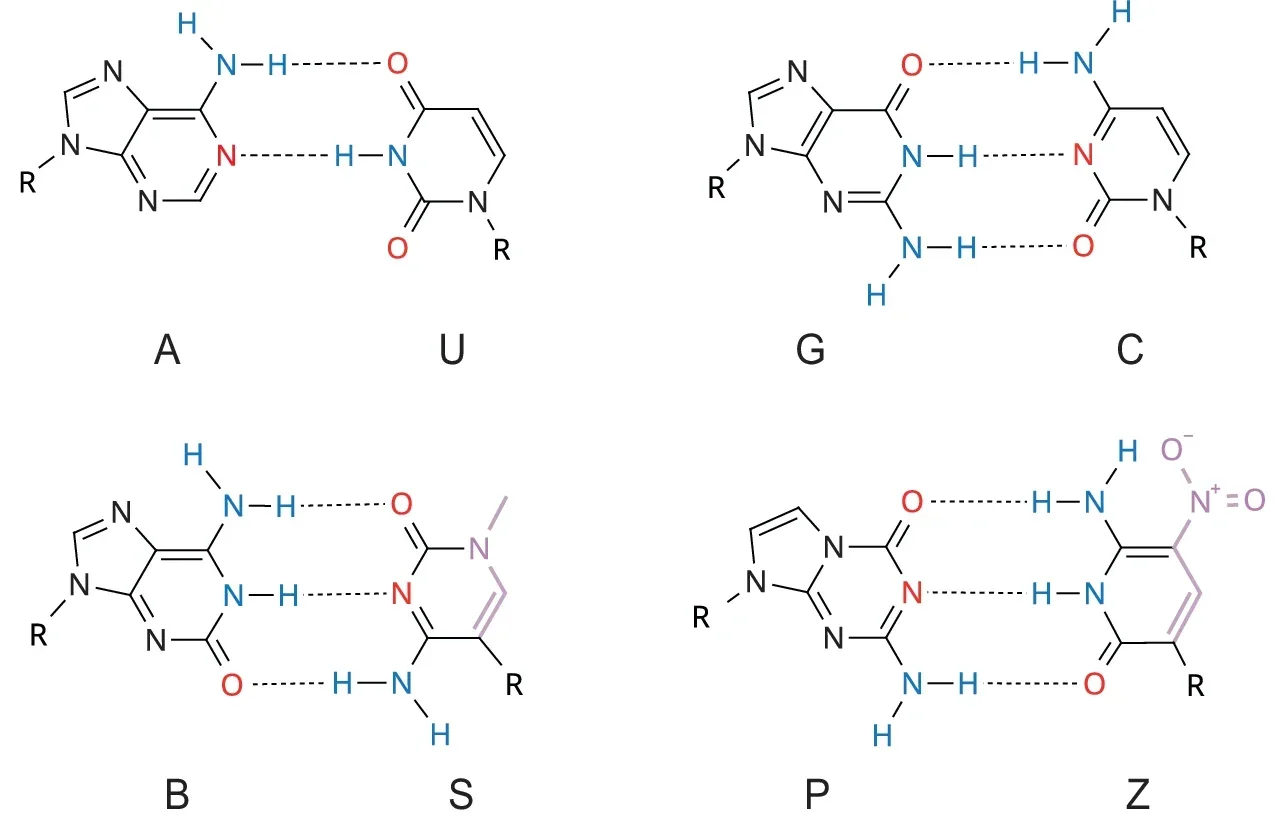
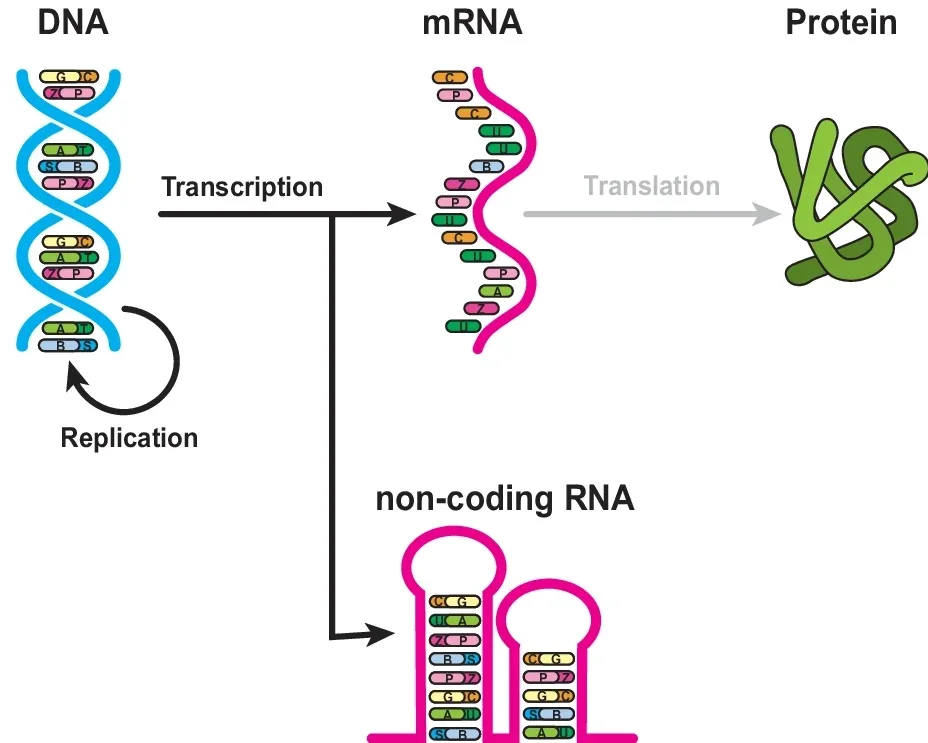
The system is known as Hachimoji, a name derived from the Japanese words for “eight letters.” Its synthetic DNA letters, called P, Z, B and S, form two additional base pairs alongside the familiar A:T and G:C pairs.
RNA polymerase performs one of the central jobs of life.
The enzyme moves along DNA, reads its sequence and builds a complementary RNA molecule. That process, called transcription, is the first major step toward turning genetic information into biological function.
Synthetic bases are useful only if biological machinery can recognize them accurately enough to preserve their information. Previous experiments had shown that simpler polymerases could handle expanded alphabets, and earlier work from the same research group demonstrated that E. coli RNA polymerase could process a six-letter system.
The new experiments pushed that idea to eight letters.
Researchers constructed DNA templates containing P, Z, B or S and supplied RNA polymerase with all four natural RNA building blocks plus the four synthetic ones. When the correct synthetic partner was available, the enzyme efficiently added it to the growing RNA strand.
For the P:Z pair, incorporation rates were only about twofold slower than those measured for a natural G:C pair under the same experimental conditions.
The synthetic pairs also largely remained independent of one another. P paired with Z, while B paired with S, allowing all four artificial letters to carry distinct information.
Efficiency alone did not explain how the enzyme was accepting molecules that do not exist naturally.
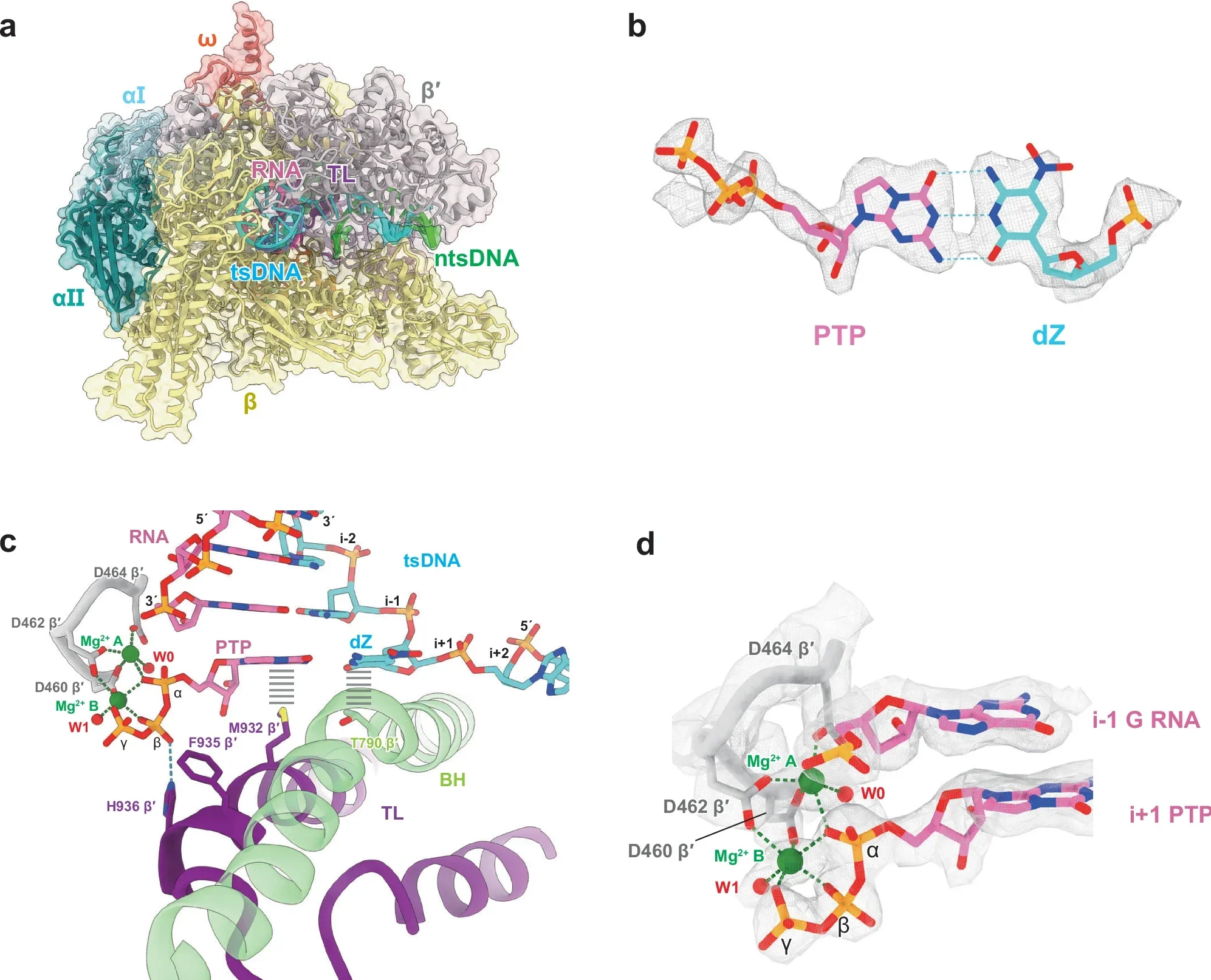
The researchers used cryo-electron microscopy to capture four structures of E. coli RNA polymerase interacting with synthetic nucleotides. The structures reached resolutions ranging from 2.42 to 2.75 angstroms, allowing the team to examine how the artificial bases fit inside the enzyme’s active site.
The answer was surprisingly familiar.
Both the P:Z pair and a modified P:Z* pair adopted the same broad Watson-Crick geometry used by natural DNA bases. RNA polymerase therefore did not need an entirely new recognition mechanism.
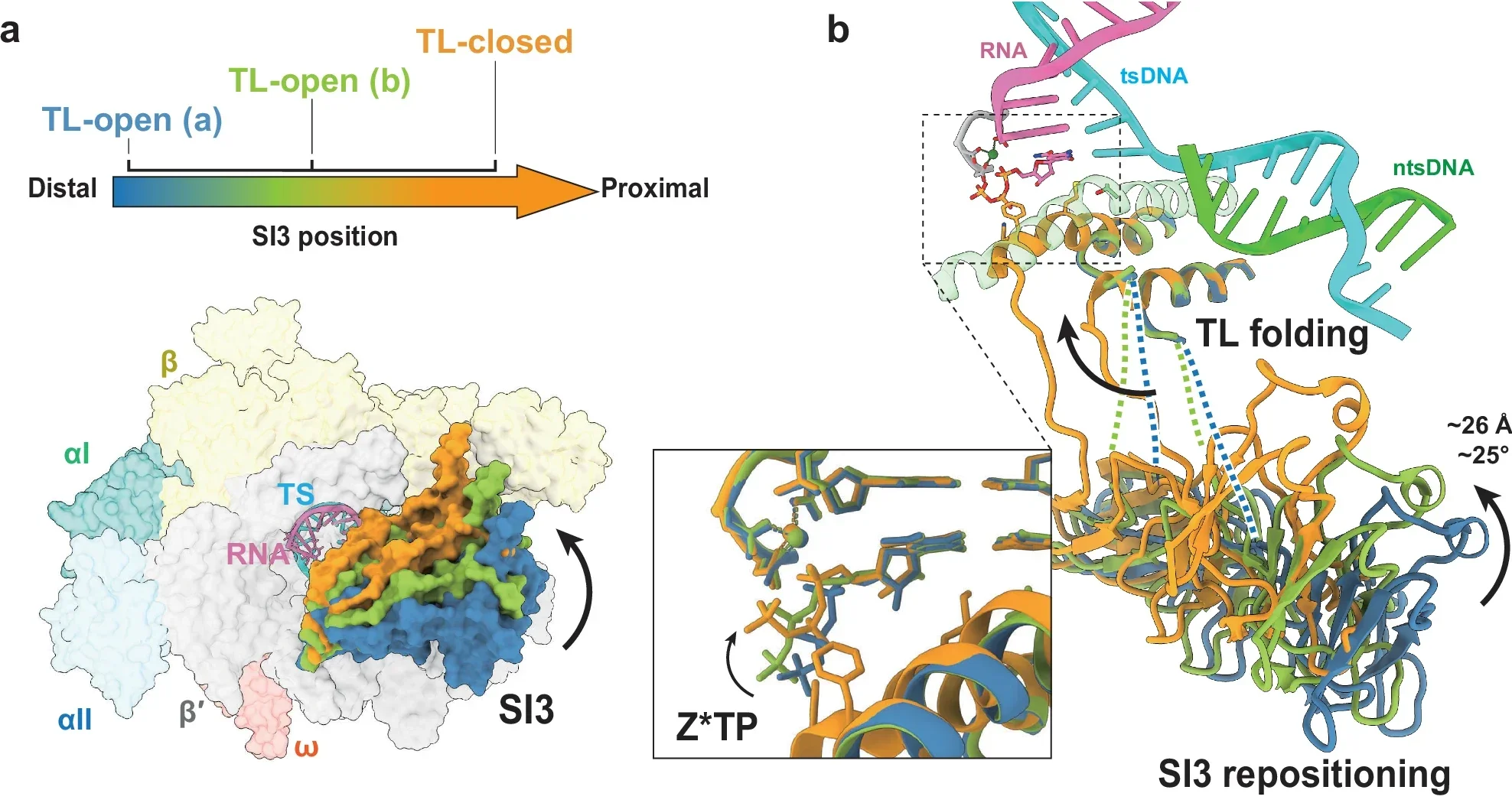
The enzyme also underwent normal structural changes as the artificial nucleotide entered its active site.
One important component called the trigger loop folded around the incoming nucleotide. That motion is part of the quality-control process RNA polymerase normally uses before adding a natural nucleotide to RNA.
The catalytic magnesium ions and other active-site components were also positioned much like those seen during ordinary transcription.
Together, the structures suggest that shape and geometry are central to how RNA polymerase decides what looks like a valid genetic letter.
The eight-letter system was not error-free.
One of the largest fidelity problems involved the synthetic nucleotide Z. Under physiological conditions, Z can lose a proton, altering its hydrogen-bonding pattern enough that it can pair with the natural base guanine.
That created unwanted Z:G mismatches during transcription.
The researchers emphasized that their single-nucleotide experiments can exaggerate mismatch rates because incorrect nucleotides were sometimes tested without their correct competitors present. In a complete mixture, the correct nucleotide would often be incorporated much faster.
Even so, the chemical weakness in Z represented an important obstacle to building a reliable synthetic genetic system.
The team therefore tested a modified version called Z*. Its nitro group was replaced with a carboxamide group, raising the molecule’s pKa above 10 and making the problematic deprotonated form much less likely under neutral conditions.
Z* retained its ability to pair with P while substantially reducing misincorporation with guanine and other bases.
The structural analysis uncovered another unexpected detail.
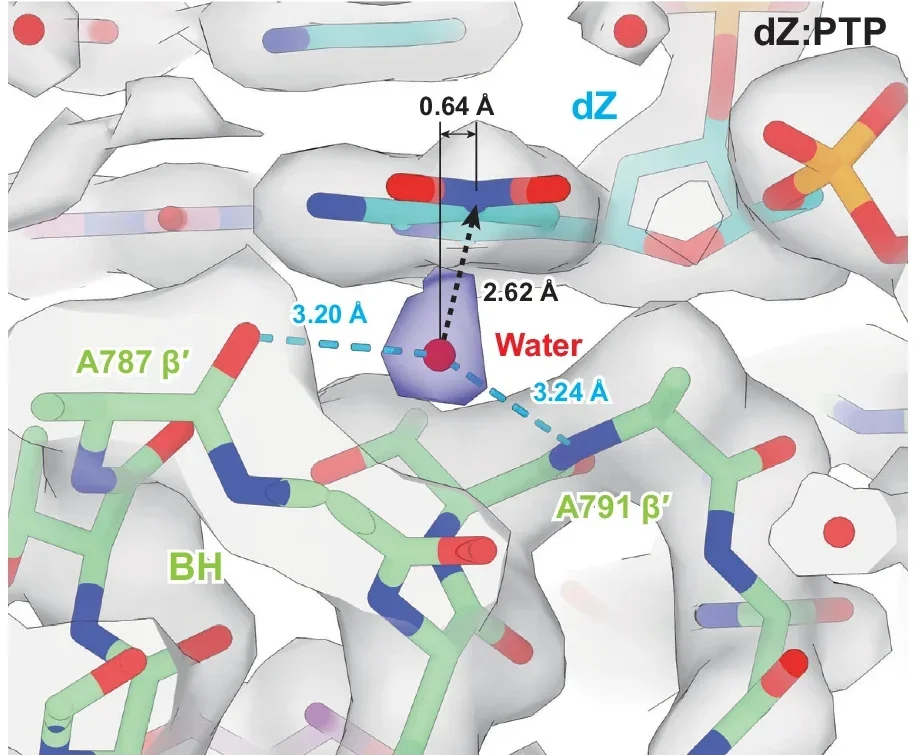
When RNA polymerase processed Z, the researchers found a water molecule positioned between the synthetic nucleotide and part of the enzyme called the bridge helix. The water participated in an unusual interaction involving the nitro group on Z.
That interaction appeared to stabilize bending of the bridge helix and promote closure of the trigger loop.
The difference was visible across thousands of cryo-EM particles. With one Z-containing complex, about 76.8% of particles showed the trigger loop in its closed form. In the Z* complex examined in the opposite base orientation, only 19.4% occupied the closed state.
The Z-containing complex also supported faster nucleotide incorporation.
The researchers caution that this water-mediated interaction probably does not explain the entire difference. Base size and other chemical features may also contribute.
Still, the observation suggests synthetic DNA letters could eventually be designed not merely to fit an enzyme, but to influence how that enzyme moves.
The experiment does not mean scientists have created an organism operating with an eight-letter genetic code.
The study demonstrated transcription using E. coli RNA polymerase in controlled biochemical systems. Researchers still need to solve additional problems before a full eight-letter system could operate through the entire cellular information pathway.
Most importantly, translation of the complete Hachimoji alphabet into proteins has not yet been achieved.
RNA polymerase could continue extending RNA after encountering the artificial base pairs, showing that synthetic letters did not cause the enzyme to stall. That establishes an important prerequisite for eventually producing messenger RNA containing expanded genetic information.
Another route may not require proteins at all.
Expanded alphabets could instead produce functional RNA molecules with chemical capabilities unavailable to conventional four-letter RNA. Previous work has already produced expanded-alphabet molecules capable of binding particular targets, including liver cancer cells.
That larger chemical vocabulary could eventually support new diagnostics, medicines, molecular sensors or engineered biological systems.
The immediate finding is more fundamental. Biology’s transcription machinery evolved in a world containing four genetic letters, yet it appears capable of recognizing more.
The genetic alphabet used by life may therefore be less chemically restrictive than nature’s four-letter version makes it appear.
These resources explore the development of artificial base pairs, Hachimoji DNA and earlier efforts to move expanded genetic information through biological machinery.
Hachimoji DNA and RNA: A genetic system with eight building blocks: Introduced an eight-letter DNA and RNA system containing four orthogonal base pairs and demonstrated that expanded genetic alphabets can retain predictable molecular structure and information storage. (Science, 2019)
A unified Watson-Crick geometry drives transcription of six-letter expanded DNA alphabets by E. coli RNA polymerase: Demonstrated how cellular RNA polymerase recognizes a six-letter expanded alphabet and established the structural groundwork for the new eight-letter experiments. (Nature Communications, 2023)
Transcription, Reverse Transcription, and Analysis of RNA Containing Artificial Genetic Components: Showed that artificial P and Z nucleotides could be incorporated into RNA using T7 RNA polymerase, an earlier milestone in expanded-alphabet transcription. (ACS Synthetic Biology, 2015)
Artificially Expanded Genetic Information Systems for New Aptamer Technologies: Reviews how expanded alphabets can increase the chemical diversity of DNA and RNA and enable new classes of molecular binding agents. (Biomedicines, 2018)
An Aptamer-Nanotrain Assembled from Six-Letter DNA Delivers Doxorubicin Selectively to Liver Cancer Cells: Demonstrates a potential biomedical application by using six-letter DNA to build an aptamer system that selectively targeted liver cancer cells in laboratory experiments. (Angewandte Chemie International Edition, 2020)
Research findings are available online in the journal Nature Communications.
The original story “Biology’s four-letter DNA alphabet just expanded to eight” is published in The Brighter Side of News.
Like these kind of feel good stories? Get The Brighter Side of News’ newsletter.
The post Biology’s four-letter DNA alphabet just expanded to eight appeared first on The Brighter Side of News.


Leave a comment
You must be logged in to post a comment.