For just one-tenth of a second in May 2019, the universe delivered a signal that did not fit the usual script.
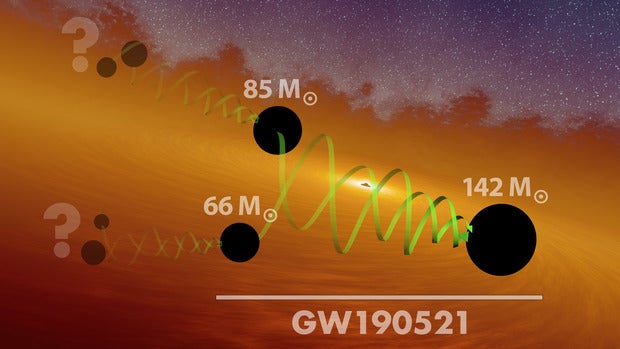
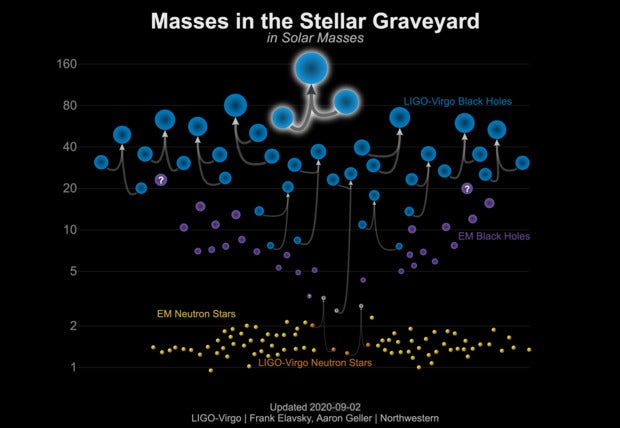
LIGO and Virgo recorded a gravitational wave from GW190521, but unlike the familiar rising chirps from orbiting black holes spiraling together, this one arrived more like a crack, brief, blunt, and missing a clear inspiral phase. That made it an oddity from the start. The LIGO-Virgo-KAGRA collaboration interpreted it as the merger of two black holes, one about 85 times the Sun’s mass and the other about 66 times, which then formed a remnant black hole of about 142 solar masses. In that reading, GW190521 became the first observed example of an intermediate-mass black hole.
Even so, the event has never sat comfortably within standard expectations. The source black holes fell into a mass range that the article describes as being in tension with established models of stellar evolution, a region often discussed as the “forbidden gap.” That tension has helped keep GW190521 near the center of debate, even as the broader catalog of gravitational-wave detections has grown to 218 events reported by the LVK collaboration.
Most of those detections have matched a familiar pattern. They come from binary black holes or binary neutron stars and carry the expected inspiral-merger-ringdown shape. GW190521 did not.
A new paper written by Physicist Qi Lai, from the University of Chinese Academy of Sciences and his team asks whether that strange burst might have come from something far more exotic than a heavy black hole merger in our own universe.
The authors propose that GW190521 could be a single gravitational-wave echo from a wormhole, specifically a wormhole created after two black holes merged in another universe and connected to ours through a throat. In their picture, the merger’s ringdown signal traveled through that throat, crossed into our side, and emerged as a short burst without any visible pre-merger buildup. That, they argue, could explain why detectors saw a compact signal instead of the longer pattern expected from two black holes spiraling together.
It is a bold interpretation, but the paper does not claim victory. Its central result is more restrained: the conventional black hole merger model still fits the data better, yet the wormhole echo idea remains a viable alternative worth testing.
That distinction matters.
To explore the idea, the researchers used a Schwarzschild-like Morris-Thorne wormhole as a proof-of-principle model. In this setup, the wormhole connects two regions through a throat, while barriers near the photon spheres act a bit like mirrors for gravitational waves. A post-merger ringdown pulse from the far side could bounce inside this structure, with part of the signal leaking into our universe as a sequence of delayed echoes.
The authors focused on the first echo only. They modeled it as a simplified sine-Gaussian pulse, a short wave packet defined by a central frequency, a width, an amplitude, and several orientation and timing parameters. In their Bayesian analysis, the best-fit central frequency came out to 56.93 hertz, with a pulse width of about 0.02 seconds. Those values, they argue, match the narrow-band, short-lived character of GW190521.
There is an important caveat here. The model leaves out spin, even though the reported remnant of GW190521 is highly spinning, with a final spin parameter of 0.72, including uncertainty. The paper explicitly identifies this as a limitation. It also does not build a full echo train with a preceding ringdown. Instead, it tests whether the observed event itself could be interpreted as the first echo pulse. That makes the work a simplified framework, not a full physical reconstruction.
Any unconventional idea has to compete with the standard explanation on the data, not just on imagination.
For that comparison, the researchers used the IMRPhenomXPHM waveform for the binary black hole case, the same general class of model used in the earlier LVK analysis. With that template, they recovered source parameters consistent with the collaboration’s reported results: black holes with masses of 97 and 59 solar masses, within the stated uncertainties, at a luminosity distance of 3.5 gigaparsecs, again with broad uncertainty.
They then compared the signal-to-noise ratios from both models across the three detectors. The wormhole-echo model produced values of 7.59 in H1, 11.84 in L1, and 3.30 in V1, for a network signal-to-noise ratio of 14.45. The binary black hole model scored 8.57, 12.58, and 3.36, with a network total of 15.59.
Those numbers are close. Close enough to make the alternative hard to dismiss out of hand.
But Bayesian model comparison still favored the black hole merger explanation. The paper reports a log Bayes factor of about -2.9 for the echo model relative to the binary black hole model, meaning the data prefer the standard interpretation. The authors point out that this outcome may partly reflect the simplified nature of their wormhole template. A more complete model, especially one including rotation and possible later echoes, would be needed for a sharper test.
Part of the fascination comes from what the event is not showing. There is no clear inspiral phase, which is usually the easiest part of a compact binary merger to recognize. That missing lead-in keeps the door open to alternative ideas, including primordial black holes, cosmic strings, new light particles, horizonless compact objects, and now this wormhole-echo scenario.
The wormhole proposal also brushes up against some of the deepest questions in physics. Wormholes belong to the broader family of horizonless exotic compact objects, which researchers study partly because they could carry clues about quantum gravity and the black hole information paradox. If a real gravitational-wave signal ever turned out to come from a wormhole, the implications would extend far beyond one astrophysical event.
Still, the paper is careful not to overstate the case. Morris-Thorne wormholes require negative-energy matter around the throat, and the article notes that this remains a serious physical hurdle. The authors also acknowledge another problem: if wormholes generate repeated echoes, why was only one seen? Their answer is that the wormhole may have pinched off quickly and collapsed into a black hole, or that later echoes were simply too faint for current detectors.
A newer burst-like event, GW231123, has only added to the sense that these short signals deserve closer scrutiny.
For now, the safest conclusion has not changed. GW190521 is still better explained as a binary black hole merger than as a wormhole echo.
Yet this study gives astronomers something useful even without overturning the standard picture. It offers a concrete way to test an exotic idea against real detector data, rather than leaving wormholes in the realm of speculation alone. It also sharpens the case for treating short-duration gravitational-wave bursts as a category that may need more systematic model comparisons, especially when they lack a clear inspiral phase.
If future detectors become more sensitive and waveform models improve, researchers may be able to sort ordinary mergers from stranger possibilities with much more confidence. Even if wormholes never emerge from the data, the effort to rule them out could improve how scientists analyze the most puzzling gravitational-wave events now arriving from deep space.
Research findings are available online in the journal arXiv.
The original story “Black hole GW190521 may be a wormhole from another universe” is published in The Brighter Side of News.
Like these kind of feel good stories? Get The Brighter Side of News’ newsletter.
The post Black hole GW190521 may be a wormhole from another universe appeared first on The Brighter Side of News.

