Black holes merge, but reversing that process presents obstacles that go far beyond running a collision backward. A single black hole cannot ordinarily divide into two smaller ones under the usual assumptions of Einstein’s gravity. A theoretical study examines those restrictions and asks what would need to change for fragmentation to become possible.
Published in Physical Review D, the work brings together researchers affiliated with the University of Southern Denmark, the University of Naples Federico II and the CNRS–Sorbonne Université laboratory LPTHE. Its title, “When black holes admit pair-of-pants topologies,” describes a hypothetical horizon branching through time. The analysis maps possible conditions for fragmentation without calculating a complete splitting process.
“In our study, we investigate which physical laws normally prevent a black hole from splitting into two,” said co-author Francesco Sannino, a professor affiliated with Naples and Southern Denmark. “We also investigate if certain circumstances may allow a split to happen.” His collaborators are Giacomo Cacciapaglia, Manuel Del Piano and Vania Vellucci.

Entropy describes how many microscopic arrangements can correspond to the same large-scale physical state. In ordinary general relativity, black hole entropy is proportional to horizon area. For an isolated, nonrotating black hole, that area grows with the square of its mass, making one large hole entropically preferable to two smaller holes of equal combined mass.
The arithmetic illustrates the problem without requiring the details of curved spacetime. Dividing a nonrotating black hole into two equal-mass pieces would give the pair only half the original horizon area. That comparison assumes the same total mass and neglects energy carried away by radiation, an idealization the study makes explicit.
Hawking’s classical area theorem provides a related restriction: horizon area cannot decrease when its assumptions hold. Those assumptions include conditions on matter and the predictability of spacetime. The theorem therefore constrains fragmentation within a particular framework, rather than settling every possibility in every proposed theory of gravity.
The researchers mainly compare states containing one or two approximately stationary black holes. They examine whether the final state passes entropy and conservation tests. Passing those tests would be necessary for the proposed channel, but would not show that an instability exists or that a physical evolution connects the states. The distinction is central because the study deliberately leaves the detailed spacetime dynamics of a proposed splitting event unspecified.
A rotating black hole has less entropy than a nonrotating black hole of the same mass. That creates a possible advantage for fragmentation if the original spin becomes orbital angular momentum carried by the separating objects. Their combined entropy could then compete with the starting black hole’s entropy.
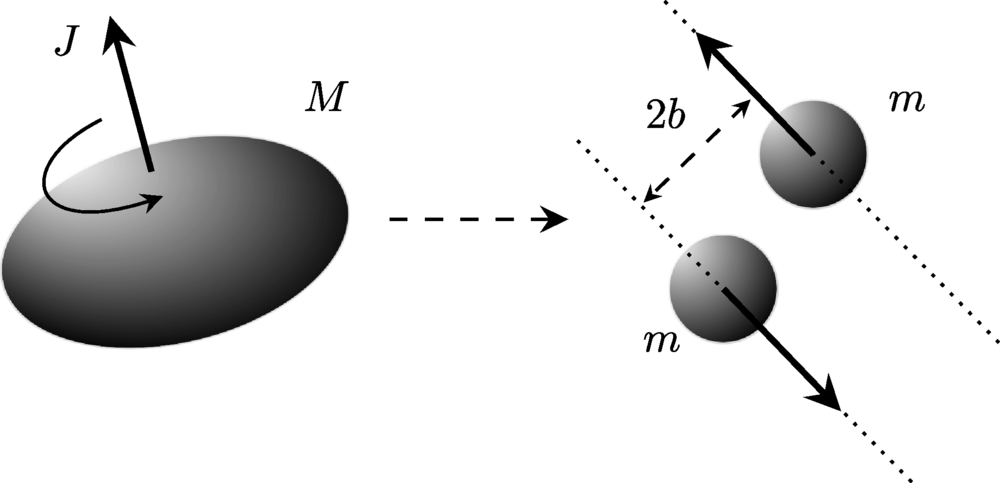
However, separation requires energy as well as angular momentum. A fragment that forms near the larger remnant must overcome its gravitational pull, rather than quickly falling back. Energy spent giving that fragment motion also reduces the mass available to the remnants and changes the entropy balance.
To explore this tension, the team considers a simplified split into two nonrotating fragments, with one much lighter than the other. The smaller fragment is approximated as a test particle moving around the larger one. This allows the researchers to combine escape requirements with energy conservation, angular momentum conservation and increasing entropy.
Those conditions generally conflict. Their overlap appears only when the original rotating black hole is near its maximum allowed spin. That is a restricted result within the model, not evidence that rapidly rotating astrophysical black holes actually break apart.
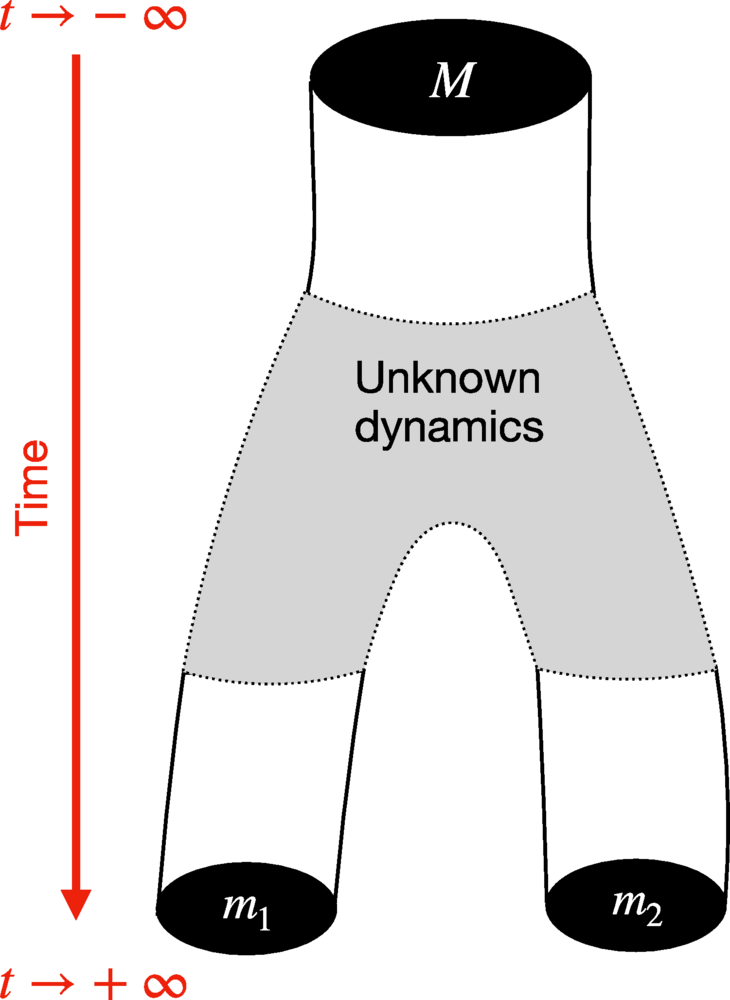
The “pair of pants” is a picture of a horizon’s history, not an ordinary object shaped like clothing. A single connected section at an earlier time would lead into two separate sections later. The waist represents the original horizon, while the two legs represent the proposed descendants.
A further mathematical restriction makes this picture particularly delicate. Under appropriate predictability assumptions, an event horizon cannot bifurcate toward the future. An entropy calculation that favors two objects does not remove that global obstruction, even if their proposed motion also satisfies escape conditions.
The paper carefully distinguishes an event horizon from an apparent horizon. The former is defined using the full spacetime history, while the latter identifies a trapping boundary on a chosen time slice. Their behavior need not be interchangeable in a changing spacetime, although they coincide in stationary situations considered here.
Consequently, a literal classical event-horizon split would require a failure of the relevant predictability assumptions. The paper associates such failures with naked singularities, places where extreme spacetime curvature is not hidden behind a horizon. Establishing whether that behavior can arise requires studying the evolving geometry, rather than just comparing possible endpoints.
Additional spacetime dimensions provide examples where fragmentation-like behavior has been studied dynamically. Extended objects called black strings can develop the Gregory–Laflamme instability, producing increasingly uneven horizons. Numerical studies have followed configurations resembling black holes connected by narrowing string segments, with a pinch-off associated with singular behavior.
These examples concern higher-dimensional models, rather than observations of ordinary black holes in our universe. Their importance is that they demonstrate how changing the setting changes the restrictions. They also show why thermodynamic arguments need to be supplemented by calculations of the actual evolution.
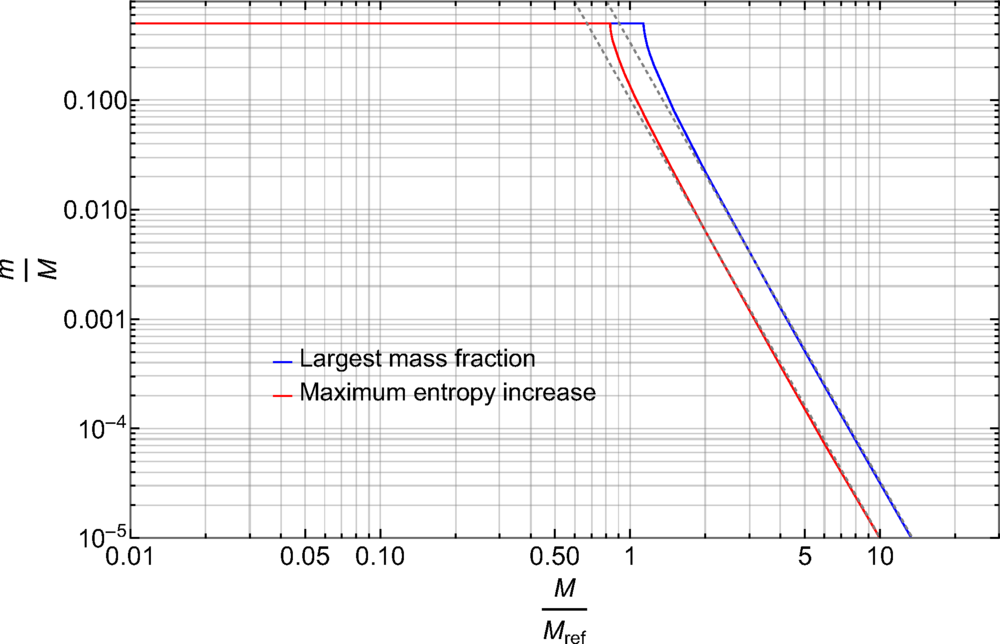
The new paper explores modified gravity theories in which horizon size or entropy depends differently on mass. Some corrections can make strongly unequal splits entropically favorable, especially when a fragment is sufficiently small. Certain higher-curvature models can even permit favorable entropy comparisons for astrophysical parent black holes, without establishing that those objects fragment.
Other possibilities involve distorted horizons supported by vortex-bearing matter configurations, or amplification of trapped radiation around rotating holes. These scenarios remain distinct, with different assumptions and unresolved obstacles. The authors do not present them as one verified mechanism with a common, calculable rate.
Small primordial black holes, hypothetical objects originating in the early universe, could be especially relevant to some fragmentation scenarios. Corrections to ordinary gravity often become important at smaller scales. Nevertheless, the authors cannot yet assign a single probability that a black hole will split, and the answer depends on the underlying gravitational theory.
One suggested observational route involves tiny black hole fragments that might form during mergers. Under the hypothesis that these fragments exist, their predicted Hawking evaporation could generate gamma rays. Instruments such as Fermi-LAT could search for such signals, but the proposal does not establish that fragments have formed or been detected.
The immediate challenge is to connect permissive conditions with an actual dynamical process. Researchers would need to determine how fragments form, whether they survive and escape, and what signals distinguish them from other sources. Until those questions are resolved, the study offers a map of the barriers and possible exceptions, rather than a prediction that black holes routinely divide.
These resources explain horizon-area tests, higher-dimensional instabilities and the proposed radiation signatures of hypothetical fragments.
GW250114: Testing Hawking’s Area Law and the Kerr Nature of Black Holes
Gravitational-wave observations test the classical relationship between merging black holes and the area of their final horizon. (Physical Review Letters, September 2025)
Looking for black hole morsels in astrophysical mergers via Hawking radiation
This theoretical study asks what gamma-ray signals might reveal tiny fragments, explicitly assuming that mergers can produce them. (Nuclear Physics B, July 2025)
Endpoint of the Gregory-Laflamme instability of black strings revisited
Numerical simulations investigate unstable black strings in five-dimensional spacetime, including horizon pinch-off and cosmic censorship. (Physical Review D, February 2023)
The Thermodynamics of Black Holes
Robert Wald’s review explains black hole entropy, the generalized second law and the relationship between gravity and thermodynamics. (Living Reviews in Relativity, July 2001)
Particle creation by black holes
Stephen Hawking’s foundational calculation describes quantum particle emission and the resulting loss of black hole mass. (Communications in Mathematical Physics, August 1975)
Research findings are available online in the journal Physical Review D.
The original story “Can a black hole split into two in accordance with Einstein’s general relativity?” is published in The Brighter Side of News.
Like these kind of feel good stories? Get The Brighter Side of News’ newsletter.
The post Can a black hole split into two in accordance with Einstein’s general relativity? appeared first on The Brighter Side of News.



Leave a comment
You must be logged in to post a comment.