For generations, the thylacine carried the reputation of a wolf in stripes. Its dog-like head, carnivorous diet and supposed appetite for livestock helped turn Australia’s largest modern marsupial predator into a target.
Its skull tells a different story.
A detailed examination of preserved thylacine skulls suggests the extinct Tasmanian tiger was poorly matched to the large-prey hunting style of wolves. Instead, its enormous head and unusually long, slender jaws appear adapted for fast, high-impact snapping bites, probably aimed at relatively small and agile animals.
The study, led by Flinders University and published in Nature Communications, found no close living mammalian equivalent for the thylacine’s combination of skull features. Researchers from Flinders University, the University of Melbourne and the Australian Museum contributed to the work.
“Our latest findings on their feeding adaptations counter the myths that drove the thylacine to extinction,” said study lead Professor Vera Weisbecker of Flinders University’s College of Science and Engineering.
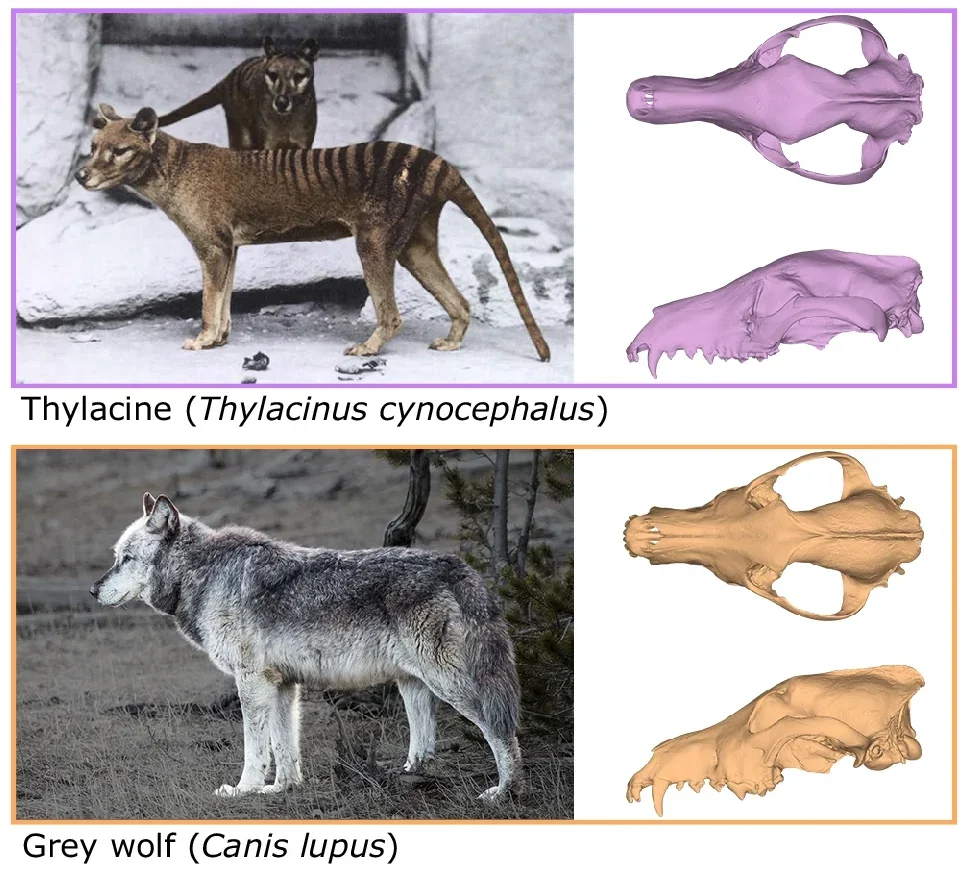
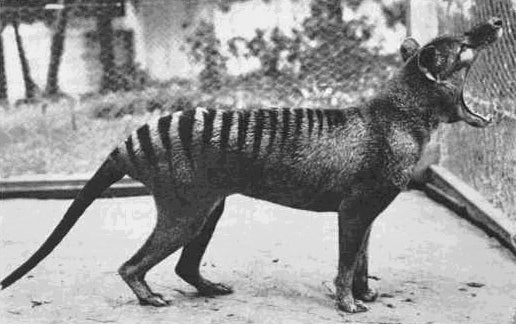
The thylacine, Thylacinus cynocephalus, became extinct in the 20th century, with the last known captive animal dying in 1936. Its scientific name means “dog-headed,” reflecting a resemblance that shaped both scientific thinking and public perceptions of the animal.
But that similarity concealed an enormous evolutionary distance.
“Thylacines were often compared to Northern Hemisphere predators such as wolves, jackals and foxes from the dog family Canidae,” Weisbecker said. “This resemblance gave them their species name ‘cynocephalus’, meaning ‘dog-head.’
“But thylacines were in fact more closely related to kangaroos than to dogs. They were marsupials, whose ancestors separated from the other mammals long before the dinosaurs went extinct.”
The new analysis compared thylacine skull anatomy with a broad range of carnivorous mammals. The researchers examined skull shape as a whole and also studied separate regions associated with feeding, development and force.
What emerged was not a marsupial version of a wolf. The thylacine instead combined anatomical traits that do not occur together in any living mammalian meat-eater.
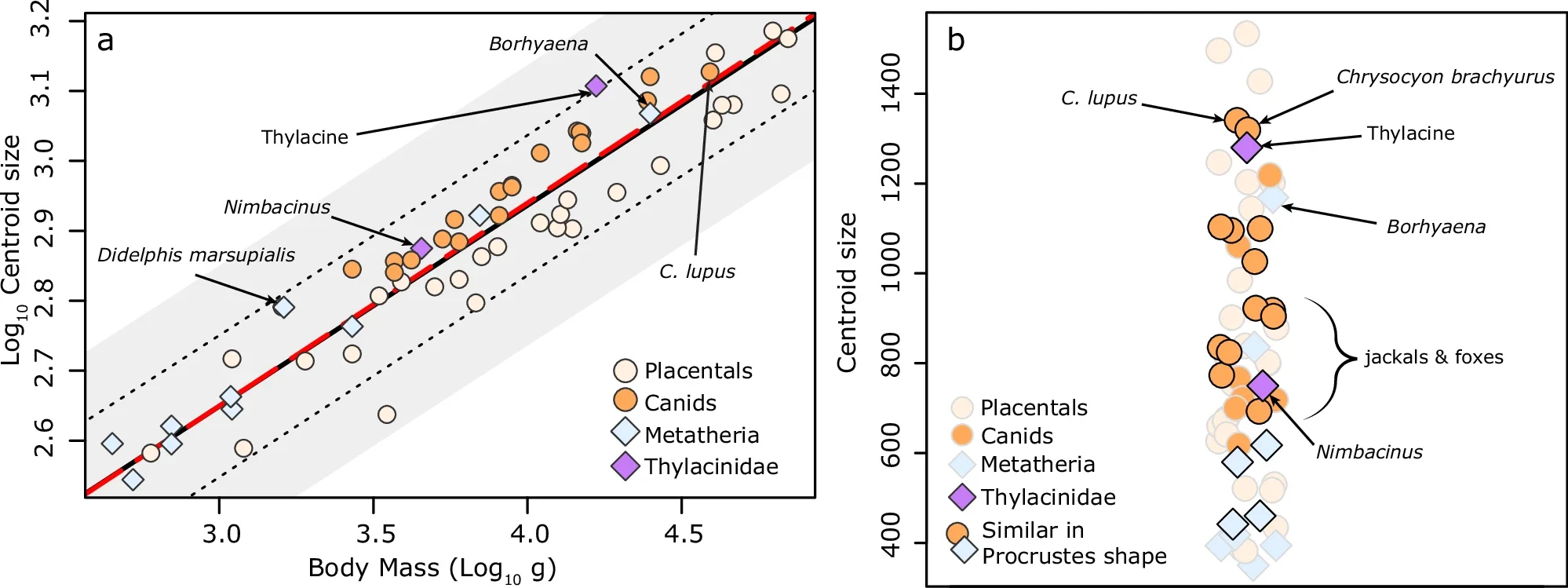
One of the animal’s strangest features was the sheer size of its skull.
The study estimates an average thylacine weighed about 17 kilograms, yet its skull approached the size of those belonging to much heavier predators, including grey wolves.
“Even though the average thylacine may have weighed only half as much as the average wolf, its vastly oversized skull is about as large as a grey wolf’s skull,” said co-author Dr Douglass Rovinsky.
Its snout, however, told another story.
“But while it was big, it wasn’t really shaped like the skull of a big predator,” Rovinsky said. “Instead, the thylacine’s snout was long and slender, almost delicate, not robust like the snout of a grey wolf. It very much looks like the snout of a fox or jackal, which can be much smaller than thylacines.”
That combination matters mechanically. Wolves that routinely tackle large struggling prey have robust skulls capable of handling substantial stresses. A long, narrow jaw sacrifices some of that resistance but can close more quickly.
The thylacine therefore combined the speed advantages of a long jaw with a skull unusually large for its body.

The researchers argue that this anatomy points toward a distinctive method of catching prey. Rather than clamping onto and wrestling large animals, a thylacine may have delivered rapid, forceful bites to smaller targets.
“The longer a jaw is, the faster its tip moves when an animal bites. This increases the impact of the strike. We think that the thylacine’s huge skull size allowed it to withstand these bite forces,” Weisbecker said.
Its upper jaw offered another clue. The front widened around the canine teeth before narrowing behind them, forming what the researchers call a “terminal rosette.” The snout was also unusually tall. Together, those features could have helped the skull absorb forces generated during fast canine-driven strikes.
The researchers found that comparable arrangements are easier to find outside living mammals.
“Many crocodiles and predatory fishes have long, fast-snapping jaws used to catch agile prey like fish. Their jaws are often much longer, and frequently sport tall and widened tips,” Weisbecker said.
The comparison does not mean thylacines hunted like crocodiles or fish. The study describes the thylacine as a terrestrial predator without adaptations for eating fish. Instead, those animals show how similar mechanical solutions can support fast snapping bites.
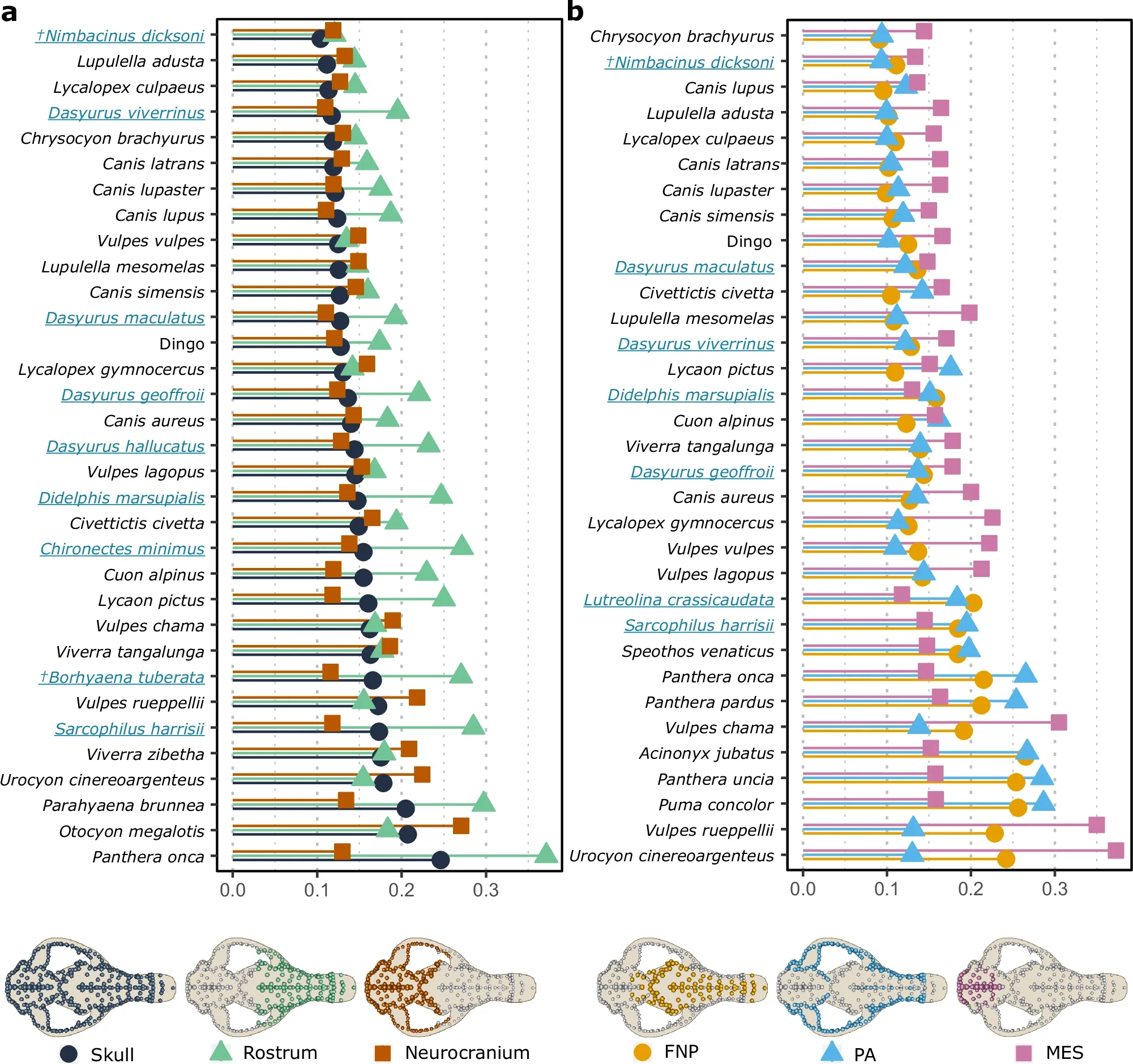
The thylacine’s skull shared individual traits with several mammals, but none reproduced the entire package.
Foxes and jackals have relatively slender snouts but much smaller skulls. Grey wolves have large skulls, but their snouts are more robust. The maned wolf comes relatively close in combined size and shape, yet its diet and body form differ substantially from those of the thylacine.
The researchers also identified an unusually large opening beneath the thylacine’s eye called the infraorbital foramen. In mammals, this opening carries nerves associated with sensation in parts of the face, including the upper lip and nose.
Its role in thylacine hunting remains uncertain. The authors caution that no preserved dissection evidence can show exactly what passed through the opening or how the animal used that sensitivity.
That uncertainty highlights the difficulty of reconstructing an animal whose behavior was never systematically studied in the wild.
The findings also complicate earlier evidence linking thylacines and wolves.
Previous work involving University of Melbourne researchers Professor Andrew Pask and Dr Axel Newton found similarities in DNA regions involved in regulating skull development. Other research showed that parts of thylacine and wolf skulls followed similar developmental patterns as the animals grew.
The new anatomical results suggest those genetic and developmental similarities did not necessarily produce skulls designed for the same hunting behavior.
“These genomic similarities might explain our previous finding that regions of thylacine and wolf skulls show similar growth patterns, even though they are quite dissimilar as adults,” the researchers said.
“Together, these findings point to exciting new opportunities in combining evolutionary biology, anatomy and genomics to explain how unique shapes like the thylacines’ skull evolve.”
For Weisbecker, the findings also carry a darker historical message. Thylacines were persecuted partly because they were portrayed as major livestock predators, even though evidence for substantial economic damage was limited.
“Thylacines were hunted because of myths that they were ferocious predators of livestock, when there was little evidence for this,” she said. “Their extinction is a story of ignorance and lack of respect for Australia’s unique wildlife and its Indigenous custodians.”
These resources examine the thylacine’s skull development, genome, hunting behavior and disappearance, helping place its unusual anatomy in a broader evolutionary and ecological context.
Ontogenetic origins of cranial convergence between the extinct marsupial thylacine and placental gray wolf: Researchers digitally reconstructed skull development in thylacines and wolves and found nearly parallel growth trajectories despite roughly 160 million years of separate evolution. The study helps explain why their skulls could look similar even when their underlying biology differed. (Communications Biology, 2021)
Genome of the Tasmanian tiger provides insights into the evolution and demography of an extinct marsupial carnivore: Genome sequencing of a preserved thylacine revealed evidence that its resemblance to canids arose largely through changes in gene regulation rather than identical protein-coding changes. The work also identified a long-term decline in genetic diversity before the species disappeared. (Nature Ecology & Evolution, 2018)
The predatory behaviour of the thylacine: Tasmanian tiger or marsupial wolf?: Analysis of thylacine limb anatomy found features more consistent with an ambush predator than with the sustained pursuit hunting associated with wolves. The findings provided an earlier anatomical challenge to the idea that thylacines behaved like canids simply because they resembled them. (Biology Letters, 2011)
Resolving when (and where) the Thylacine went extinct: Researchers compiled 1,237 records of thylacine observations and used uncertainty modeling to reconstruct the species’ decline across Tasmania. Their analysis examined whether small populations could have survived for decades beyond the death of the last known captive animal in 1936. (Science of the Total Environment, 2023)
Australia’s recently established predators restore complexity to food webs simplified by extinction: This analysis examines how the loss of native Australian predators, including the thylacine, altered mammalian food webs and how introduced predators subsequently reshaped them. It places the thylacine’s disappearance within the wider ecological consequences of Australia’s mammal extinctions. (Current Biology, 2024)
Research findings are available online in the journal Nature Communications.
The original story “Century-old myth about the Tasmanian tiger may have been dangerously wrong” is published in The Brighter Side of News.
Like these kind of feel good stories? Get The Brighter Side of News’ newsletter.
The post Century-old myth about the Tasmanian tiger may have been dangerously wrong appeared first on The Brighter Side of News.


Leave a comment
You must be logged in to post a comment.