A microscopic black hole created inside the Large Hadron Collider would vanish almost instantly. Its brief existence, however, could leave behind a spectacular spray of particles carrying enough information for physicists to recognize what happened.
Researchers working with CERN’s Compact Muon Solenoid experiment have now performed an expanded search for those signatures using 138 inverse femtobarns of proton-proton collision data collected from 2016 through 2018. They found no evidence that microscopic black holes were produced.
The absence is scientifically useful. Depending on the theoretical model, the analysis excludes semiclassical black holes with masses below about 9.0 to 11.4 tera-electron volts, or TeV, substantially shrinking the range where certain extra-dimensional theories could still produce them.
Tamas Almos Vami and Danyi Zhang of the University of California, Santa Barbara, presented the analysis for the CMS Collaboration in Progress in High Energy Physics under the title “Search for Black Holes and Sphalerons Using Novel Machine Learning Techniques at CMS.”

“It’s not a dead-end,” Zhang said. “The result is an exclusion limit, which is a real, publishable statement: ‘If this thing existed with these properties, we’d have seen it. We didn’t, so we can rule it out here.’”
Under ordinary physics, the LHC cannot produce black holes.
The collider smashes protons together at a center-of-mass energy of 13 TeV. Compressing that energy into a black hole using the familiar four-dimensional laws of gravity would require an unimaginably tiny region, around 10^-50 meters across, far below the roughly 10^-35-meter Planck length associated with quantum gravity.
Some theories involving extra spatial dimensions change that calculation. Gravity could spread into dimensions inaccessible at everyday scales, making it appear much weaker in our familiar three dimensions of space.
At extremely short distances, gravity could then become much stronger than expected. In representative models, the effective Schwarzschild radius associated with an LHC collision could reach roughly 10^-20 meters, comparable to the distance scale probed by such energetic collisions.
That possibility inspired proposals more than two decades ago that colliders might briefly produce microscopic black holes.
These objects would be nothing like the long-lived astronomical black holes produced by collapsing stars. They would decay essentially immediately, theoretically through Hawking radiation, creating a large number of energetic particles moving in many directions.
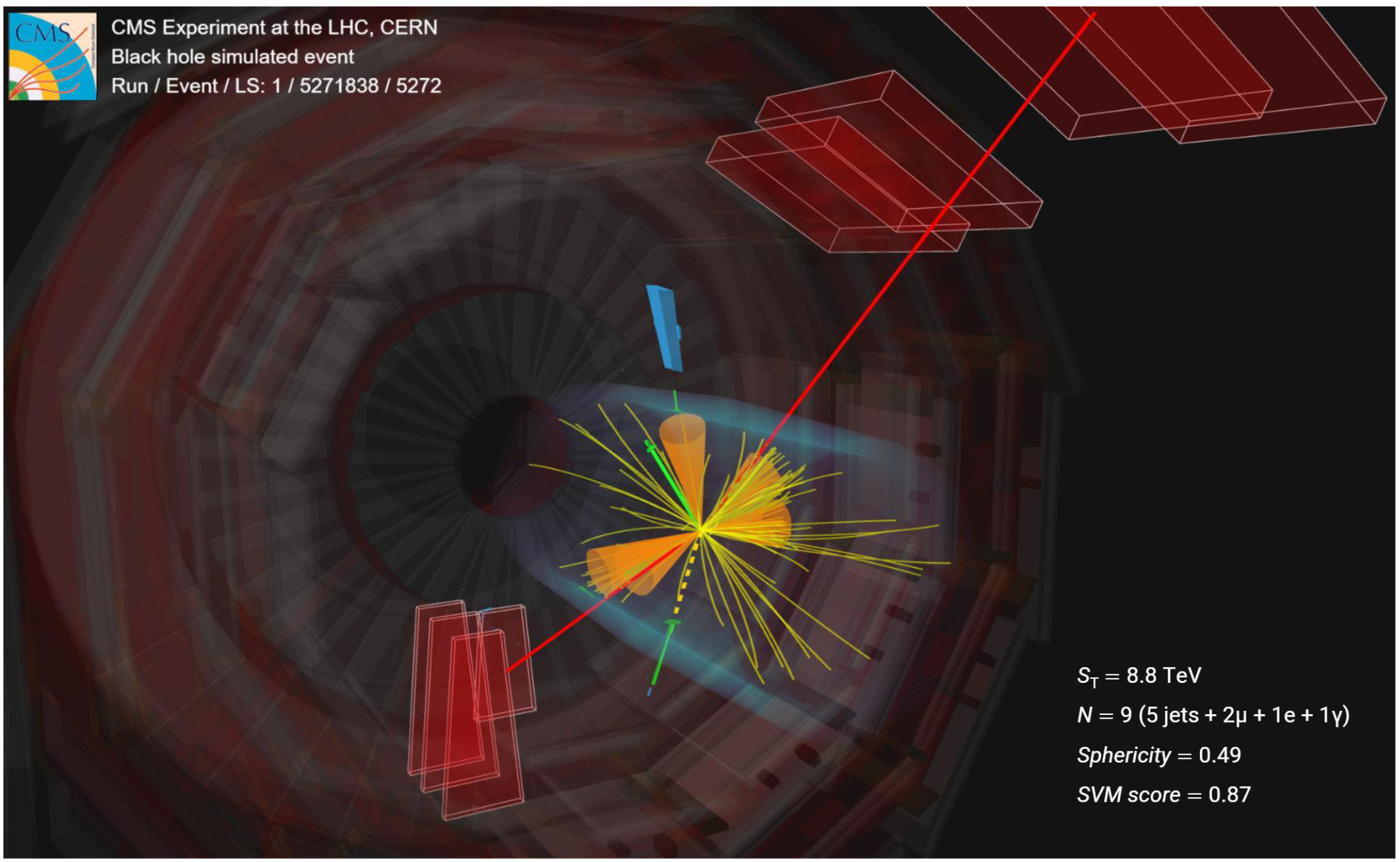
A microscopic black hole would not appear inside CMS as a tiny dark object. Researchers would instead reconstruct the particles produced during its decay.
The expected signature contains jets, electrons, muons, photons and missing momentum. Because a decaying black hole should emit in many directions, the resulting collision event would also tend to look unusually spherical.
Physicists therefore examined several features of each event. One was sphericity, a measure of whether the observed particles spread broadly through the detector rather than concentrating into a few preferred directions.
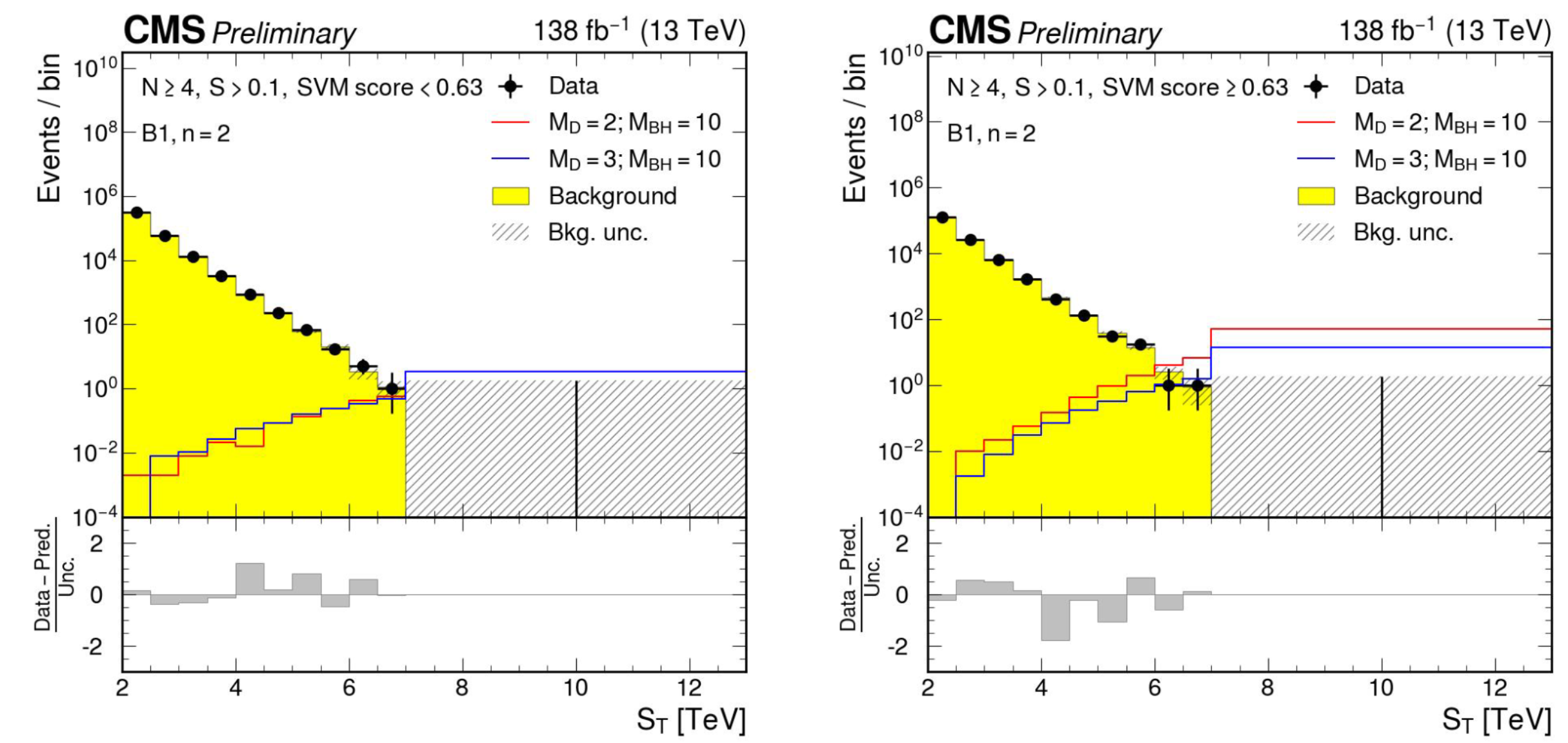
Another was total transverse energy, represented by a quantity called ST. Researchers calculate it by adding the transverse momenta of reconstructed particles and the missing transverse momentum in the event.
A black hole candidate would be expected to produce an unusually large ST value because so much collision energy would emerge in its decay products.
The challenge is that conventional Standard Model processes can occasionally produce complicated, energetic events too. Distinguishing an extraordinarily rare signal from that background requires finding subtle differences across many measured properties at once.
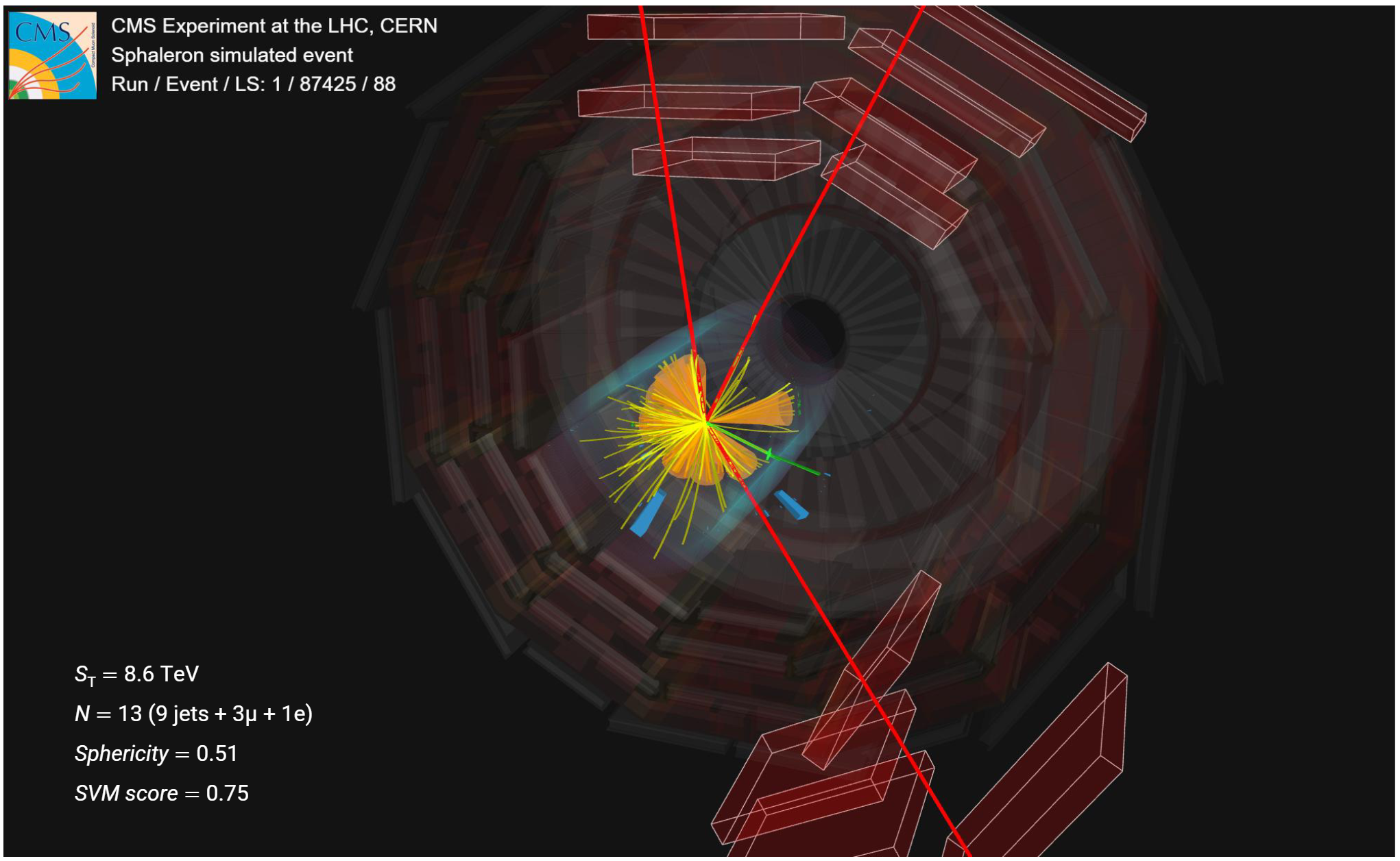
The team applied a recently developed concept called phase-space distance.
In particle physics, phase space is a multidimensional mathematical description containing information about quantities such as the momenta and energies of all particles in an event. Two collisions that look physically similar occupy nearby positions in that space, while events with different structures sit farther apart.
Researchers calculated distances between simulated black hole events and ordinary multijet collisions. They then fed that information into a support vector machine, or SVM, a supervised machine-learning algorithm that learns how to separate two classes.
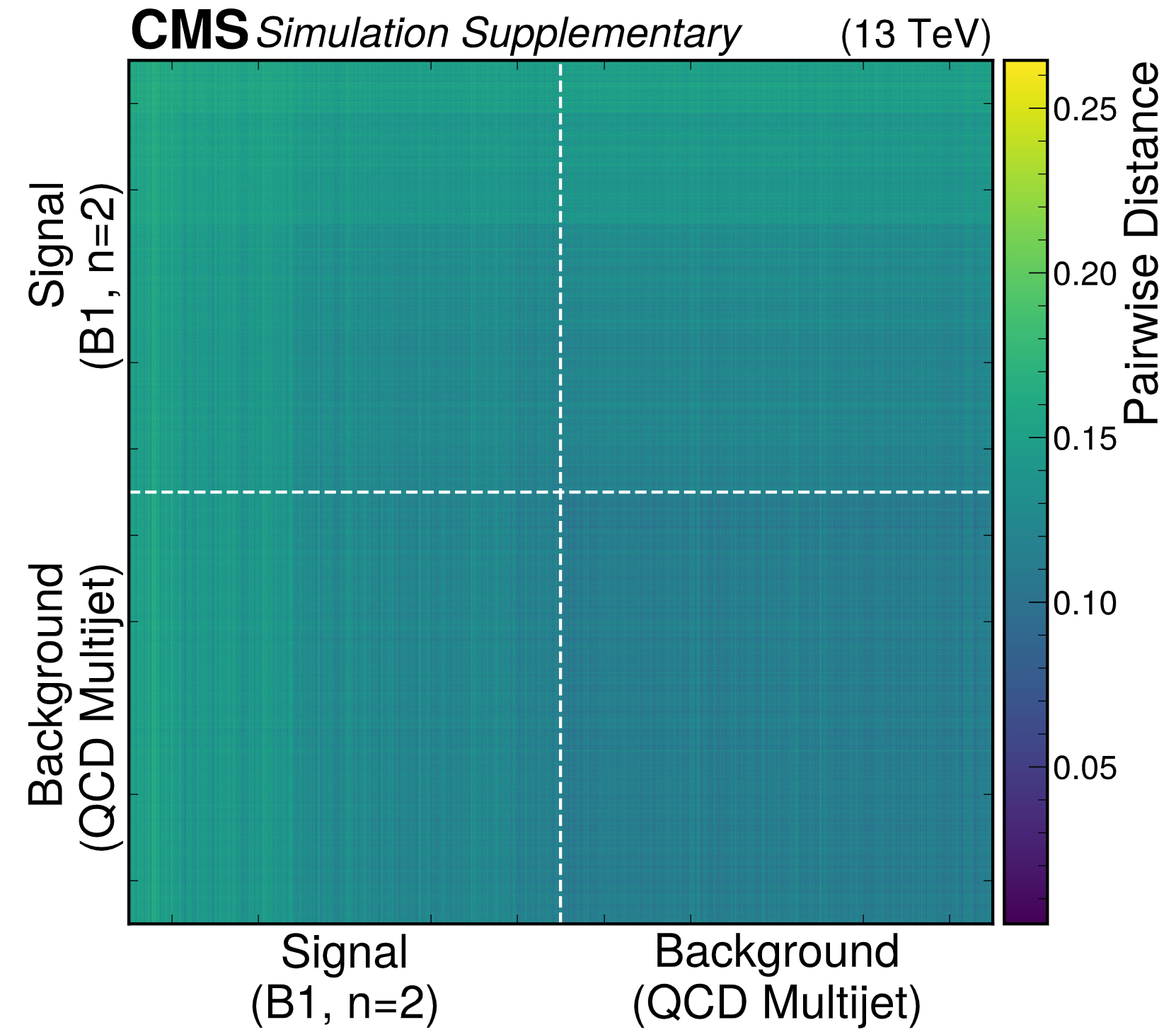
Each collision received an SVM score indicating how signal-like it appeared. Higher scores meant the event more closely resembled the simulated exotic processes.
Unlike some neural-network approaches, the method starts with a physically meaningful geometric quantity. That makes its reasoning easier for researchers to inspect.
“We compared phase space distance with the sphericity variable and our conclusion is that phase space distance outperforms sphericity,” Zhang said.
The analysis used a global SVM threshold of 0.63 and examined the remaining events as a function of ST. No statistically significant excess or deficit emerged above the expected Standard Model background.
Because CMS did not detect the predicted signal, the researchers translated the null result into limits on the models.
Across the black hole scenarios tested, masses below approximately 9.0 to 11.4 TeV were excluded. The exact boundary depends on assumptions about the fundamental Planck scale, the number of extra dimensions, whether the black hole rotates and how it loses energy.
Those exclusions improve earlier sensitivity by roughly 1 to 1.6 TeV.
The result also constrains some models containing large extra dimensions. For much of the parameter space tested, several possible numbers of additional dimensions are excluded, although the conclusions apply specifically to the theoretical assumptions used in the simulations.
That distinction is important. The experiment did not demonstrate that extra dimensions do not exist, nor did it rule out all conceivable microscopic black holes. It showed that particular combinations of black hole mass, Planck scale and extra-dimensional physics would probably have produced signals CMS should already have seen.
The analysis also targeted a second hypothetical phenomenon called an electroweak sphaleron.
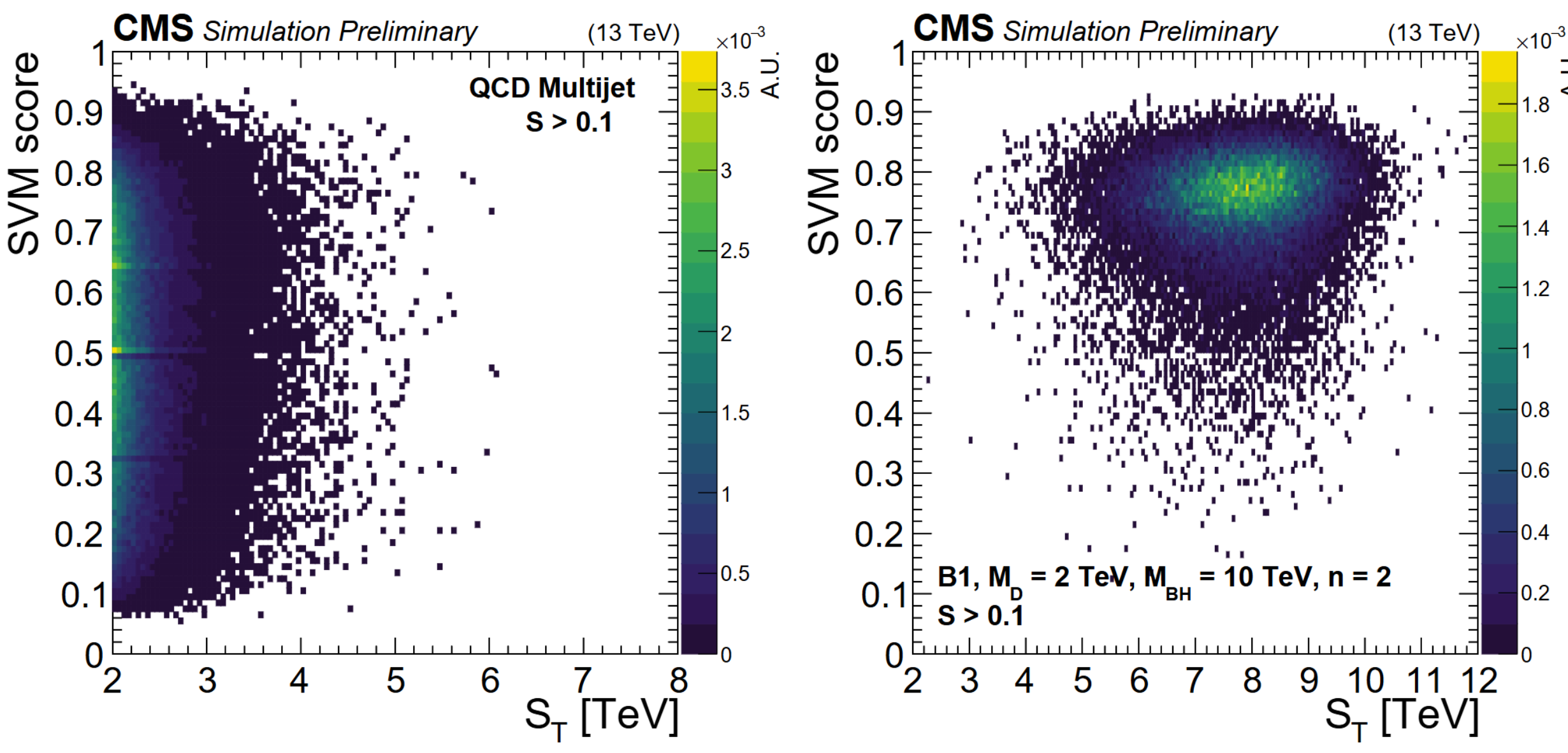
Sphalerons are not particles. They are unstable configurations of the electroweak fields that could allow transitions between different vacuum states.
Such transitions are especially interesting because they violate baryon and lepton number while conserving their difference. That property has connected sphaleron physics to one of cosmology’s enduring puzzles: why the observable universe contains far more matter than antimatter.
If sphalerons occurred at LHC energies, their decays could resemble microscopic black hole events, producing many energetic particles distributed relatively broadly through the detector. The same phase-space and machine-learning techniques could therefore search for both.
No sphaleron signal appeared.
The researchers set a 95% confidence upper limit of 0.0025 on the fraction of quark-quark interactions above a nominal 9-TeV threshold that could result in the sphaleron transitions described by the model.
Particle physics advances not only through discoveries but also by steadily eliminating possibilities.
The Higgs boson itself was found only after decades of experiments narrowed the allowed range of masses and interactions. Searches that find nothing can force theorists to revise models, move parameters or develop entirely different explanations.
The new work leaves the broader hierarchy problem unresolved. Physicists still lack a complete explanation for the enormous apparent difference between the strength of gravity and the other fundamental forces.
Without new physics such as large extra dimensions, producing even the smallest black holes accessible to direct study would require energies vastly beyond current accelerators.
For now, the LHC has not opened a doorway to microscopic black holes. But it has made the doorway narrower, while introducing a new way to search the enormous landscape of collider data for whatever unexpected physics might still be hiding there.
These studies trace the theoretical origins of collider black-hole searches and the newer methods used to distinguish exotic events from ordinary particle collisions.
Black Holes at the LHC: This influential paper proposed that microscopic black holes could become accessible at particle colliders if the fundamental scale of gravity lies near the TeV range. (Physical Review Letters, 2001)
High energy colliders as black hole factories: The end of short distance physics: This foundational study explored black hole production and Hawking-like decay signatures expected in theories with a low fundamental Planck scale. (Physical Review D, 2002)
Search for black holes and sphalerons in high-multiplicity final states in proton-proton collisions at √s = 13 TeV: An earlier CMS search using 2016 data found no excess and established previous limits on black holes, string balls and sphaleron production. (Journal of High Energy Physics, 2018)
The phase space distance between collider events: Researchers developed the geometric event-distance framework later used with support vector machines to distinguish exotic collision signatures from background. (Journal of High Energy Physics, 2024)
Search for sphalerons in proton-proton collisions: This theoretical study examined how electroweak sphaleron transitions could appear at the LHC and what their high-multiplicity signatures might look like. (Journal of High Energy Physics, 2016)
Research findings are available online in the journal Progress in High Energy Physics.
The original story “CERN scientists find no evidence that the Large Hadron Collider created microscopic black holes” is published in The Brighter Side of News.
Like these kind of feel good stories? Get The Brighter Side of News’ newsletter.
The post CERN scientists find no evidence that the Large Hadron Collider created microscopic black holes appeared first on The Brighter Side of News.


Leave a comment
You must be logged in to post a comment.