A small box on a laboratory bench can register particles produced by collisions high above Earth. Students can build it, watch its indicator flash and turn those otherwise invisible encounters into measurements.
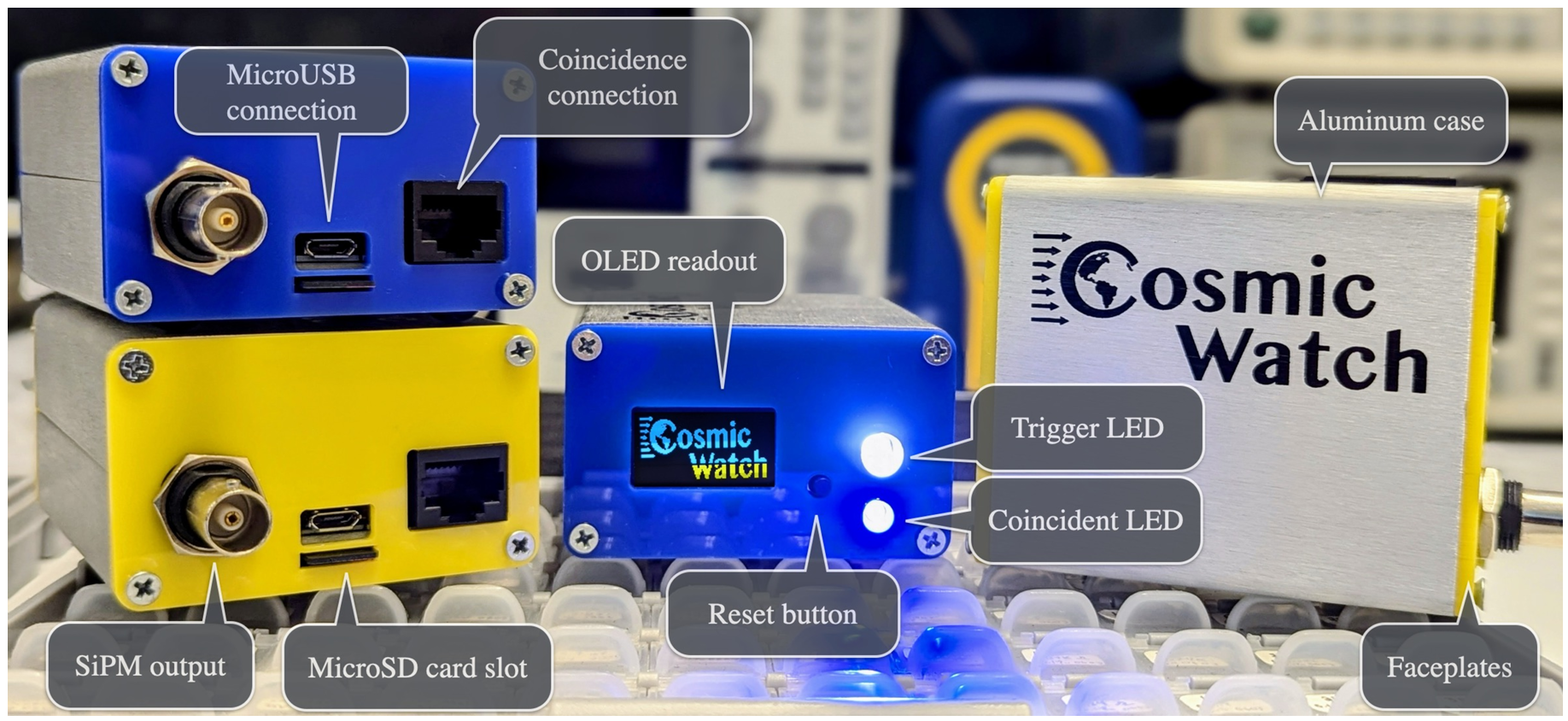
The device, called CosmicWatch, uses roughly $100 in components and fits comfortably in a hand. Developed by University of Delaware physicist Spencer Axani, it gives students and researchers a portable way to investigate cosmic-ray particles.
Its third version, described in the Journal of Instrumentation, combines faster electronics with environmental sensors and improved data collection. Demonstrations include measurements of particle direction, a balloon flight into the stratosphere and an estimate of muon speed.
The price refers to components for a detector, rather than every tool or instrument needed for every experiment. Some measurements require two units, and the speed demonstration used an external oscilloscope.
Cosmic rays are energetic particles that arrive from space. When they collide with atomic nuclei in Earth’s atmosphere, they generate showers of secondary particles, including muons.
Those muons can travel through the atmosphere and penetrate substantial amounts of matter. CosmicWatch registers their passage using a plastic slab called a scintillator, which produces light when a charged particle deposits energy inside it.
The slab measures five centimeters by five centimeters and is one centimeter thick. A silicon photomultiplier collects some of that light and converts it into an electrical signal.
Electronics amplify and measure the pulse. A small display reports counts, while a microSD card stores individual events for later analysis. The device can also stream measurements to a computer through USB.
CosmicWatch responds to other ionizing radiation as well, including signals associated with electrons and protons. A flashing indicator therefore does not, by itself, guarantee that the detected particle was a muon.
To improve identification, users can connect two detectors. When both register a particle nearly simultaneously, that coincidence helps distinguish a passing cosmic-ray muon from unrelated background radiation.
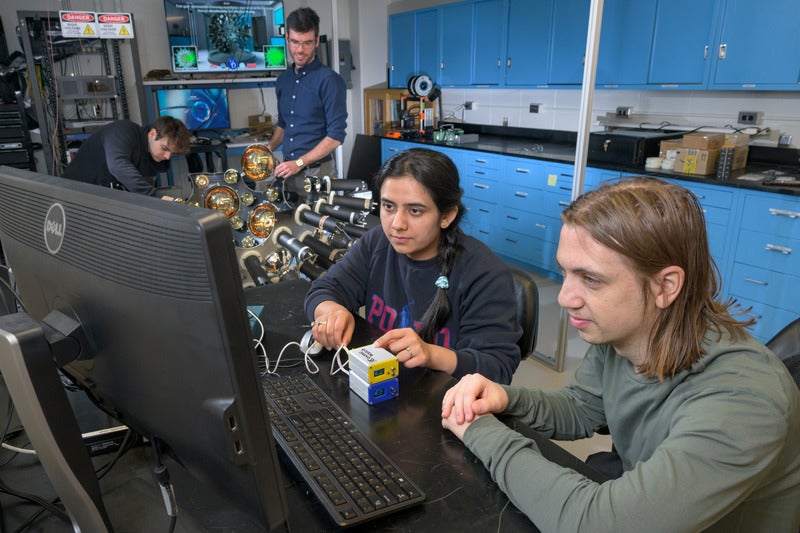
Axani began developing CosmicWatch as a graduate student at MIT in 2017. His initial goal involved a small, low-power detector for work connected with Antarctica’s IceCube neutrino observatory.
The project expanded into education when he recognized the potential of an inexpensive, portable instrument. He continued developing it after joining Delaware’s faculty in 2022.
“A typical undergraduate physics lab course uses a rack of electronics about the size of a small bookshelf to measure muons,” Axani said.
The updated model, known as v3X, weighs about 110 grams with its optional aluminum enclosure. It uses approximately half a watt of power and can run from a USB connection or portable battery.
Its maximum event rate increased from 15 events per second in the previous model to 700. The interval when the detector cannot record another event dropped from 50 milliseconds to about 400 microseconds.
That reduced downtime matters when particle rates increase. It allows measurements at particle rates that would overwhelm slower electronics.
Onboard sensors record temperature, pressure, acceleration and rotation alongside particle events. Those readings help users examine environmental effects and understand how the detector was positioned during an experiment.
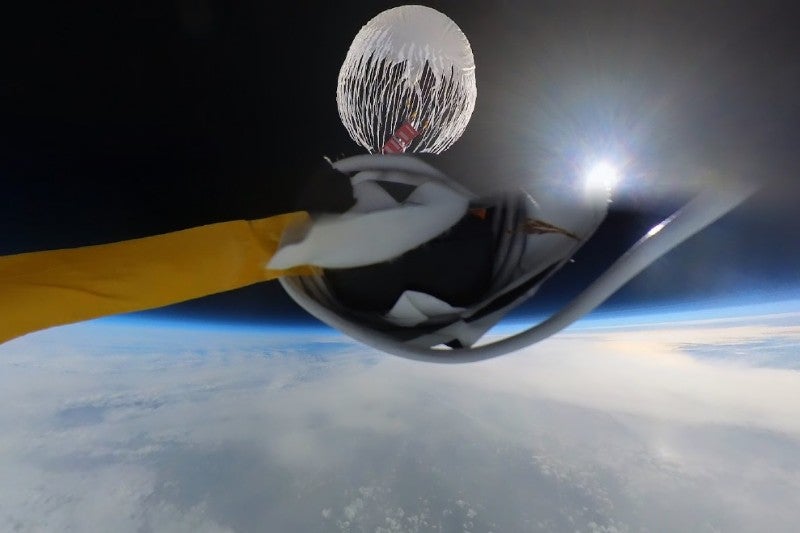
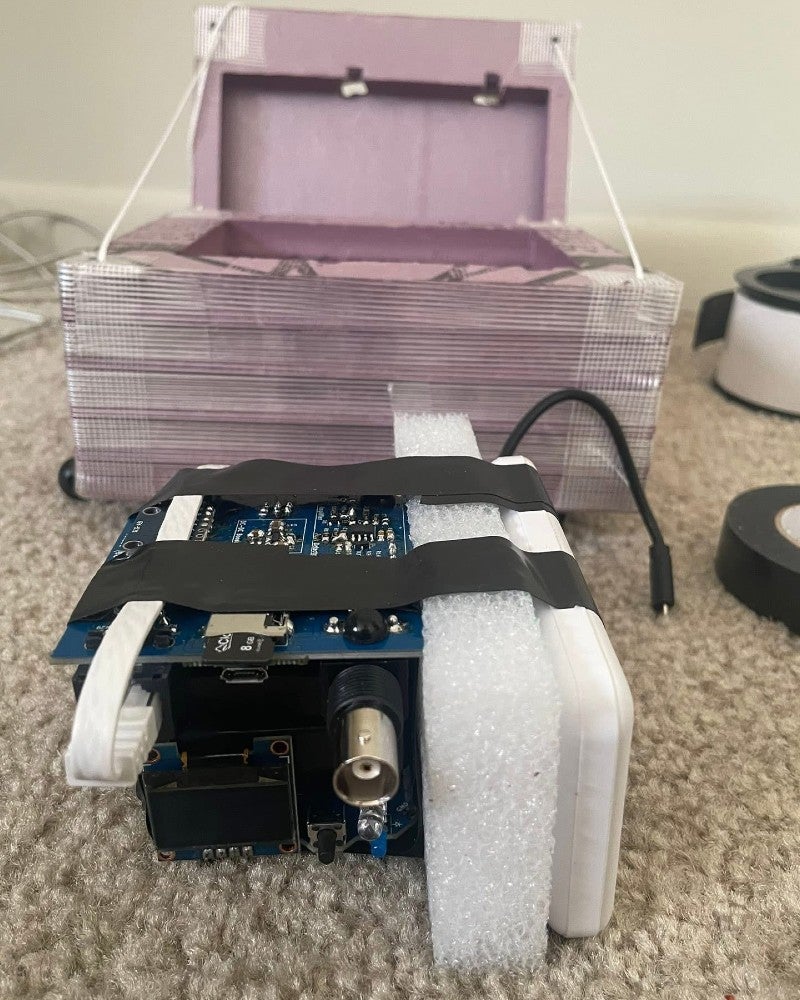
For doctoral student Musarate Shams, CosmicWatch became a way to investigate how particle rates change above Earth’s surface. He built and customized a detector system for a high-altitude balloon experiment.
The paper describes two detectors carried to roughly 31 kilometers, or about 100,000 feet. That altitude lies deep in the stratosphere, rather than at the conventional boundary of space.
A single battery pack powered the instruments, which recorded continuously to memory cards. Pressure readings provided altitude estimates, while motion sensors tracked the payload’s orientation and rotation.
The measurements showed particle counts rising during ascent and reaching a broad maximum near 20 kilometers. Above that altitude, the count rate declined as the thinner atmosphere produced fewer secondary particles.
This pattern reflects a balance between particle production and attenuation. The maximum is known as the Regener-Pfotzer maximum, a recognizable feature of atmospheric radiation measurements.
The balloon eventually burst, and Shams recovered the payload miles from its launch site. The flight turned a device assembled in a laboratory into an instrument capable of examining atmospheric particle production.
CosmicWatch’s educational role extends beyond watching a counter. Students assemble electronics, learn programming, collect measurements and design experiments around questions they can test.
At Delaware, Axani uses the instruments to teach particle, nuclear and astrophysics. Cornell University also incorporates detector building into introductory physics courses.
For Masooma Sarfraz, a doctoral student who contributed significantly to the paper’s analysis and writing, the project connected theoretical work with practical measurement.
“For a student like me who has been working on theoretical ideas, this was a perfect opportunity to dive into the experimental side,” she said.
The paper illustrates several possible investigations. Rotating paired detectors reveals how muon counts vary with direction, while separating them vertically allows a speed measurement with suitable external equipment.
In that demonstration, detectors placed 2.97 meters apart recorded 92 events over several weeks. The estimated average speed was 0.92 times the speed of light, with a reported spread of 0.09 times that speed.
Such measurements require careful attention to timing, backgrounds and detector geometry. They give students experience with the practical choices that shape an experimental result.
The detectors also serve as calibration instruments in larger research projects. Delaware reports their use in NuDot and the Coherent CAPTAIN-Mills experiment at Los Alamos.
Axani estimates that thousands have been built since the project began. He envisions a citizen-science network that would collect measurements from different locations, although that remains a broader goal.
Space-oriented variants and satellite radiation-monitoring applications are also under development. These efforts build on a compact design that already supports measurements beyond a classroom bench.
The device’s immediate contribution is concrete: students can construct an instrument, collect particle data and investigate the physical processes behind each count.
These resources explore affordable detectors, muon imaging and practical uses of particles produced in the atmosphere.
The CosmicWatch Desktop Muon Detector: a self-contained, pocket sized particle detector: Describes an earlier CosmicWatch design and its educational and research applications. (Journal of Instrumentation, 2018)
Muography: Introduces muon-based imaging and other technologies, including their measurement limitations. (Nature Reviews Methods Primers, 2023)
Precise characterization of a corridor-shaped structure in Khufu’s Pyramid by observation of cosmic-ray muons: Demonstrates how muon measurements can characterize inaccessible spaces inside a monumental structure. (Nature Communications, 2023)
Discovery of a big void in Khufu’s Pyramid by observation of cosmic-ray muons: Reports a major archaeological application of noninvasive cosmic-ray muon imaging. (Nature, 2017)
Recent research progress on cosmic ray muon imaging technology: Reviews muon sources, imaging principles and developments in detector applications. (Nuclear Engineering and Technology, 2026)
Research findings are available online in the Journal of Instrumentation.
The original story “CosmicWatch lets students build a detector for invisible cosmic-ray particles” is published in The Brighter Side of News.
Like these kind of feel good stories? Get The Brighter Side of News’ newsletter.
The post CosmicWatch lets students build a detector for invisible cosmic-ray particles appeared first on The Brighter Side of News.


Leave a comment
You must be logged in to post a comment.