Flat, fruit-flavored drinks may not sound like a breakthrough in spaceflight. But for astronauts headed into longer missions, they could solve two stubborn problems at once: how to make food less monotonous, and how to deliver nutrients that are hard to get from standard space meals.
That is the idea behind a new study in ACS Food Science & Technology, where researchers designed fortified beverage emulsions that could be made both on Earth and in microgravity. The drinks are built to carry omega-3 fatty acids, offer different sweetness levels and flavor profiles, and remain stable when mixed through a low-energy microfluidic process.
Current space menus still rely heavily on ultrastable foods such as dehydrated and thermostabilized meals. Those products meet basic nutritional needs, but they do not fully solve a problem astronauts have reported for years: reduced appetite during space travel. If crews eat less than they should, meeting calorie and nutrient targets becomes harder, especially on missions lasting more than six months.
Svenja Schmidt from the School of Chemical Engineering at Adelaide University and lead author of the study, said the issue becomes more urgent as missions get longer. Astronauts lose bone mass and muscle density in microgravity, and although exercise helps, diet also matters. “Fortified beverage emulsions could potentially help there, especially when providing nutrients at levels not met by normal nutrition,” she said. “We suggested omega-3 fatty acids to help protect against space radiation and increase the bone formation rate.”
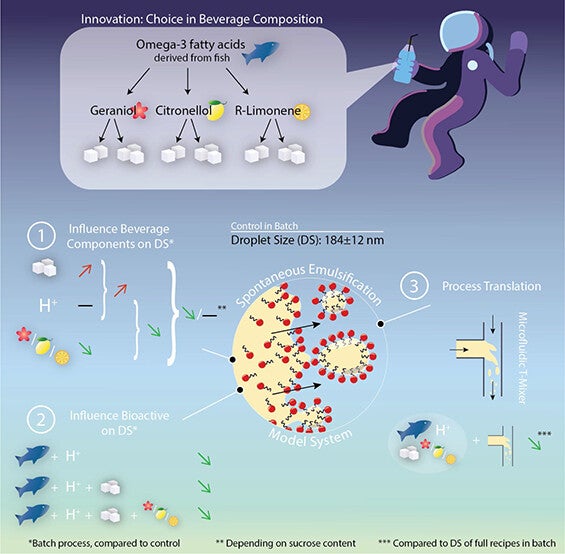
The team, led by Schmidt, Volker Hessel and Ian Fisk, did not set out to replace meals. Their approach is closer to a customizable supplement system, one that could work alongside standard foods and eventually be prepared on demand during space missions.
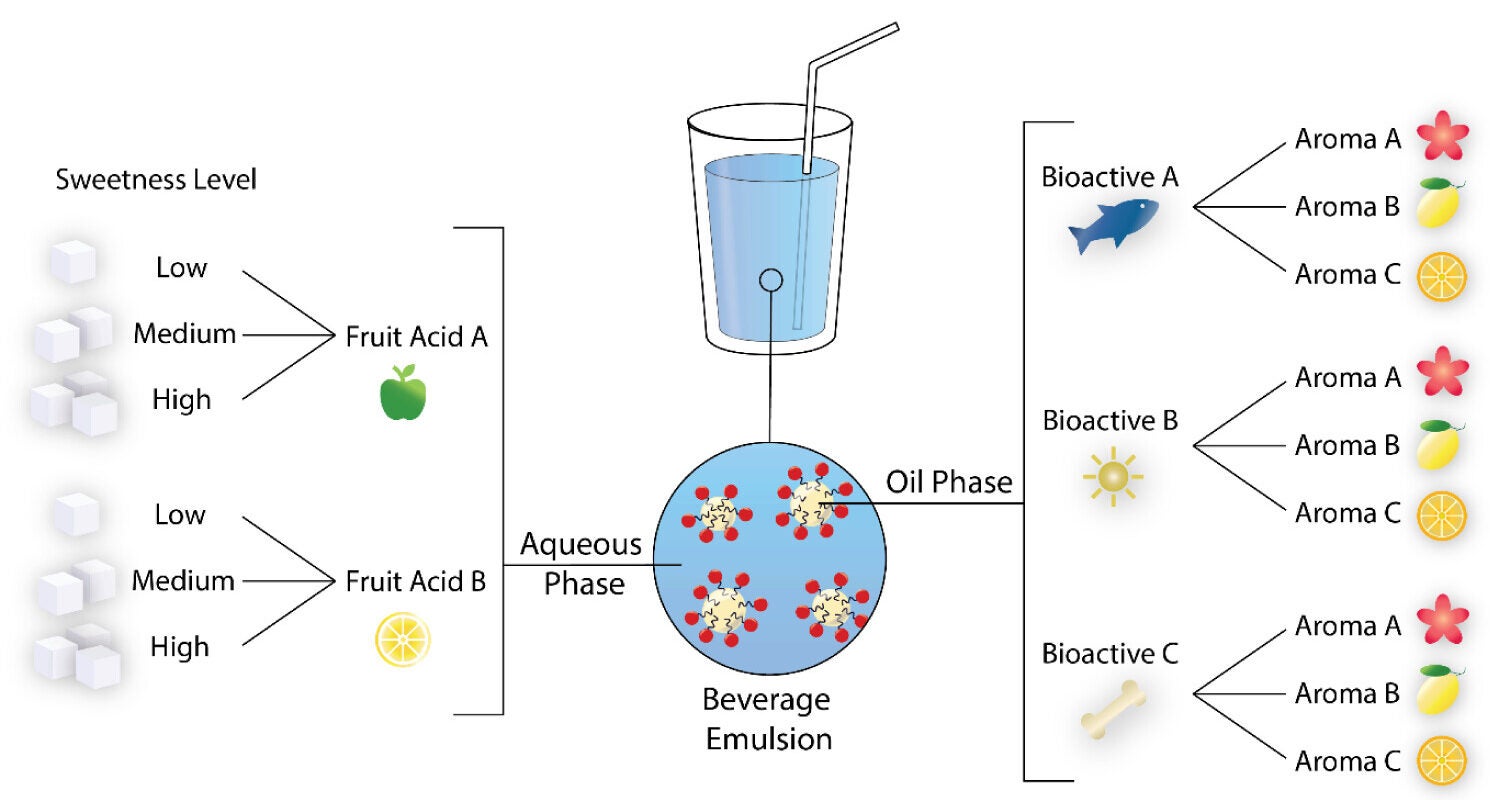
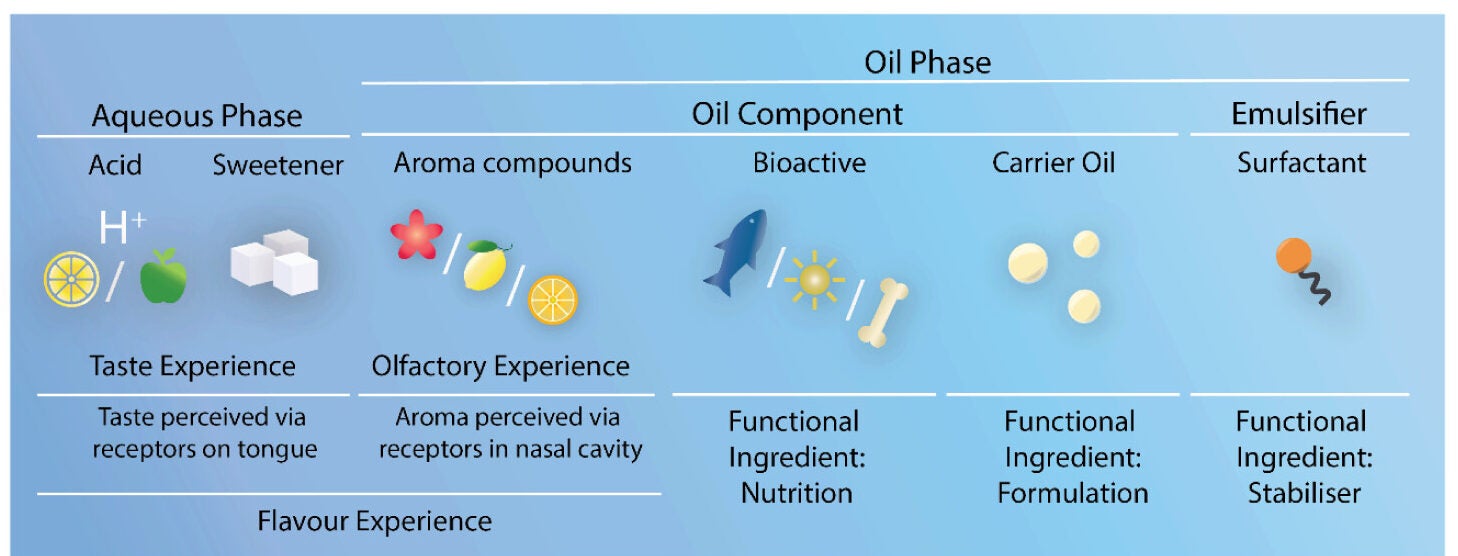
Their concept uses what the researchers call a recipe library. Instead of shipping every finished beverage from Earth, astronauts could combine a small set of building blocks, including sweetened water phases and flavored oil phases, into different drinks depending on taste or nutritional need. In practice, that could let a crew member choose a certain flavor, a certain sweetness, and a certain bioactive ingredient through software tied to an automated production line.
That matters because food monotony is more than an annoyance. Variety can affect morale, appetite and long-term willingness to eat enough.
Omega-3 fatty acids were the first target nutrient in this work. The human body cannot make them, and typical sources such as seafood are not easy to provide on long missions. The research points to two reasons they matter in space: they may help reduce bone resorption by supporting bone formation, and they may also help lower some radiation-linked health risks.
Getting omega-3s into a water-based drink is not simple. Oils and water resist each other, which is why the team focused on nanoemulsions, mixtures with extremely small oil droplets dispersed in water. Smaller droplets can improve bioavailability and help keep the drink from separating.
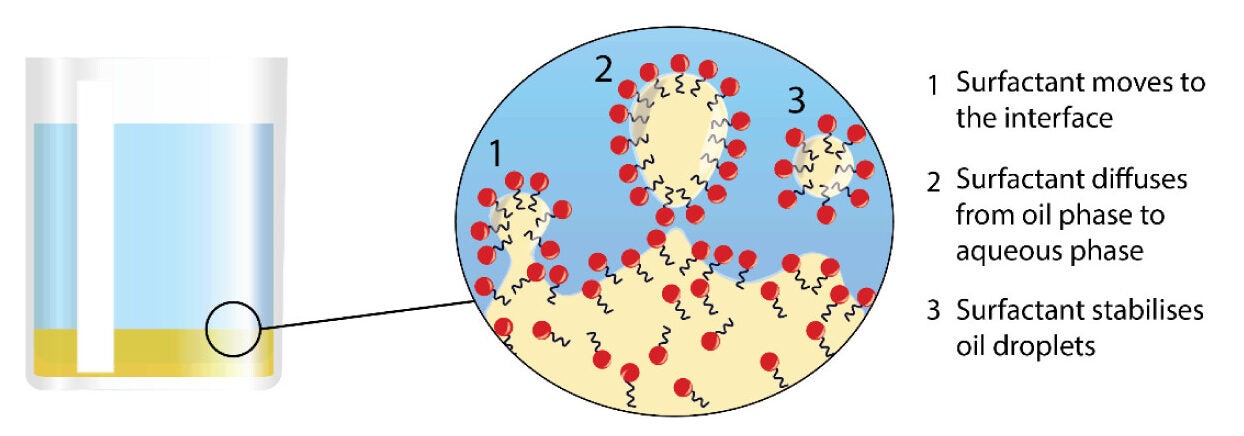
The researchers used spontaneous emulsification, a low-energy method that avoids the strong mechanical forces often used in conventional emulsification. That matters because high-energy mixing can create heat and potentially damage sensitive ingredients. In this method, a surfactant diffuses from the oil phase into the water phase, helping droplets form on their own.
They tested sugars, acids, aroma compounds and fish oil to see how each changed droplet size and stability. Some ingredients made the system work better. Others got in the way.
Sugar was the biggest obstacle. At concentrations above 25 grams per liter, fructose, glucose and sucrose generally pushed droplet sizes upward, often beyond the target range for nanoemulsions. The likely reason is physical rather than chemical: added sugar increases the density and viscosity of the water phase, which slows diffusion.
Fish oil did the opposite. It had the strongest positive effect of any ingredient the team tested. When it replaced part or all of the carrier oil in the oil component, droplet size dropped sharply, in some cases by nearly half. The authors suggest the structure of omega-3-rich triglycerides, especially their flexible double bonds, may help the diffusion process that drives droplet formation.
Flavor compounds also played a useful role. Several reduced droplet size and narrowed the size distribution. Among those tested, geraniol, citronellol and R-limonene became the most useful candidates for the final formulations.
Acids had a smaller effect. Citric acid and malic acid sometimes lowered droplet size slightly, but they also tended to widen the droplet-size distribution, making the emulsions less uniform.
From those results, the team created six fortified beverage recipes. Each used sucrose, citric acid, one of three aroma compounds, and a one-to-one mix of fish oil and medium-chain triglycerides. The recipes offered two sweetness levels, 50 and 100 grams of sucrose per liter, and three flavor directions through geraniol, citronellol and R-limonene.
In the batch process, these drinks produced droplet sizes from about 110 to 148 nanometers, squarely within the nanoemulsion range. Each 330-milliliter serving delivered about 90 milligrams of omega-3 fatty acids, or roughly one-third of the daily amount the researchers referenced for astronauts, depending on mission guidelines and sex. Schmidt said the finished drinks had a consistency similar to flat soda that has lost its carbonation.
The next test was whether those recipes could be made through a continuous microfluidic setup, using a simple T-shaped mixer. That question matters for space because a continuous system is easier to imagine in an automated dispenser than a beaker-and-stirrer process.
The answer was yes, with a caveat.
Across all six recipes, the continuous process produced smaller droplets than the batch method, usually in the 80 to 120 nanometer range. That suggests microfluidics improved the mixing environment and made spontaneous emulsification more efficient. But the system was also more sensitive to sugar concentration, and at low flow rates the researchers observed gel formation in parts of the equipment, which could complicate cleaning and maintenance.
Even so, Hessel sees the work as a meaningful step. “Being one small piece in the big puzzle of human space exploration and helping astronauts to stay healthy is a visionary privilege,” he said.
The drinks are not ready for a spacecraft menu yet.
The study did not include human taste testing, and that is no small omission when fish oil is involved. The researchers note that fish oil can produce a strong aftertaste, and they still need to find out how these beverages taste both in normal gravity and in microgravity, where sensory perception can shift.
Shelf life is another open question. Emulsions are not permanently stable, and omega-3-rich oils are vulnerable to oxidation. The team says future work should examine long-term storage, safety, flavor release, and whether the emulsions can hold up under radiation exposure and launch forces. They also call for in vitro and in vivo safety studies, even though the ingredients themselves are food-grade.
Still, the broader result is hard to miss. The study shows that carefully chosen ingredients, paired with a low-energy microfluidic process, can turn a difficult nutritional problem into something more flexible, and maybe more drinkable.
This work points to a practical new tool for long-duration space travel: on-demand fortified drinks that can add variety and deliver nutrients that standard space meals may not provide in sufficient amounts.
The system could help support bone health, improve dietary flexibility, and reduce reliance on carrying fully prepared beverages from Earth. It also suggests a path for future food systems that are more personalized, which could matter on missions lasting months or years.
The findings may also have uses on Earth. A low-energy way to produce fortified nanoemulsions could interest the beverage industry, especially for products that combine flavor customization with added nutritional ingredients.
Research findings are available online in the journal ACS Food Science & Technology.
The original story “Customizable drinks help astronauts get nutrients they miss in orbit” is published in The Brighter Side of News.
Like these kind of feel good stories? Get The Brighter Side of News’ newsletter.
The post Customizable drinks help astronauts get nutrients they miss in orbit appeared first on The Brighter Side of News.

