A crater that never sees sunlight might sound like the wrong place to build delicate scientific equipment. Jun Ye sees it differently.
In the permanent darkness near the Moon’s south pole, some craters stay so cold and still that they may offer the best natural setting in the solar system for one of physics’ most demanding instruments: an ultrastable laser. Ye, who is affiliated with both the National Institute of Standards and Technology (NIST) and JILA, a joint institute of NIST and the University of Colorado Boulder, and an international team of researchers argue that these permanently shadowed regions could support a silicon optical cavity with a level of frequency stability beyond today’s best Earth-based systems.
That kind of laser would do far more than sit quietly in a crater. It could help create a lunar time standard, guide spacecraft trying to land in badly lit terrain, link satellites with precise optical signals, and support future experiments in gravity, astronomy, and quantum networking.
The case rests on a simple idea. A laser becomes more stable when its light is locked to an optical cavity, a carefully built silicon structure with mirrors at both ends. Only certain light frequencies can resonate inside it, and those frequencies depend on the exact spacing between the mirrors. If that spacing stays constant, the laser’s color stays constant too.
On Earth, that spacing is always under attack from vibration, heat, air molecules, and other disturbances. The Moon, the team argues, removes much of that trouble at once.
The permanently shadowed regions, often called PSRs, are among the coldest places in the solar system. Remote sensing from NASA’s Lunar Reconnaissance Orbiter has tracked temperatures near the south pole ranging from about 20 kelvins in winter to 60 kelvins in summer. The slow seasonal drift is about 50 millikelvins per day.
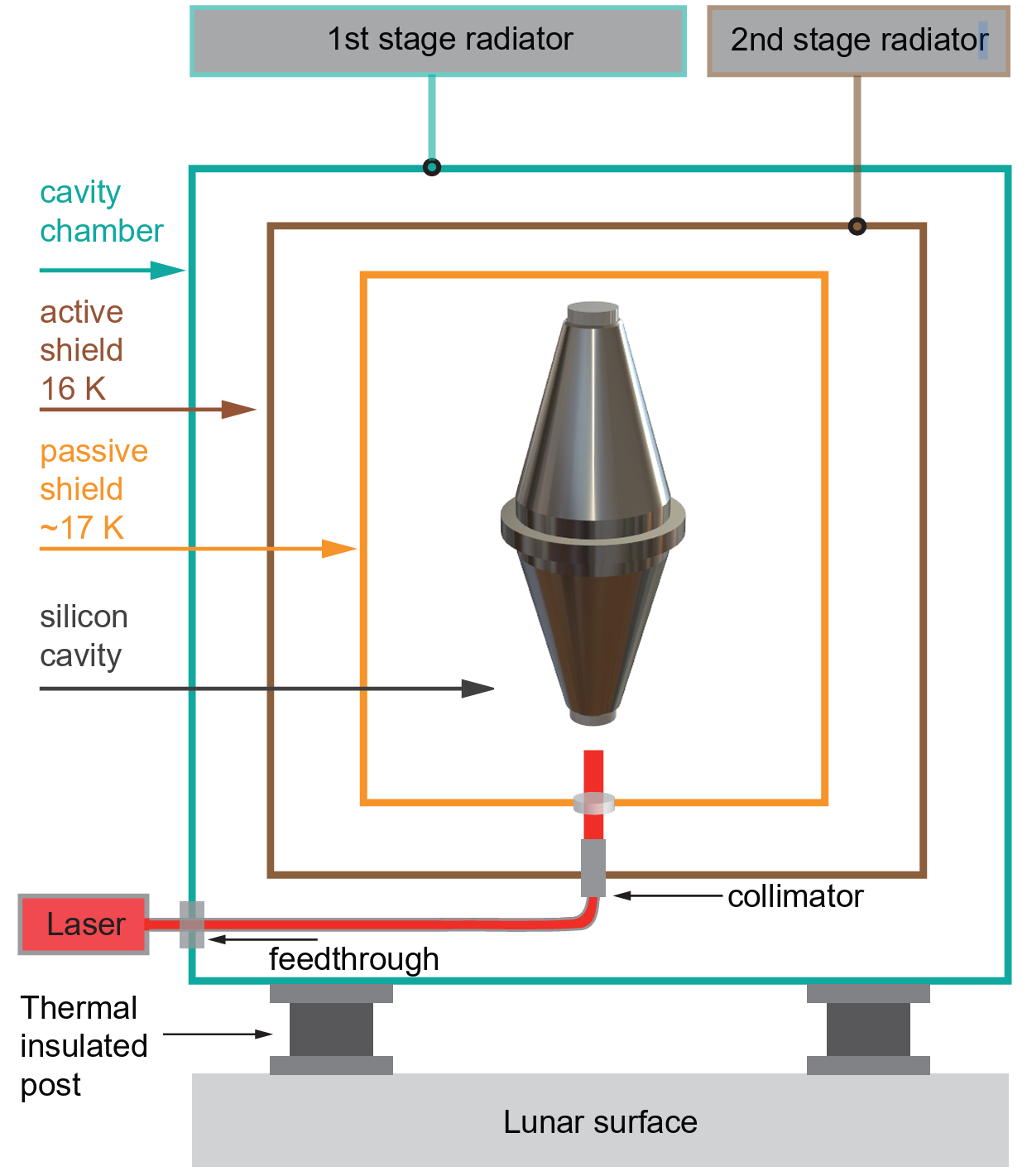
That matters because the mirrored surfaces inside an optical cavity jitter less at lower temperatures. The team proposes cooling a silicon cavity to about 17 kelvins, close to the point where silicon’s thermal expansion coefficient crosses zero. At that temperature, tiny thermal changes no longer make the material noticeably expand or contract.
The Moon’s polar shadows offer another advantage: passive cooling. Instead of relying on a vibration-producing cryostat, the cavity could dump heat into deep space through radiators. The proposed system uses multiple thermal shields and two radiators facing the black sky, with the cold of deep space, about 2.7 kelvins, helping stabilize the cavity.
That design, the researchers write, could keep the active thermal shield near 16 kelvins and the cavity itself operating near 17 kelvins.
Ye said the idea clicked once he understood what those shadowed regions could offer. “As soon as I understood what the permanently shadowed regions can offer, I felt that this would be the most ideal environment for a super-stable laser.”
Temperature is only part of the story.
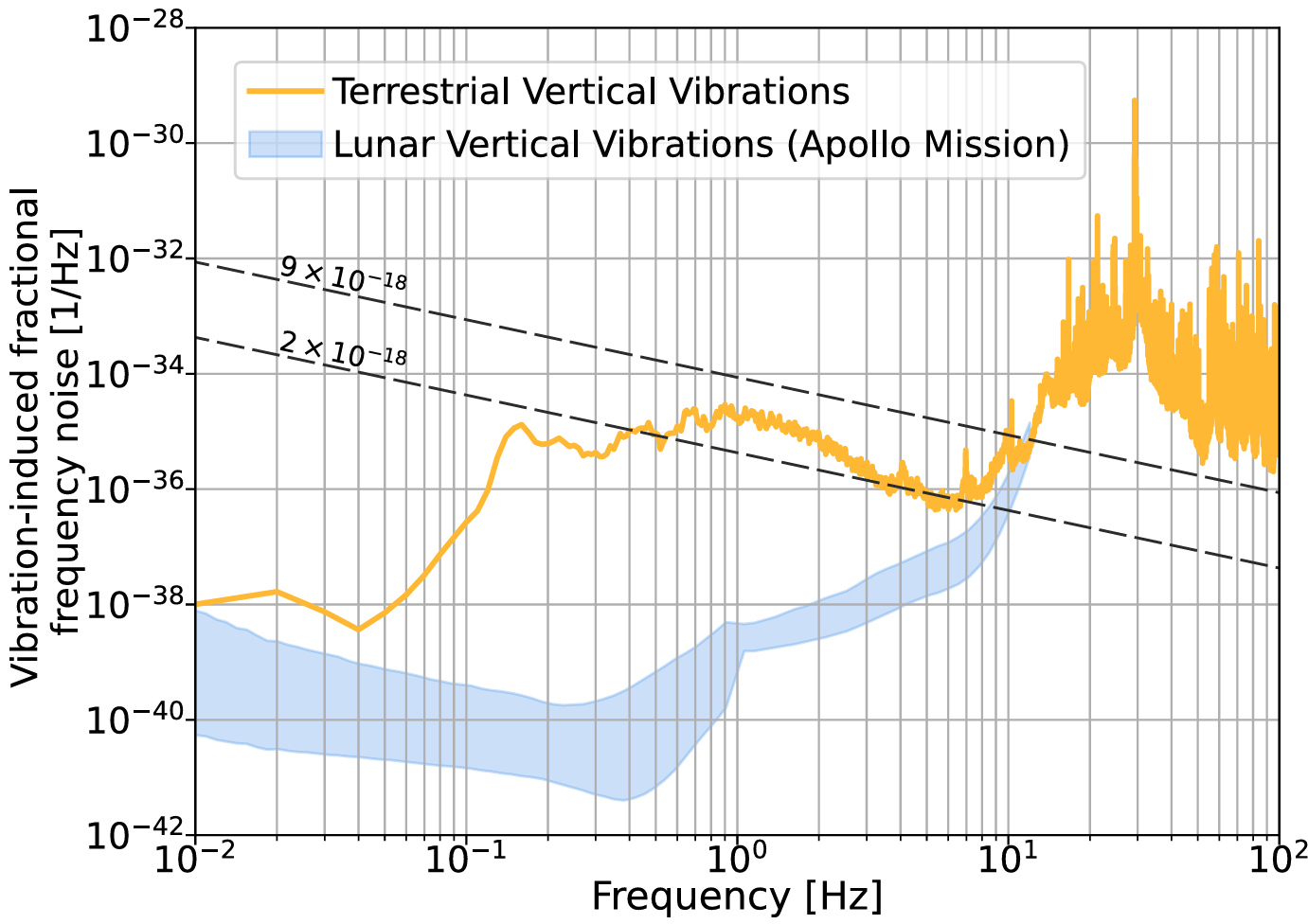
The Moon has no substantial atmosphere, which means no above-ground acoustic noise. Its seismic background is also far weaker than Earth’s. Apollo-era measurements found ambient lunar ground vibration below the seismometer noise floor, around 0.3 nanometers at 1 hertz in quiet periods. The team notes that overall seismic noise on the Moon is about four orders of magnitude lower than even the quietest continental sites on Earth.
That does not mean the Moon is perfectly still. Moonquakes happen. So do meteor impacts. Thermal moonquakes can occur when surface temperatures swing sharply between lunar day and night. But inside permanently shadowed regions, where temperature changes are much smaller than at Apollo landing sites, the authors expect fewer thermal quakes.
The vacuum helps too. Apollo missions measured surface neutral particle pressures of about 10⁻⁶ pascals during lunar day and 10⁻¹⁰ pascals at night. In the colder, darker PSRs, the researchers expect pressure to be even lower and more stable. That should reduce stray particles and pressure changes that could otherwise alter the optical path inside the cavity.
Put together, the cold, the quiet, and the vacuum make a strong case for pushing laser stability well past what terrestrial systems can manage.
The team estimates that a lunar silicon cavity could reach thermal noise-limited stability in the low 10⁻¹⁸ range, with coherence time exceeding one minute. They describe that as more than a decade better than the current best terrestrial system. Their cavity designs, depending on length and mirror coating, produce predicted thermal noise floors from 9 × 10⁻¹⁸ down to 8 × 10⁻¹⁹.
The hardware would not be fabricated on the Moon. Study co-author Wei Zhang of NASA’s Jet Propulsion Laboratory said the silicon optical cavity would be fully assembled on Earth and sized to fit inside an Artemis spacecraft.
Once on the lunar surface, astronauts or a mechanically controlled rover would deploy it. Radiation panels would unfold, and the cavity would be lowered into a permanently shadowed crater. A nearby commercially available laser, placed either on the rim or within the crater, would send a small amount of light into the cavity and lock its frequency to one of the cavity’s resonances.
Ye said the concept grew out of conversations about what Artemis missions might realistically place on the Moon. Some ideas felt too immature. This one did not.
“I thought, ‘let me throw out another crazy idea’,” he said, “except it turned out to be not so crazy after all.”
Still, the proposal is not free of risk. The authors point to hazards that would need protection, including lunar dust, ionizing radiation, and micrometeorites. Their vacuum estimates for PSRs also remain projections, not direct local measurements. Some performance claims depend on environmental conditions inferred from Apollo data and remote sensing rather than tests inside an actual polar crater.
Those limits do not erase the opportunity. They define what has to be proven next.
The most immediate value may be practical.
Lunar south polar terrain is hard to navigate because the Sun sits low on the horizon and casts long shadows. Precision positioning, navigation, and timing, often shortened to PNT, will be essential for safe landings and surface operations. A stable optical reference on the Moon could anchor that system and help create Lunar Coordinated Time.
The researchers say the cavity alone would already provide strong performance for timing needs, with stability below 10⁻¹⁵ over a one-day timescale. With an added atomic standard, either on the Moon or linked from a satellite, it could become the backbone of a full lunar optical atomic clock.
That same optical reference could be shared with satellite networks through phase-stable optical links. Instead of each spacecraft carrying its own elaborate frequency stabilization system, satellites could lock onto the lunar master laser. That would support communications, coordinated measurements, formation flying, and long-baseline interferometry.
It could also open the door to more ambitious science.
If multiple lunar lasers were installed across the surface, Ye said, they could measure distances between lunar objects with extraordinary precision. In principle, that sensitivity could let the network pick up gravitational waves by detecting tiny shifts in the spacing between objects as ripples in space-time pass through.
The authors also mention possible uses in deep-space imaging, tests of general relativity, and even searches for dark matter effects in solids.
Yiqi Ni of Lunetronic, another co-author, said the path could move in stages: a demonstration in low-Earth orbit within two years, a deployment on the lunar surface within three to five years, and eventually installation inside a dark crater through coordinated multiagency efforts.
This proposal points to a way of turning the Moon’s harshest terrain into infrastructure. If it works, permanently shadowed craters would become more than scientific curiosities or resource targets. They could host the timing and navigation backbone for future lunar missions.
A laser stabilized in one of these craters could help spacecraft land near the south pole, support a local lunar timescale, and reduce dependence on Earth for precision timing. It could also simplify how satellites communicate and coordinate around the Moon.
Beyond operations, the same system could give researchers a new platform for gravitational wave studies, optical interferometry, and quantum-linked space experiments. The idea remains conceptual, but it offers a concrete use for the Moon’s extreme environment rather than treating it only as a hazard.
Research findings are available online in the journal PNAS.
The original story “Dark crater laser could standardize lunar navigation and timekeeping” is published in The Brighter Side of News.
Like these kind of feel good stories? Get The Brighter Side of News’ newsletter.
The post Dark crater laser could standardize lunar navigation and timekeeping appeared first on The Brighter Side of News.

