The universe is expanding faster today than early cosmic measurements appear to allow. A proposed reversal in dark energy once seemed capable of closing that gap, but a sharper statistical test finds the mismatch survives.
For nearly a century, astronomers have known that space itself is growing. In the late 1990s, teams led by Saul Perlmutter, Brian Schmidt and Adam Riess found that this expansion is accelerating. Their work earned the 2011 Nobel Prize in Physics.
The standard explanation assigns that acceleration to dark energy, represented by a constant called Lambda. Combined with cold dark matter, it forms the Lambda cold dark matter model, or ΛCDM, which has guided cosmology for roughly 25 years.
The model explains the cosmic microwave background, galaxy clustering and the brightness of Type Ia supernovae with striking success. Yet one major inconsistency remains: the Hubble tension.
The Hubble constant, written as H0, measures how quickly the universe is expanding today. Scientists estimate it through two broad routes, and they do not agree.
One route begins with the cosmic microwave background, the leftover radiation from the Big Bang. Using early-universe physics, cosmologists project forward and calculate the present expansion rate.
The second route measures nearby distances directly. Astronomers calibrate Type Ia supernovae with pulsating Cepheid stars, then use those supernovae as markers across greater distances.
The disagreement between the two approaches stands at roughly five to seven standard deviations. That level is difficult to dismiss as chance, and it has inspired proposals involving new particles, altered gravity and changing forms of dark energy.
One candidate, called ΛsCDM, keeps most of the standard model intact but changes the behavior of the cosmological constant. Under this scenario, dark energy was once negative and contributed an attractive effect before abruptly switching to a positive value.
The transition occurs near a redshift of about 2, when the universe was less than one-third of its current age. After the switch, dark energy behaves like the familiar force associated with accelerated expansion.
Earlier analyses suggested this one added parameter could reduce both the Hubble tension and the related S8 tension while preserving the standard model’s early-universe successes.
The crucial question, however, is whether the datasets truly become consistent or merely look closer under simplified statistics.
Many tension estimates compare the average values from two datasets and divide the difference by their combined uncertainty. The method assumes that the probability distributions resemble smooth, symmetric bell curves.
Cosmological posteriors do not always behave that way. Some stretch along narrow parameter combinations, lean to one side or remain weakly constrained. A broad dataset can also interact unevenly with a much more precise one.
Those shapes matter because a Gaussian shortcut can exaggerate or misrepresent the level of agreement.
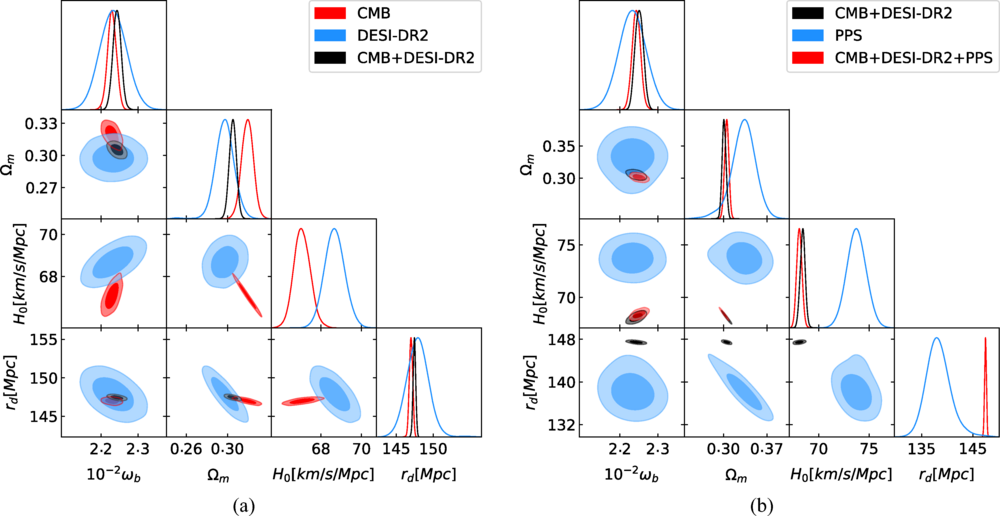
The analysis published in Physical Review D tested ΛCDM and ΛsCDM with several methods. The team combined cosmic microwave background observations from Planck, the Atacama Cosmology Telescope and the South Pole Telescope.
It also used baryon acoustic oscillation measurements from the Dark Energy Spectroscopic Instrument’s second data release. Those measurements trace large-scale patterns in galaxies, quasars and the Lyman-alpha forest across redshifts from 0.295 to 2.330.
For the nearby universe, the researchers included the Pantheon Plus catalog of 1,701 Type Ia supernovae, spanning redshifts from 0.0012 to 2.26. The catalog incorporated Cepheid calibration data from the SH0ES collaboration.
The models were tested with standard mean-shift calculations, updated mean comparisons, best-fit goodness checks, an exact non-Gaussian parameter-shift test and posterior predictive testing.
That last method asks a direct question: If a model were correct, how often would it generate measurements resembling the ones actually observed?
The reassuring result came from comparing the cosmic microwave background with DESI.
Under ΛCDM, the exact non-Gaussian test placed their tension near 2.2 standard deviations, lower than one directional Gaussian estimate of 3.98. Under ΛsCDM, the exact shift fell to about 0.95 standard deviations, while several Gaussian measures dropped below 0.3.
These results indicate that early-universe and intermediate-redshift observations occupy strongly overlapping regions of parameter space. The core framework connecting the cosmic microwave background and large-scale structure remains stable.
The picture changed once locally calibrated supernova measurements entered the comparison.
For ΛCDM, the exact parameter-shift analysis found a discrepancy of at least 5.1 standard deviations between the combined CMB and DESI constraints and the Pantheon Plus and SH0ES data.
The same lower bound remained for ΛsCDM. Although the sign-switching model moved the predicted Hubble constant upward, the high-probability regions from the two sides still did not overlap enough.
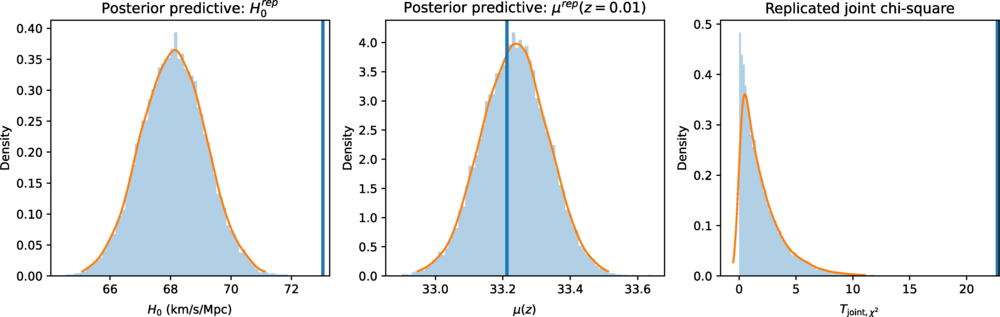
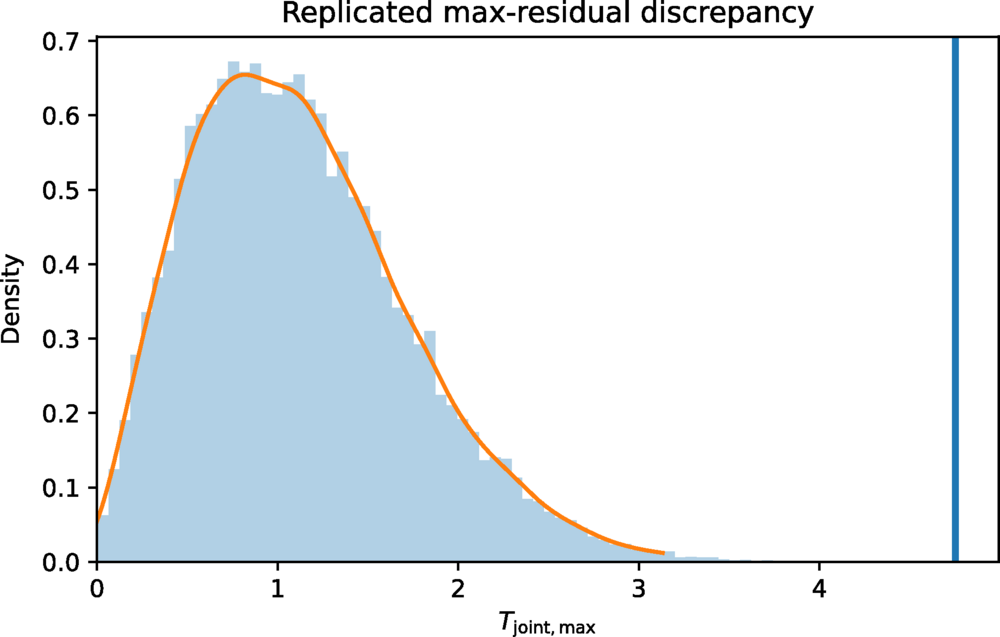
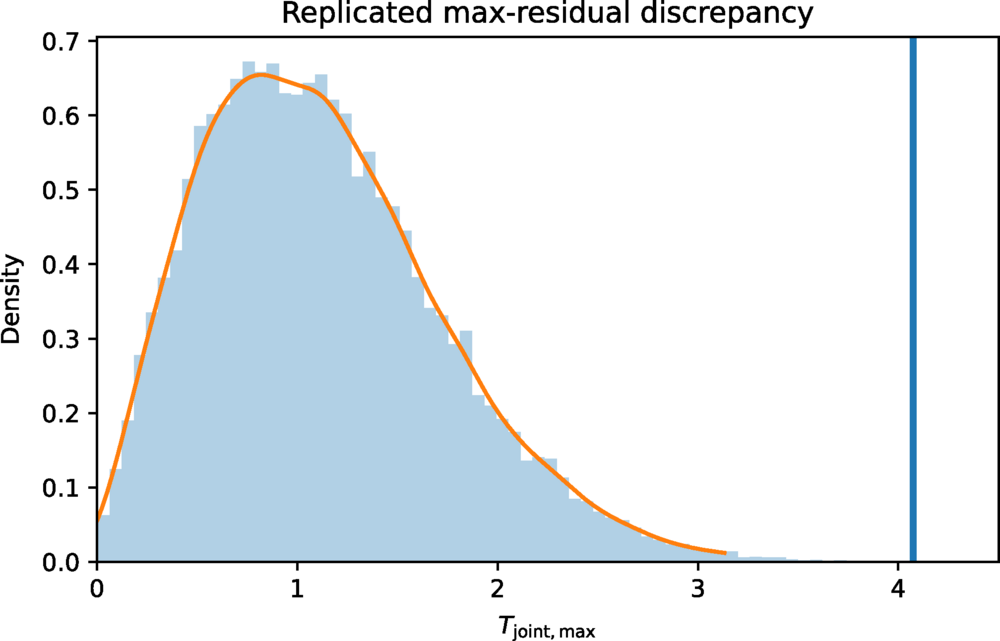
The posterior predictive tests made the remaining problem especially clear. Under ΛCDM, the locally measured value of 73.04 plus or minus 1.04 kilometers per second per megaparsec fell deep in the predictive tail.
The corresponding probability was about 5 in 100,000.
ΛsCDM improved the joint predictive probability to about 4 in 10,000. That is an eightfold increase, but the observed expansion rate remained highly unusual under the model.
The nearby supernova distance modulus at redshift 0.01 was reproduced well, with a predictive probability near 0.81 in the standard model. This indicates that the central mismatch lies in the inferred expansion rate rather than in the low-redshift distance proxy alone.
The sign-switching model therefore delivers a limited gain. It improves geometric compatibility between the CMB and DESI and shifts late-time predictions in the direction favored by local measurements.
It does not, however, make all three datasets jointly typical.
The distinction matters because a model can improve one parameter without repairing the full network of correlated distances and expansion rates. ΛsCDM raises H0 modestly, but it does not reorganize the combined predictions enough to make the local result ordinary.
The analysis also shows why cosmological claims depend on more than a single headline sigma value. Different statistical tools can react sharply to broad, skewed or highly correlated distributions.
In this case, more exact tests did not erase the Hubble tension. They clarified where agreement is strong and where the conflict remains real.
The work provides a stricter standard for evaluating proposed solutions to cosmological tensions. Future models will need to improve both individual parameters and joint predictive behavior across early-, intermediate- and late-universe observations.
It also gives researchers a reusable testing framework. Exact non-Gaussian comparisons and posterior predictive checks can separate genuine physical improvement from changes caused mainly by posterior shape or dataset dominance.
For ΛsCDM, the verdict is measured rather than dismissive. The model moves expansion estimates closer and preserves successful distance predictions, but it does not solve the central discrepancy.
Closing that gap will require more precise observations, a stronger theoretical explanation or both.
Research findings are available online in the journal Physical Review D.
The original story “Dark energy reversal cannot close the universe’s expansion gap” is published in The Brighter Side of News.
Like these kind of feel good stories? Get The Brighter Side of News’ newsletter.
The post Dark energy reversal cannot close the universe’s expansion gap appeared first on The Brighter Side of News.

