Wolfsbane and larkspur can make chemicals potent enough to cause neurotoxicity and paralysis, yet members of the same chemical family also have promising medicinal uses. Now scientists have reconstructed a key part of the plants’ chemical machinery.
The work brought together researchers from Michigan State University and the Czech Academy of Sciences. Their goal was to understand how these plants manufacture diterpenoid alkaloids, a large group of structurally complex natural compounds.
“These plants have been used in different forms of medicine throughout the world for thousands of years,” said Garret Miller, an MSU alumnus, co-first author and now an assistant professor of biotechnology at the University of Michigan-Flint.
“We know they interreact with our bodies in so many ways, and understanding how to create them can help provide totally new routes of testing.”
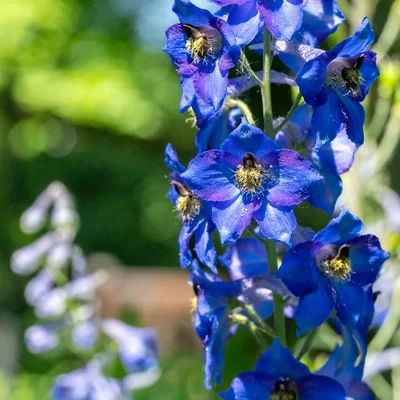
The challenge was considerable. Diterpenoid alkaloids combine features of two enormous groups of plant chemicals, terpenoids and alkaloids. Their complicated molecular structures have made them difficult to reproduce by conventional chemistry.
One of the best-known examples is aconitine, a powerful neurotoxin associated with wolfsbane. It contains six interconnected rings and 15 stereocenters, structural features that make laboratory synthesis especially difficult.
Aconitine was first isolated in 1833. Despite numerous attempts since then, chemists have not successfully completed its total chemical synthesis.
Plants, however, already know how to make such molecules.
“Plants are the best chemists around, upgrading their arsenal of natural compounds over millions of years to help them survive,” said Björn Hamberger, study author and the James K. Billman Endowed Professor in MSU’s Department of Biochemistry and Molecular Biology.
Many familiar substances come from this chemistry. Caffeine, capsaicin, menthol and vanillin are plant products, while numerous medicines either originate in plants or were inspired by plant molecules.
Diterpenoid alkaloids have attracted attention because members of the group have been associated with analgesic, anti-cancer, antiplasmodial and pest-deterring activity. Some, including lappaconitine, 3-acetylaconitine and crassicauline A, are used as non-narcotic analgesic drugs.
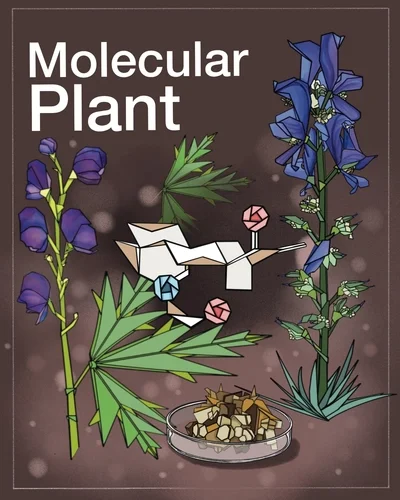
Plants in the Aconitum and Delphinium genera have also been used in traditional medicine. The processed lateral root of Aconitum carmichaelii, known as Fuzi, has been documented for at least 2,000 years.
Hamberger’s group had been investigating larkspur, also called delphinium, while scientists in Tomáš Pluskal’s group at the Czech Academy of Sciences were studying closely related chemistry in wolfsbane, or monkshood.
The teams joined forces after meeting at a conference in Barcelona.
“When this happens, we can either go our own ways, or come together, and it’s joining up that always leads to the best science,” Hamberger said.
They began searching for the genes responsible for building diterpenoid alkaloids. The team sequenced RNA from several tissues of Delphinium grandiflorum, Aconitum plicatum and Aconitum lycoctonum. They also analyzed public data from four additional Aconitum species.
Because these compounds tend to accumulate in roots, the scientists looked for genes that were especially active there.
The strategy resembled tracing an assembly line. Each enzyme performs a particular chemical step. If researchers can identify the enzymes in sequence, they can reconstruct how the final molecule is built.
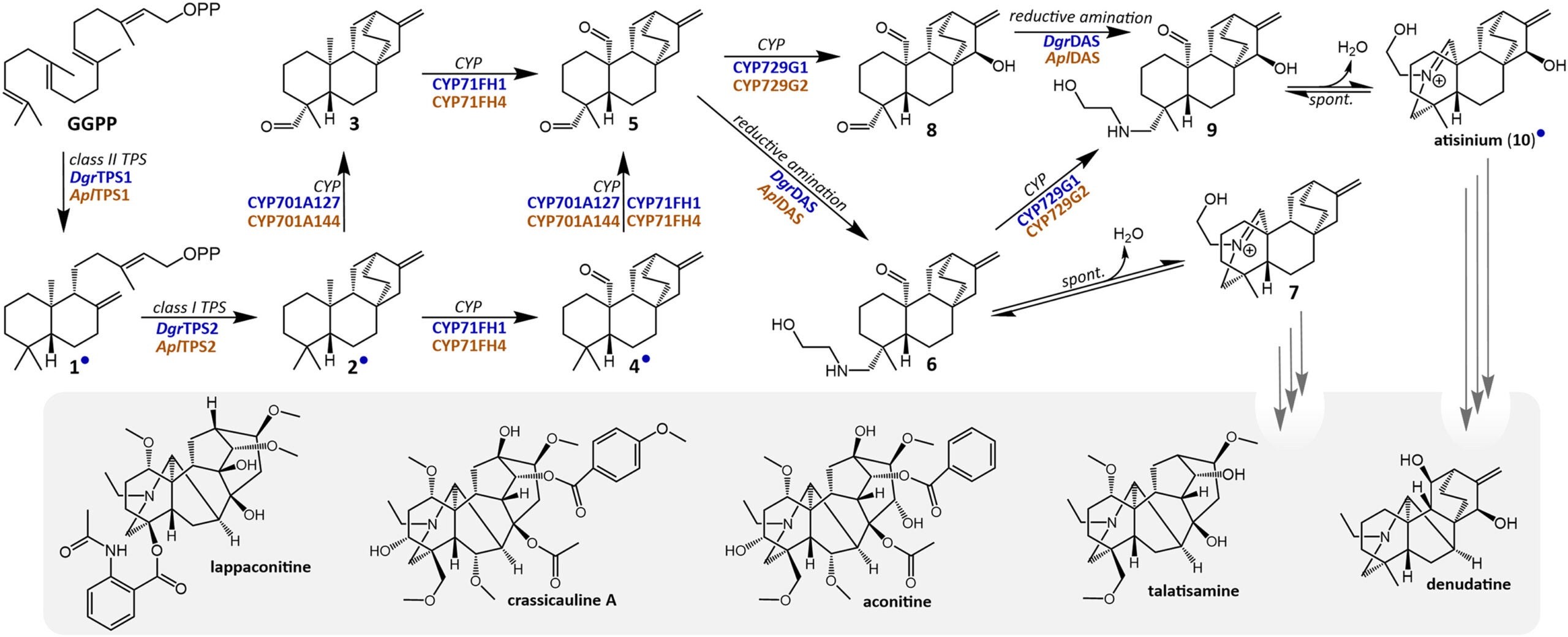
“You can imagine a biosynthetic pathway almost as an assembly line,” Miller said. “If you have ten steps in a row needed to build a finished product, and suddenly one quits, the next steps can’t happen.”
Two terpene synthase enzymes provided the opening steps, creating a molecular scaffold called ent-atiserene.
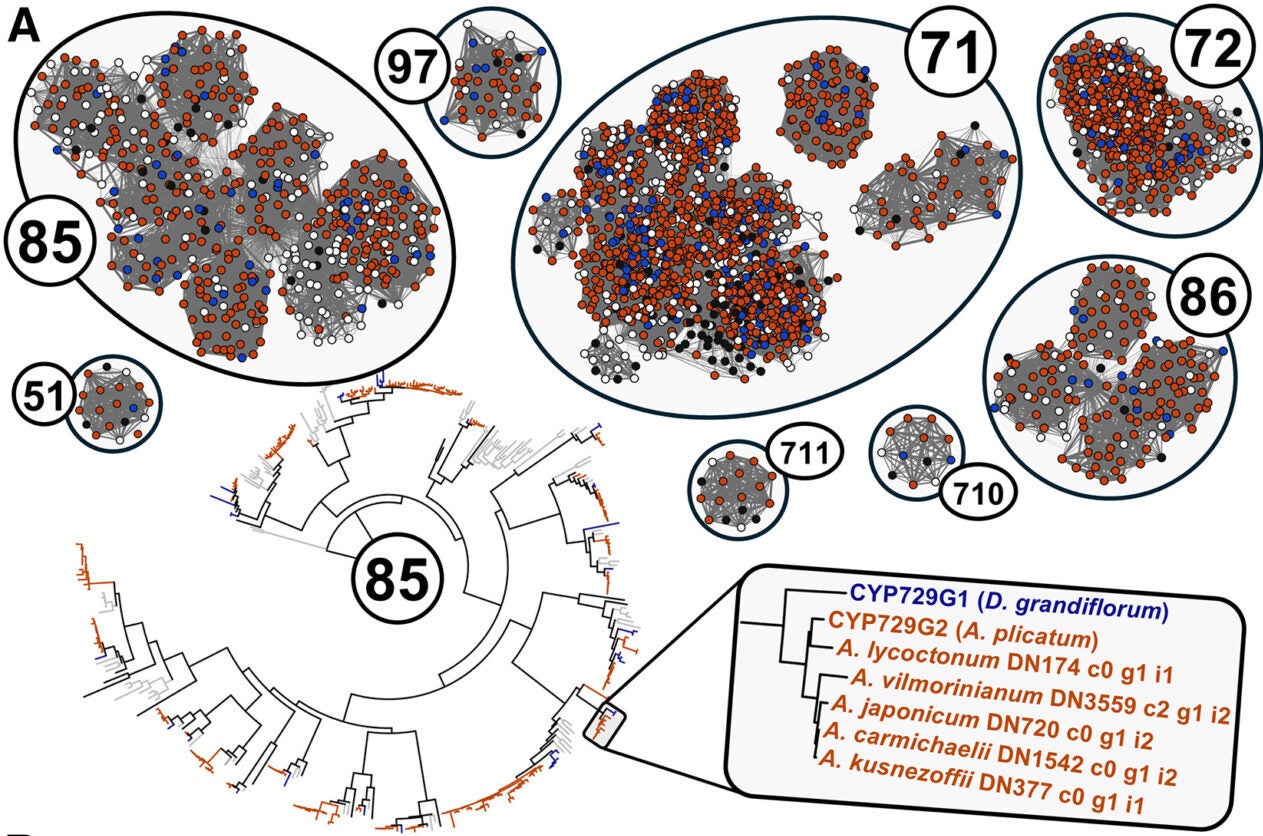
Finding the next enzymes was harder. The researchers identified 2,123 predicted cytochrome P450 transcripts across their assembled datasets, including 284 in D. grandiflorum alone. Cross-species comparisons and root-specific expression narrowed those 284 candidates to six for testing.
Three P450 enzymes proved active in modifying the ent-atiserene scaffold.
The defining step in turning the scaffold into a diterpenoid alkaloid required adding nitrogen.
Researchers initially expected ethylamine to supply that nitrogen because many finished diterpenoid alkaloids contain an ethyl group attached to it. The experiments pointed somewhere else.
Coexpression analysis led the team to a previously uncharacterized reductase they called diterpenoid alkaloid synthase, or DAS. When combined with the earlier pathway enzymes, DAS helped produce atisinium, a diterpenoid alkaloid with reported antiplasmodial activity.
The researchers ultimately identified six enzymes sufficient to reconstruct the pathway toward atisinium.
They inserted the relevant genes into Nicotiana benthamiana, a tobacco relative commonly used for transient plant expression. The engineered plants then functioned as temporary biological factories for the pathway.
Further isotope-labeling experiments produced another surprise. Ethanolamine, rather than ethylamine, emerged as the preferred nitrogen source.
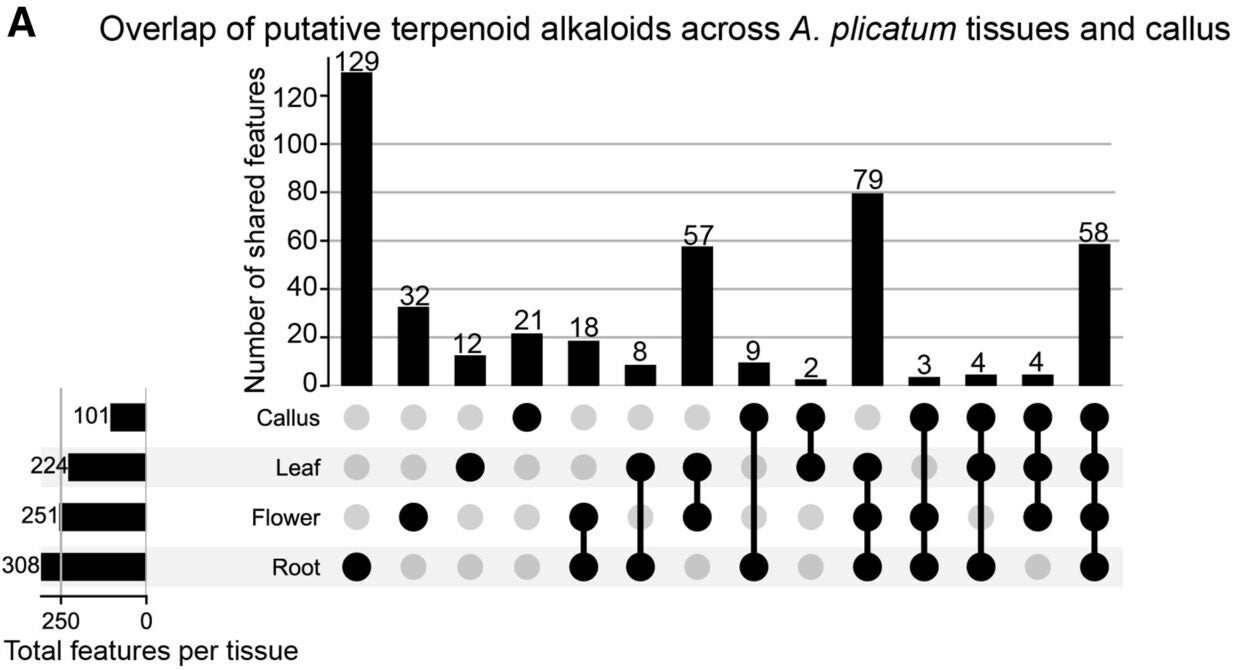
The team tested that finding in A. plicatum callus cultures. Among 1,331 aligned chemical features with fragmentation data, computational analysis classified 144 as terpenoid alkaloids. Filtering produced 60 candidates, with atisinium added separately for a final set of 61.
Of those, 41 incorporated labeled atoms only when the cultures received labeled ethanolamine. Both atisinium and aconitine showed ethanolamine incorporation.
No corresponding incorporation from labeled ethylamine was detected.
That result leaves important questions unanswered. Scientists still do not know how later reactions transform these early intermediates into the hundreds of more elaborate diterpenoid alkaloids found in the plant family.
Reconstructing the early pathway gives researchers a way to investigate plant molecules that have been difficult to obtain in useful quantities.
Plants often produce specialized metabolites slowly and at low levels. Complete chemical synthesis can also become impractical when molecules contain many rings, stereocenters and precisely positioned chemical groups.
Once researchers know the necessary genes and enzymes, they can transfer that biological blueprint into another organism and test whether it can manufacture the desired compound.
“In an ideal scenario, this could eventually help create new drugs inspired by these natural products,” said Lana Mutabdžija, a graduate student at the Czech Academy of Sciences and co-first author.
The work does not provide a complete route to aconitine or the many other complex diterpenoid alkaloids. Additional downstream enzymes remain unknown, and some steps may differ among species and tissues.
Still, the reconstructed atisinium pathway provides a starting point for finding them.
“Our vision is to provide green, sustainable tools that will allow us harness these plants’ natural power,” Hamberger said.
Research findings are available online in the journal Molecular Plant.
The original story “Deadly poisons in wolfsbane and larkspur linked to pain relief, malaria and cancer therapy” is published in The Brighter Side of News.
Like these kind of feel good stories? Get The Brighter Side of News’ newsletter.
The post Deadly poisons in wolfsbane and larkspur linked to pain relief, malaria and cancer therapy appeared first on The Brighter Side of News.


Leave a comment
You must be logged in to post a comment.