An El Niño of potentially historic strength is gathering force across the tropical Pacific, and signs of the warming have already reached Southern California. Water temperatures off Santa Barbara climbed into the low 70s Fahrenheit in late August, while anglers reported catching dorado and yellowtail around the Channel Islands.
Those unusually warm waters arrive alongside evidence that something more fundamental may be changing. El Niño events in the eastern Pacific have become about 36.5% stronger than during the pre-industrial era, according to a study published in Science. The largest increase has occurred during the past four decades.
Researchers reached that conclusion by building a roughly 1,000-year history of Pacific Ocean temperatures from living and ancient corals collected in the Galápagos Islands. The reconstruction indicates that modern El Niño variability stands apart from anything recorded during the centuries before industrialization.
“We show that the strength of El Niño changes in parallel with the warming of global temperature,” said lead author Julia Cole, professor and chair of the University of Michigan’s Department of Earth and Environmental Sciences. “Our findings tell us that the big El Niño events of the last 40 years are not normal in the context of the last thousand years.”
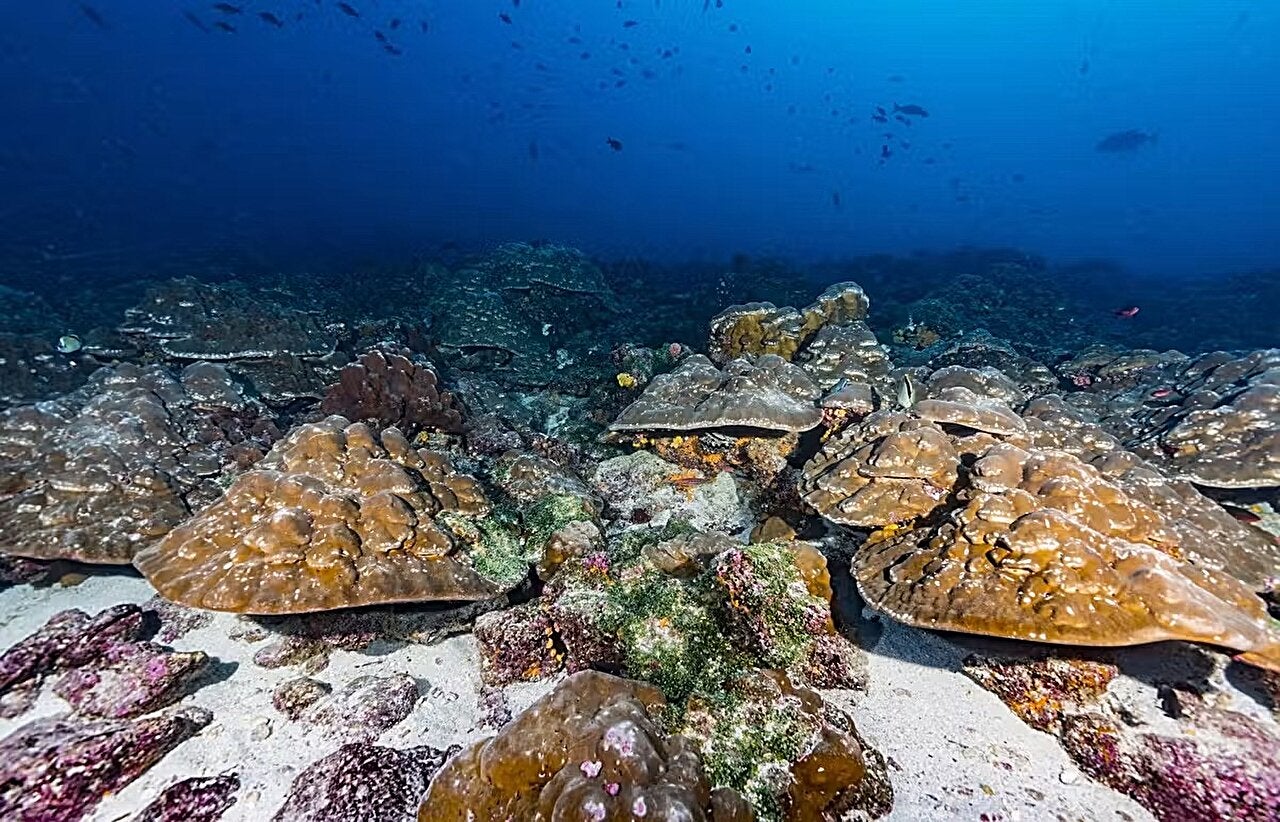
El Niño begins with changes in the tropical Pacific. Under normal conditions, trade winds push warm surface water westward from South America toward Australia. When those winds weaken, warm water spreads back toward the eastern Pacific.
Atmospheric circulation changes with it. Heavy rainfall shifts away from Indonesia toward the central Pacific, which can weaken the trade winds further and reinforce El Niño conditions. An event can persist for one to two years, even though its effects reach far beyond the tropical ocean where it begins.
In the western United States, a strong El Niño tends to push the jet stream farther south, directing more atmospheric-river storms toward California instead of the Pacific Northwest. “A big El Niño tends to mean wet winters for us in Southern California,” said co-author Samantha Stevenson, an assistant professor at UC Santa Barbara’s Bren School of Environmental Science & Management.
Elsewhere, shifts associated with El Niño can contribute to drought, floods, wildfire, agricultural losses and disease. The concern is not simply that these events occur, but whether their strongest forms are becoming more extreme as global temperatures rise.
Direct measurements offer only a short view of El Niño. Systematic observations of sea surface temperatures across the remote tropical Pacific became much stronger with satellite measurements beginning in the 1980s, leaving scientists with a relatively brief instrumental record for a naturally erratic system.
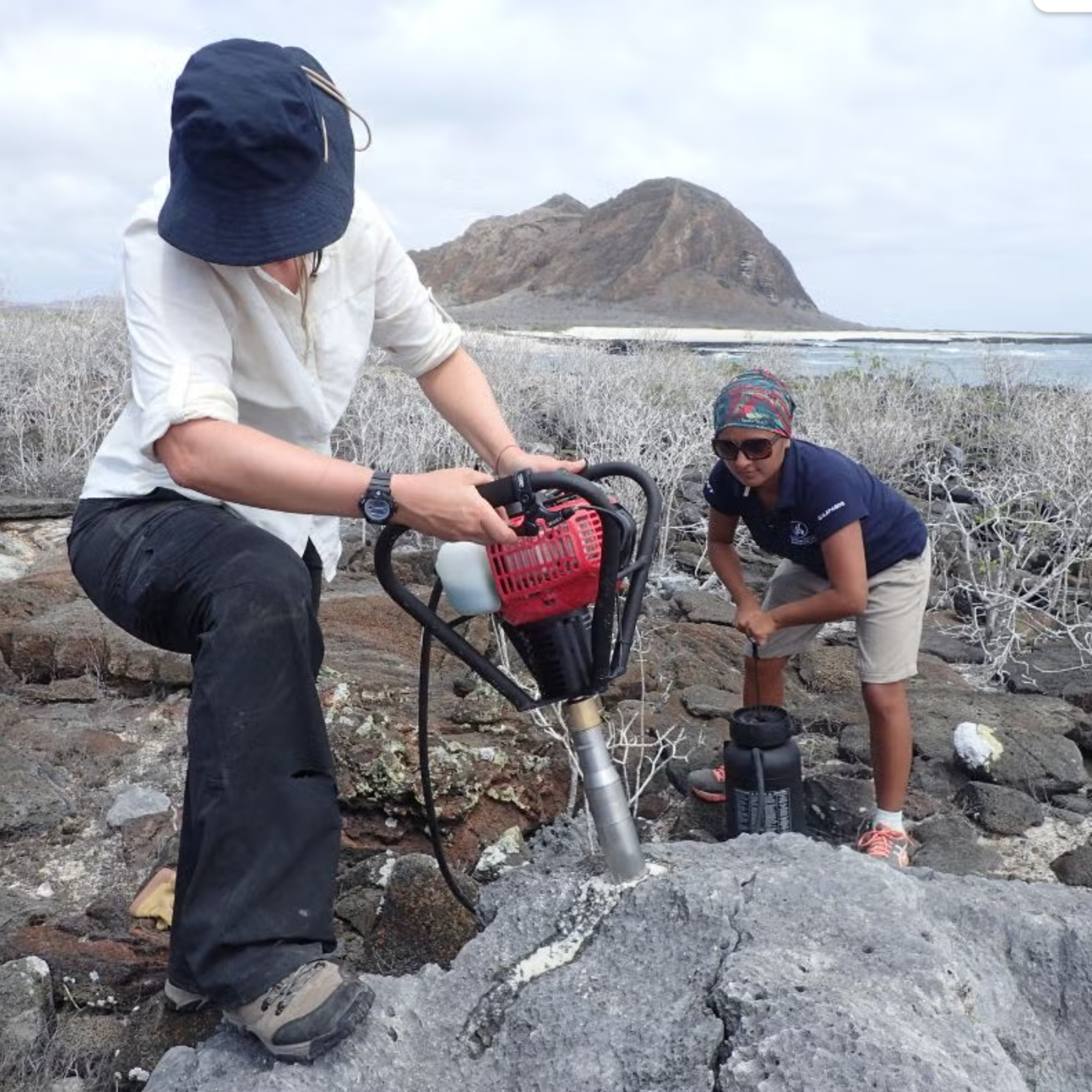
The researchers extended that history using corals from five islands in the Galápagos, a region where eastern Pacific El Niño temperature anomalies are especially strong. Their analysis included 28 time series produced from modern and subfossil corals, with individual records selected to capture decades of ocean conditions.
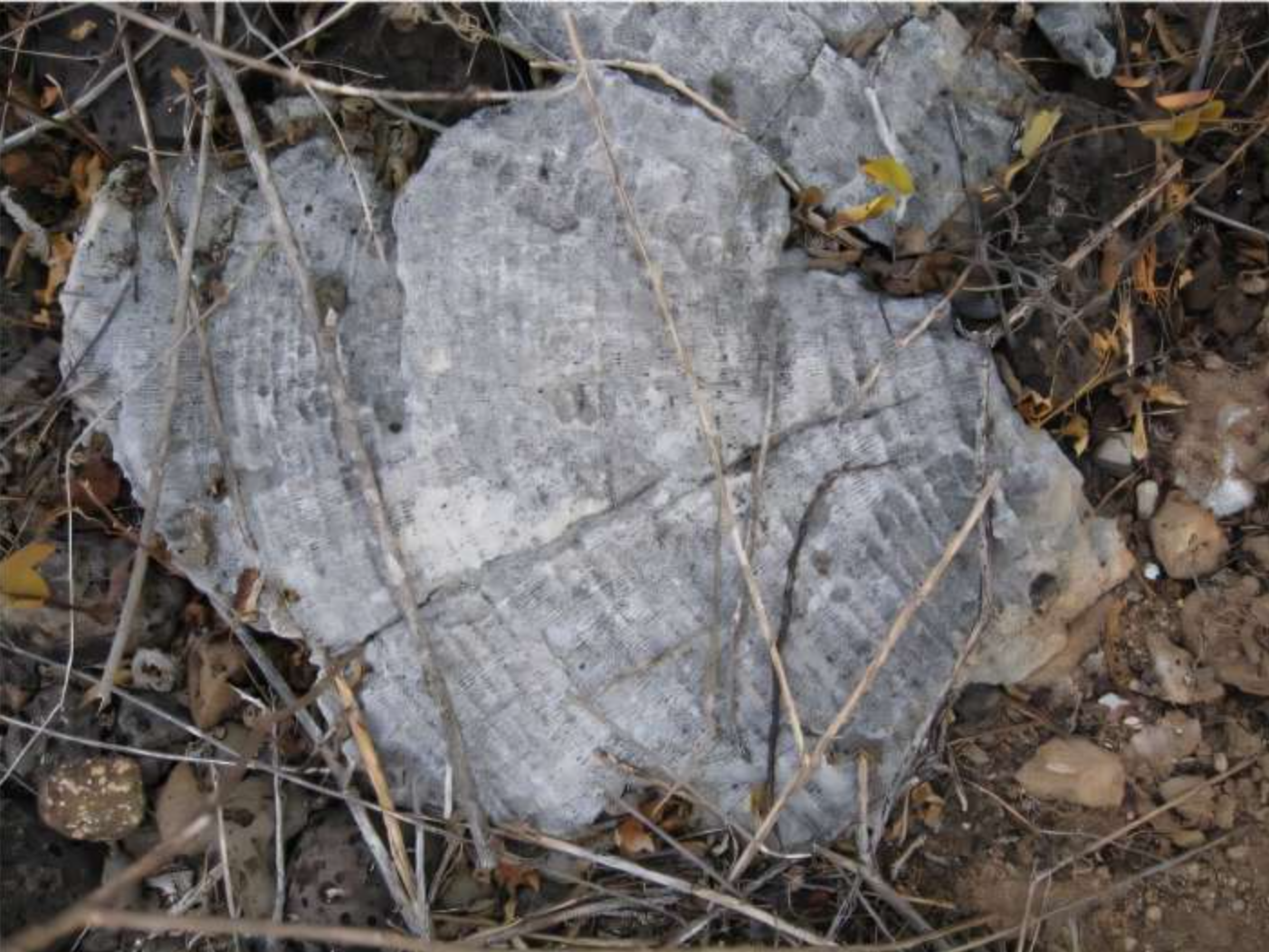
Corals add layers of calcium carbonate as they grow, preserving chemical traces of the water around them. The team measured ratios of strontium to calcium and different oxygen isotopes in the coral skeletons, both of which can provide information about past seawater temperatures.
“Thanks to these new coral reconstructions, we can go farther back in the eastern Pacific’s past than we ever could before,” Stevenson said. “When we do that, we see that El Niño has been getting stronger, and that the changes have really taken off in the past few hundred years.”
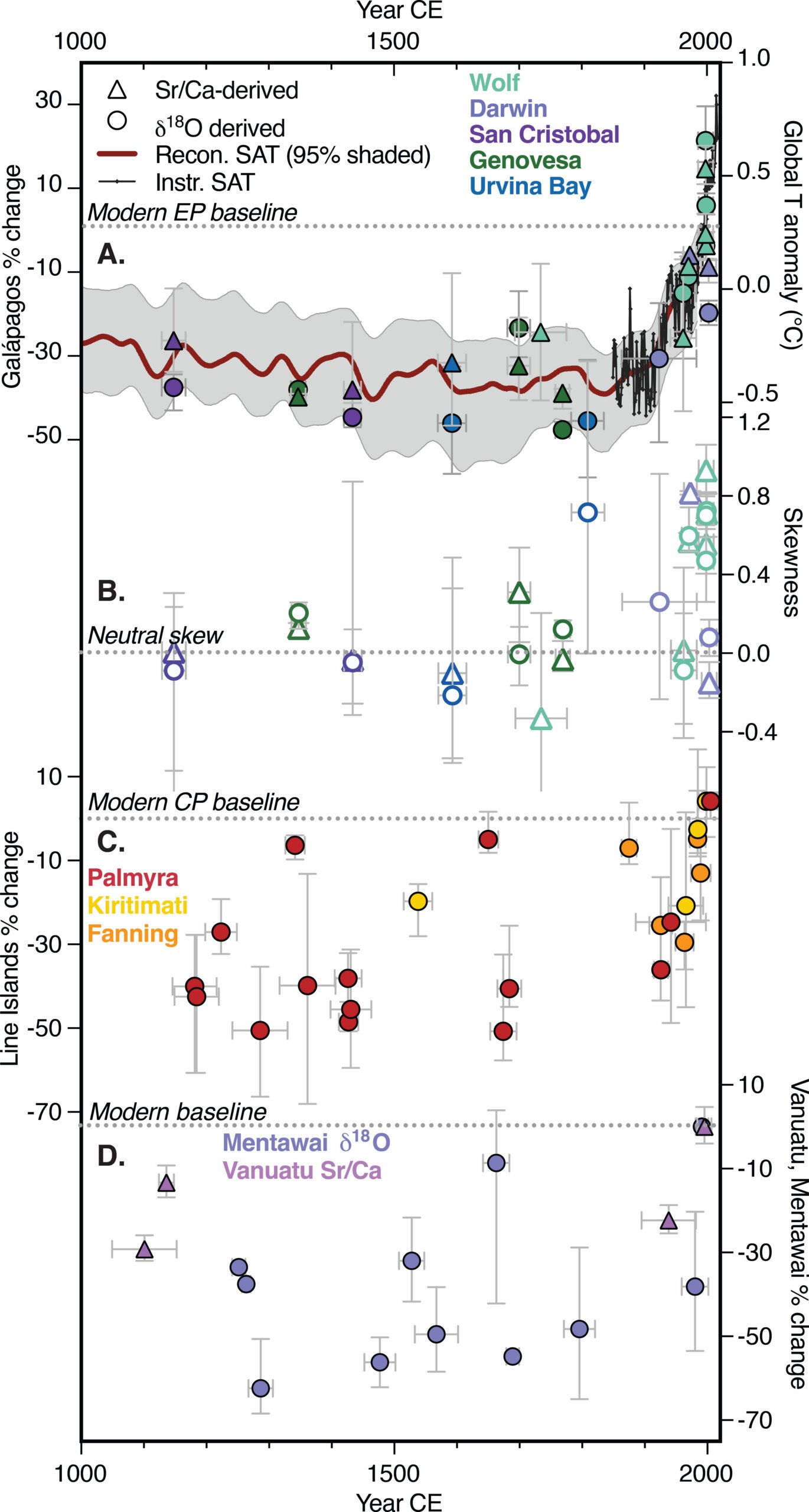
The pattern remained relatively subdued from about 1000 to 1850. Variability began climbing after the 19th century, then rose sharply during the modern era. The researchers calculated that eastern Pacific El Niño variability is now 36.5%, plus or minus 8%, greater than in the pre-industrial period. It is also 16.2%, plus or minus 10%, greater than during the 20th century before the modern benchmark period.
The coral chemistry also revealed a shift toward stronger warm extremes. Rather than simply showing larger swings in both directions, the modern record became increasingly weighted toward powerful El Niño conditions.
That distinction matters because particularly strong El Niños can carry larger climate impacts. The recent rise in variability closely tracked increasing global temperatures, with the most dramatic amplification appearing in roughly the past 40 years.
“We kept adding records thinking ‘well, this is going to get more complicated,’ but it really didn’t,” Cole said. “This is such a clear story.”
Coral records from the central Pacific also showed stronger modern variability, although the distinction between modern and pre-industrial conditions was less pronounced there. That geographical difference is consistent with climate simulations suggesting that changes in El Niño may emerge earlier and more strongly in the eastern Pacific.
The researchers next asked whether natural climate forces could reproduce the increase. They compared the coral reconstruction with simulations from 12 climate models covering the last millennium, including models that incorporated volcanic eruptions and changes in solar activity.
The reconstructed increase in eastern Pacific variability exceeded what the models produced from natural forcing or internal climate variability. The difference was statistically unusual at the 95% level and approached 99% significance when compared with unforced pre-industrial control simulations.
The study stops short of a formal attribution analysis, but the timing and magnitude of the changes point toward a connection with anthropogenic warming. The authors also identified an important problem: most climate models did not reproduce an increase as large as the one recorded by the corals.
“I’m concerned that none of the climate models picked up on the increase we observed in the coral record,” Stevenson said. “That probably means the models are missing something about how El Niño responds to climate change, and we need to know why that’s happening.”
That uncertainty makes the developing 2026 event especially important. NOAA reported in August that El Niño was strengthening, with a greater than 90% chance of becoming a very strong event during the Northern Hemisphere fall and winter.
A stronger El Niño does not guarantee a particular storm, drought or flood. But the study suggests that the ocean conditions underlying these events are moving beyond the range seen through much of the past millennium.
“If this trend continues into the future, ‘super El Niños,’ like the one developing right now, might become much more common — with all the impacts that go along with them,” Stevenson said.
For the researchers, those impacts are the larger concern. El Niño already alters rainfall, temperatures and ecosystems across much of the world. If its strongest warm events continue intensifying on top of a warming planet, communities may face larger extremes from a climate pattern that has never been particularly gentle.
These resources explore how ENSO may respond to continued warming, why eastern Pacific events can intensify and how stronger El Niño conditions could amplify climate effects around the world.
Stronger ENSO-induced global SST variability in a warming climate: Climate-model simulations indicate that ENSO could exert a stronger influence on global sea surface temperatures as greenhouse warming continues, partly because atmospheric connections and air-sea interactions strengthen. (Nature Communications, 2026)
Unraveling non-monotonic responses of the El Niño–Southern Oscillation to post-2100 global warming: This modeling study finds that ENSO strengthens under moderate warming but may eventually become more frequent and less intense under extreme, long-term warming, highlighting the complex relationship between ENSO and rising temperatures. (npj Climate and Atmospheric Science, 2026)
Collapsed upwelling projected to weaken ENSO under sustained warming beyond the twenty-first century: Long-term simulations suggest ENSO variability may initially change unevenly before weakening substantially after 2100 as extreme warming alters equatorial Pacific upwelling and convection. (Nature Climate Change, 2024)
Deep ocean warming-induced El Niño changes: Researchers found that warming below the ocean surface can strengthen sea surface temperature variability in the eastern Pacific, providing another possible mechanism through which a warming ocean could alter El Niño behavior. (Nature Communications, 2024)
Increased variability of eastern Pacific El Niño under greenhouse warming: This influential modeling study found a robust increase in eastern Pacific El Niño variability under greenhouse warming, linking the change partly to stronger ocean-atmosphere coupling caused by increased upper-ocean stratification. (Nature, 2018)
Research findings are available online in the journal Science.
The original story “El Niño is stronger than at any point in the past 1,000 years, coral records reveal” is published in The Brighter Side of News.
Like these kind of feel good stories? Get The Brighter Side of News’ newsletter.
The post El Niño is stronger than at any point in the past 1,000 years, coral records reveal appeared first on The Brighter Side of News.


Leave a comment
You must be logged in to post a comment.