Summer heat is becoming harder for buildings to handle. Air conditioning can protect people indoors, but it also uses large amounts of energy and pushes waste heat outside. A new study suggests part of the answer may come from an animal that cannot sweat.
Researchers at the University of Pennsylvania and Syracuse University created cement-based tiles inspired by elephant skin. The tiles use planned cracks and tiny pores to trap water, spread it across a surface and cool buildings through slow evaporation.
The work shows how a simple material could cool roofs and façades without fans, compressors or moving parts. The design turns cracks, usually a sign of damage, into useful channels for water.
On hot days, people cool themselves through sweat. As moisture evaporates from skin, it pulls heat away. The process feels ordinary, but it is highly efficient.
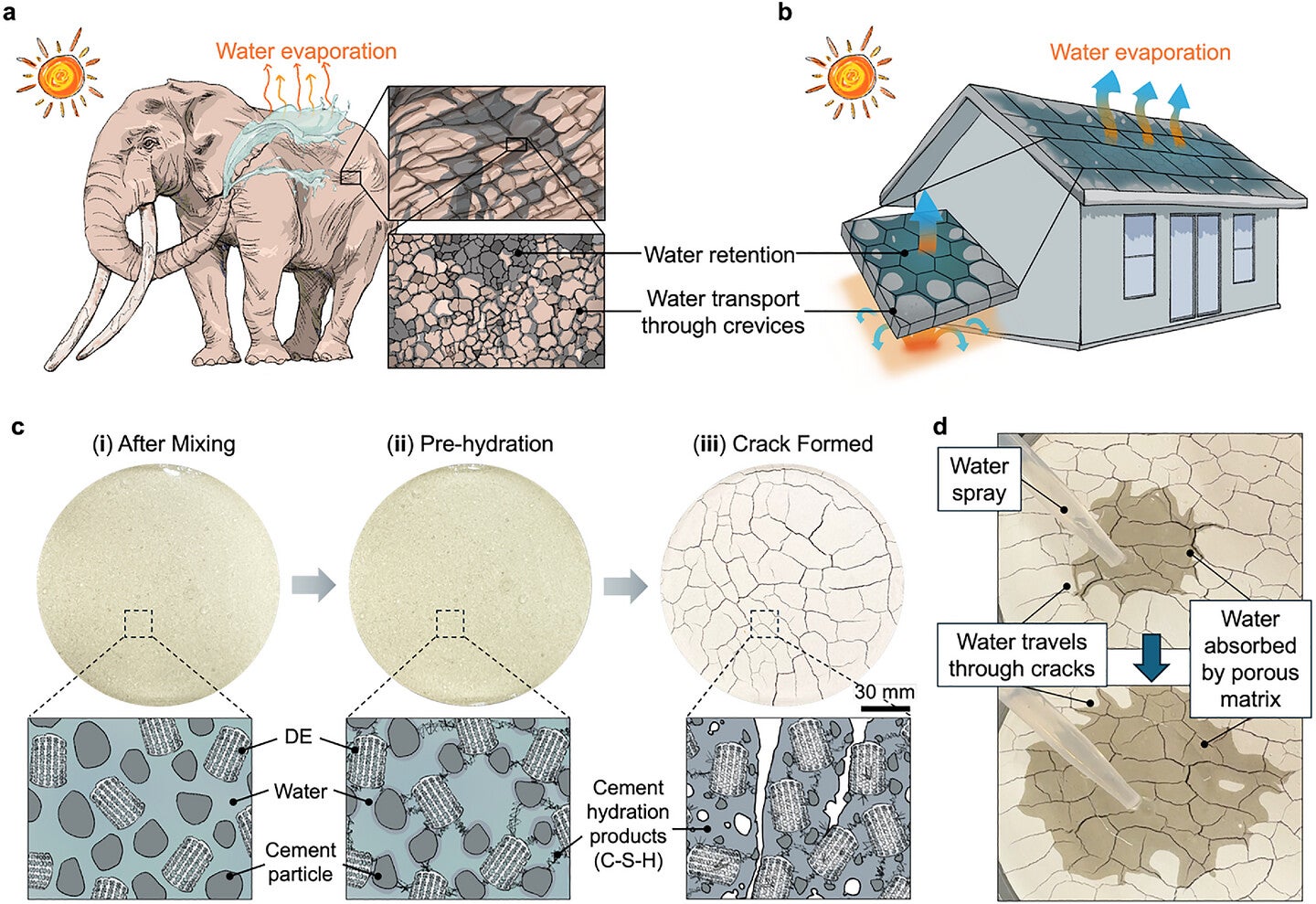
Elephants face a tougher problem. They live under intense sun with thick, dark gray skin, yet they do not sweat like people do.
“Wrinkles,” said Dorit Aviv, an associate professor of architecture in the Weitzman School of Design. “Elephants have a network of cracks in their skin that trap water. When they spray themselves, that water stays put and evaporates slowly, cooling them over time.”
That idea came to Aviv through longtime collaborator Shu Yang, a materials scientist at Penn Engineering. It fit Aviv’s work on making buildings more thermally efficient.
The connection was direct. Buildings do not sweat either.
In the United States, people spend about 90% of their time indoors. Buildings also use about 40% of primary energy.
Nearly half of that building energy goes to heating, cooling and ventilation. As cities grow hotter, that demand is likely to rise.
“In the United States, we spend roughly 90% of our time indoors, and buildings consume about 40% of primary energy, nearly half of that for heating, cooling, and ventilation,” said Yang. “A passive, bio-inspired cooling façade like this could lower surface temperatures by 10-20° Fahrenheit compared to traditional stucco.”
Mechanical cooling can save lives during heat waves. But it also consumes electricity and dumps indoor heat outdoors.
A passive system works differently. It cools the building’s outer skin before heat moves inside.
Evaporative cooling sounds simple. Add water, let it evaporate and remove heat.
But most building surfaces handle water poorly. Droplets bead up, bounce off or run down before they can cool much.
The research team needed a surface that could catch each droplet, hold it and move it with purpose. That led them back to cracks.
“In conventional construction, cracks signal weakness, the beginning of a material’s decline,” Yang said. “But by engineering where and how they form, we made networks of tiny channels that act like capillaries capable of pulling water across the surface and holding it in place.”
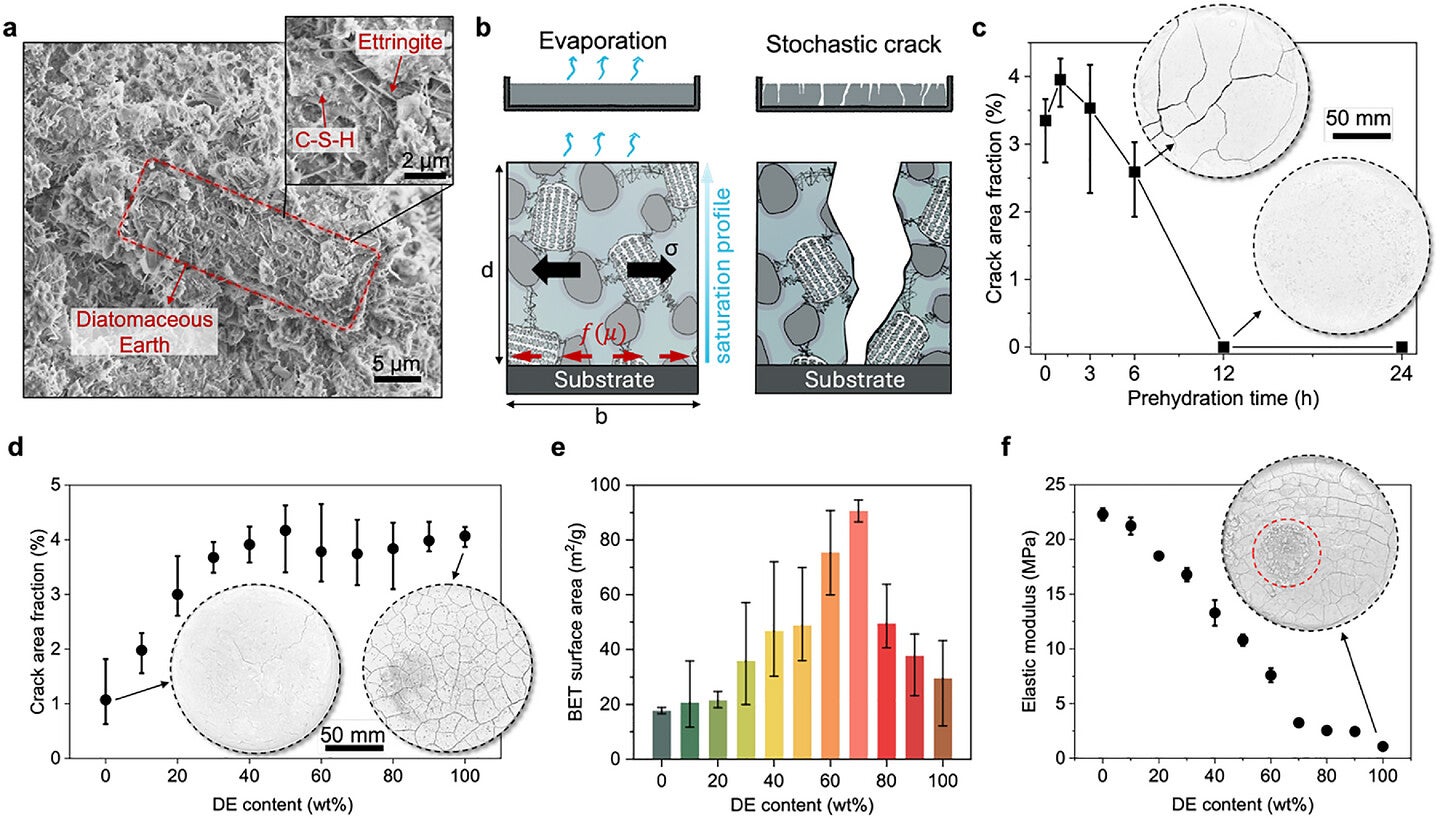
The team used ordinary Portland cement mixed with diatomaceous earth. This porous material comes from fossilized algae.
Together, they formed thin tiles that can store and transport water.
The key insight was that water storage and water movement need different structures. The material had to do both well.
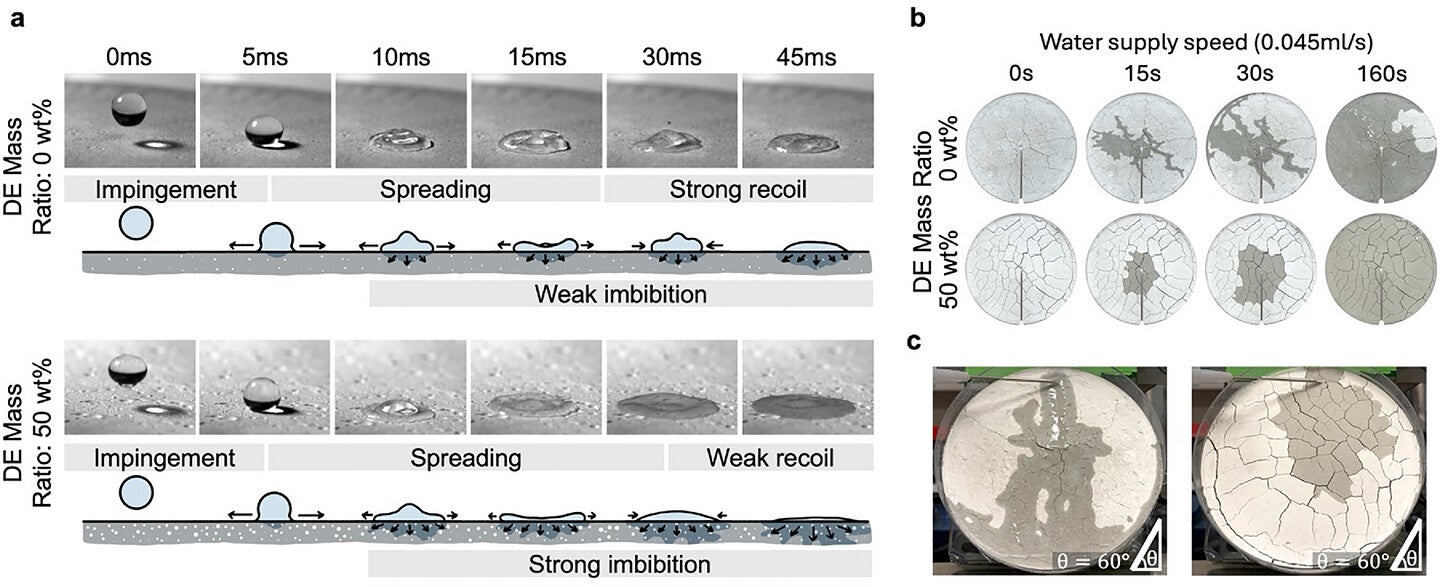
“We realized that storing water and moving water are actually two different problems,” said Kun-Hao Yu of Syracuse University. Yu conducted the experiments as a postdoctoral researcher in Yang’s lab.
“The microscopic pores inside the material act like tiny reservoirs that quickly soak up each droplet, while the engineered crack network acts like a system of canals that redistributes that water across the surface. It’s really the combination of those two features that lets the tile hold onto water instead of losing it.”
The pores absorb water in milliseconds. The cracks then move that water across the tile, even on sloped surfaces.
This keeps the surface wet longer. More time for evaporation means more cooling.
The tiles begin with a mixture of cement and diatomaceous earth. Researchers cast the material into thin shapes and let it partially hydrate.
They then dry it under carefully controlled conditions. As the material shrinks, stress builds inside it.
Instead of allowing random fractures, the team guides the stress along designed patterns. The result is a predictable lattice of cracks.
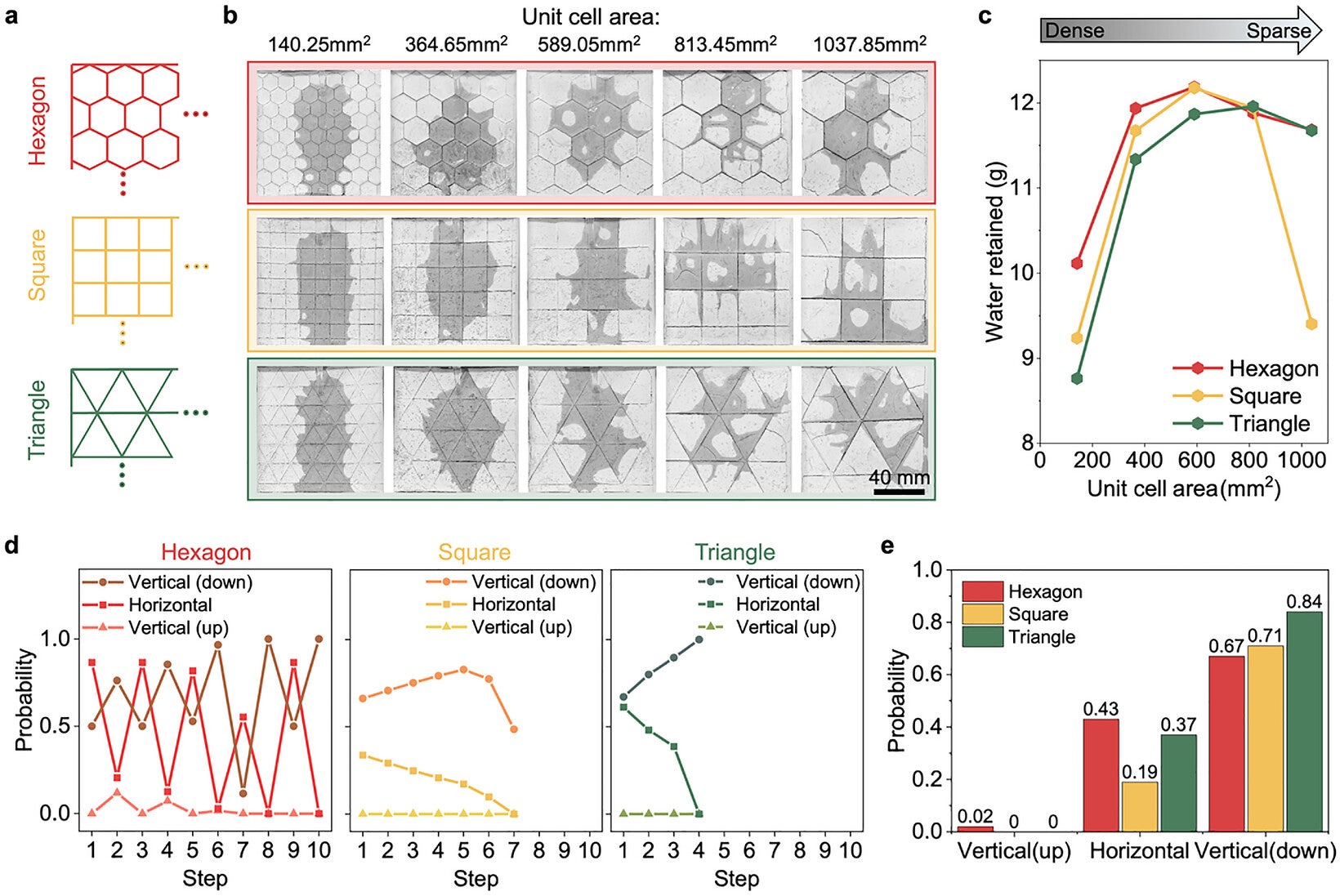
The researchers tested several crack patterns, including triangular, square and hexagonal designs. The hexagonal pattern performed especially well.
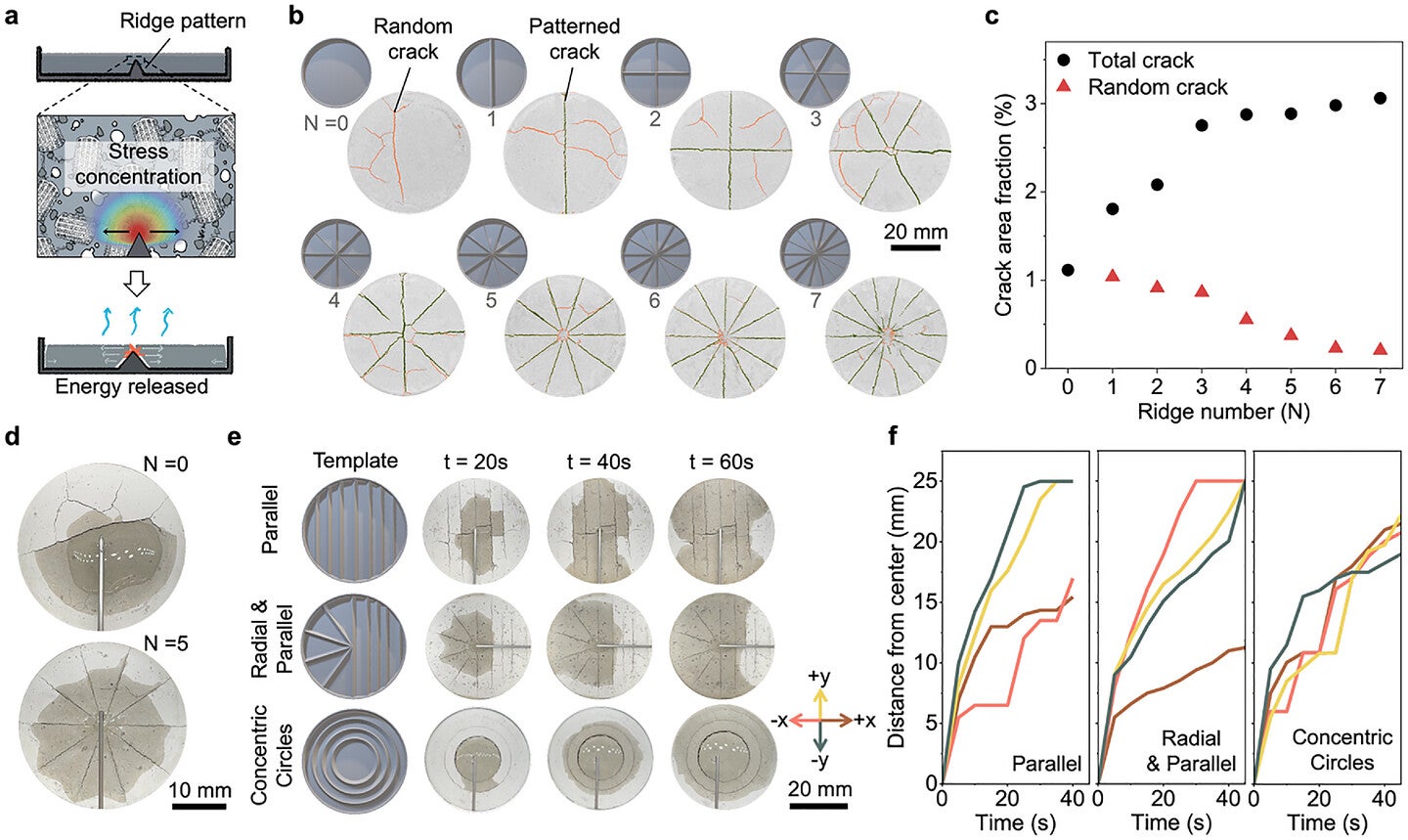
Its geometry forced water to move sideways in a zigzag path. That delayed drainage and kept more water on the surface.
When water hits the tile, it does not bounce away. It quickly enters the pores and crack network.
In tests, the material absorbed droplets in less than 50 milliseconds. That fast capture helps prevent wasted water.
The crack network then spreads water laterally. On tilted tiles, the hexagonal layout helped water resist simply draining downward.
That longer contact allowed evaporation to continue for hours. The cooling effect lasted up to 20 hours in some tests.
This matters because heat does not arrive all at once. Buildings face long hot afternoons, warm evenings and repeated sun exposure.
The team tested the tiles under infrared heating and periodic watering. The results showed a major temperature difference.
The temperature beneath the elephant-skin-inspired tiles stayed at 89.6 degrees Fahrenheit. Under cracked commercial stucco, it rose to 107.6 degrees.
Under non-cracked stucco, it reached 125.6 degrees. That difference shows how much water management can change surface heat.
The team also tested the idea on a small model building. Water was delivered in cycles, while heat came from an infrared lamp.
The new tiles spread and retained water better than commercial stucco. They kept the space beneath them cooler with the same water input.
The technology may be useful because it does not rely on complex machinery. It uses common cement, a porous additive and designed crack patterns.
The researchers also showed that the mixture could be applied to large panels using hopper guns. That suggests a possible path toward on-site construction.
The system could one day work with automated watering. Sensors and forecasts could help decide when a building needs cooling.
“Now that we understand how water moves through these patterned tiles, we can start treating water as something we manage very precisely instead of simply spraying more of it,” Yu said. “By combining these materials with weather forecasts and automated water delivery systems, we could supply just enough water, exactly where and when it’s needed, to maximize cooling while minimizing water use.”
That kind of control matters in hot, dry regions where water is limited.
The study offers a different way to think about buildings. Instead of sealing structures away from nature, materials could work with natural processes.
“Extreme heat is already the deadliest climate-related hazard, and we’ve spent decades trying to seal buildings off from the environment,” Aviv said. “If we can design materials that work with natural processes instead of against them, we can start to rethink how cities stay livable.”
The tiles are not a complete replacement for air conditioning. People will still need active cooling during dangerous heat.
But passive cooling can reduce the heat load on buildings. That may lower energy demand and make indoor spaces safer.
In a hotter world, even simple cooling gains can matter.
This research could help buildings stay cooler while using less energy. By lowering surface temperatures, elephant-skin-inspired tiles may reduce the need for mechanical air conditioning.
The technology may also help cities fight extreme heat. Cooler roofs and façades can reduce heat buildup on building surfaces and may ease pressure during heat waves.
The design could be especially valuable in dry climates, where evaporative cooling works well. With smart watering systems, buildings could use only the amount of water needed for cooling.
For humanity, the benefit is healthier, more livable cities. Extreme heat already threatens vulnerable people around the world. Materials that cool passively could help protect homes, schools, workplaces and public spaces while cutting energy use.
These resources examine evaporative cooling, radiative cooling and emerging materials designed to lower building temperatures without relying entirely on conventional air conditioning.
Advanced evaporative cooling materials: From designs to applications: Reviews the materials, structures and physical mechanisms being developed for passive evaporative cooling across buildings, electronics and other thermal-management applications. (Progress in Materials Science, 2025)
Passive isothermal film with self-switchable radiative cooling-driven water sorption layer for arid climate applications: Describes a passive material that combines radiative cooling with water-driven thermal processes to regulate temperature under extreme dry-climate conditions. (Nature Communications, 2024)
Humidity-tolerant porous polymer coating for passive daytime radiative cooling: Demonstrates a scalable porous coating designed to retain passive radiative-cooling performance across a wider range of environmental humidity conditions. (Nature Communications, 2024)
A biomass-derived material for passive radiative cooling: Examines a sustainable porous material that combines high solar reflectance with thermal emission to achieve passive cooling without external energy. (Nature Reviews Materials, 2024)
IEA EBC Annex 80: Summarizes an international research effort examining resilient passive and active strategies for reducing building overheating and cooling demand. (U.S. Department of Energy, 2020)
Research findings are available online in the journal Advanced Materials.
The original story “Elephant-skin tiles could help buildings stay cool without air conditioning” is published in The Brighter Side of News.
Like these kind of feel good stories? Get The Brighter Side of News’ newsletter.
The post Elephant-skin tiles could help buildings stay cool without air conditioning appeared first on The Brighter Side of News.


Leave a comment
You must be logged in to post a comment.