For centuries, experiments have supported a remarkable rule of nature: objects fall the same way in a gravitational field regardless of what they are made of. Physicists have tested that principle with ordinary matter to extraordinary precision, and more recently with antimatter.
One important piece of the particle world has remained out of reach. Scientists have never directly measured how gravity acts on matter dominated by a second-generation particle, such as the muon.
Researchers at ETH Zurich and the Paul Scherrer Institute, or PSI, have now cleared a major obstacle to doing exactly that. They created a highly controlled beam of exotic muonium atoms that could make a direct gravity experiment possible.
The advance, reported in Nature Physics, does not yet show whether muonium falls normally. Instead, it provides the unusual atomic beam required to put one of Einstein’s foundational ideas to a completely new test.
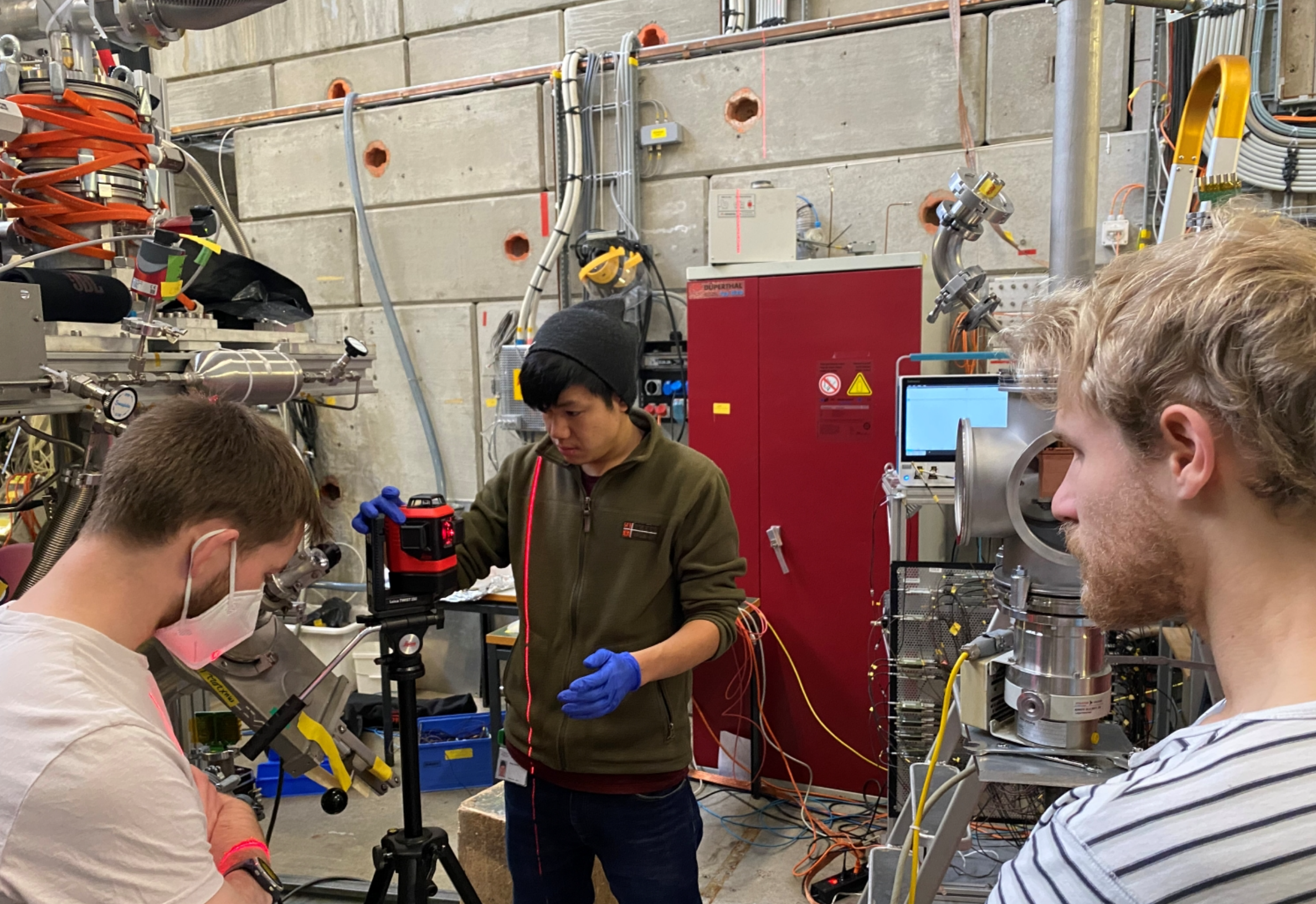
“We have taken an important step toward carrying out an exciting experiment on this topic,” said ETH Zurich physics professor Anna Soter. “We want to measure the gravitational interaction of the muon.”
Ordinary matter consists largely of particles from the first generation of the Standard Model, including electrons and the quarks that make up protons and neutrons. Nature also contains two additional generations whose particles are heavier.
The muon belongs to the second generation and behaves in many respects like a heavy relative of the electron. A positively charged muon, or antimuon, can bind with an electron to create a neutral atom called muonium.
That combination makes muonium unusually valuable for gravity experiments. Its mass is overwhelmingly dominated by the muon, while its electrical neutrality prevents tiny stray electric fields from simply overwhelming the far weaker gravitational force researchers want to measure.
The question goes directly to the weak equivalence principle. This principle states that gravitational mass and inertial mass are equivalent, producing the familiar result that different objects experience the same gravitational acceleration under equivalent conditions.
Experiments using ordinary matter have supported this principle with exceptional precision. Antihydrogen experiments have also found gravitational behavior consistent with ordinary matter. Muonium would extend the test into a fundamentally different part of the Standard Model.
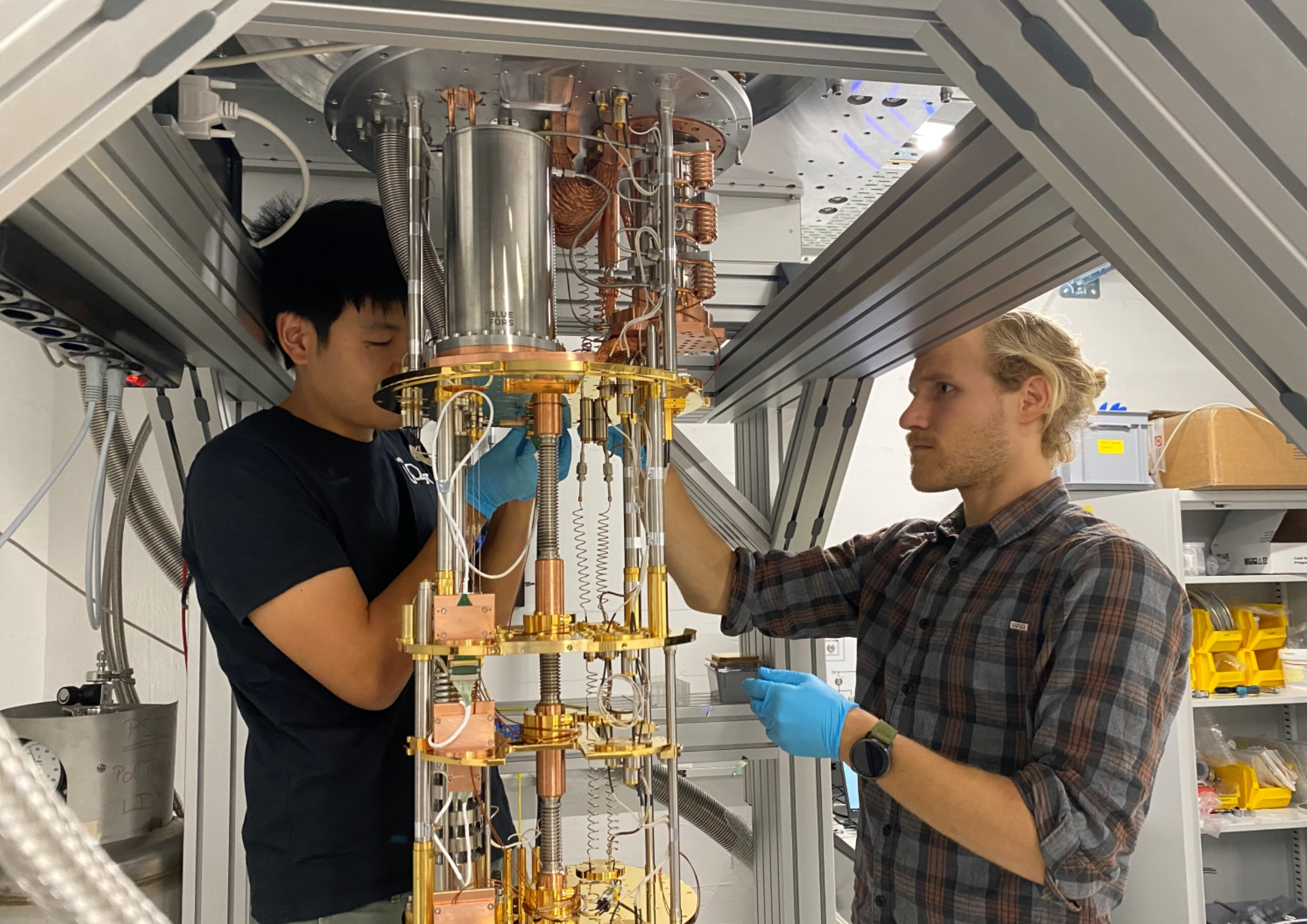
Muonium comes with one severe disadvantage: the muon survives for only about 2.2 microseconds before decaying.
That gives researchers very little time to create an atom, move it into vacuum and observe gravity changing its motion. Conventional muonium sources made the problem even harder because their atoms emerged over a broad range of speeds and directions.
An interferometer capable of detecting gravity needs something much more orderly. Researchers require an intense beam whose atoms travel at similar speeds in nearly the same direction.
Previous materials could produce muonium in vacuum, but narrowing those beams sufficiently would discard so many atoms that a gravity experiment became impractical.
Soter’s team turned to an unusual material to solve the problem: superfluid helium chilled almost to absolute zero.
“We have managed to produce the muonium atoms in a ‘cold’ state, which is what makes the gravity experiment possible in the first place,” Soter said. Here, cold describes the narrow range of velocities and directions in the resulting beam rather than simply the atoms’ temperature.
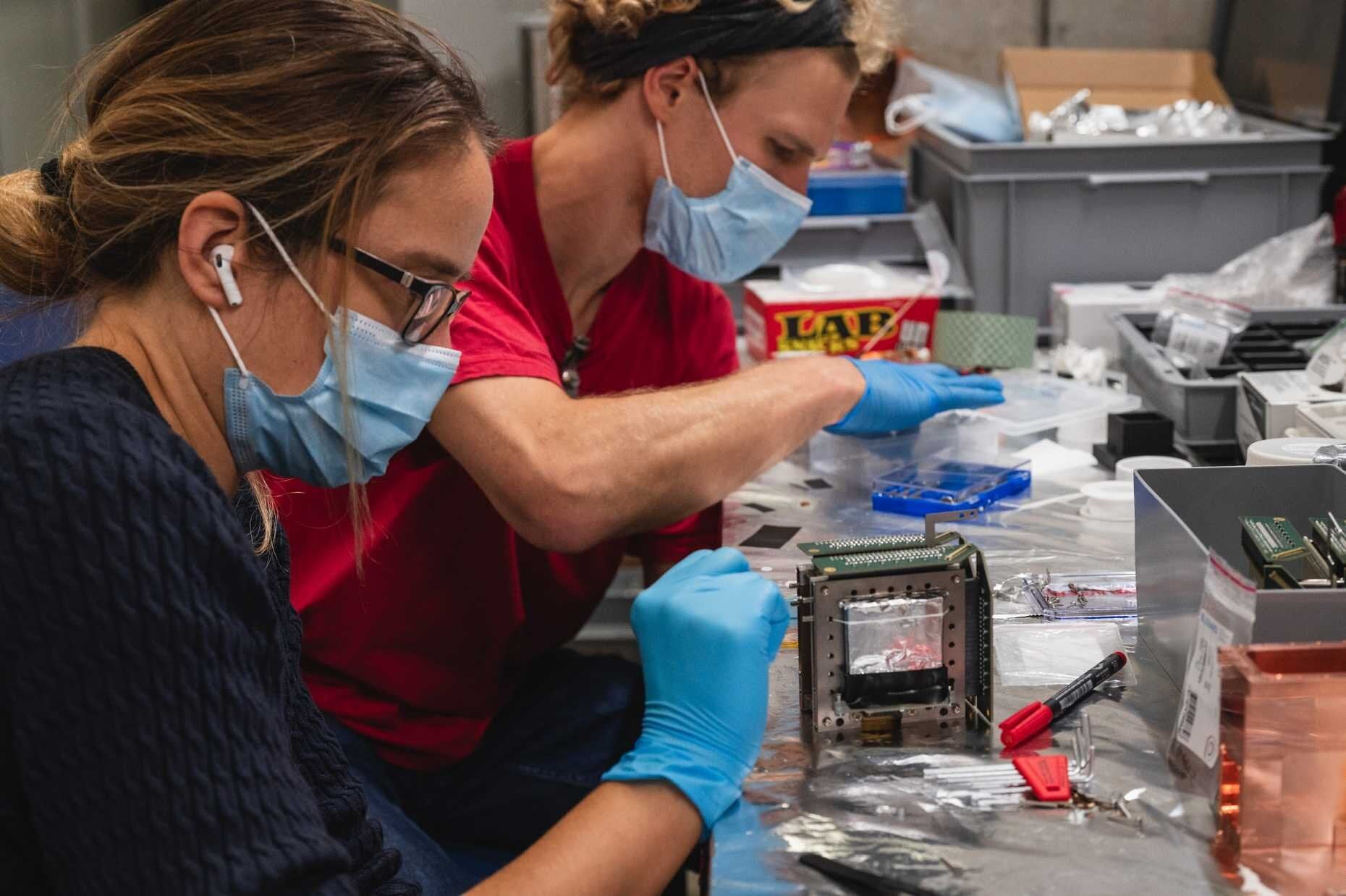
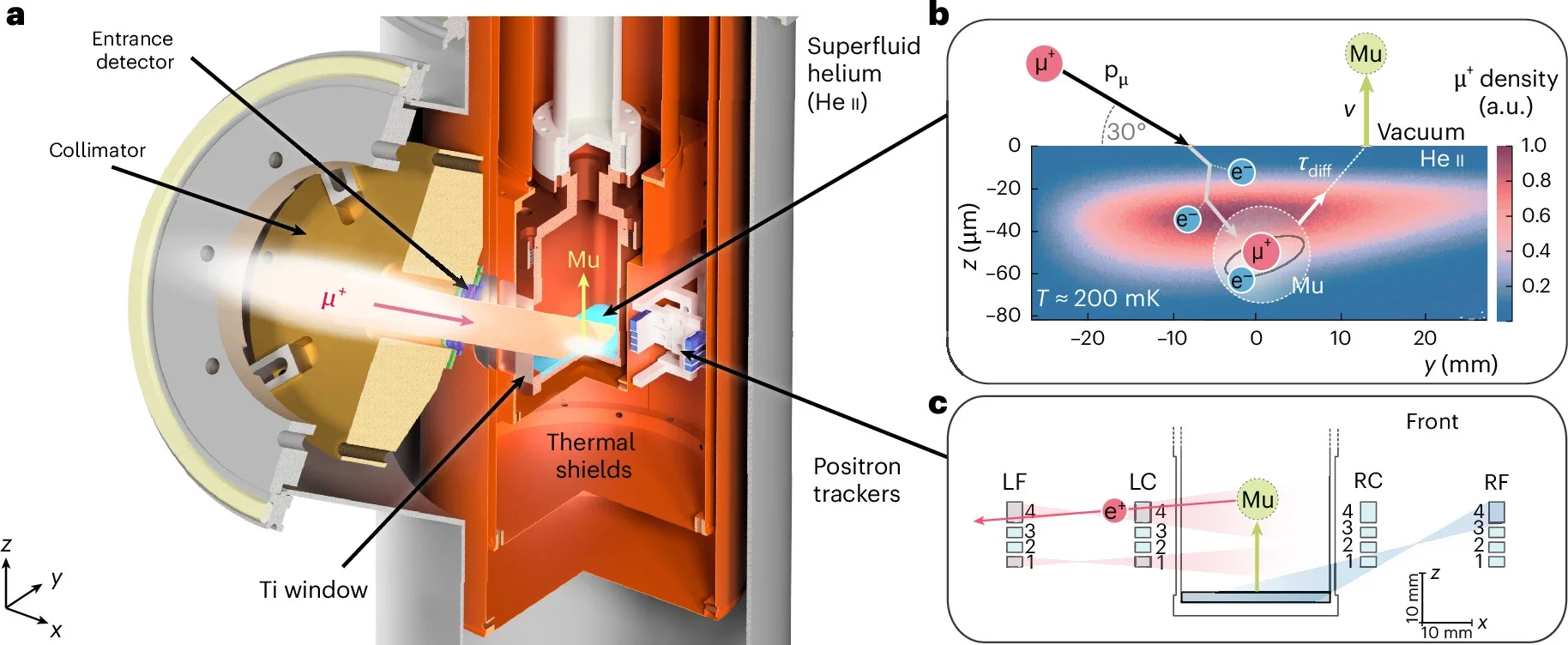
The researchers cooled a thin layer of helium to approximately 0.2 kelvin, only a fraction of a degree above absolute zero. At such temperatures, helium becomes a quantum fluid with highly unusual properties.
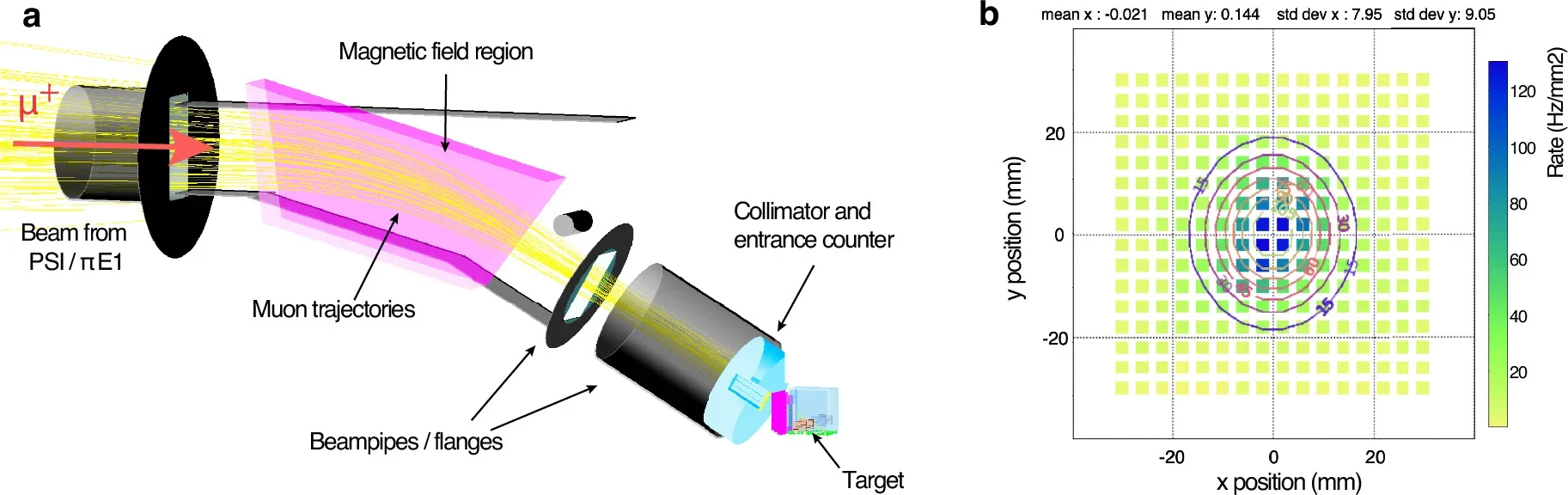
Antimuons generated by PSI’s accelerator were directed into this liquid and slowed. Once an antimuon captured an electron from its ionization trail, it formed muonium beneath the helium surface.
Muonium is energetically unfavorable inside the superfluid. The atom therefore experiences a positive chemical potential that effectively drives it toward and out of the liquid.
“When the muon reaches the surface, the chemical potential is converted into kinetic energy,” explained lead author Jesse Zhang. “So we’re using the chemical potential as an atomic cannon.”
Measurements showed muonium moving upward through the detector after escaping the helium, while an empty-target control showed no equivalent signal. A preliminary analysis placed the atoms’ propagation speed in vacuum at about 2.1 kilometers per second, with diffusion through the helium occurring on the microsecond timescale.
Most importantly, the resulting beam was far narrower in velocity and direction than a conventional thermal source.
The next stage involves sending the muonium beam through an interferometer. Instead of treating atoms simply as particles, the instrument takes advantage of their wave-like quantum behavior.
A series of extremely fine gratings would produce an interference pattern. Earth’s gravity should shift that pattern vertically by a tiny amount while the muonium travels between the gratings.
Measuring that displacement would allow the researchers to infer muonium’s gravitational acceleration.
Calculations based on the new beam suggest the proposed setup could eventually reach roughly 1% relative precision after about 100 days of measurements under projected PSI beam conditions. The researchers first need to demonstrate the required interferometry and control experimental systematics before that gravity measurement can happen.
Soter said the group hopes to test the method with the atomic beam before proceeding to the full gravitational experiment.
There is currently no evidence from this experiment that muonium violates the equivalence principle. The breakthrough is the creation of a source capable of making such a test feasible.
If muonium falls as expected, the experiment would extend a fundamental principle of gravitation into the second generation of elementary particles. That alone would mark a new kind of experimental test.
If its behavior differed significantly, however, the implications could be much larger. The result could point toward physics outside the Standard Model and general relativity, potentially including an additional interaction sometimes described as a fifth force.
“That would indeed be surprising,” Soter said.
The same beam could also improve muonium laser spectroscopy because its atoms travel in a compact stream with a much narrower velocity distribution. Those measurements could sharpen determinations of the muon mass and other fundamental quantities.
For Soter, however, the central question remains straightforward. She wants to know whether the strange, short-lived second-generation particle obeys the same gravitational rule that appears to govern everything tested so far.
“I am completely open-minded,” she said. “I simply want to measure, for the first time, whether the equivalence between gravitational and inertial mass also applies to the second generation of particles.”
These studies provide key background on muonium sources, atom interferometry and previous experimental tests of Einstein’s weak equivalence principle.
Development of a cold atomic muonium beam for next generation atomic physics and gravity experiments: Describes the proposed high-intensity cold muonium source and the motivation for using it in a direct gravitational test of the exotic atom. (SciPost Physics Proceedings, 2021)
Room-temperature emission of muonium from aerogel and zeolite targets: Characterizes earlier vacuum muonium sources and the limitations that motivated development of a colder, narrower beam for precision measurements. (Physical Review A, 2022)
Observation of the effect of gravity on the motion of antimatter: Reports the ALPHA experiment’s observation that antihydrogen responds to Earth’s gravity consistently with ordinary matter, providing an important comparison for exotic-matter gravity tests. (Nature, 2023)
MICROSCOPE Mission: Final Results of the Test of the Equivalence Principle: Presents one of the most precise tests of universal free fall using ordinary matter and finds no violation of the weak equivalence principle. (Physical Review Letters, 2022)
Atom-Interferometric Test of the Equivalence Principle at the 10−12 Level: Uses quantum interference between rubidium isotopes to test whether different atoms experience the same gravitational acceleration. (Physical Review Letters, 2020)
Research findings are available online in the journal Nature Physics.
The original story “ETH Zurich physicists built an ‘atomic cannon’ to put Einstein’s theory of gravity to the test” is published in The Brighter Side of News.
Like these kind of feel good stories? Get The Brighter Side of News’ newsletter.
The post ETH Zurich physicists built an ‘atomic cannon’ to put Einstein’s theory of gravity to the test appeared first on The Brighter Side of News.


Leave a comment
You must be logged in to post a comment.