Euclid has turned up a long-sought population of ancient quasars, including the most distant one yet seen. As a result, it has started to change how astronomers study the Universe’s first giant black holes.
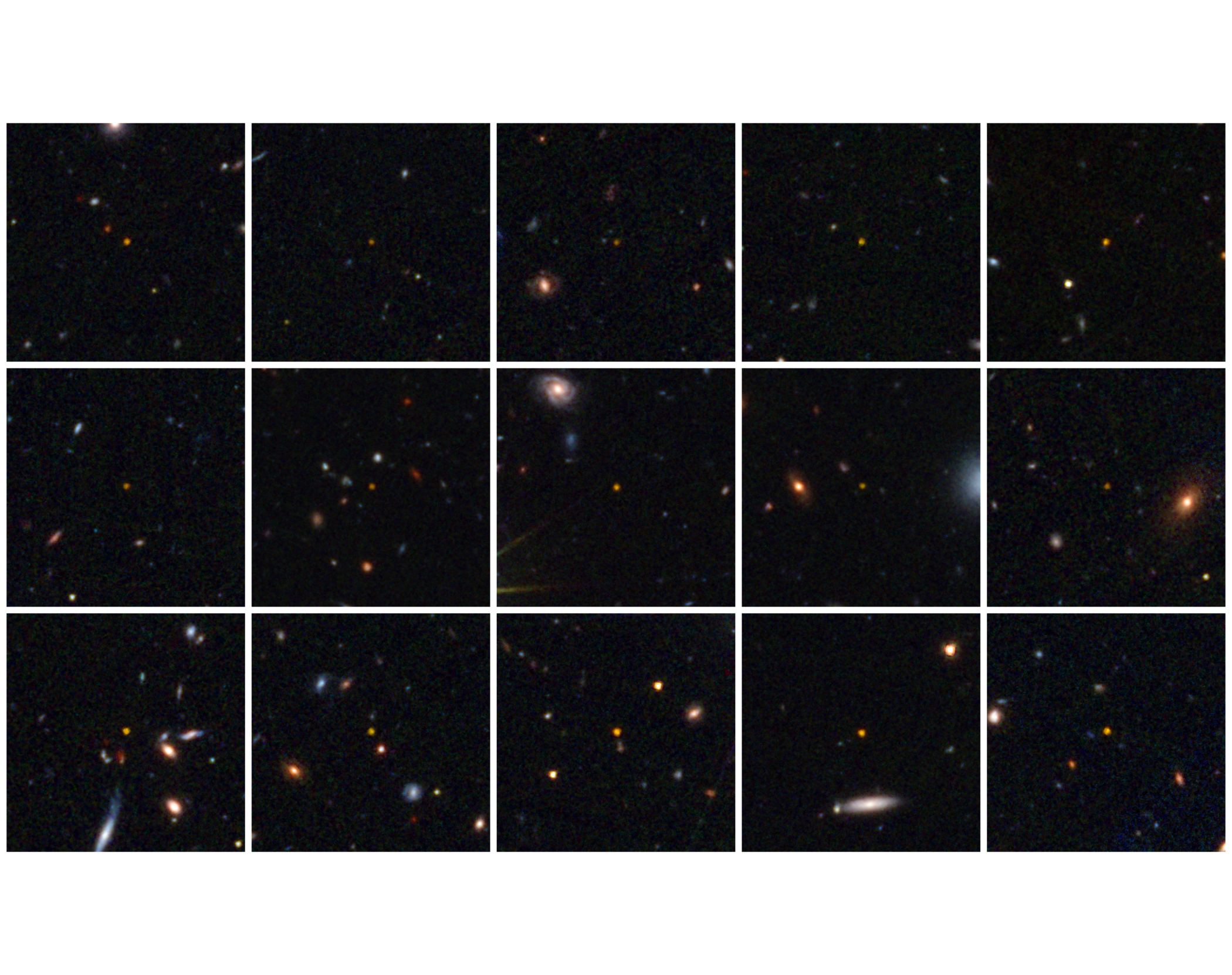
The European Space Agency telescope found 31 new quasars dating to a time when the cosmos was less than 800 million years old. Of these, twelve sit at redshift 7 or higher. That means their light comes from the first 770 million years after the Big Bang. Two go even farther back. The most distant, EUCL J172902.75+641018.1, has a redshift of about 7.77. This places it just 662 million years into cosmic history. A second, EUCL J125308.55+705432.3, sits at about 7.69.
That matters because quasars at these distances are both rare and revealing. A quasar forms during a short, violent stage in a galaxy’s life. It appears when matter spirals into the central supermassive black hole and releases huge amounts of energy. The glare can outshine the rest of the galaxy by hundreds or even thousands of times. Therefore, quasars are powerful beacons from the early Universe.
“These early quasars date back to the Universe’s infancy,” said Daming Yang of Leiden University in the Netherlands, lead author of the discovery paper. “By finding and studying them, we can better understand how these enormous systems formed and grew so quickly, one of the greatest mysteries in astrophysics.”
Until now, the known sample at these extreme distances was tiny. Before this work, only nine quasars had been found at redshift above 7. In contrast, hundreds were known between redshift 6 and 7. That imbalance left astronomers trying to explain the earliest phase of black hole growth with only a few especially bright examples.
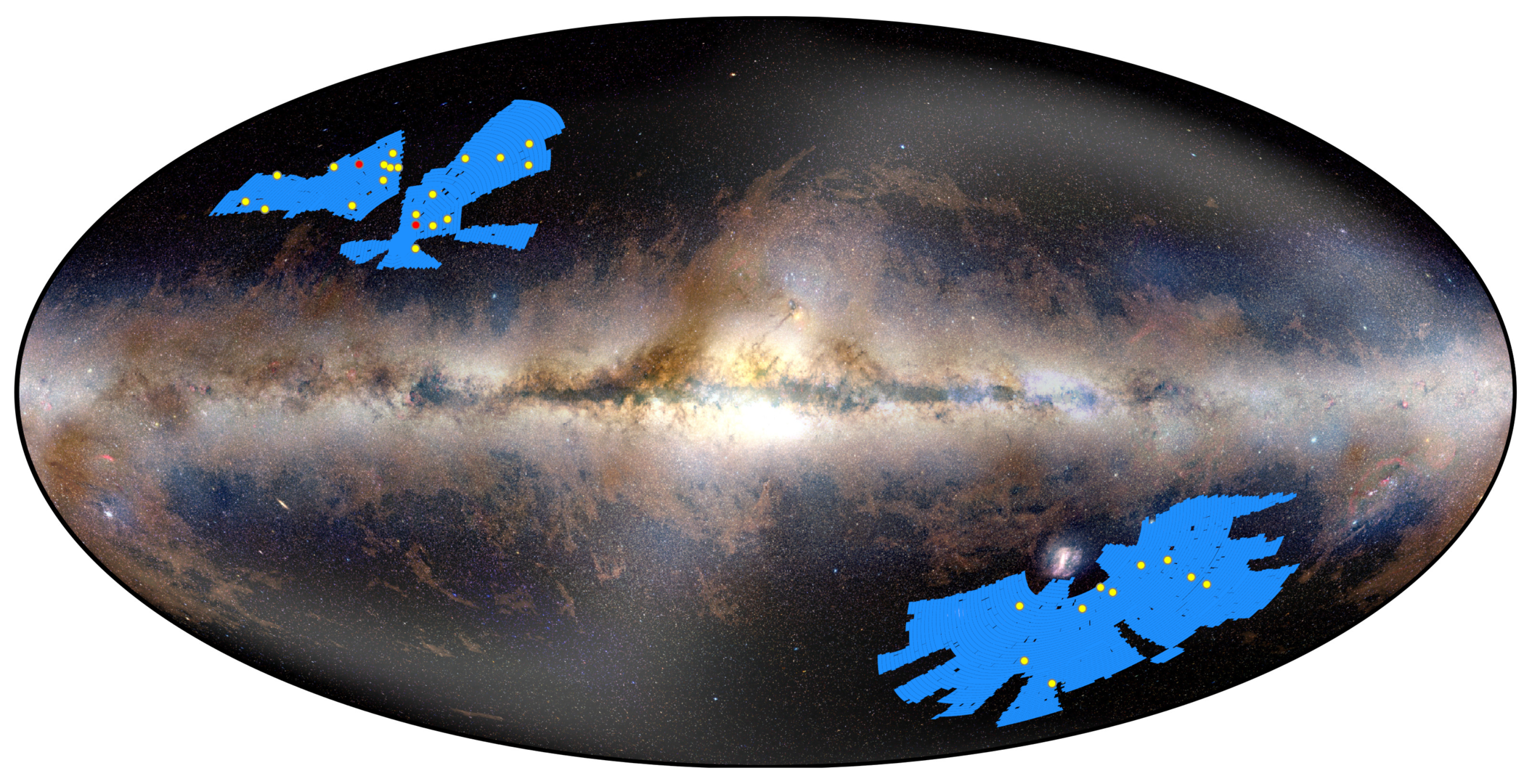
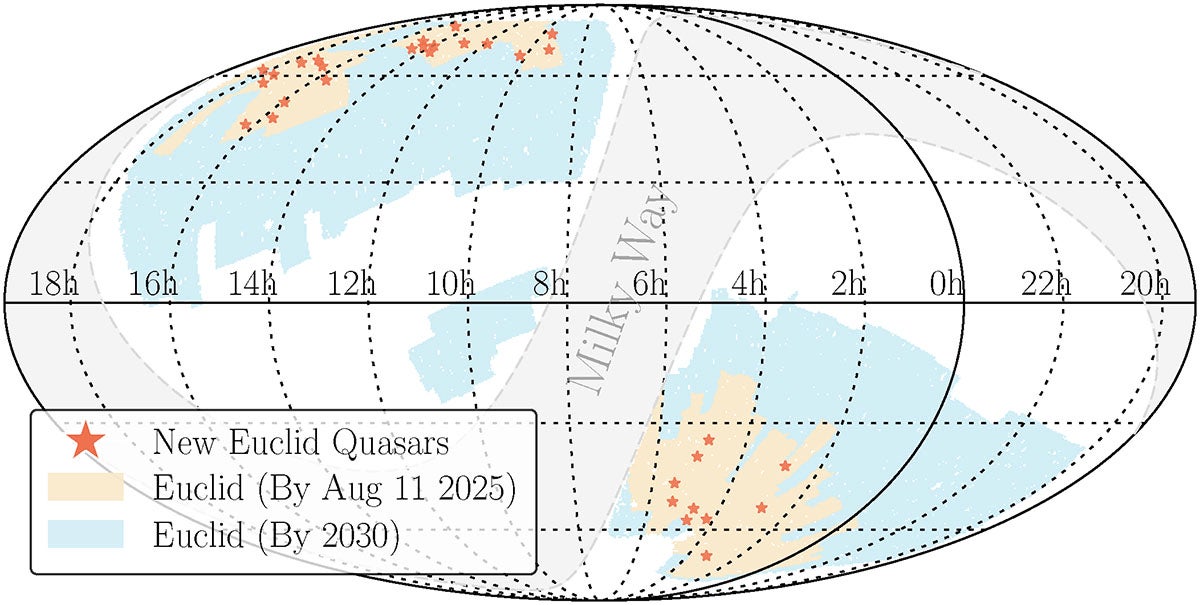
Euclid begins to change that picture. In data collected from about 3,000 square degrees of sky between February 2024 and August 2025, the mission uncovered quasars spanning redshifts 6.6 to 7.8. The telescope’s wide sky coverage and near-infrared reach made the difference. At redshifts above 7, the key light signatures astronomers look for are pushed beyond the range where standard silicon detectors work well. Moreover, Earth’s atmosphere adds bright background noise that makes ground searches much harder.
“Euclid is a true game-changer,” Yang said. “Before, we could only find a handful of the very brightest ancient quasars, but Euclid lets us search far more efficiently across huge areas of sky to capture much fainter light. It’s a unique tool for quasar hunting.”
The survey did not just add records. It also pushed into a dimmer population that had mostly escaped notice. Many of the newly found quasars are about one to two magnitudes fainter in ultraviolet light than the previously known quasars at similar redshifts. Several sit near an absolute magnitude of about minus 24. This range begins to probe the faint end of the early quasar population.
That faint end is where some of the biggest questions live. The brightest known quasars have often been described as the tip of the iceberg, unusual objects that may not represent the broader population of early black holes. Less luminous quasars could offer a better look at typical growth in the young Universe.
They may also help astronomers sort out where quasars end and very bright young galaxies begin. At these luminosities, the brightness distributions of quasars and Lyman-break galaxies start to overlap. The paper notes that some of the faintest sources show unusual Lyα emission profiles. Therefore, deeper follow-up will be needed to pin down their nature in every case. Even so, size measurements from Euclid images show that nearly all of the new sources are consistent with point sources rather than extended galaxies.
One of the most intriguing objects is EUCL J1253, the second most distant quasar in the sample. Follow-up submillimetre observations indicate that its host galaxy contains a large gas reservoir. Another target, EUCL J052209.82−512709.2, was observed with Magellan’s FIRE instrument and shows a broad range of emission features from Lyα to C III]. Using the C IV line, the team estimated a black hole mass of about 10^7.6 solar masses. Yet, the paper stresses that better data will be needed for a firmer measurement.
The survey also found two quasars with significant radio counterparts in the LOFAR Two-metre Sky Survey. If the radio detections are indeed tied to the quasars, their luminosities would place them among the most radio-powerful quasars known beyond redshift 6.5. Therefore, this likely points to jet activity rather than star formation alone.
These objects come from the epoch of reionisation, the period when the early Universe shifted from mostly cold and neutral to hot and ionised. That transition set the stage for the transparent cosmos seen today. Because quasars are so bright, they can act as backlights for studying the gas between galaxies. This helps with tracing how reionisation unfolded.
“Ancient quasars are rare discoveries. They’re interesting in themselves, but also time machines that enable us to explore the early Universe and understand how the first generation of galaxies came to be,” said ESA Euclid Project Scientist Valeria Pettorino.
The team used Euclid imaging as the backbone of the search. They then confirmed candidates with spectroscopic follow-up on Keck, Magellan, and the Large Binocular Telescope. Out of 123 candidates observed, 31 were confirmed as quasars. The paper says the work is still incomplete, especially in the southern sky. In addition, a full statistical analysis of the selection function will come later.
Even so, the early return is striking. The first 10 or so quasars above redshift 7 took more than a decade to find. Euclid has already added more than that in a single year.
“The Euclid team has taken a true ‘census’ of quasars at the dawn of the Universe for the first time,” said Antonio La Marca, an ESA Research Fellow in the Euclid team. “It’s a big step towards understanding these fascinating objects on a more fundamental level.”
This discovery gives astronomers a much larger and less biased sample for testing how the first supermassive black holes formed. It also helps to understand how quickly they grew, and how they affected the gas around them during reionisation.
It also shows that Euclid can find fainter quasars over huge swaths of sky. This creates targets for deeper observations with JWST, ALMA, and other facilities.
If that pace continues, astronomers may soon be able to move from rare record-holders to population-level studies of the early quasar era.
Research findings are available online in the journal Astronomy and Astrophysics.
The original story “Euclid finds 31 distant quasars dating back 800 million years” is published in The Brighter Side of News.
Like these kind of feel good stories? Get The Brighter Side of News’ newsletter.
The post Euclid finds 31 distant quasars dating back 800 million years appeared first on The Brighter Side of News.

