Space storms rarely make headlines until something goes wrong. A satellite drifts off course. A power grid flickers. Navigation signals weaken without warning. For decades, scientists believed there was a natural limit to how severe these events could become. New research now suggests that assumption may be flawed.
A study from Lancaster University challenges a long-held idea in space science. Researchers report that Earth’s response to extreme solar activity may not level off at high intensities. Instead, the apparent limit could be a statistical illusion caused by how scientists measure the solar wind.
Space weather begins at the Sun. A steady stream of charged particles, known as the solar wind, flows outward through the solar system. During solar eruptions, this stream intensifies, carrying bursts of energy toward Earth.
When this energy reaches the planet, it interacts with Earth’s magnetic field and upper atmosphere. This interaction drives electric currents and changes in plasma, the charged gas surrounding the planet. In mild cases, these changes create auroras. In extreme cases, they disrupt satellites, power systems, and communication networks.
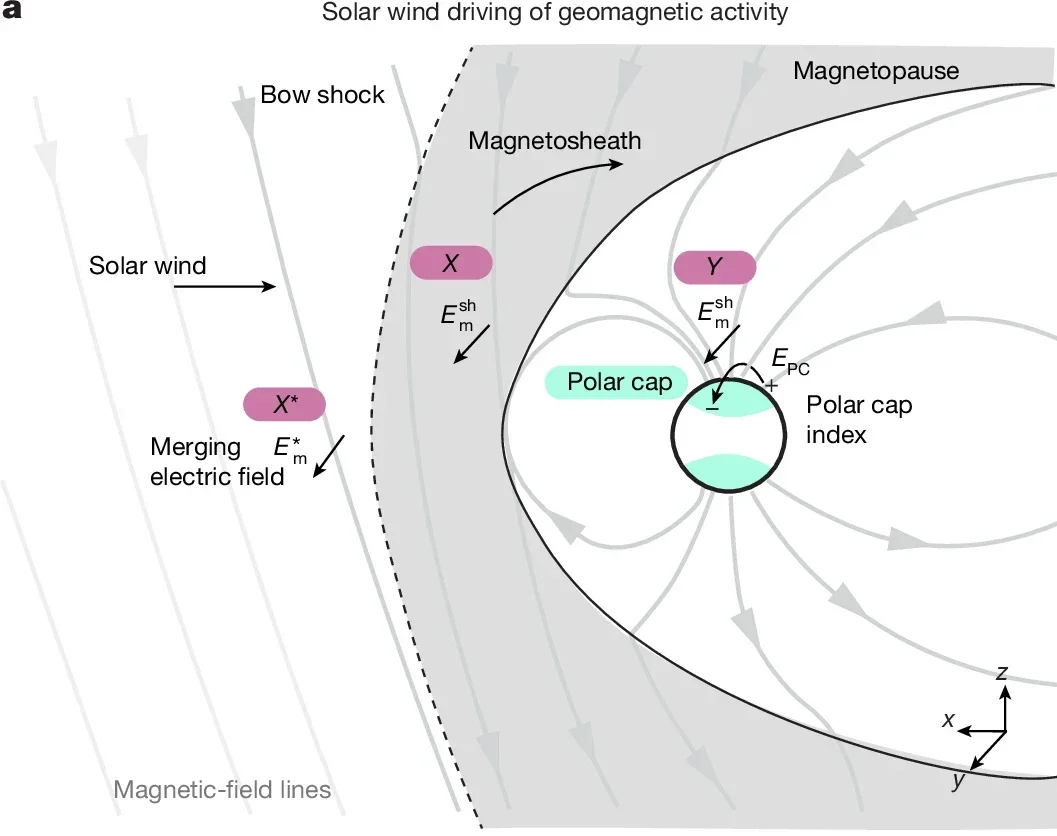
For years, scientists observed a puzzling pattern. As the solar wind grew stronger, Earth’s response increased, but only up to a point. Beyond that, the response appeared to flatten. This effect became known as “saturation.”
Many researchers believed the magnetosphere, Earth’s magnetic shield, could only absorb a limited amount of energy. More than ten theories emerged to explain why this ceiling might exist.
The new study takes a different view. It suggests that the limit may not exist at all.
To understand the issue, it helps to look at how solar wind data is collected. Most measurements come from spacecraft positioned at a location called the L1 Lagrange point. This point sits about one million miles closer to the Sun than Earth.
From this position, spacecraft record the speed, density, and magnetic properties of the solar wind. Scientists then use these measurements to estimate how the wind will affect Earth.
However, the solar wind changes as it travels. Its structure shifts, its timing varies, and its strength can weaken before it reaches Earth. This creates uncertainty in the data.
Dr Maria Walach of Lancaster University explained the consequences of this uncertainty. “Our planet’s magnetic field does a really great job of protecting us against many space weather effects and so they often just show up as glitches or beautiful aurora. There are however extreme cases, where satellites unexpectedly fall back to Earth, or we lose communication and GPS signals.”
These uncertainties are not random. They follow a predictable pattern that can distort how data is interpreted.
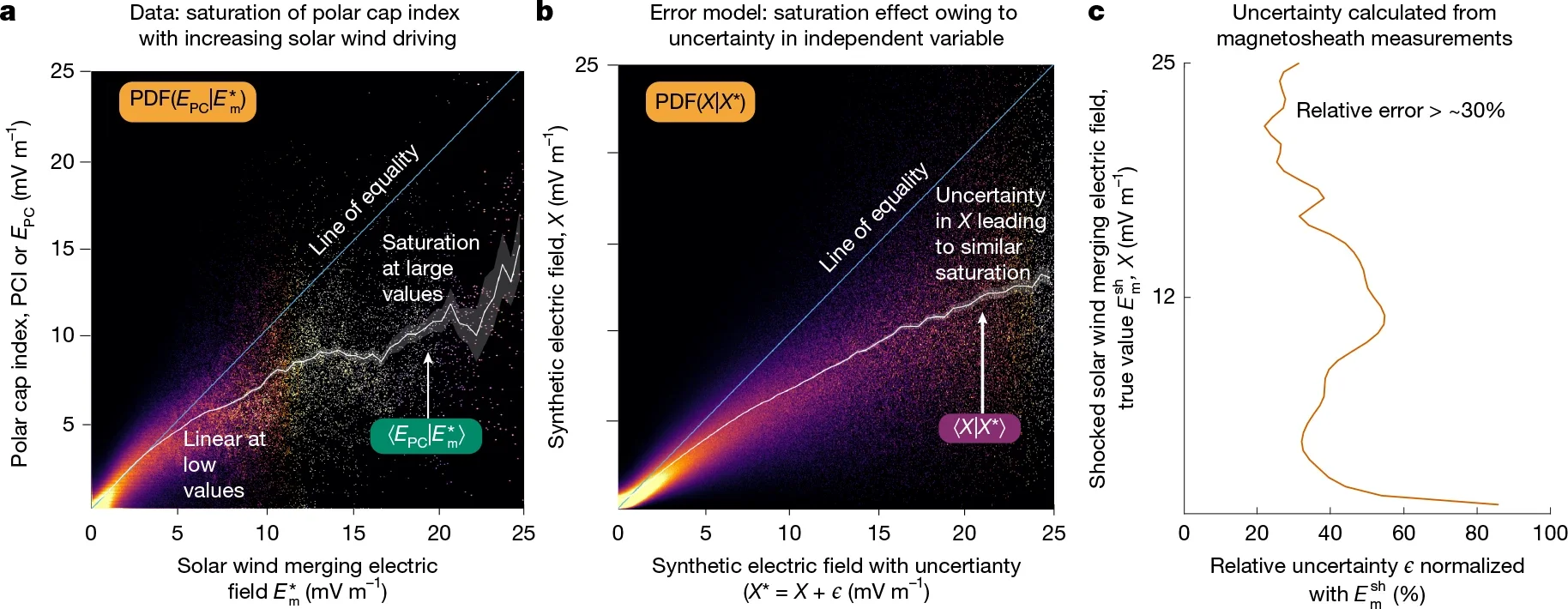
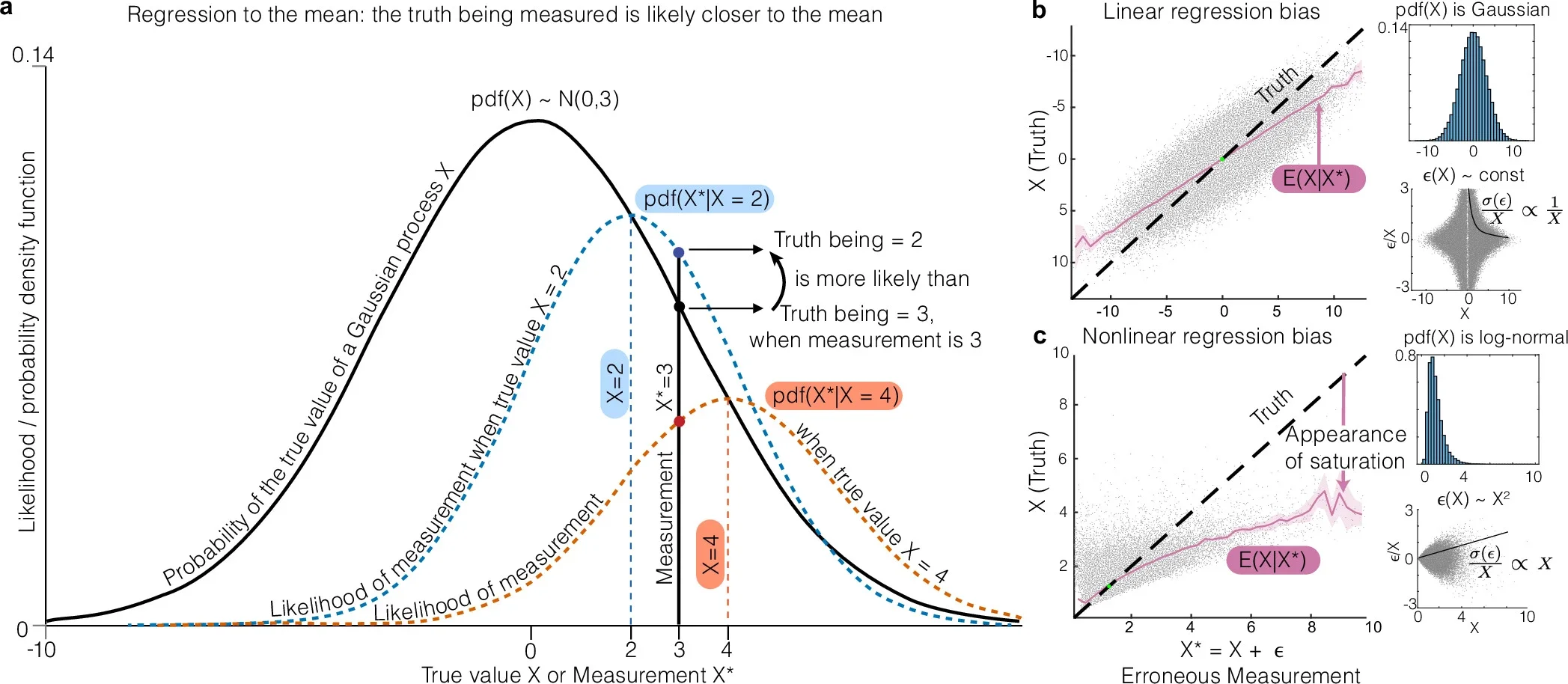
The study focuses on a statistical effect called regression to the mean. This concept describes how extreme measurements tend to be closer to average when corrected for error.
Dr Nithin Sivadas of NASA’s Goddard Space Flight Center, the study’s lead author, explained the idea. “We usually assume the truth may be around its measurement. But probability theory says it leans one way. That’s why space weather risks appear underestimated.”
When a very strong solar wind is measured at L1, the true strength at Earth is often lower. This creates a mismatch between what is measured and what actually reaches the planet.
When scientists compare these mismatched values, it can appear that Earth’s response has stopped increasing. In reality, the response may still be rising, but the input data is skewed.
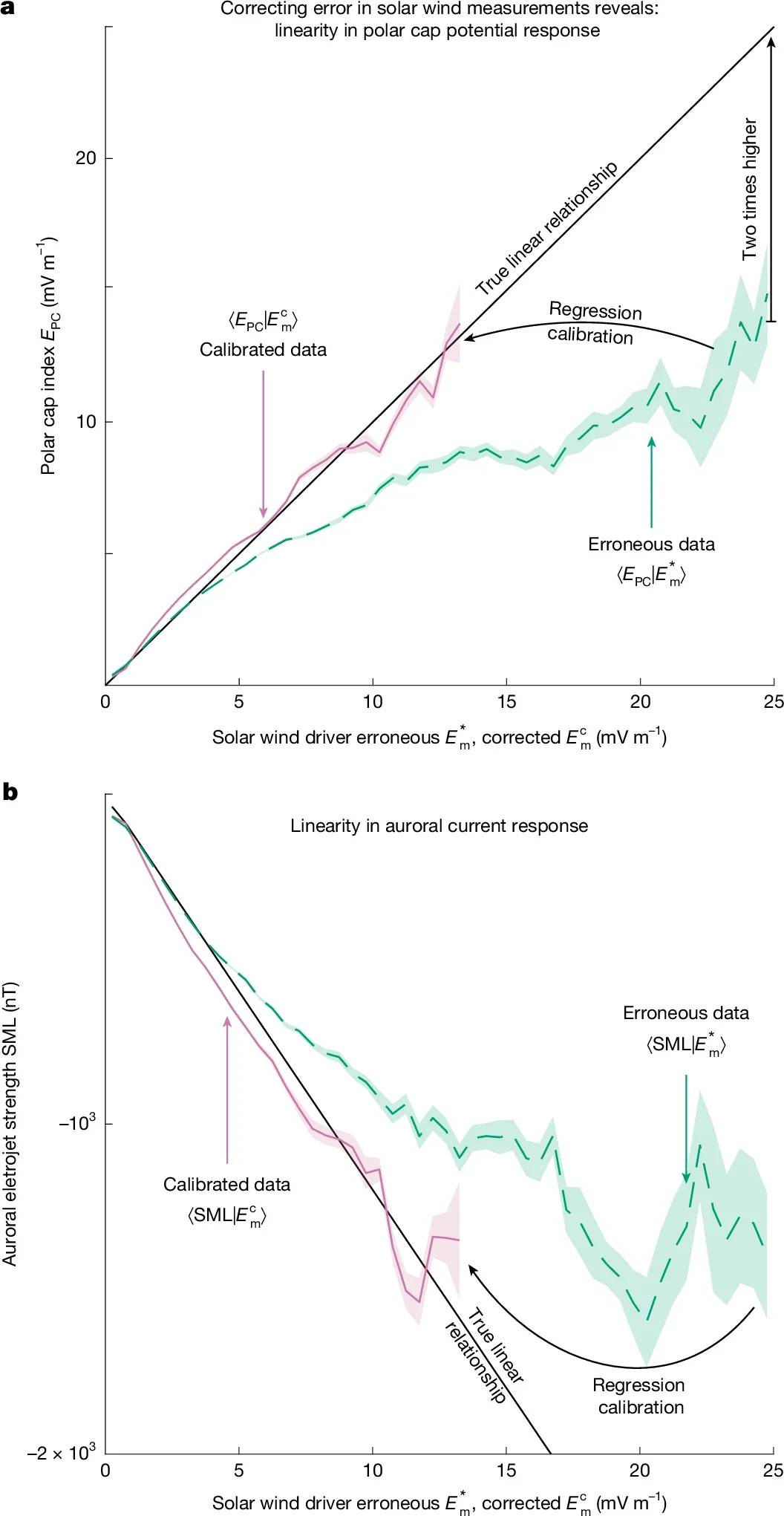
To test this idea, the research team analyzed more than one million solar wind measurements taken by NASA spacecraft orbiting close to Earth. These measurements provide a more direct view of conditions at the planet.
The results revealed a clear pattern. As the strength of the solar wind increased, the electric currents in Earth’s upper atmosphere also increased. There was no sign of a plateau within the observed range.
This finding challenges decades of assumptions. It suggests that the apparent saturation effect comes from measurement bias rather than a true physical limit.
By correcting for this bias, the researchers found a steady, continuous relationship between solar wind strength and geomagnetic activity.
If there is no natural ceiling, the implications are serious. Extreme geomagnetic storms could produce stronger effects than previously expected.
These storms can disrupt satellite operations, damage power grids, and interfere with navigation systems such as GPS. They can also increase radiation exposure for astronauts and high-altitude flights.
Dr Walach emphasized the uncertainty surrounding rare events. “If there is no upper limit to our planet’s response to the solar wind, modelling for extreme cases needs to take this into account and we should be vigilant of space weather effects. Fortunately, these very extreme cases are rare, but this also means we have limited data to work with and only time will tell what happens at the very extreme one-in-a-thousand-year kind of event.”
Because the most severe storms occur infrequently, scientists have limited data on their full impact. This makes accurate modeling even more important.
Modern society depends heavily on systems that are vulnerable to space weather. Satellites support communication, navigation, and weather forecasting. Power grids rely on stable electrical conditions. Aviation and space travel depend on accurate data and safe radiation levels.
If the risks of extreme storms have been underestimated, these systems may be more exposed than expected. Planning for worst-case scenarios becomes more challenging when the upper limits are unclear.
The study highlights the need for caution. Even if the most extreme events are rare, their potential impact could be significant.
The findings extend beyond space weather. They show how measurement uncertainty can shape scientific conclusions.
In many fields, researchers rely on indirect measurements. When those measurements contain bias, the results can be misleading. Patterns that appear real may be artifacts of the data.
The study demonstrates how careful analysis can uncover these hidden effects. By correcting for bias, scientists can reveal more accurate relationships between cause and effect.
This approach may apply to other areas of research, from climate science to medicine, where extreme values are difficult to measure precisely.
This research changes how scientists assess the risks of extreme space weather. If Earth’s response does not have a clear upper limit, models must account for stronger potential impacts. This will improve forecasting and help governments and industries prepare for rare but severe events.
The findings also highlight the need for better measurement systems closer to Earth. More accurate data can reduce uncertainty and improve predictions. This could lead to stronger protections for satellites, power grids, and communication networks.
For researchers, the study offers a new framework for analyzing extreme events. By accounting for statistical bias, scientists can better understand how natural systems respond under stress.
In the long term, this work may lead to more resilient infrastructure. It can guide the design of systems that withstand stronger geomagnetic storms, protecting critical services that people rely on every day.
These resources explore geomagnetic saturation, solar-wind coupling and the technological risks created by severe space weather.
Saturation of polar cap potential by intense solar wind electric fields: Presents influential observational evidence that the polar-cap response appeared to saturate under strong solar-wind forcing, helping establish the phenomenon challenged by newer statistical analysis. (Geophysical Research Letters, 2002)
Saturation of polar cap potential: Nonlinearity in quasi-steady solar wind-magnetosphere-ionosphere coupling: Develops a physical model explaining apparent saturation through nonlinear coupling among the solar wind, magnetosphere and ionosphere. (Journal of Geophysical Research: Space Physics, 2010)
A User’s Guide to the Magnetically Connected Space Weather System: A Brief Review: Reviews how magnetic connections link solar eruptions, the solar wind, Earth’s magnetosphere and the technological effects of extreme space weather. (Frontiers in Astronomy and Space Sciences, 2022)
Achievements and Challenges in the Science of Space Weather: Reviews major advances in space-weather science while examining unresolved problems surrounding extreme events, forecasting and solar-terrestrial interactions. (Space Science Reviews, 2017)
Severe Space Weather Events: Understanding Societal and Economic Impacts: A Workshop Report: Examines how extreme geomagnetic events could affect electricity grids, satellites, navigation, communications and other critical technological systems. (National Academies Press, 2008)
Research findings are available online in the journal Nature.
The original story “Extreme solar storms could hit Earth harder than scientists expected” is published in The Brighter Side of News.
Like these kind of feel good stories? Get The Brighter Side of News’ newsletter.
The post Extreme solar storms could hit Earth harder than scientists expected appeared first on The Brighter Side of News.


Leave a comment
You must be logged in to post a comment.