For nearly 150 years, every confirmed Diplodocus fossil had come from the western United States. A series of remarkably preserved tail bones in eastern Spain has now broken that geographic boundary.
Paleontologists identified 14 vertebrae and several chevrons from the La Tejería site in El Castellar, Teruel, as belonging to Diplodocus. The animal lived about 150 million years ago during the Late Jurassic and may have stretched roughly 25 meters, or 82 feet, from head to tail.
The finding represents the first confirmed Diplodocus outside North America. It also adds unusually direct evidence to a larger paleontological question: how similar dinosaur communities appeared on opposite sides of the developing North Atlantic.
“We were looking at a Diplodocus,” lead author Sergio Sánchez Fenollosa of Fundación Dinópolis said after anatomical and evolutionary analyses repeatedly produced the same conclusion.
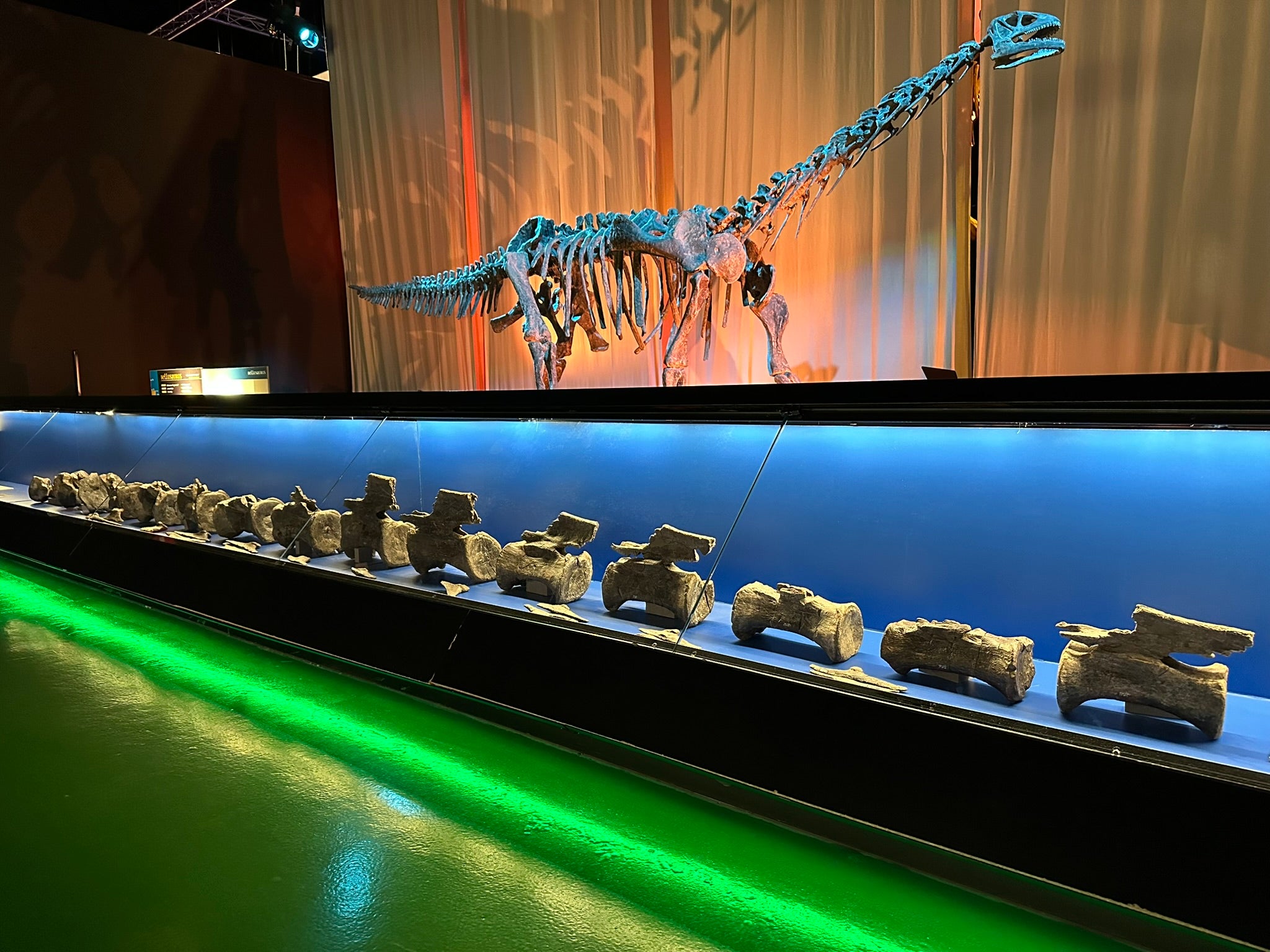
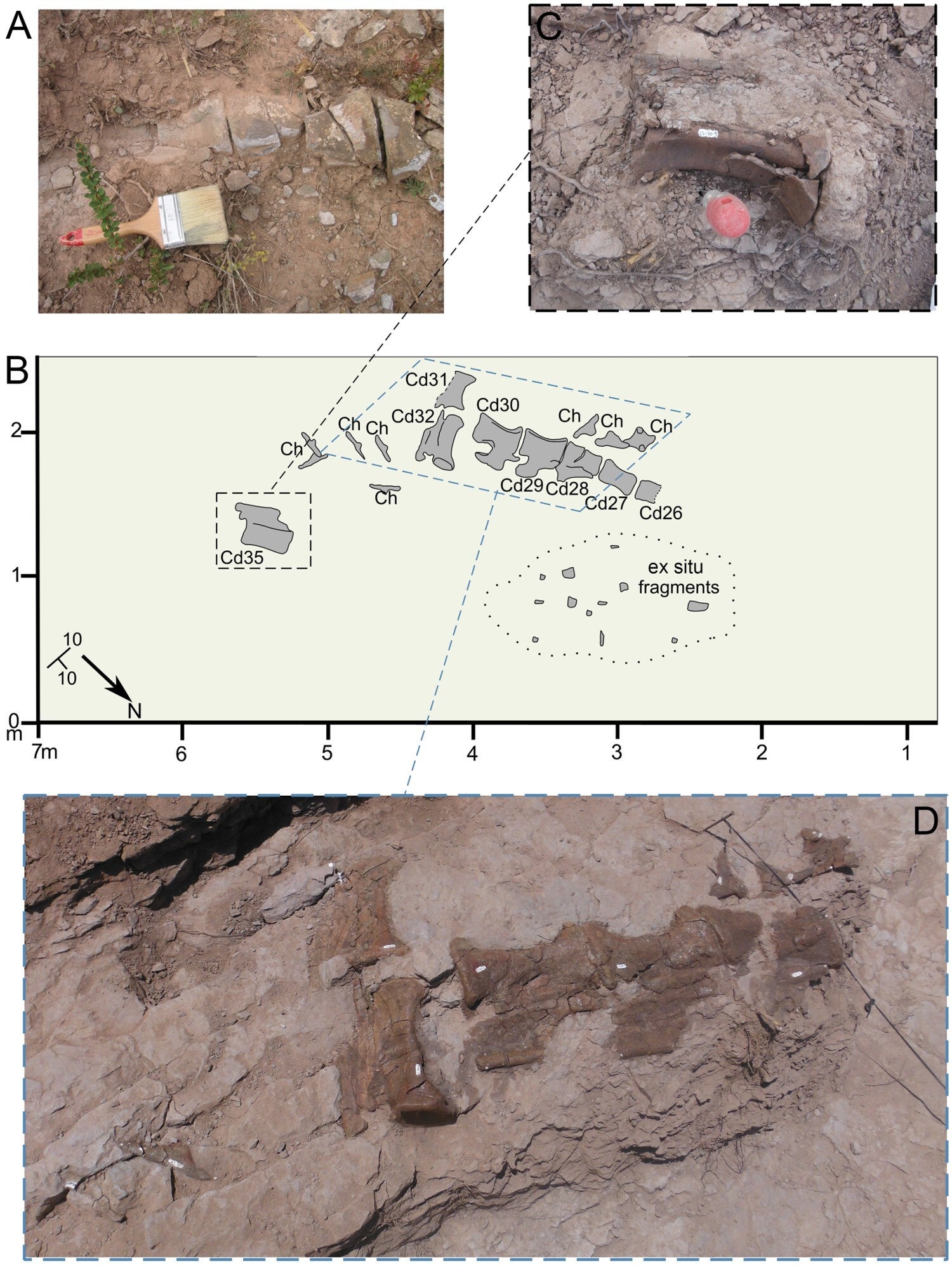
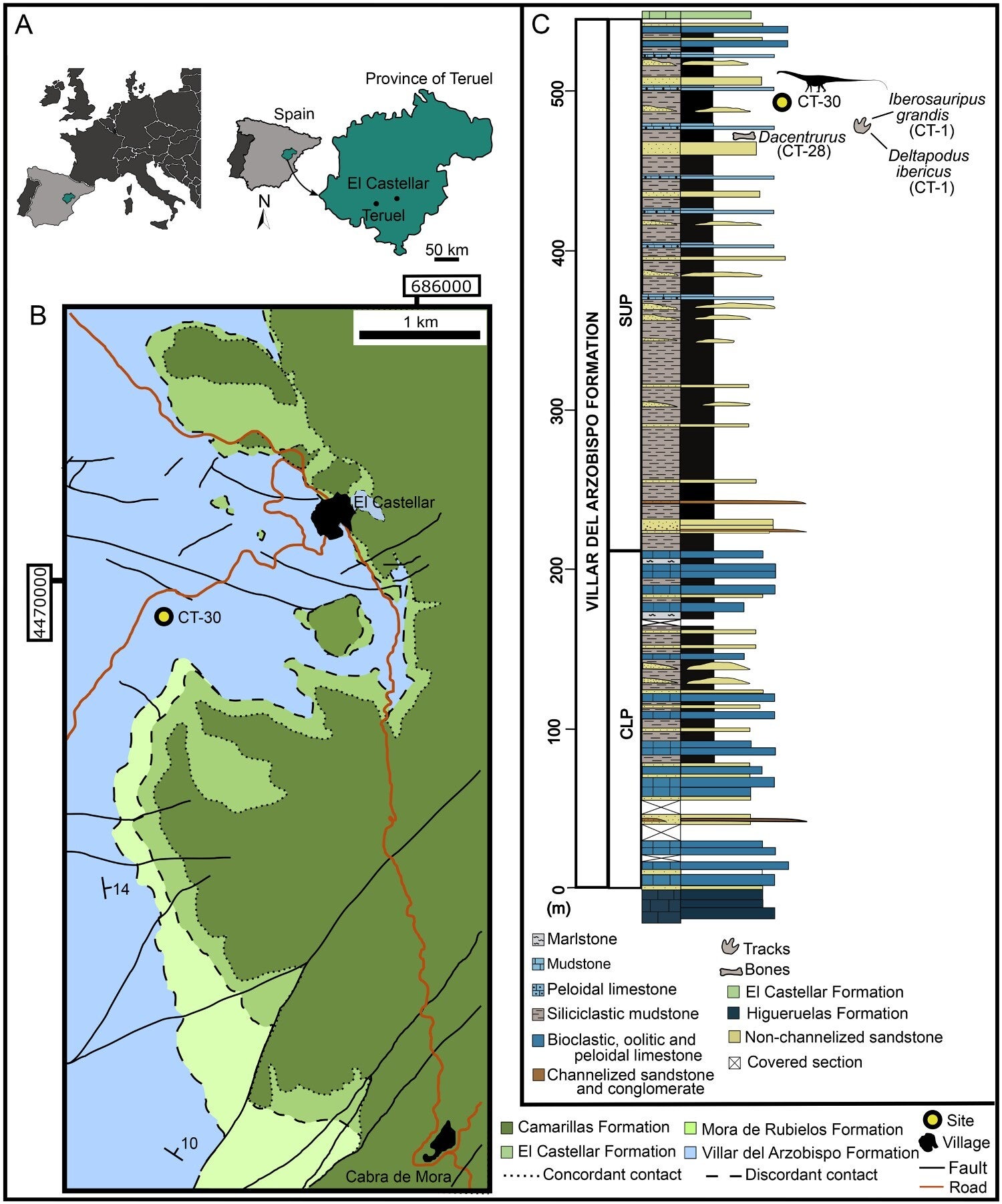
The specimen, CT-30, comes from the Villar del Arzobispo Formation. The fossil site was discovered in 2008, when paleontologists recovered five tail vertebrae. Excavations in 2014 and 2015 added another nine vertebrae and numerous chevrons, some still articulated or lying close together.
Researchers concluded that the bones probably represent the 22nd through 35th vertebrae in the tail. That makes CT-30 one of Europe’s more complete diplodocid specimens, a group whose European fossil record has often consisted of incomplete skeletons or isolated remains.
Comparisons with North American diplodocines suggest the Spanish animal was approximately the same size as its American relatives. Its estimated 25-meter length also places it among the giant sauropods known from the Jurassic deposits of Teruel.
The region has produced other large sauropods, including Turiasaurus and Losillasaurus, but those animals belonged to very different branches of the sauropod family tree.
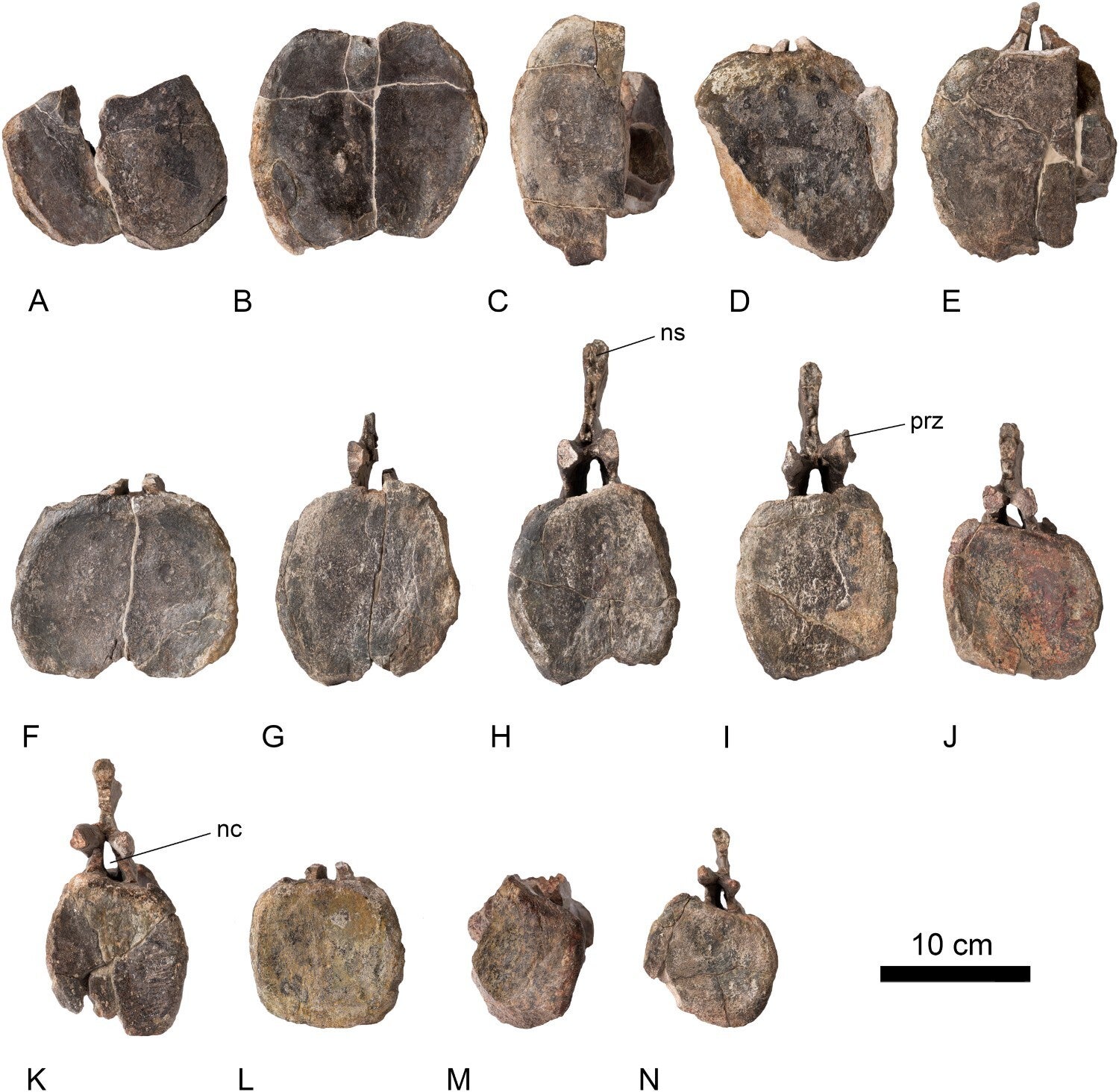
Identification depended on a particular combination of anatomical features rather than one striking bone.
The Spanish dinosaur had elongated vertebral centra, the main bodies of the vertebrae, without longitudinal ridges along their sides. Deep grooves ran along the undersides of several tail vertebrae, in some cases exceeding 1 centimeter in depth.
Researchers also identified large pneumatic depressions associated with air spaces inside one vertebra. Preserved neural arches had strongly backward-leaning spines, while some contained elongated projections connected by sheets of bone.
The chevrons, bones attached underneath the tail vertebrae, added further evidence. They were elongated and forked, and some contained distinctive depressions on their inner surfaces.
Several of those traits closely resemble Diplodocus hallorum. However, the available skeleton does not preserve enough distinctive anatomy for researchers to confidently assign CT-30 to that species.
They therefore classified it as Diplodocus sp., identifying the genus while leaving the exact species unresolved.
The team tested that anatomical identification with several phylogenetic methods.
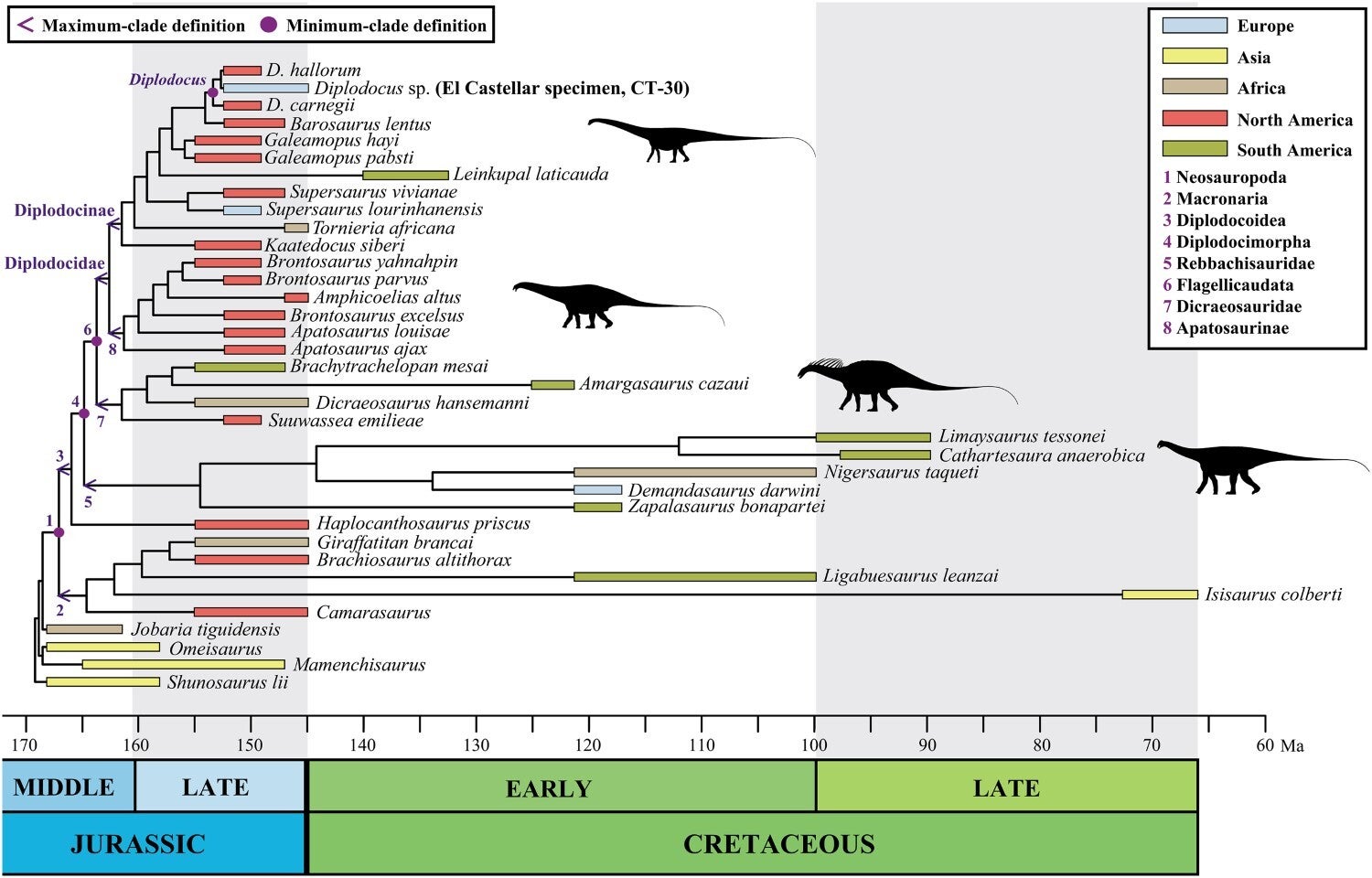
Researchers coded 23 observable characteristics from CT-30 into a dataset containing 489 anatomical characters across 36 taxonomic groups. They then analyzed those data using multiple maximum parsimony approaches and Bayesian inference.
Despite differences elsewhere in the resulting family trees, CT-30 consistently remained inside Diplodocus. The parsimony analyses placed it as the closest tested relative of D. hallorum.
Bayesian analysis produced 8,986 evolutionary trees and reached the same basic conclusion. The Spanish animal again grouped within Diplodocus and alongside D. hallorum.
Researchers also tested an alternative explanation: that CT-30 belonged closer to Supersaurus lourinhanensis, a diplodocid already known from Portugal. A statistical test rejected that forced placement as significantly less parsimonious.
Together, the anatomy and evolutionary analyses gave the researchers confidence that the fossil represents the first European record of the iconic genus.
The geographic implications extend beyond one dinosaur.
Until this discovery, confirmed Diplodocus remains were restricted to the Morrison Formation of the western United States. Yet several other Late Jurassic dinosaur groups show close links between North America and the Iberian Peninsula.
The Spanish study points to genera including Allosaurus, Stegosaurus, Torvosaurus and Supersaurus. Related sauropods, armored dinosaurs and ornithopods also appear on both sides of the ancient ocean.
CT-30 adds Diplodocus to that pattern.
During the late Kimmeridgian and early Tithonian, the proto-North Atlantic was continuing to open between North America and Europe. The researchers describe geological evidence for periods of falling sea level that may have temporarily exposed land through a Newfoundland-Iberia corridor.
Those connections would not have needed to remain permanently open. Episodic land areas could have provided windows in which terrestrial animals dispersed between continents before rising seas again increased the separation.
The discovery does not reveal whether Diplodocus moved from North America into Europe or how widespread the genus became after reaching Iberia. More fossils would be needed to resolve those questions.
It nevertheless turns a genus once considered geographically restricted into another example of Late Jurassic connections across the proto-Atlantic.
The La Tejería fossils also deepen the picture of eastern Iberia as a diverse dinosaur ecosystem. The region preserves sauropods, theropods, stegosaurs and ornithopods alongside other vertebrates from ancient coastal and alluvial environments.
The CT-30 bones are now held at the Museo Aragonés de Paleontología at Dinópolis in Teruel, where they are available for research and public display.
For more than a century, museum skeletons helped make Diplodocus one of the most recognizable dinosaurs from North America. Fourteen Spanish tail vertebrae now show that its real Jurassic range crossed a much larger world.
These studies place the Spanish Diplodocus within broader evidence for sauropod evolution and dinosaur movement between Jurassic landmasses.
A new Middle Jurassic diplodocoid suggests an earlier dispersal and diversification of sauropod dinosaurs: The discovery of Lingwulong in China pushed diplodocoid origins and geographic expansion deeper into the Jurassic than previously recognized. (Nature Communications, 2018)
Fossils of the oldest diplodocoid dinosaur suggest India was a major centre for neosauropod radiation: Fossils of Tharosaurus broadened evidence for early diplodocoid evolution and showed that members of the wider group had dispersed far beyond the regions that later produced classic diplodocids. (Scientific Reports, 2023)
New evidence of shared dinosaur across Upper Jurassic Proto-North Atlantic: Stegosaurus from Portugal: A Portuguese Stegosaurus provided earlier evidence that closely related dinosaur populations occupied both North America and Iberia during the Late Jurassic. (Naturwissenschaften, 2007)
Cranial osteology of a new specimen of Allosaurus Marsh, 1877 (Theropoda: Allosauridae) from the Upper Jurassic of Portugal and a specimen-level phylogenetic analysis of Allosaurus: A detailed Portuguese Allosaurus analysis supports close biogeographic links between Iberia and North America during the Kimmeridgian-Tithonian. (Zoological Journal of the Linnean Society, 2025)
Descendants of the Jurassic turiasaurs from Iberia found refuge in the Early Cretaceous of western USA: North American turiasaurs provided evidence for later Europe-North America dispersal and showed how temporary land connections could reshape sauropod distributions. (Scientific Reports, 2017)
Research findings are available online in the journal Taylor & Francis Online.
The original story “First Diplodocus found outside North America rewrites dinosaur migration history” is published in The Brighter Side of News.
Like these kind of feel good stories? Get The Brighter Side of News’ newsletter.
The post First Diplodocus found outside North America rewrites dinosaur migration history appeared first on The Brighter Side of News.


Leave a comment
You must be logged in to post a comment.