Titanium is famous for being strong, lightweight and corrosion resistant. Floating is not usually on that list.
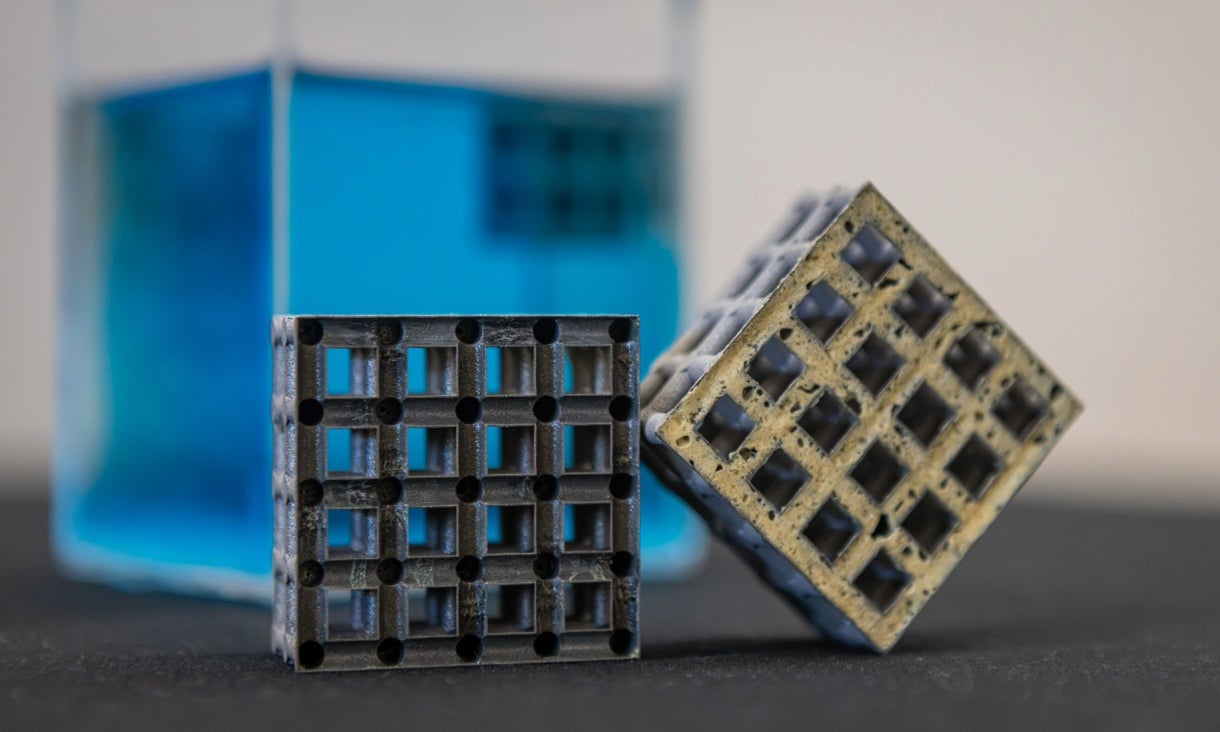
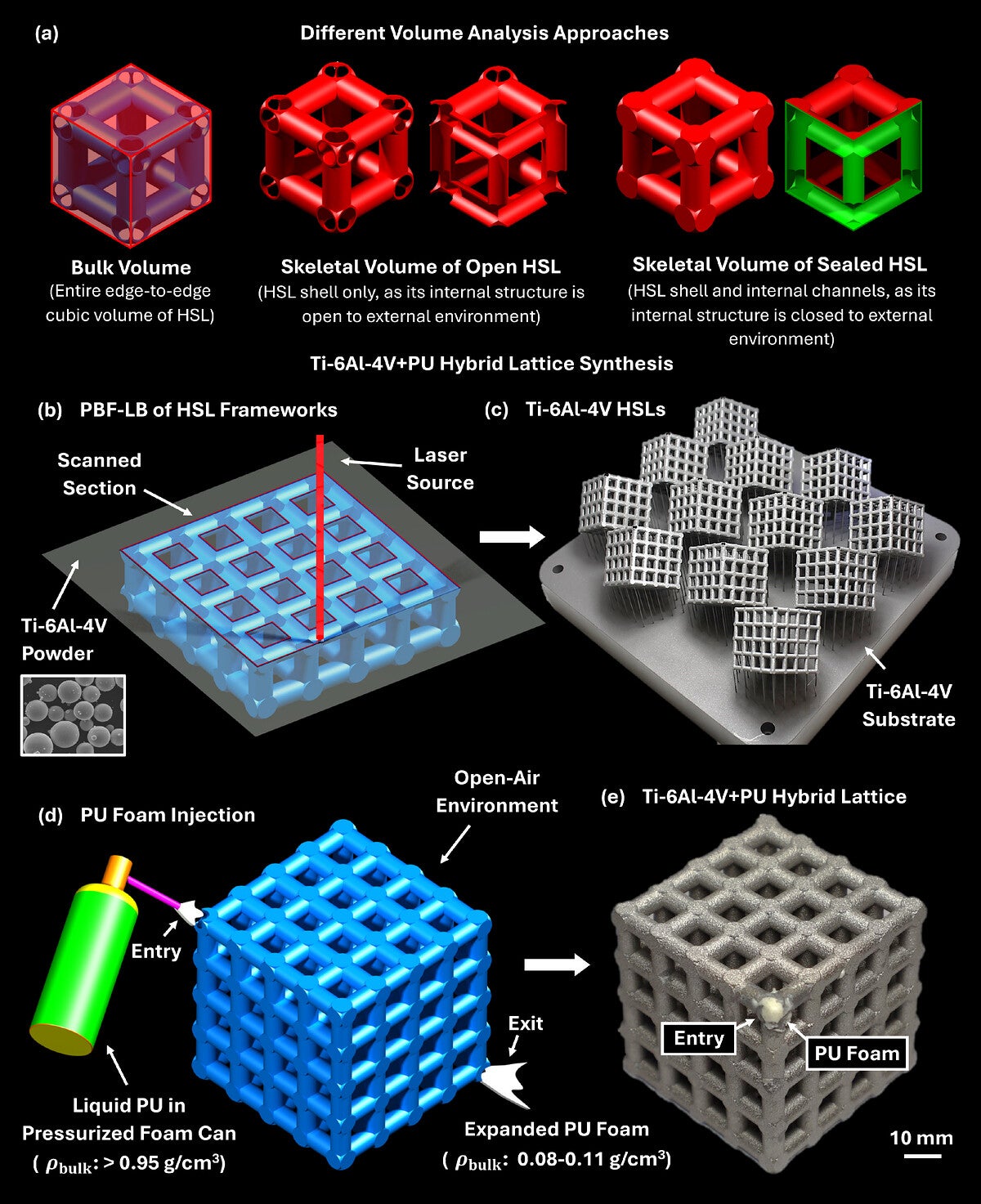
Australian engineers have now created a 3D-printed titanium structure that remains buoyant in water even after suffering major structural damage. The open lattice combines hollow titanium struts with polyurethane foam hidden inside their internal channels, allowing water to flow freely through the structure without making it sink.
The work, led by researchers at RMIT University’s Centre for Additive Manufacturing, introduces what the team describes as the first floating metal-hybrid lattice metamaterial of its kind. The research appears in Advanced Materials.
“Although metallic lattices can be incredibly light, with densities less than one-tenth the density of water, their open, interconnected spaces allow water to enter, causing them to sink,” said lead researcher Dr. Jordan Noronha.
“This has made these strong, lightweight structures unsuitable for marine infrastructure, until now.”
Metal lattices can contain enormous amounts of empty space, making their overall density surprisingly low. Yet those openings become a problem underwater.
Once submerged, water floods the interconnected pores. The air occupying those spaces disappears, removing much of the buoyancy that engineers might expect from the material’s low overall density.
The RMIT team solved that problem without sealing the entire structure.
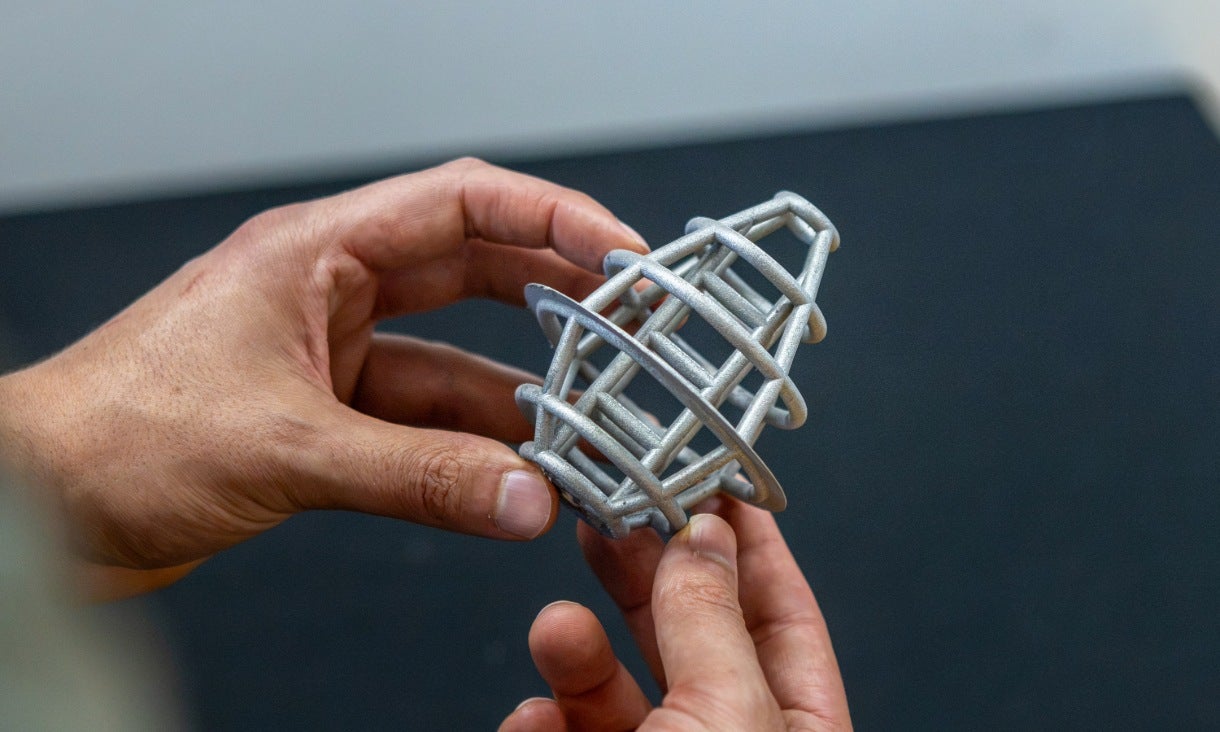
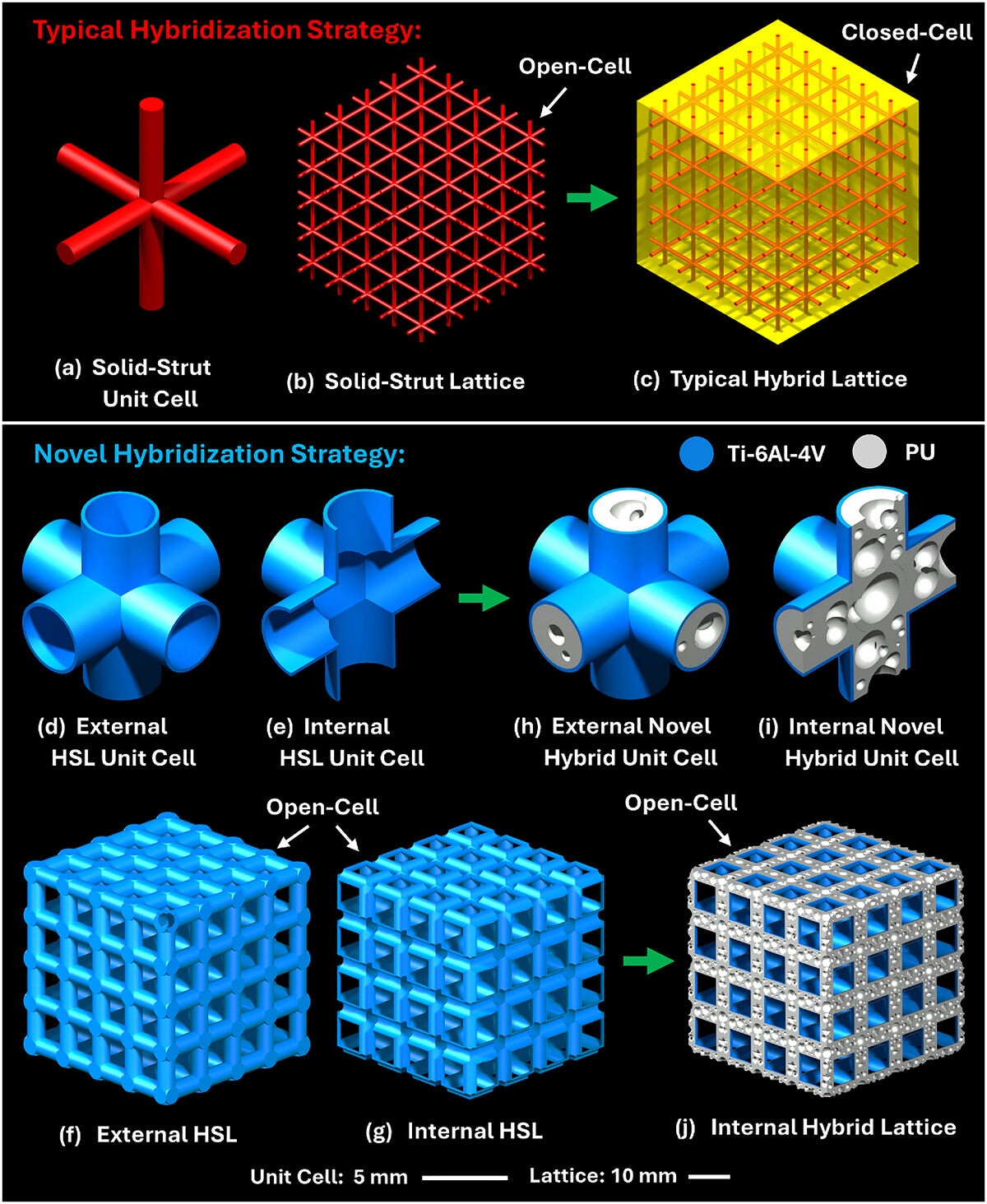
Instead, researchers 3D printed hollow struts from Ti-6Al-4V titanium alloy and injected expandable polyurethane foam into the internal channels. The large spaces between the struts remain open, so water can pass through the lattice.
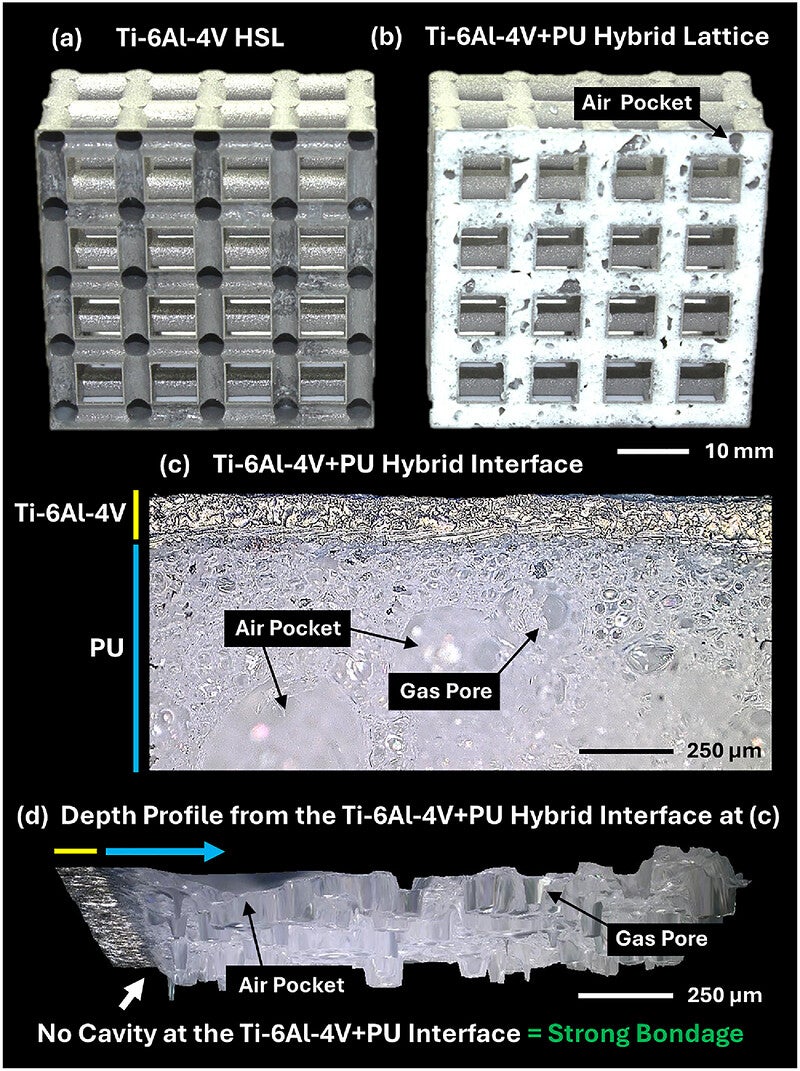
Inside the titanium, however, microscopic closed cells in the foam trap gas and keep water from flooding the hollow channels.
“By filling only the hollow titanium struts with polyurethane foam, we created a structure that allows water to flow through it while remaining buoyant even after significant cracking and damage,” Noronha said.
The approach preserves the open architecture that makes lattice materials attractive while adding flotation where it matters most.
The researchers also introduced a concept they call skeletal density.
Traditional density calculations divide an object’s mass by its overall volume. That works well for solid objects but becomes less useful for an open lattice because much of the volume consists of spaces that water can occupy.
Skeletal density considers only portions that actually exclude surrounding liquid. In the new structure, that includes the titanium walls and sealed foam-filled channels.
The result gives engineers a straightforward rule. If the skeletal density remains below the density of the surrounding liquid, the structure should float even when water fills all of its external openings.
“This gives engineers a simple design rule: if the skeletal density is lower than that of the surrounding liquid, the structure will float, even when water flows through all its external openings,” Noronha said.
Tests supported the prediction. Buoyant samples remained floating in freshwater for more than two months.
Buoyancy would be much less useful if it came at the expense of structural strength.
Mechanical testing showed that the titanium-polyurethane lattice maintained substantial load-bearing performance despite its extremely low overall density.
When the researchers compared materials at the same density, the titanium hybrid showed about 70% greater strength than density-adjusted stainless steel or high-density polyethylene, materials commonly used in marine applications such as floating structures and buoys.
The polyurethane itself contributed relatively little to the main load-bearing behavior. Its primary job was flotation, while the titanium lattice continued carrying most of the structural stress.
That separation of responsibilities could allow future engineers to tune the two functions independently. The metal skeleton could be optimized for strength while the internal material could be chosen for buoyancy or another desired property.
One of the most unusual results came when the researchers intentionally damaged the structures.
The lattice remained buoyant after cracking began at important connection points. It continued floating after fractures propagated and even after an entire layer of the lattice failed.
A conventional hollow structure can lose flotation quickly after damage. One crack may allow water to flood a large sealed cavity.
The foam-filled design behaves differently because buoyancy is distributed throughout many tiny closed cells.
“Tiny, sealed cells in the foam trap gas and prevent water from flooding the hollow struts,” Noronha said.
“In this way the foam acts as a distributed barrier that helps the structure remain afloat after damage, unlike conventional hollow marine structures, which can rapidly fill with water after cracking.”
The samples finally sank only after researchers crushed them severely enough to compact the lattice. At that point, the reduced volume made the structure too dense to remain buoyant.
The team also tested the material in natural seawater collected from Port Phillip Bay in Melbourne.
After two weeks of immersion, the lattice lost only about 0.15% of its mass. Its strength declined by less than 1%.
Those results suggest the titanium alloy and protected internal structure can tolerate short-term marine exposure without substantial deterioration.
The experiment does not establish how the material would perform after years in the ocean. Waves, repeated loading, impacts, marine organisms and long-term corrosion could introduce additional stresses that were not captured in the short trial.
That longer testing will be essential before the material could move into major infrastructure.
Researchers also built a small 3D-printed marine buoy to demonstrate the concept beyond simple lattice blocks.
The prototype remained stable in turbulent seawater while rotating by as much as about 45 degrees. It required no external sealed shell, protective coating or separate flotation material.
Potential applications could eventually include buoys, floating sensors, jetties and other marine infrastructure where low weight, corrosion resistance and resilience after damage are valuable.
Project leader Distinguished Professor Ma Qian said the team plans to scale up its demonstration components and test them under more realistic marine and deep-sea conditions.
The basic architecture may also have uses beyond the ocean.
“By changing the material inside the titanium framework, we could tailor a similar structure for energy absorption, thermal management, vibration control and other applications,” Qian said.
For now, the advance demonstrates a counterintuitive engineering idea: a metal structure does not necessarily need to keep water outside to stay afloat. It only needs to keep the right parts of itself lighter than the water surrounding them.
These resources explore hollow-strut lattices, additive manufacturing and the engineering principles behind lightweight titanium structures.
Ti-6Al-4V hollow-strut lattice materials by laser powder bed fusion: Examines the fabrication and mechanical behavior of hollow titanium lattice structures produced through additive manufacturing. (Additive Manufacturing, 2023)
Node-reinforced hollow-strut metal lattice materials for higher strength: Shows how strengthening vulnerable lattice nodes can improve the mechanical performance of hollow metallic architectures. (Scripta Materialia, 2023)
Geometrical parameters and mechanical properties of Ti6Al4V hollow-walled lattices: Investigates how hollow-strut geometry influences density, strength and manufacturability in titanium lattice structures. (Materials Science and Engineering: A, 2022)
Additive Manufacturing of Anisotropic TC4 Cubic Hollow-Strut Lattice Structures with High Specific Yield Strength: Optimization, Properties, and Failure Modes: Explores strategies for increasing the strength-to-weight performance of hollow titanium lattices. (Advanced Engineering Materials, 2024)
Corrosion of an Additively Manufactured Ti6Al4V Alloy in Saline and Acidic Media: Examines corrosion behavior of additively manufactured Ti-6Al-4V under environments relevant to possible marine applications. (Materials, 2024)
Research findings are available online in the journal Advanced Materials.
The original story “First-ever floating titanium looks to transform marine construction” is published in The Brighter Side of News.
Like these kind of feel good stories? Get The Brighter Side of News’ newsletter.
The post First-ever floating titanium looks to transform marine construction appeared first on The Brighter Side of News.


Leave a comment
You must be logged in to post a comment.