The forests of the Jurassic are silent to us now. Fossils preserve bones, shells and sometimes remarkably delicate wings, but the calls and songs that once filled those landscapes vanished almost as soon as they were made.
A collection of fossilized insect wings is offering an unusual way to bring part of that lost soundscape back.
Scientists have reconstructed the likely calls of nine relatives of modern crickets and katydids that lived about 165 million years ago. Some apparently produced low, musical tones similar to calls heard from living insects. One species probably communicated using ultrasound, frequencies too high for humans to hear.
The findings, published in the Proceedings of the National Academy of Sciences, suggest ultrasonic animal communication appeared far earlier than previously established. They also challenge the idea that bats alone drove insects toward ultrasonic signaling.
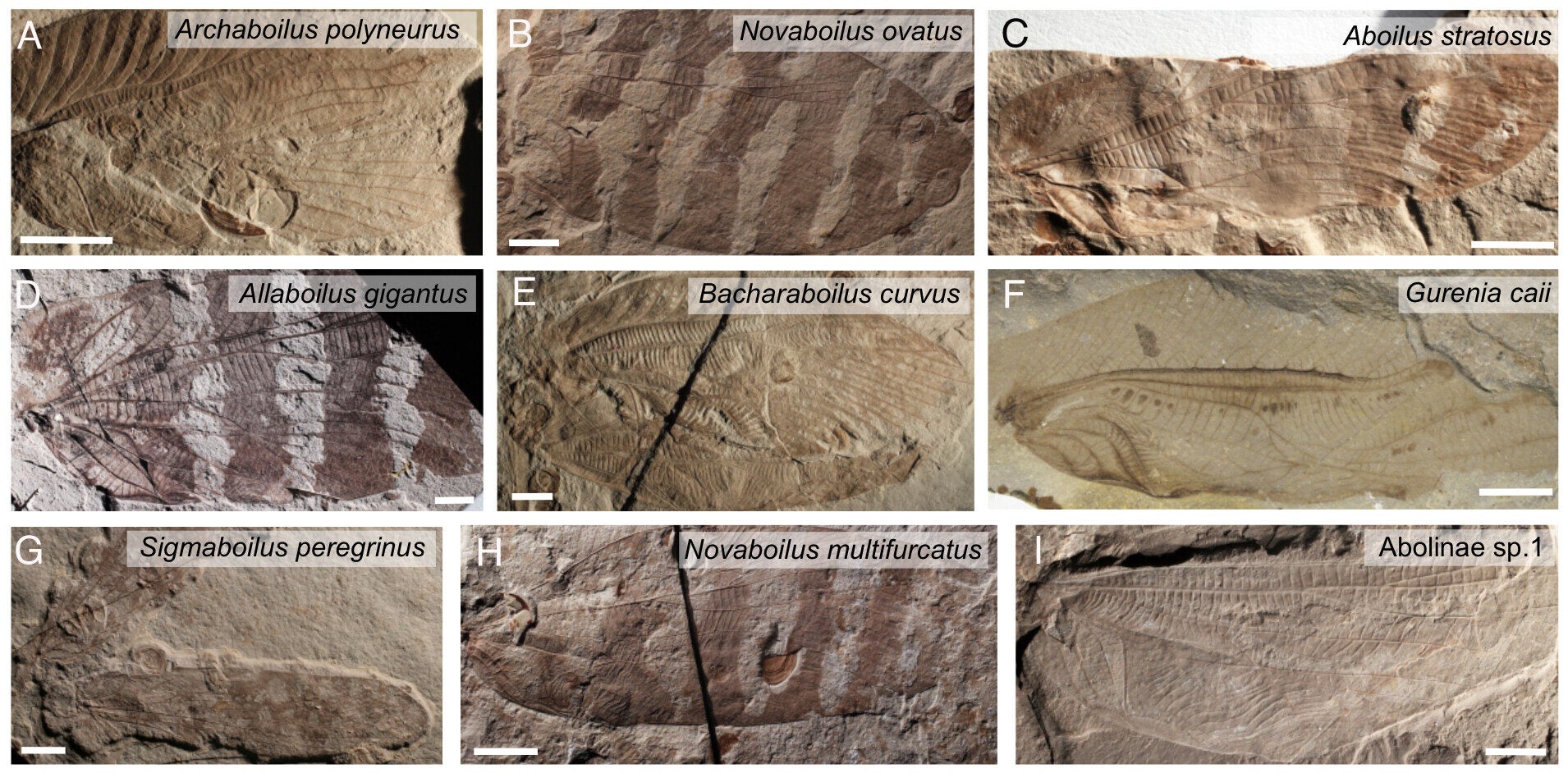
“For now, we can only confirm that Jurassic ensiferans were communicating with a broad range of frequencies from low audio to moderate ultrasound,” Dr. Jun-Jie Gu of Sichuan Agricultural University and colleagues wrote.
Reconstructing prehistoric sound is unusually difficult because most vocal organs do not fossilize well.
“The sounds made by dinosaurs and other charismatic vertebrates are not definitively known because their vocal organs rarely preserve well in fossils,” the researchers wrote.
Insects offer an important exception.
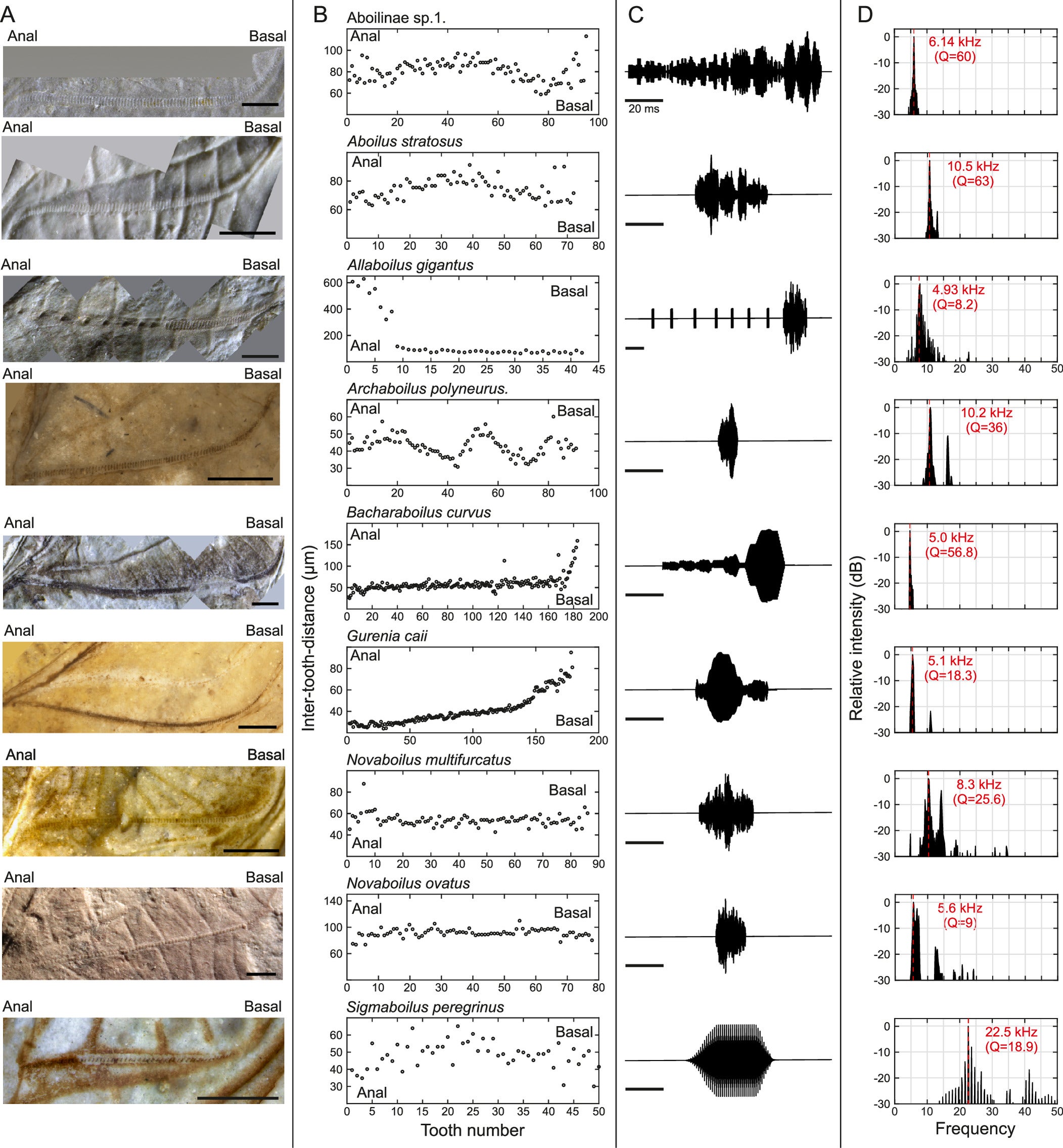
Crickets, katydids and related insects can make sounds through stridulation, rubbing a serrated structure called a file on one wing against a scraper on the other. The spacing of the file’s tooth-like ridges and the properties of the vibrating wing help determine the resulting sound.
Those structures are part of the insect’s hardened outer skeleton, which can survive fossilization.
“These fossils incorporate a fingerprint of the acoustic signals they generated, offering a unique window into the soundscapes of the past,” the team wrote.
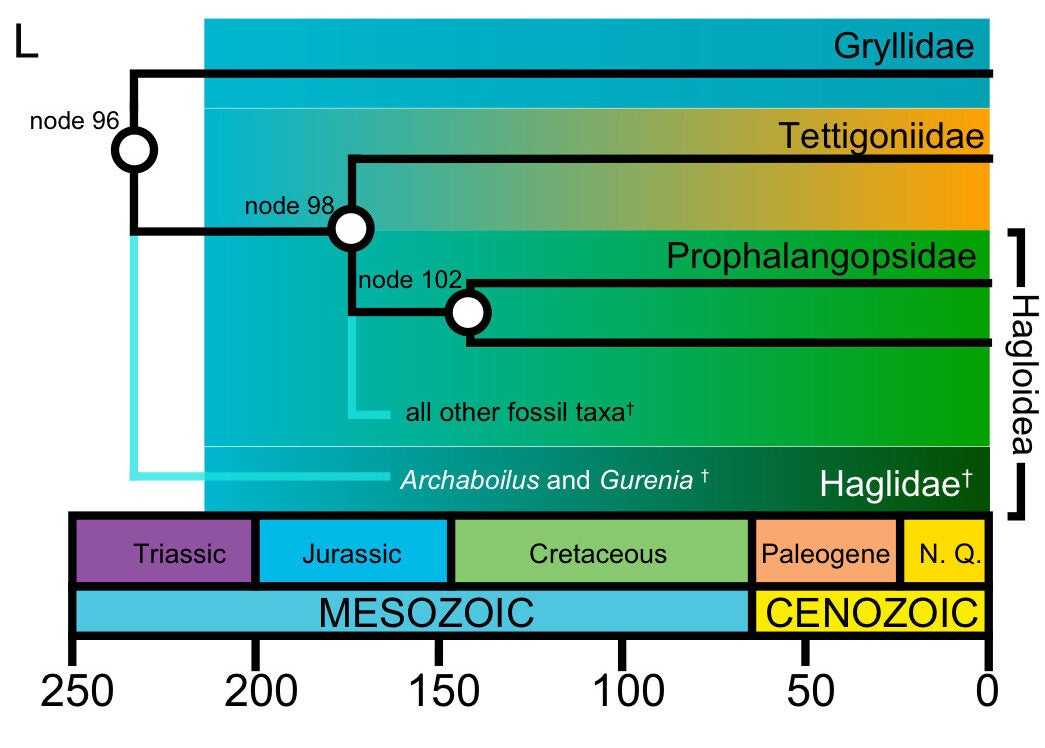
The researchers analyzed 20 exceptionally preserved fossil insects from the Jiulongshan Formation near Daohugou village in Inner Mongolia, China. The collection represented nine species, seven belonging to Prophalangopsidae and two to the extinct family Haglidae.
All lived in roughly the same place and period, allowing the scientists to reconstruct an acoustic community rather than the call of a single animal.
The team combined several approaches to estimate how the insects sounded.
Scientists compared the fossils with nearly 100 living insect species and examined how wing anatomy relates to calling frequency. They also used laser measurements of vibrating wings in modern insects to test models of how fossil wings might have behaved.
Computer simulations then reproduced vibrations in the ancient wings.
The researchers could even model individual “syllables,” the basic sound units generated as the wings closed and the scraper moved across the file. Because behavior and neural control cannot fossilize, the researchers could not directly recover complete calling rhythms.
A machine-learning model trained on modern insects was therefore used to estimate likely syllable rates and create a hypothetical Jurassic soundscape.
“We reconstructed their acoustic landscape, showing pure tone, diverse, and in some cases ultrasonic calls,” the researchers wrote.
Five of the nine species appear to have produced low-frequency pure tones between about 5 and 7 kilohertz.
Those frequencies resemble calls still used by some living crickets and relatives. Pure tones also exploit the natural resonance of the wings, allowing insects to produce strong signals efficiently.
Other species apparently occupied higher-frequency channels.
The most striking example was Sigmaboilus peregrinus. Modeling placed its likely carrier frequency at about 20.4 kilohertz, putting the signal in the ultrasonic range beyond typical human hearing.
The finding pushes ultrasonic communication deep into the Middle Jurassic.
“We show that ultrasonic communication was likely adopted by katydid ancestors during the Middle Jurassic, some 165 million years ago, the oldest record known for ultrasound communication in animals,” the authors wrote.
The fossils also showed sophisticated variations in the spacing and arrangement of teeth along the stridulatory files. Those structures suggest Jurassic insects had already developed several mechanical ways to alter their signals.
The timing creates an evolutionary puzzle.
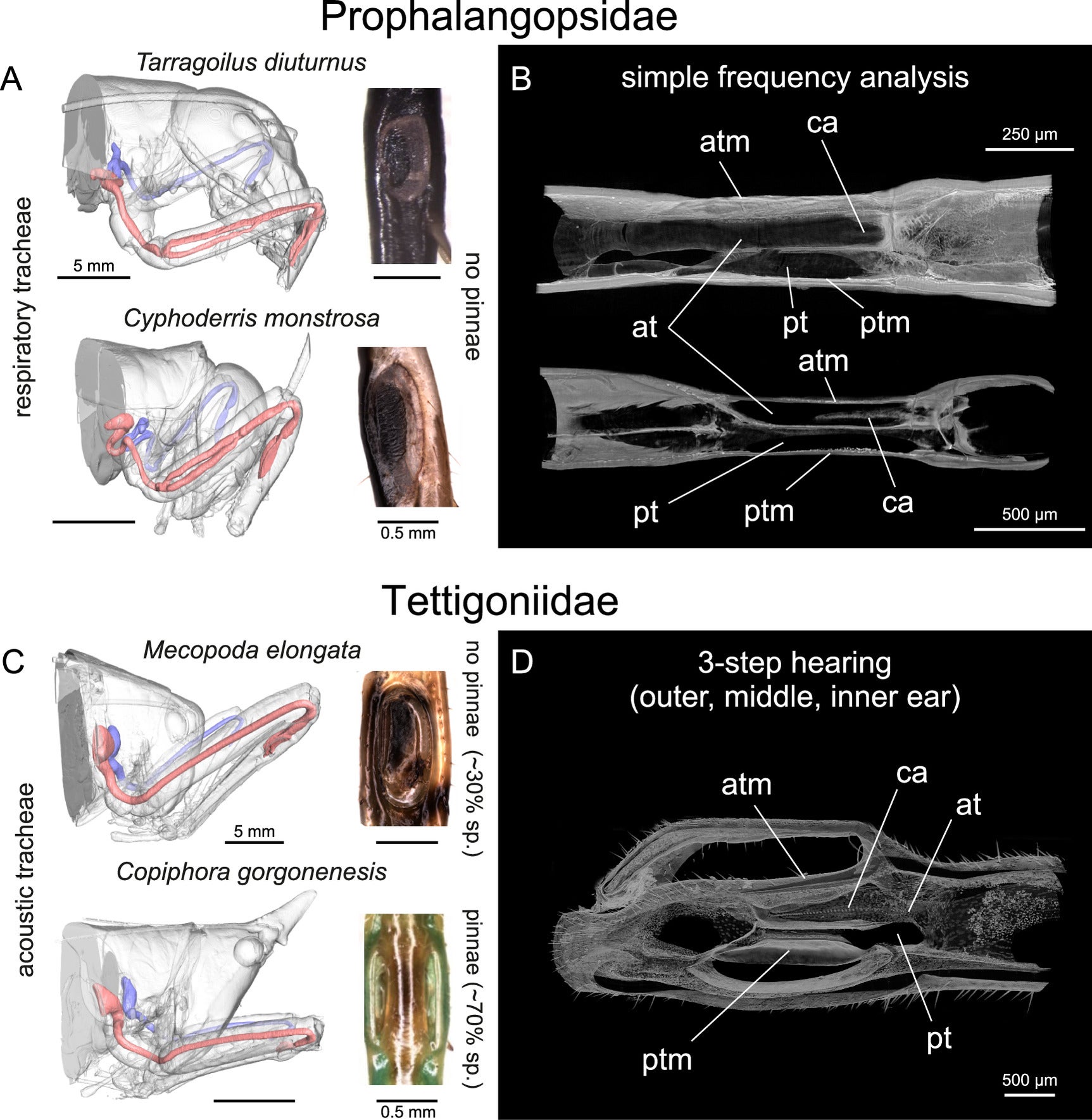
Modern katydids frequently use ultrasound, and roughly 70% of known living species communicate at ultrasonic frequencies. Bats, which use high-frequency echolocation to hunt, have often been viewed as an important force behind those signals.
High-frequency calls do not travel as far as lower-frequency sounds. That can help an insect communicate with a nearby mate while making it harder for a distant predator to locate the caller.
But the Jurassic insects were using ultrasound tens of millions of years before bats appeared.
“We here reject the hypothesis that bats were the sole driver of ultrasound evolution in katydids,” the team wrote.
Instead, early mammals and their non-mammalian relatives may already have been listening.
The scientists propose that predator eavesdropping could have helped shape Jurassic insect songs.
Pure tones may have been difficult for early mammalian hearing systems to localize precisely. Higher frequencies could also have reduced the distance over which a predator could detect a calling insect.
“Instead, it is likely that early mammals and non-mammalian ancestors were also listening in to the songs of ensiferans, driving early diversification of acoustic signaling strategies,” the researchers wrote.
Competition between insects offers another possibility.
Multiple species calling at the same frequency risk masking one another. Different species could have shifted into separate frequency ranges, a process known as acoustic niche partitioning.
Those explanations are not mutually exclusive. Predators, mates and competing callers could all have shaped the growing variety of sounds.
The fossils cannot reproduce every detail of a Jurassic night. Volume, full calling patterns and many behavioral features remain beyond reach.
They do show that the ancient soundscape was more complicated than a chorus of low chirps.
By the Middle Jurassic, insects were already communicating across frequencies ranging from audible musical tones to ultrasound. When bats eventually entered the skies much later, they encountered a world where high-frequency sound had been part of animal communication for millions of years.
These resources explore earlier reconstructions of fossil insect songs, the evolution of insect hearing and acoustic signaling, and the later rise of bats and echolocation.
High acoustic diversity and behavioral complexity of katydids in the Mesozoic soundscape
Researchers examined fossil sound-producing structures and ears from Mesozoic katydids, finding evidence that complex communication, high-frequency calls and acoustic niche partitioning were already established by the Middle Jurassic. (Proceedings of the National Academy of Sciences, 2023)
An Eocene insect could hear conspecific ultrasounds and bat echolocation
A 44-million-year-old katydid preserved in Baltic amber revealed an advanced hearing system tuned both to ultrasonic mating signals and higher-frequency bat calls, showing how insect hearing later developed during the era of echolocating bats. (Current Biology, 2023)
Wing stridulation in a Jurassic katydid produced low-pitched musical calls to attract females
This earlier reconstruction used a 165-million-year-old fossil of Archaboilus musicus to estimate a pure-tone call near 6.4 kilohertz, providing one of the foundational demonstrations that fossil wing anatomy can preserve evidence of ancient insect songs. (Proceedings of the National Academy of Sciences, 2012)
An Integrative Perspective on Bat Evolution
This review brings together paleontology, genomics, biomechanics, ecology and sensory biology to examine how flight, echolocation and other specialized traits shaped bat evolution and diversification. (Annual Review of Ecology, Evolution, and Systematics, 2025)
Behaviors and Interactions of Insects in Mid-Mesozoic Ecosystems of Northeastern China
This review examines more than 1,600 fossil insect species from Jurassic and Cretaceous deposits in northeastern China, including evidence for feeding, camouflage, mating, parental care and sound production in ancient ecosystems. (Annual Review of Entomology, 2021)
Research findings are available online in the journal PNAS.
The original story “Fossil insect wings reveal a Jurassic world already buzzing with ultrasound communication” is published in The Brighter Side of News.
Like these kind of feel good stories? Get The Brighter Side of News’ newsletter.
The post Fossil insect wings reveal a Jurassic world already buzzing with ultrasound communication appeared first on The Brighter Side of News.


Leave a comment
You must be logged in to post a comment.