Before a fruit fly can produce a healthy egg, matching chromosomes must somehow find one another inside a nucleus crowded with DNA. New experiments suggest part of that search depends on repetitive sequences once widely dismissed as genetic clutter.
Scientists at ETH Zurich found that satellite DNA surrounding chromosome centers forms chromosome-specific patterns that behave somewhat like molecular barcodes. When those patterns were disrupted, matching chromosomes became less reliable at pairing during meiosis, the specialized cell division that produces eggs and sperm.
The findings appear in Nature Communications in the study “Meiotic pairing through barcode-like satellite DNA repeats,” led by Lena Skrutl and Madhav Jagannathan.
“This showed us that satellite DNA functions as a recognition aid and ensures that the chromosomes that belong together can reliably find one another,” Skrutl said.
Most cells contain two copies of each chromosome, one inherited from each parent. Meiosis reduces that number by half so reproductive cells receive one copy of each chromosome.
Before separation can occur, corresponding maternal and paternal chromosomes must identify and pair with each other.
Recombination, in which homologous chromosomes exchange DNA, helps establish those connections in many organisms. Yet chromosome pairing can sometimes begin without recombination, suggesting cells possess additional ways to recognize matching partners.
Satellite DNA emerged as one possible mechanism.
These stretches consist of short DNA sequences repeated many times, often in large blocks around centromeres and nearby pericentromeric regions. They generally do not encode proteins and historically were often grouped under the loose label “junk DNA.”
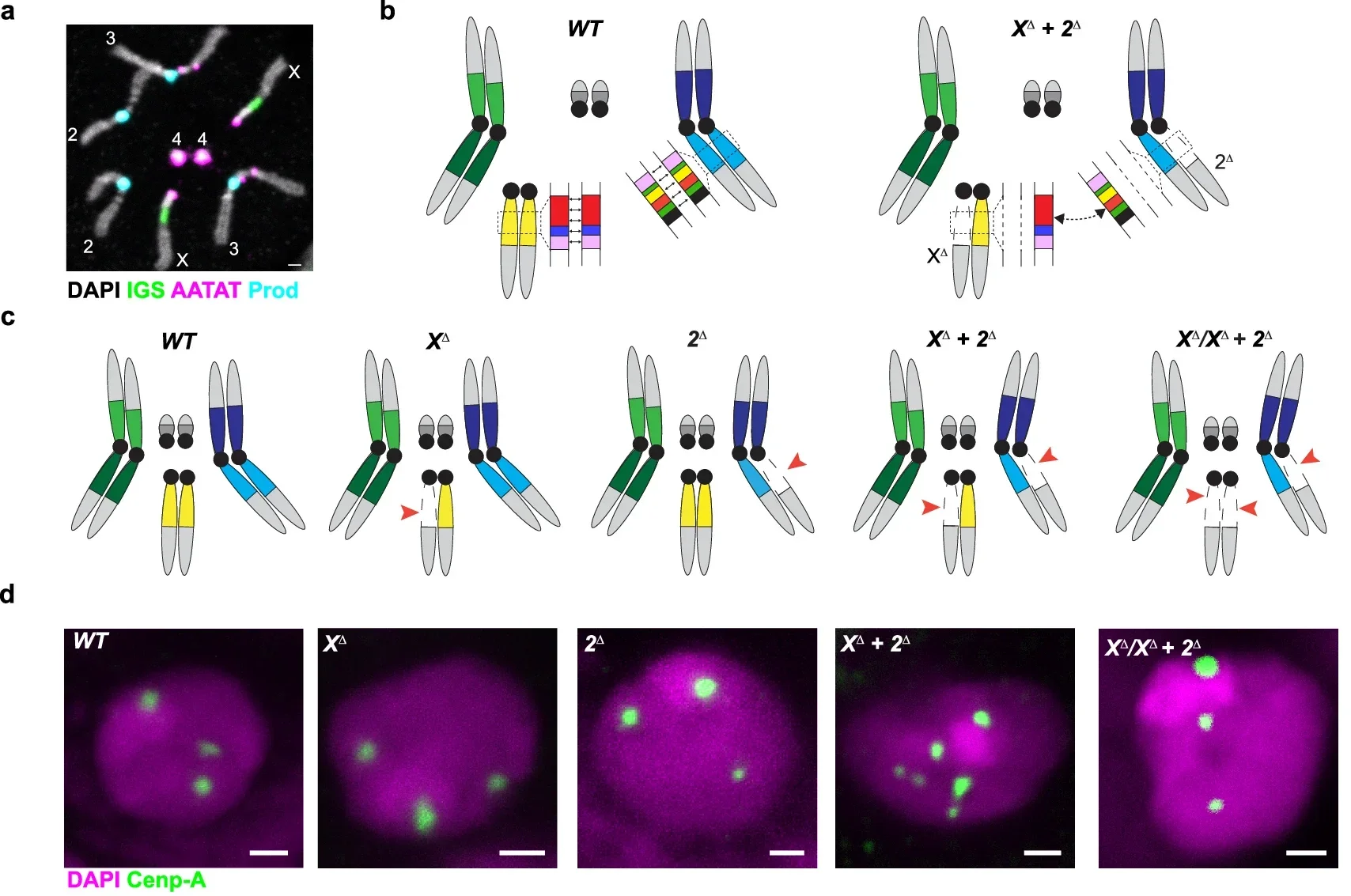
In Drosophila melanogaster, however, different chromosomes carry distinctive combinations of satellite repeats. The researchers proposed that those arrangements could supply each chromosome with a recognizable molecular identity.
Earlier experiments involving disruption of satellite DNA on a single chromosome had not produced dramatic pairing failures.
The new work suggests why.
With only one chromosome pair altered, all the other chromosomes can still find their matching partners. The remaining unmatched chromosomes can then effectively identify each other by elimination, similar to reaching the final pair in a memory-matching game.
The researchers therefore altered satellite DNA on two chromosome pairs simultaneously.
One experimental X chromosome lacked nearly all of an approximately 11-megabase region containing a prominent 359-base-pair repeat. A chromosome 2 deletion removed nearly all satellite repeats in another region, along with 41 genes.
Pairing defects became much easier to see.
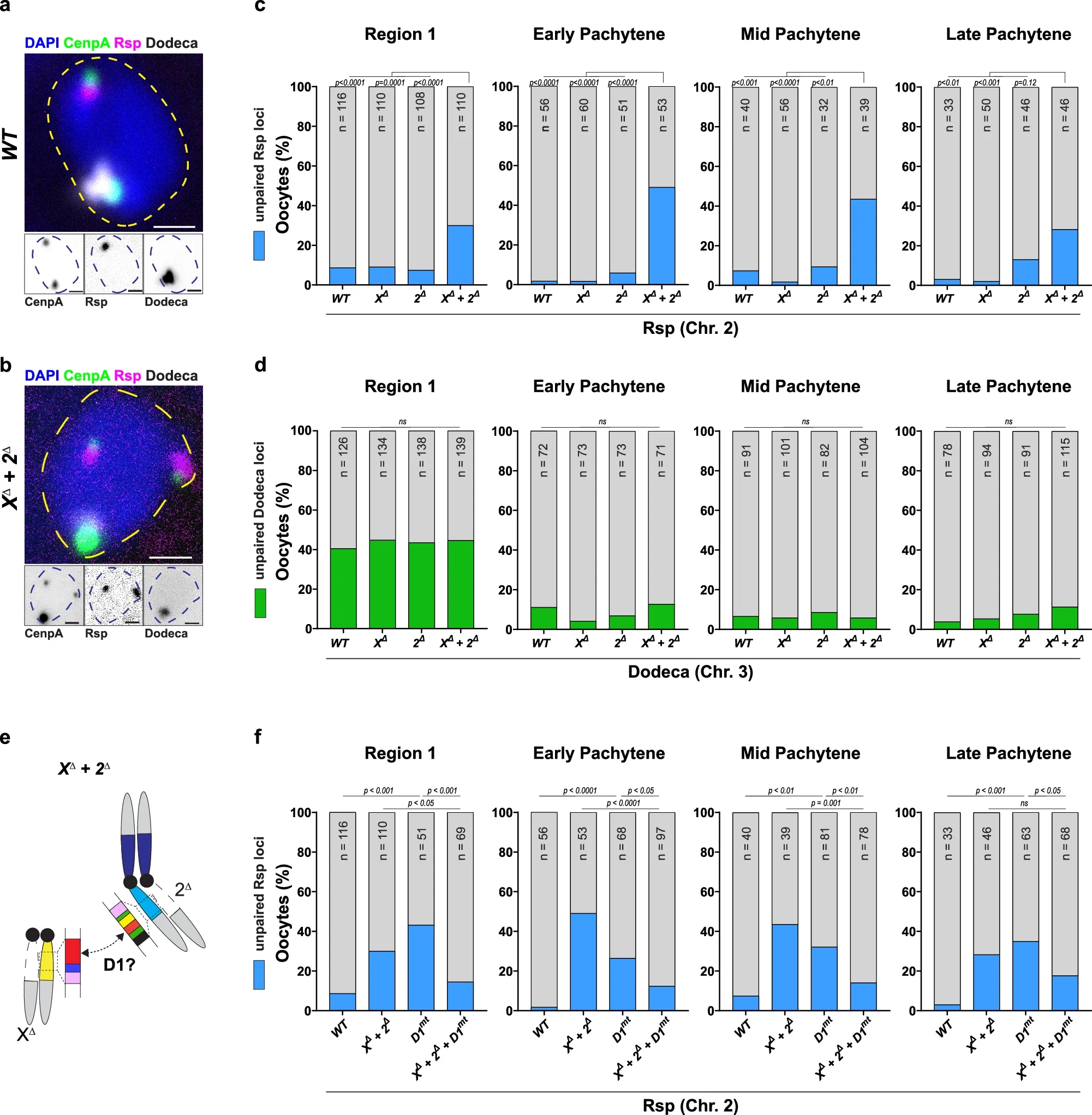
In flies carrying both deletions, 19.4% of late-pachytene egg cells displayed more than four visible centromere signals, indicating that some homologous centromeres had failed to remain paired. That represented roughly a fourfold increase over controls.
A more direct measurement of chromosome 2 produced an even stronger signal. Its Responder satellite region remained unpaired in 28.2% of late-pachytene cells, more than twice the control rate.
The pairing failure did not affect the chromosomes uniformly.
A satellite marker on chromosome 3 remained paired, while three roughly 1-megabase locations along the arm of chromosome 2 continued pairing during mid-pachytene.
That pattern pointed toward centromeric and pericentromeric regions rather than a general collapse of chromosome pairing.
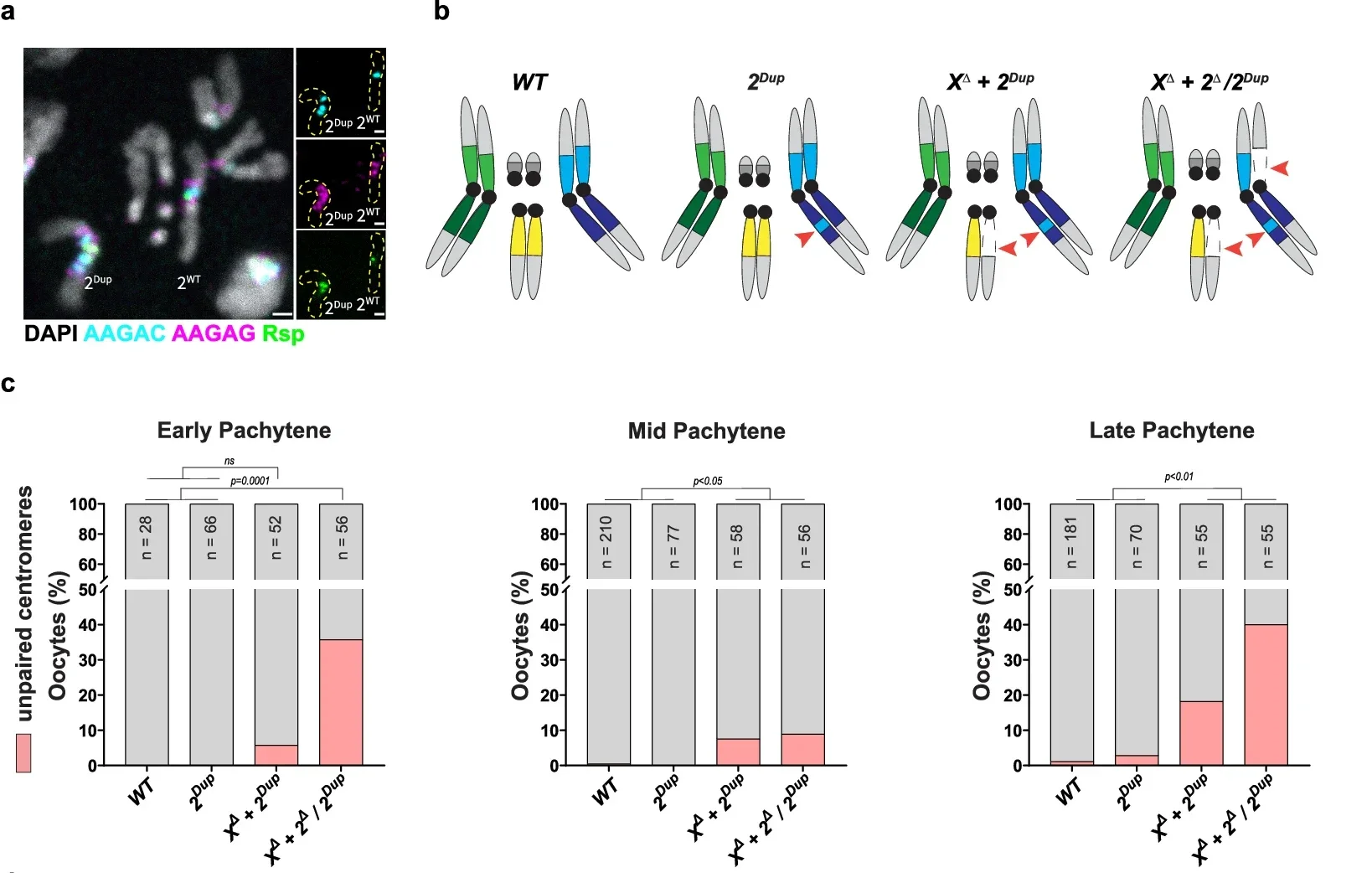
The researchers also created other arrangements involving satellite DNA duplication and translocation. Mismatched repeat patterns again interfered with proper pairing, supporting the idea that chromosome identity depends partly on the overall arrangement of repetitive sequences.
A protein called D1 appears to help translate those patterns into physical associations.
D1 binds satellite DNA. In laboratory experiments, purified D1 attached directly to both 359-base-pair and related 260-base-pair repeat sequences. When researchers added the protein to microscopic beads coated with the repeats, those beads clustered together.
That provides a possible mechanism for how similar satellite regions on homologous chromosomes could physically associate.
D1 was not simply beneficial under every condition.
When chromosomes carried intact satellite patterns, D1 helped support their organization. But mismatched barcodes created opportunities for individual repeat sequences to associate with similar repeats on the wrong chromosome.
Removing D1 from flies carrying the double deletion improved chromosome 2 pairing during several stages of meiosis. Yet eliminating D1 from otherwise normal flies could itself cause pairing defects.
The results suggest that D1 acts more like molecular glue than a perfect recognition system. It can reinforce correct associations when the repeat patterns match, but altered patterns may allow inappropriate connections.
Other proteins responded when pairing went wrong.
Pachytene checkpoint 2, or Pch2, appeared to delay meiosis when satellite matching was incomplete, potentially giving chromosomes additional time to pair correctly. Mad2 produced a different effect. Loss of Mad2 improved pairing in double-deletion flies, while adding an extra copy sharply increased unpairing when satellite patterns were already disrupted.
Pairing failures were also associated with cell death during egg development, suggesting defective cells may sometimes be eliminated before chromosome segregation proceeds.
The researchers then asked whether naturally occurring satellite differences produce similar effects.
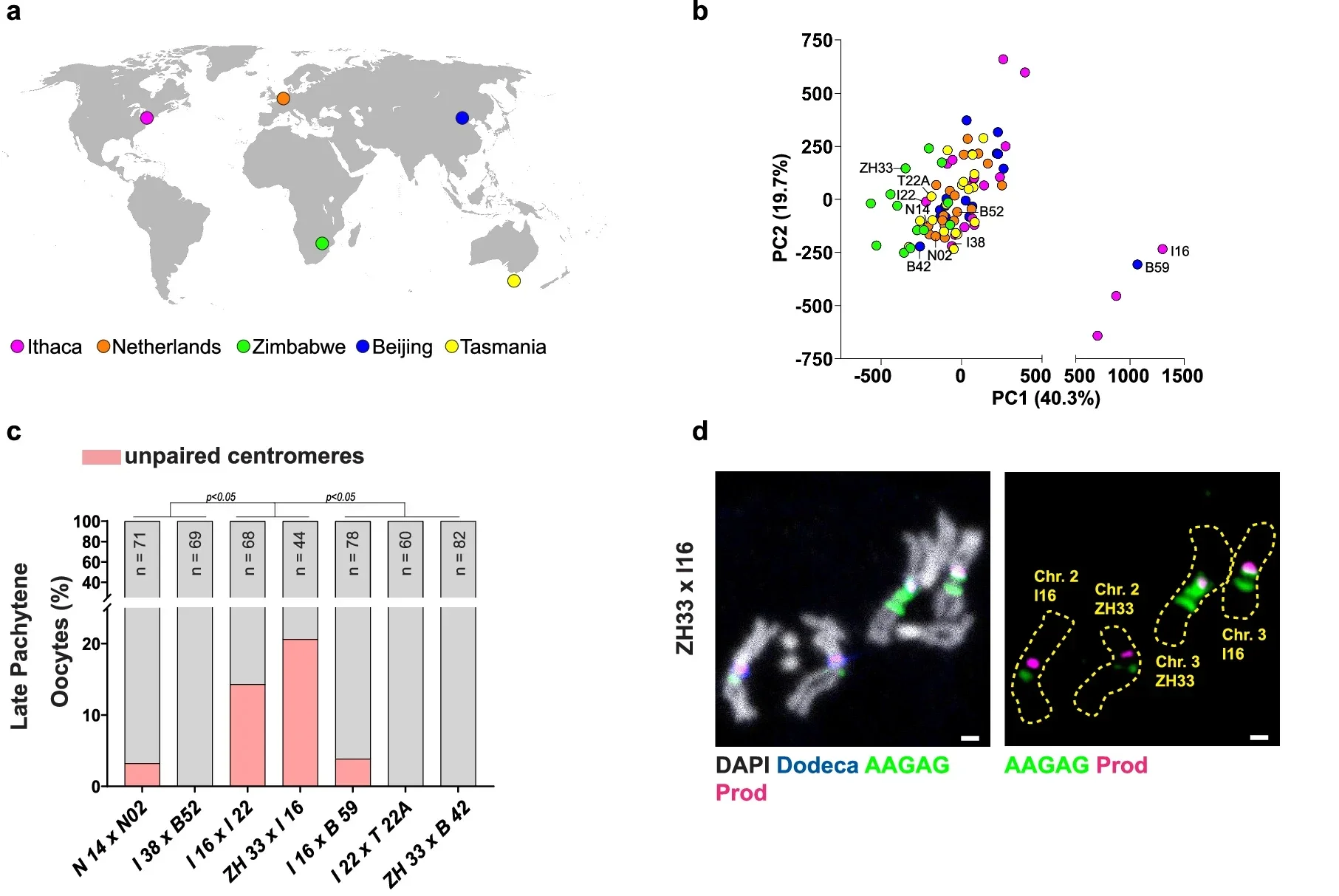
They examined 84 wild D. melanogaster strains collected across five continents through the Global Diversity Lines project. These populations vary naturally in their satellite DNA content.
Crosses between flies with strongly divergent satellite profiles produced offspring with significantly more centromere-unpairing defects than crosses involving similar profiles.
Ordinary differences in single DNA letters and small insertions or deletions did not show the same relationship. Satellite DNA divergence did.
That raises the possibility that rapidly evolving satellite sequences could eventually contribute to reproductive isolation between separated populations.
The idea remains tentative. The experiments were performed in fruit flies, several engineered deletions affected DNA beyond satellite repeats, and the researchers have not established that comparable chromosome barcodes operate in humans or other animals.
Still, the work gives repetitive DNA another potential function beyond protein coding.
“The term ‘junk DNA’ is no longer tenable,” Jagannathan said. “We clearly demonstrate that this so-called rubbish has an important function during meiosis in the fruit fly.”
These studies provide additional background on meiotic chromosome recognition, satellite DNA function and the rapid evolution of repetitive sequences.
A conserved function for pericentromeric satellite DNA: Experiments in fruit flies and mice showed that satellite DNA-binding proteins cluster chromosomes into chromocenters that help keep the genome inside a single nucleus. (eLife, 2018)
Defective Satellite DNA Clustering into Chromocenters Underlies Hybrid Incompatibility in Drosophila: Divergent satellite sequences disrupted chromosome clustering in fruit fly hybrids, linking repetitive DNA evolution with reproductive incompatibility. (Molecular Biology and Evolution, 2021)
Female Meiosis: Synapsis, Recombination, and Segregation in Drosophila melanogaster: This review explains chromosome pairing, synapsis and segregation in female fruit flies and provides context for centromere-based pairing mechanisms. (Genetics, 2018)
Homologous chromosome interactions in meiosis: diversity amidst conservation: This review examines the different strategies organisms use to recognize and pair homologous chromosomes during meiosis. (Nature Reviews Genetics, 2005)
In-Depth Satellitome Analyses of 37 Drosophila Species Illuminate Repetitive DNA Evolution in the Drosophila Genus: A broad comparison of fruit fly genomes shows how satellite DNA families can expand, disappear and change rapidly over evolutionary time. (Genome Biology and Evolution, 2022)
Research findings are available online in the journal Nature Communications.
The original story “Genetic ‘barcodes’ could explain why chromosomes recognize one another” is published in The Brighter Side of News.
Like these kind of feel good stories? Get The Brighter Side of News’ newsletter.
The post Genetic ‘barcodes’ could explain why chromosomes recognize one another appeared first on The Brighter Side of News.


Leave a comment
You must be logged in to post a comment.