Two beagles born in 2024 carry a genetic change designed to remove Can f 1, the major dog allergen. Early tests found no detectable protein in their saliva or dander, raising a new question about whether allergy exposure can be reduced at its source.
Kindred Companion Sciences used CRISPR-Cas9 gene editing to disrupt the Can f 1 gene in two female beagles named Alfie and Bailey. The work, published in The CRISPR Journal, is a proof of concept for reducing dog allergen production through genetic modification rather than treating allergic people after exposure.
Dog allergies affect about 15% of the population and can contribute to allergic rhinitis and asthma. Can f 1, a salivary lipocalin protein, accounts for much of the dog-specific IgE binding seen in sensitized people.
Existing approaches mainly focus on limiting exposure or changing the immune response. Avoidance and cleaning can help, but dog allergens are widespread. Allergen immunotherapy remains the only disease-modifying treatment described in the study, yet its effectiveness for dog allergy is limited and inconsistent.

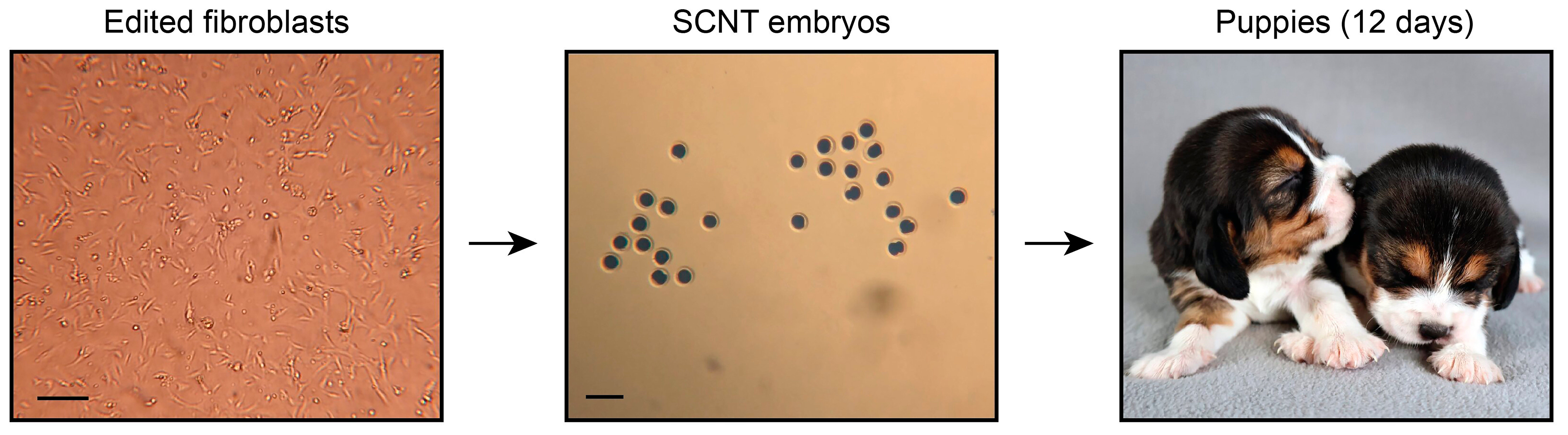
The team began with primary fibroblast cells from female beagle fetal tissue. CRISPR-Cas9 introduced a one-base-pair insertion in exon 1 of Can f 1, causing a frameshift intended to disrupt production of the protein.
Researchers screened 24 edited cell clones. Fifteen carried the one-base-pair insertion at the expected Cas9 cut site. A confirmed edited clone was selected for somatic cell nuclear transfer, or SCNT.
In SCNT, researchers removed the nucleus from canine egg cells and replaced it with a nucleus from the edited donor cells. They generated 25 reconstructed embryos and transferred them into a surrogate female dog. Two embryos developed to term.
Alfie and Bailey were born on September 22, 2024, weighing 320 grams and 318 grams. Both came from the same edited donor clone.
Genetic testing confirmed the intended insertion in both dogs. An initial computer analysis identified 11 possible off-target sites, and targeted sequencing found no detectable edits there.
Whole-genome sequencing expanded that search to 413 predicted Cas9 target sites, including the intended site. The analysis found no de novo single-nucleotide changes or insertions and deletions at predicted sites outside the intended Can f 1 edit. Researchers also reported no high-confidence large structural changes.
The biological role of Can f 1 remains uncertain. It belongs to the lipocalin family, a group of secreted proteins that bind hydrophobic molecules, but established receptor-mediated functions for Can f 1 have not been identified.
Veterinary examinations found no clinically apparent health abnormalities. The dogs showed normal mentation, age-appropriate activity, steady growth, and adult body weights of about 20 to 22 pounds, within expected ranges for female beagles.
Routine vaccinations were well tolerated. Chest and abdominal radiographs showed normal skeletal alignment, heart and lung silhouettes, and gross organ size. The study did not include formal behavioral testing.
“Kindred was founded on the belief that people shouldn’t have to choose between their health and the companionship of dogs,” said Matt Walker, PhD, CEO of Kindred Companion Sciences.
The researchers compared protein samples from an edited beagle, an unedited beagle, a standard poodle, and a goldendoodle.
Western blot testing detected Can f 1 in saliva from the unedited beagle, poodle, and goldendoodle. The protein was not detected in samples from the edited dogs. The same pattern appeared in hair and dander.
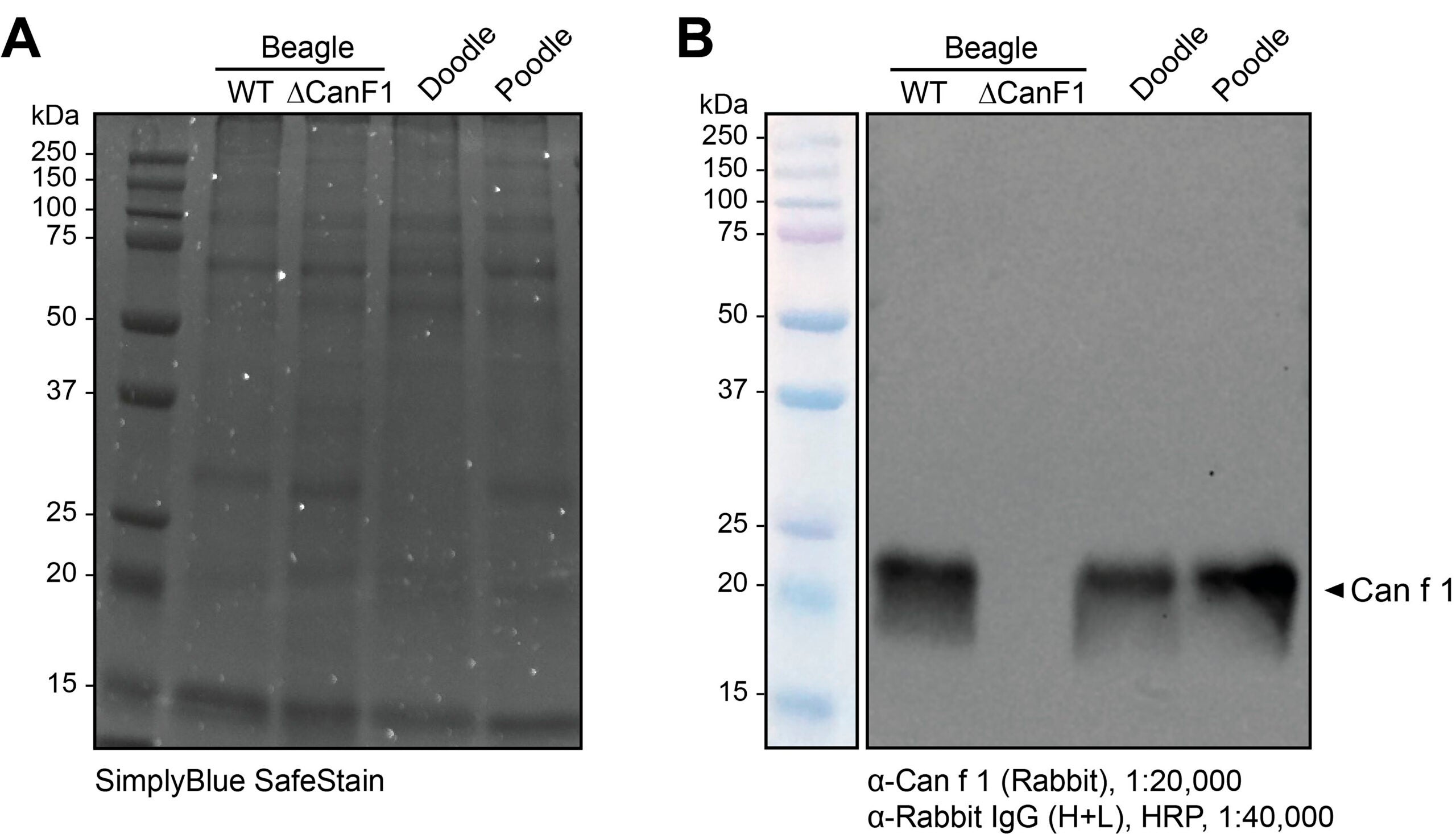
The result also challenges the idea that certain breeds are reliably hypoallergenic. Previous quantitative research cited in the study found that breeds marketed that way do not consistently produce lower environmental exposure to Can f 1. Here, both the poodle and goldendoodle still produced detectable Can f 1.
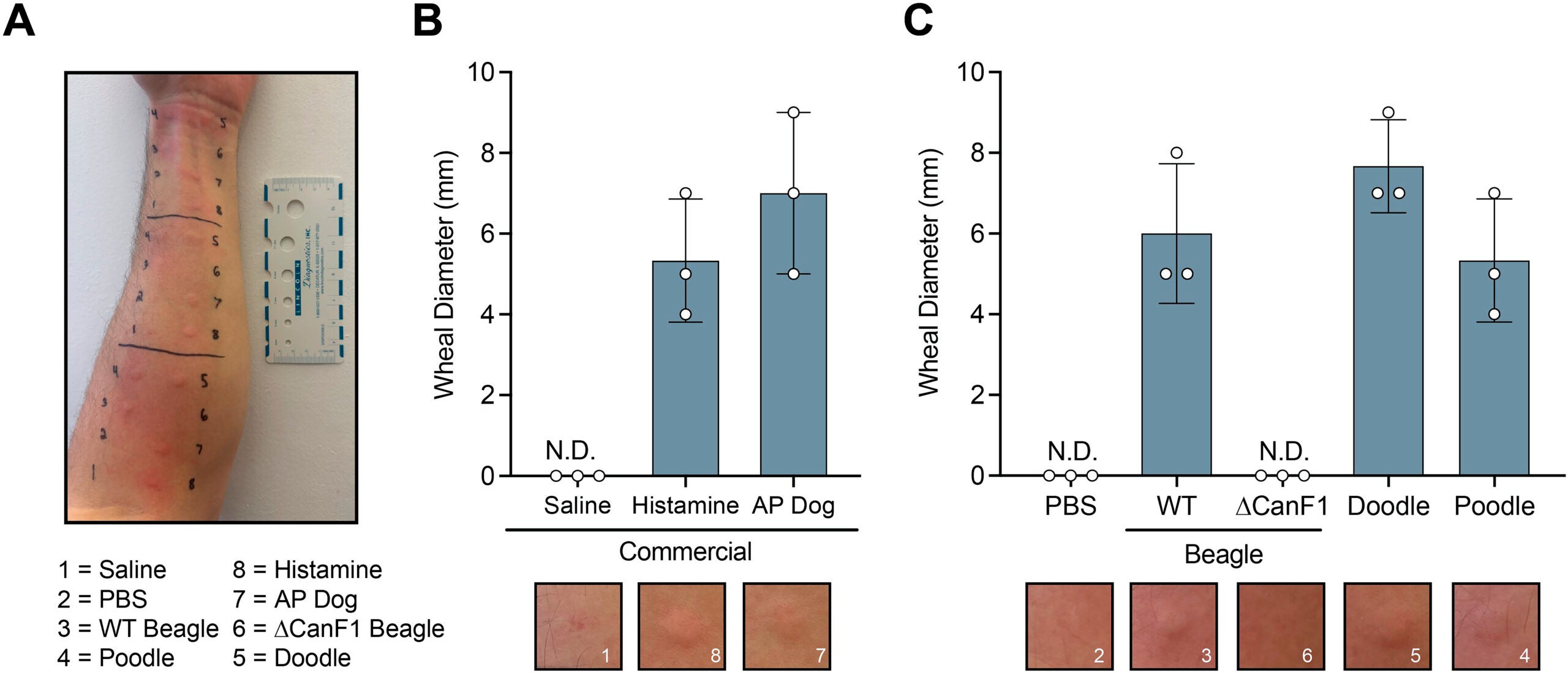
The team then performed skin prick testing using samples from the dogs. The test involved one healthy adult male participant with a documented dog allergy and measurable IgE against Can f 1, but no detectable IgE against Can f 2 through Can f 6.
A commercial dog dander extract produced a skin wheal of about 7 millimeters. Saliva from the unedited beagle produced one of about 6 millimeters. Poodle and goldendoodle samples also triggered clear reactions.
Samples from the edited dog produced no detectable wheal response. Hair and dander extracts from the edited dogs likewise produced no detectable reaction.
“These data help validate our approach, which addresses the allergen at its genetic source,” Walker said. “We’re hopeful that Alfie and Bailey will be the first of many Kindred dogs as we build carefully and responsibly toward the next generation of companion animals.”
The study does not establish that dogs edited this way would be nonallergenic for everyone. Dog allergy varies between people, and individuals can react to several canine proteins.
The human testing involved only one sensitized participant whose immune response was directed toward Can f 1. That prevents conclusions about people with different allergy profiles.
The off-target analysis also focused on predicted Cas9 sites rather than serving as a comprehensive population-level assessment. The authors describe the work as a targeted proof of concept.
Kindred dogs are not commercially available. The genomic alteration remains investigational and has not been approved by the U.S. Food and Drug Administration.
The work shows that a major dog allergen can be removed at its biological source while the two edited animals developed without overt clinical abnormalities during the period studied.
That approach differs from allergy treatments that try to reduce exposure or alter a person’s immune response. Instead, it targets production of the allergen itself.
The findings could guide research into long-term safety, outcomes in larger groups of dogs, and allergic responses among people with more varied sensitization patterns.
They also raise a broader scientific question: whether other nonessential animal allergen genes could be modified in similar ways without harming the animals that produce them.
Research findings are available online in The CRISPR Journal.
The original story “Genetically engineered beagles could bring relief to millions of dog allergy sufferers” is published in The Brighter Side of News.
Like these kind of feel good stories? Get The Brighter Side of News’ newsletter.
The post Genetically engineered beagles could bring relief to millions of dog allergy sufferers appeared first on The Brighter Side of News.


Leave a comment
You must be logged in to post a comment.