South of India, the ocean surface slumps into one of Earth’s strangest depressions, a gravity hole so deep it has puzzled geophysicists for decades. Now a new reconstruction points to a buried plume of hot mantle rock, but not where anyone expected.
The Indian Ocean looks flat from above, but one part of it sits far lower than it should. South of India, the sea surface dips so deeply that scientists have spent decades trying to explain what could pull it down.
This feature, known as the Indian Ocean Geoid Low, covers about 1.2 million square miles. In that region, the ocean surface lies roughly 106 meters lower than surrounding areas because gravity there is weaker. It is the lowest geoid anomaly on Earth, and for years it has stood out as one of the planet’s hardest geophysical puzzles.
Seen from space, Earth appears smooth and round. It is not. Mass is spread unevenly inside the planet, and those buried differences slightly alter gravity from place to place. If the oceans were stripped of tides and currents, seawater would settle into a warped global surface shaped only by gravity. That surface is called the geoid.
The Indian Ocean Geoid Low is one of the most dramatic places where that invisible surface caves in.
Prof. Attreyee Ghosh, a geophysicist at the Centre for Earth Sciences, Indian Institute of Science, called it a longstanding mystery. “The existence of the Indian Ocean geoid low is one of the most outstanding problems in Earth Sciences,” she said. “It is the lowest geoid/gravity anomaly on Earth and so far no consensus existed regarding its source.”

No drill can reach the depths involved here. Earth’s crust is only the outer shell, and the deepest interior remains beyond direct access. That leaves researchers relying on indirect evidence, including gravity measurements, seismic imaging, plate reconstructions, and computer modeling.
Earlier ideas pointed to many possible causes. Scientists proposed uncompensated crust, changes at the core-mantle boundary, lower mantle slabs, mantle upwelling tied to old subducted plates, or combinations of hot and cold structures beneath the Indian Ocean. But most of those attempts focused on the anomaly as it exists today, not on how it formed.
In the new work, Ghosh and colleagues at the GFZ German Research Centre for Geosciences took a different route. Writing in Geophysical Research Letters, they ran time-dependent mantle convection models forward from the Mesozoic to the present, testing how deep structures might have evolved over roughly 140 million years.
Their answer centers on mantle convection, the slow circulation of hot and cold material inside the planet.
The team used the mantle convection code CitcomS and built 19 model runs with different physical settings. They fed those models reconstructed plate motions, temperature differences in ancient oceanic lithosphere, and a range of assumptions about viscosity, heat production, density structure, and behavior near the 660-kilometer boundary inside the mantle. Then they compared the resulting present-day geoid to the one actually observed.
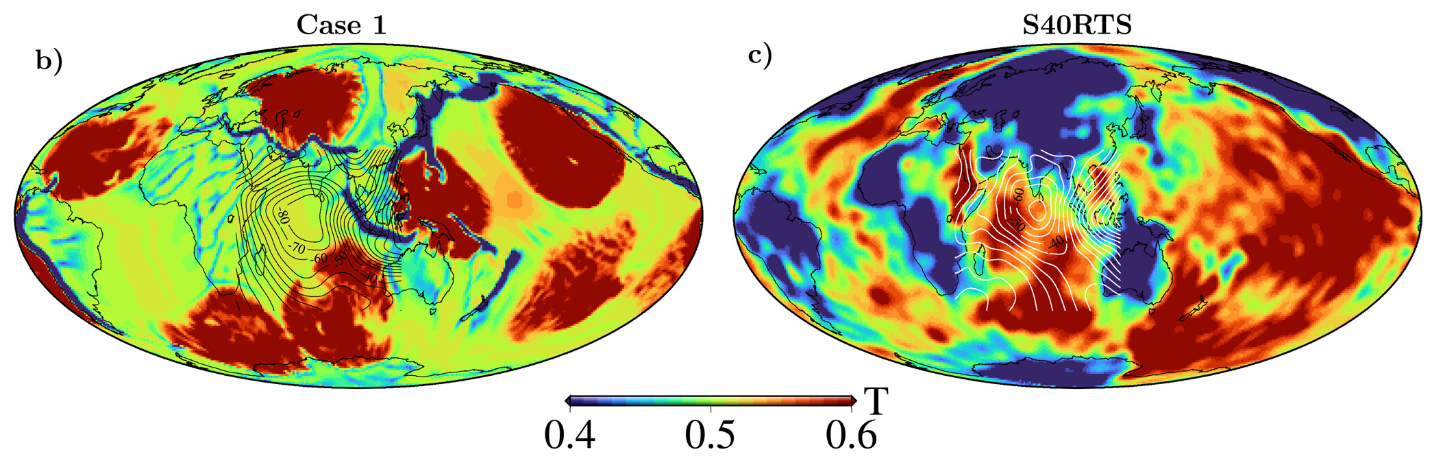
Only seven of the 19 cases reproduced both the broad global geoid pattern and the Indian Ocean feature especially well. From those, the team chose one representative model, called Case 1, which reached a regional correlation of 0.80 with the observed Indian Ocean Geoid Low.

The study points to a mass deficit in the mantle beneath the northern Indian Ocean. In simple terms, the models suggest that hotter, lighter material between about 300 and 900 kilometers deep helps create the gravitational low.
“A geoid low or a negative geoid anomaly would be caused by a mass deficit within the deep mantle,” Ghosh said. “Our study explains this low with hotter, lighter material stretching from a depth of 300 km up to ~900 km in the northern Indian Ocean, most likely stemming from the African superplume.”
That hot material does not appear to rise from a known mantle plume directly beneath the anomaly. Instead, the researchers argue that it likely originates from the African large low-shear-velocity province, often called the African superplume, and then gets deflected eastward beneath the Indian Ocean. They suggest the fast motion of the Indian plate may have helped steer it.
The picture is more complicated than a single upwelling. The models indicate that lower mantle slabs, remnants of ancient oceanic crust that sank as India moved north and the Tethys Ocean closed, are still important. But they matter mainly because they disturb the African deep-mantle structure and help trigger plumes. On their own, the slabs do not reproduce the observed gravity hole very well.
That was one of the clearest results in the analysis. When plumes failed to form in the simulations, the geoid low came out too broad, too diffuse, or in the wrong shape. When hot anomalies appeared around the region, the modeled low looked much closer to what satellites and gravity data show today.

To build that case, the group reconstructed the movement of tectonic plates and mantle flow back through deep time.
“The Earth is basically a lumpy potato,” Ghosh said. “Technically, it’s not a sphere, but what we call an ellipsoid, because as the planet rotates, the middle part bulges outward.”
She said the team needed that long view to understand the present structure. “We have some information and some confidence about what the Earth looked like back then,” she said. “The continents and the oceans were in very different places, and the density structure was also very different.”
According to the model evolution, the geoid low was not strongly developed by 30 million years ago, even though Tethyan slabs had already sunk into the lower mantle. Around 20 million years ago, hot material spreading beneath the lithosphere near the northern Indian Ocean intensified the anomaly. The low strengthened further as that upper mantle hot material crept closer to the Indian peninsula.
The team also tested what parts of the mantle mattered most. Removing the upper 1,000 kilometers from the model failed to reproduce the circular low. Keeping only shallow structure also failed. But combining upper mantle structure with hot anomalies below 1,000 kilometers produced a much better match. That suggests the feature depends on both shallow and deep mantle contributions working together.
Not everyone is convinced the new models settle the question.
Dr. Alessandro Forte, a geology professor at the University of Florida, said using computer simulations to tackle the problem makes sense, but he sees weaknesses in the execution. He pointed to one especially notable absence.
“The most outstanding problem with the modeling strategy adopted by the authors is that it completely fails to reproduce the powerful mantle dynamic plume that erupted 65 million years ago under the present-day location of Réunion Island,” Forte said. He noted that this eruption is widely linked to the Deccan Traps, one of Earth’s largest volcanic features.
Forte also said the agreement between the modeled and observed geoid is incomplete outside the Indian Ocean, especially in the Pacific, Africa, and Eurasia. Although the study reports a moderate global match, he argued that the remaining mismatch may reflect shortcomings in the simulations.
Ghosh agreed that no model can capture every uncertainty in Earth’s past. “That’s because we do not know with absolute precision what the Earth looked like in the past,” she said. “The farther back in time you go, the less confidence there is in the models. We cannot take into account each and every possible scenario, and we also have to accept the fact that there may be some discrepancies on how the plates moved over time. But we believe the overall reason for this low is quite clear.”
This work does not just explain an odd dip in the sea surface. It sharpens how scientists connect gravity, plate motion, mantle plumes, and the deep structure of the planet. That matters because the geoid is one of the clearest surface expressions of mass moving far below the crust.
A better account of the Indian Ocean Geoid Low could help researchers refine models of mantle circulation, improve interpretations of seismic tomography, and better understand how old subducted slabs can reshape deep Earth over tens of millions of years.
It also shows that some of the planet’s biggest surface-scale signals may depend on interactions between distant mantle structures rather than a single local cause.
Research findings are available online in the journal Geophysical Research Letters.
The original story “Geophysicists solve the mystery of a 75-year-old ‘gravity hole’ in the Indian Ocean” is published in The Brighter Side of News.
Like these kind of feel good stories? Get The Brighter Side of News’ newsletter.
The post Geophysicists solve the mystery of a 75-year-old ‘gravity hole’ in the Indian Ocean appeared first on The Brighter Side of News.

