A pacemaker inside the heart has very little room for anything extra. Yet its largest burden is often the battery, which can run out years before a patient’s need for pacing ends.
A University of Wisconsin–Madison research team has developed an experimental leadless pacemaker that draws power from the heartbeat itself. The implantable device uses tiny generators that convert the heart’s motion into electricity, raising the possibility of pacemakers that last far longer than current battery-powered versions.
The work appears in the Aug. 19, 2026, issue of Science Advances. It was led by Pengfei Chen, a postdoctoral scholar in materials science and engineering at UW–Madison. Xudong Wang, a professor of materials science and engineering, oversees Chen’s research.
“For a device like this, it’s not just about producing energy. Power density is the most important part. You need to get enough power in a small enough volume,” Wang says. “With our technology, we achieved a power output density an order of magnitude higher than previous nanogenerators.”

Pacemakers have changed greatly over the past 70 years. Early versions were bulky and simple. Modern devices can sense heart rhythms and adjust their stimulation as needed.
For many years, the standard device was a transvenous pacemaker. It sits in the chest and connects to the heart through leads threaded through veins.
In 2016, the Micra leadless intracardiac pacemaker entered the market. It fits inside a titanium capsule about the size of a large vitamin pill. Doctors guide it through the femoral vein to the heart, then implant it inside the right ventricle.
That design brings major advantages. It avoids a chest implant, does not require leads and can allow faster recovery with fewer complications.
But it still has a battery.
In an intracardiac pacemaker, the battery makes up more than half the device’s size and weight. It usually lasts between seven and 10 years. When it dies, removal from inside the heart can be difficult. Often, the expired pacemaker stays in place while a new one is inserted.
That can become a serious issue for younger patients who may need several replacements over a lifetime.
Researchers have explored many ways to power tiny heart implants. Possibilities include tritium batteries, piezoelectric nanogenerators and triboelectric nanogenerators.
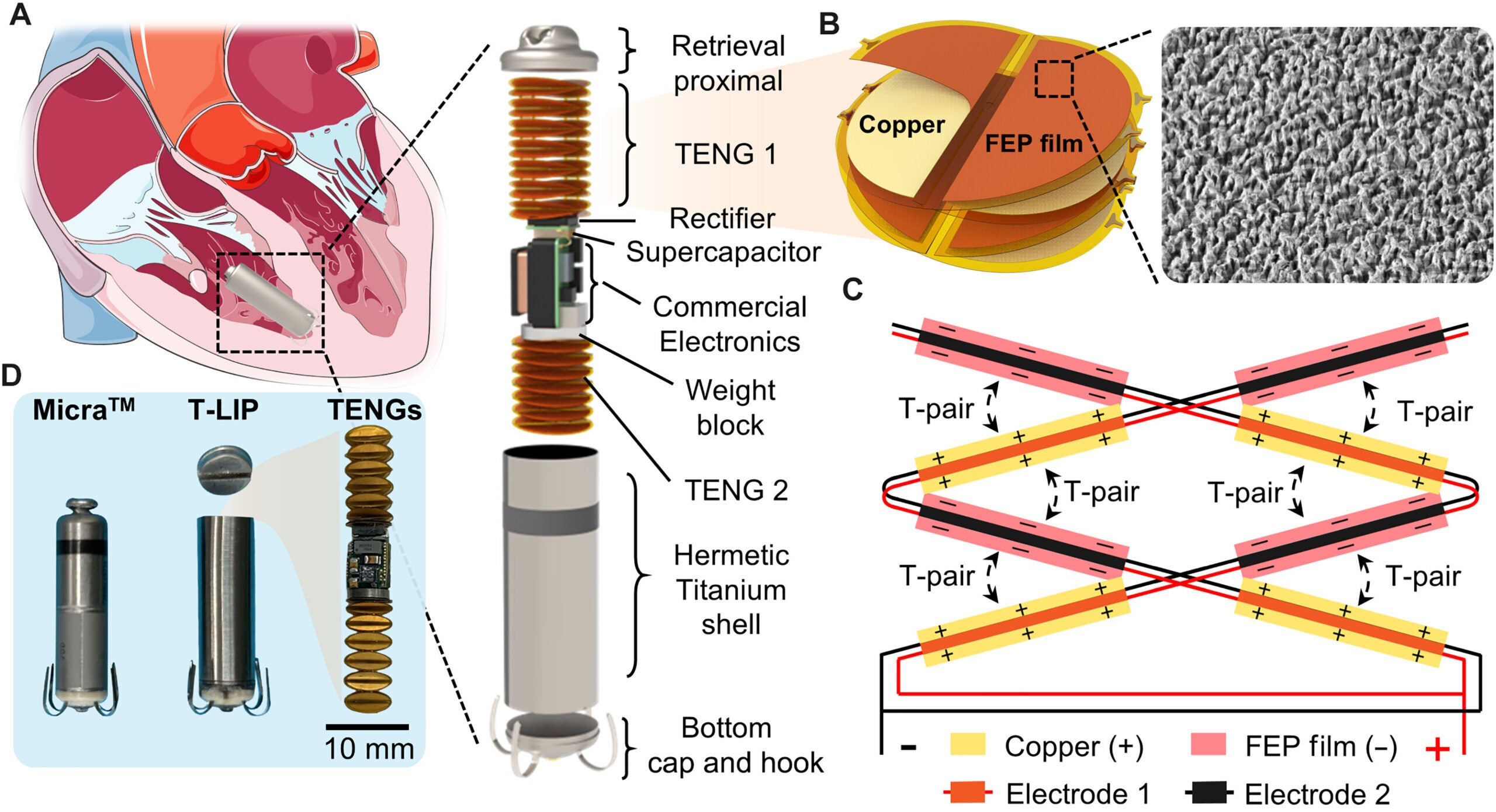
Piezoelectric devices create electricity when squeezed or stretched. Triboelectric devices generate power when two oppositely charged materials touch and separate.
So far, the challenge has been scale. A pacemaker needs enough energy from a device small enough to fit inside the heart.
Wang and Chen designed specialized oscillating triboelectric structures that fit into the battery compartment of the Medtronic Micra, while keeping the overall device the same size. They placed the structures above and below the electronics package inside the titanium shell.
The oscillators use pairs of electrode plates wired together. One side has a positive copper coating. The other has a negative fluorinated ethylene propylene film coating.
When the heart beats, the motion compresses the oscillators. The oppositely charged plates touch. When they separate, the movement creates an electrical charge. That charge can power the pacemaker or be stored in a small onboard capacitor.
Designing the generator required careful mechanical tuning. The device has to move enough to make electricity, but not so much that it fails.
“We had to think about how to balance stability and flexibility so it could oscillate millions and millions of times but maintain the desired mechanical behavior,” Chen says. “We had to optimize the placement and width of every wire, and the thickness of every electrode plate and substrate.”
The team worked with researchers across engineering and medicine. Collaborators included Professor Bo Liu, a cardiovascular biologist in the University of Wisconsin School of Medicine and Public Health; Dr. Eric Schmuck, a large-animal cardiac expert at the UW–Madison Center for Biomedical Swine Research and Innovation; and Dr. Daniel Modaff, a cardiac electrophysiologist at UW Hospital and Clinics.
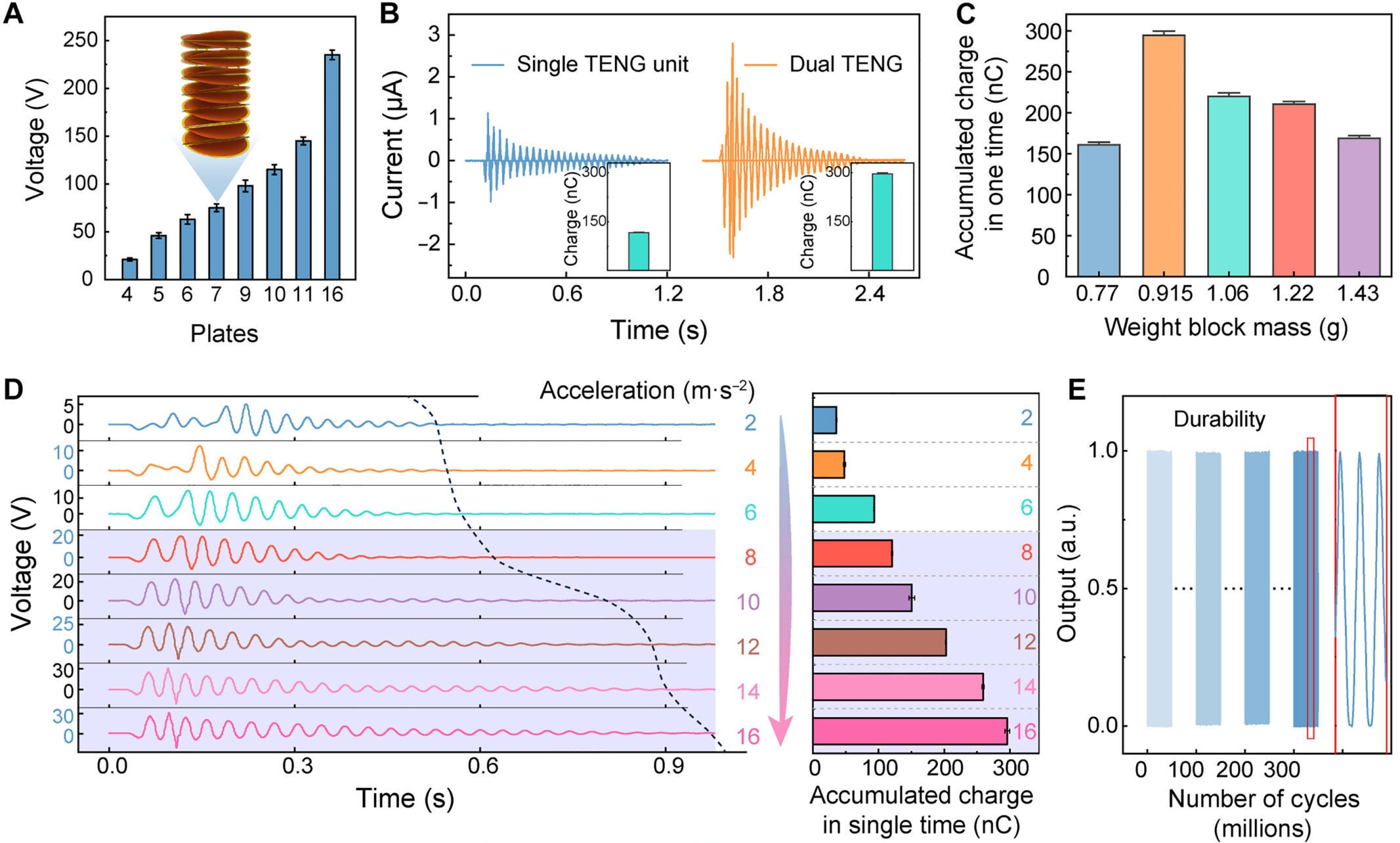
Lab tests showed the nanogenerator could produce 276.6 microwatts per cubic centimeter. That output was enough to operate the pacemaker. It also exceeded earlier miniaturized piezoelectric and triboelectric approaches.
The researchers then tested a prototype in a pig. They observed the device for one month, studying both performance and biocompatibility.
The nanogenerator successfully powered cardiac stimulation during functional testing. The team reported no adverse reactions beyond those seen with conventional battery-powered intracardiac pacemakers.
Modaff said the device could address a real problem in patient care.
“This technology shows incredible promise. One of the clinical challenges in managing patients with pacemakers is the need for generator replacement procedures when the battery depletes, which involves reoperation to replace it,” Modaff says. “I look forward to a world in which we can implant a single device that will last a patient’s lifetime, and this is a big step closer to realizing this dream.”
The device is not ready for human use. Wang said the oscillator is relatively inexpensive to produce and mechanically robust enough to potentially last the lifetime of a pacemaker. But commercialization and clinical deployment will likely take years.
The team has registered the device with the Wisconsin Alumni Research Foundation.
One technical challenge appeared inside the pig’s heart. The nanogenerator did not reach the same power peak there that it reached in the lab. Soft heart tissue dampened the oscillator’s mechanical movement.
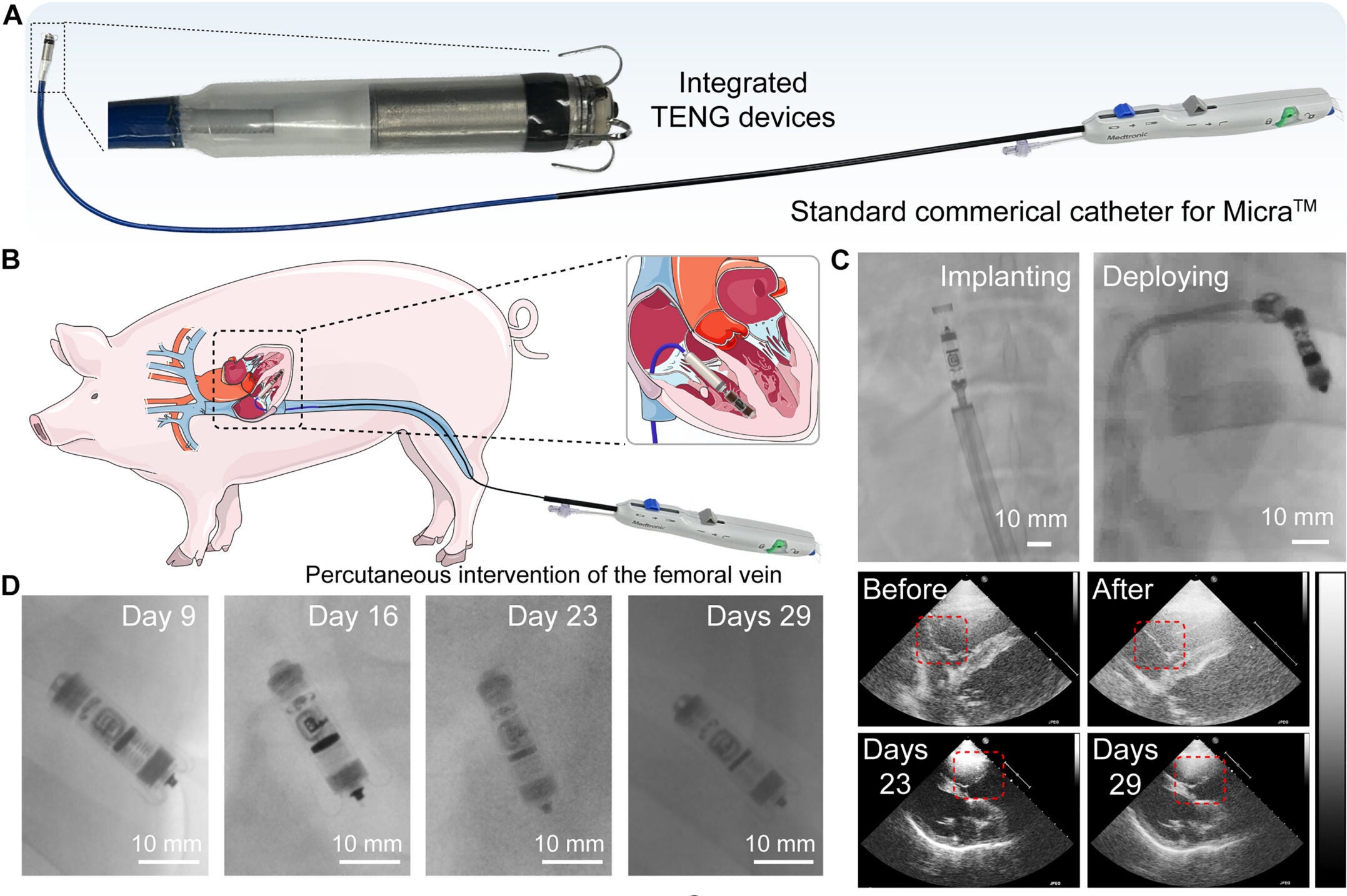
Another issue involves the heart’s natural motion. The oscillator works best with straight up-and-down movement. The heart moves more like a twist.
“We want to figure out how to transfer the more irregular movement of the heart into this mechanical oscillation efficiently,” Wang says. “This will lead to our goal by demonstrating sufficient and stable energy generation from hearts in vivo.”
A heartbeat-powered pacemaker could reduce the need for replacement procedures when batteries fail. That could lower risks and costs, especially for patients who need pacing for many years.
The work also gives engineers a path toward smaller and longer-lasting cardiac implants. A self-sustaining power source could make device designers less dependent on bulky batteries while keeping implants compact enough for catheter delivery.
Schmuck said the impact could extend beyond this one pacemaker design.
“What excites me most about this technology is not simply its ability to power a pacemaker, but how it could enable the next generation of implantable cardiac devices,” he says. “From a translational standpoint, a reliable self-sustaining power source gives device developers greater freedom to design smaller implants with enhanced diagnostic and therapeutic capabilities. As we continue to move toward smarter, more personalized cardiac care, technologies that harvest energy directly from the body could play a critical role in bringing these innovations from the laboratory to the patient.”
These resources examine the clinical challenges of leadless pacemakers and the technologies being developed to harvest energy from the body for longer-lasting cardiac implants.
Safety and efficacy of leadless pacemakers: A systematic review and meta-analysis
This systematic review and meta-analysis covered 55 studies involving more than 286,000 patients, comparing leadless and transvenous pacemakers across several safety outcomes. It found lower risks of some lead and pocket-related complications with leadless systems, while identifying higher risks for cardiac tamponade and access-site complications. (Heart Rhythm O2, 2026)
Long-term management of leadless pacemakers
This state-of-the-art review examines one of the central issues facing leadless pacemakers: what happens when the device reaches the end of its service life. It explores removal, abandonment and the clinical challenges created by finite battery life. (European Heart Journal Supplements, 2025)
Device longevity of a leadless pacemaker family
Researchers projected the longevity of newer Micra leadless pacemakers using real-world pacing data. The analysis estimated median longevity of 16.7 years for Micra VR2 and 15.6 years for Micra AV2, showing why device lifespan remains an important consideration even as batteries improve. (Future Cardiology, 2025)
Piezoelectric Energy Harvesting for Pacemaker Applications: Current State-of-the-Art, Materials, Design, and Alternative Technologies
This review examines efforts to capture biomechanical energy for self-powered pacemakers, with particular attention to piezoelectric materials, implant design, biocompatibility and in vivo testing. It also compares piezoelectric approaches with other energy-harvesting technologies. (ACS Biomaterials Science & Engineering, 2025)
Implantable Triboelectric Nanogenerators for Self-Powered Cardiovascular Healthcare
This review focuses specifically on implantable triboelectric nanogenerators, including their use as energy sources for pacemakers and other cardiovascular devices. It also examines biocompatibility and the obstacles that must be addressed for long-term implantation. (Advanced Energy Materials, 2023)
Research findings are available online in the journal Science Advances.
The original story “Heartbeat-powered pacemaker could eliminate the need for battery replacements” is published in The Brighter Side of News.
Like these kind of feel good stories? Get The Brighter Side of News’ newsletter.
The post Heartbeat-powered pacemaker could eliminate the need for battery replacements appeared first on The Brighter Side of News.


Leave a comment
You must be logged in to post a comment.