For more than a century, human origins have been told as a story of expansion, migration, and survival. But deep in that story sits a long, quiet stretch when almost nothing seems to happen. Fossils thin out. The trail goes cold. Then our lineage reappears.
A new genetic analysis argues that this silence was anything but uneventful.
Between about 930,000 and 813,000 years ago, the ancestral population that eventually gave rise to modern humans appears to have fallen to an average of roughly 1,280 breeding individuals. According to a new study, published in the journal Science, that collapse lasted about 117,000 years. Moreover, it wiped out nearly 98.7 percent of the ancestral population at the start of the bottleneck. It also erased about 65.85 percent of the genetic diversity seen in the lineage before it.
That number is startling on its own. It is even more striking when set against the fossil record. Human remains in Africa and Eurasia become unusually scarce between roughly 950,000 and 650,000 years ago during this interval.
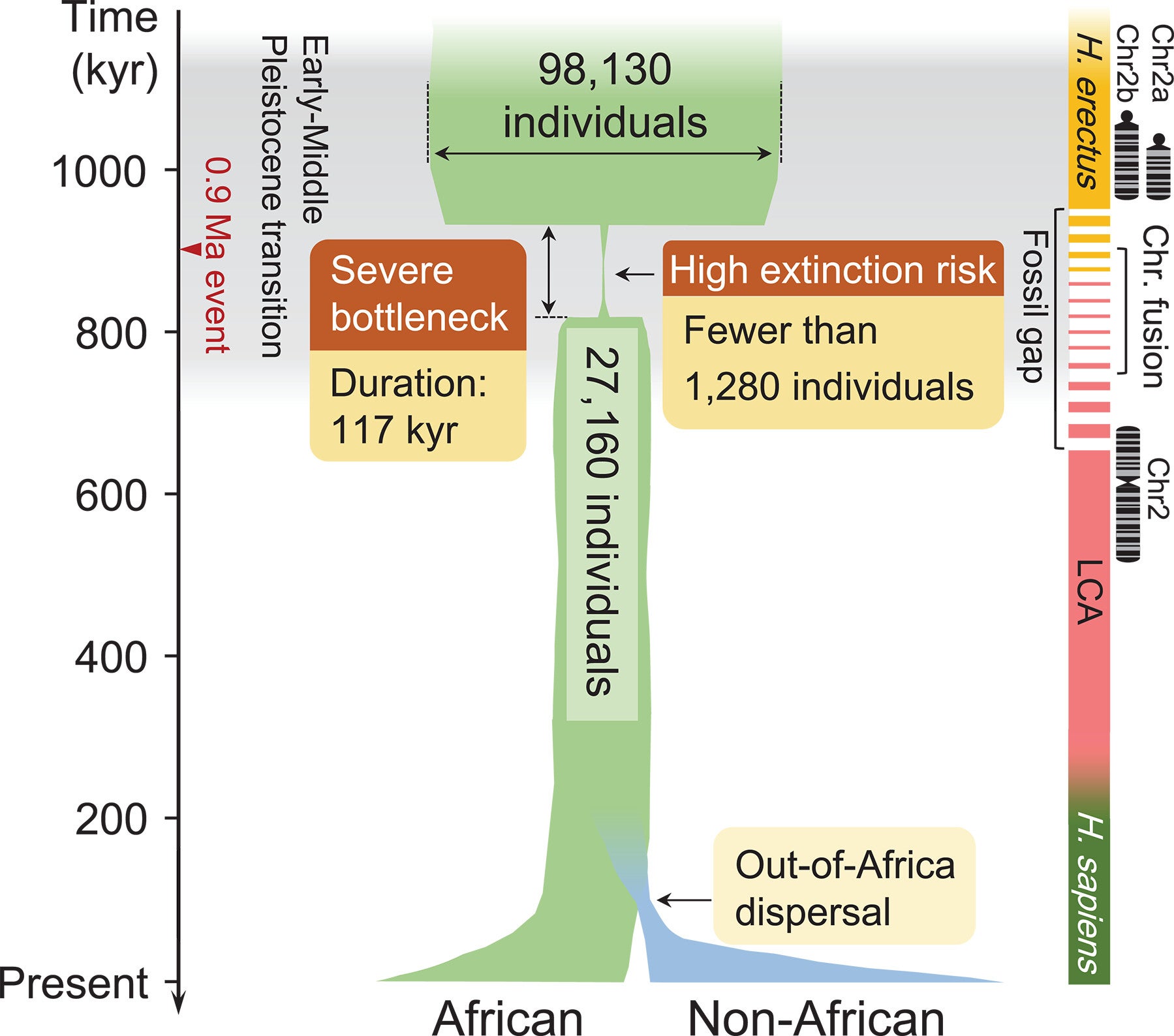
“The gap in the African and Eurasian fossil records can be explained by this bottleneck in the Early Stone Age. Chronologically, it coincides with significant loss of fossil evidence,” said Giorgio Manzi, an anthropologist at Sapienza University of Rome.
The work draws its conclusions not from ancient bones, but from living people. Researchers analyzed genomic data from 3,154 present-day individuals from 10 African and 40 non-African populations. Then they used a newly developed computational method to infer how population size changed across vast stretches of time.
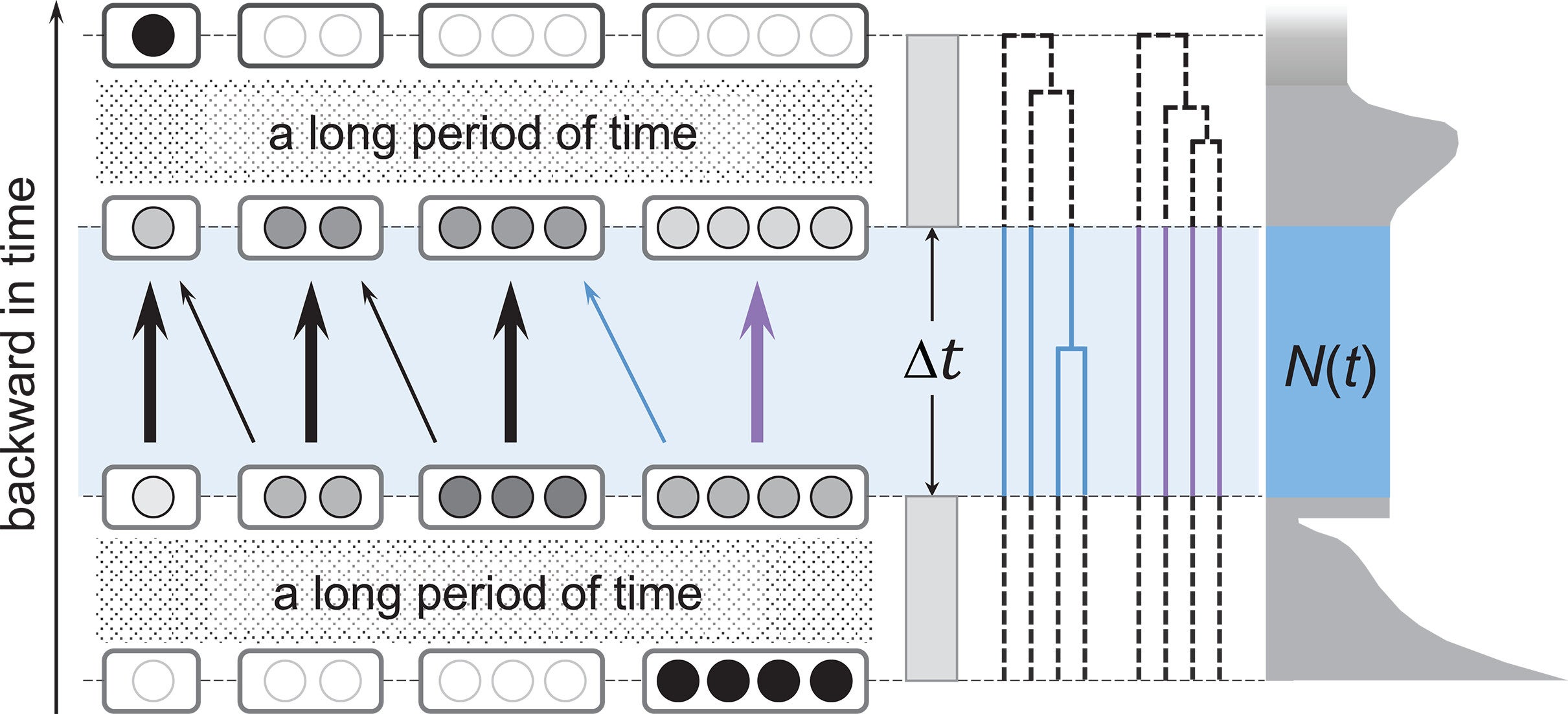
The method is called FitCoal, short for fast infinitesimal time coalescent process. It uses patterns in the site frequency spectrum, the distribution of genetic variants in a population, to reconstruct past changes in the number of breeding individuals.
The authors designed it to avoid some of the numerical problems that can blur older demographic events. They also focused on autosomal noncoding regions and excluded high-frequency mutations to reduce the effects of purifying selection, positive selection, and sequencing errors.
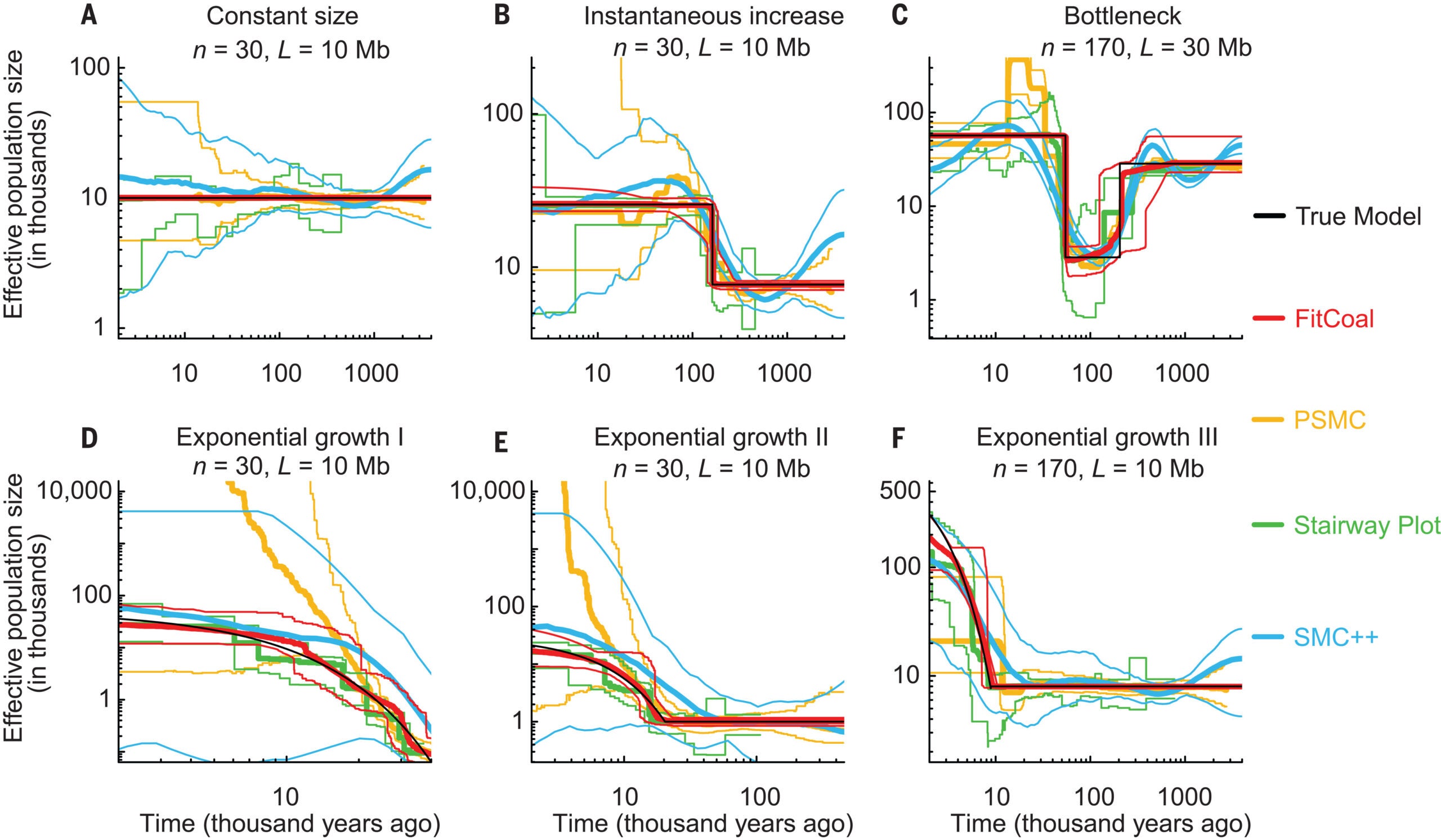
In simulations, the team reported that FitCoal tracked known demographic scenarios more accurately than several earlier methods. These methods include PSMC, Stairway Plot, and SMC++.
“The fact that FitCoal can detect the ancient severe bottleneck with even a few sequences represents a breakthrough,” said Yun-Xin Fu, a population geneticist at the University of Texas Health Science Center at Houston.
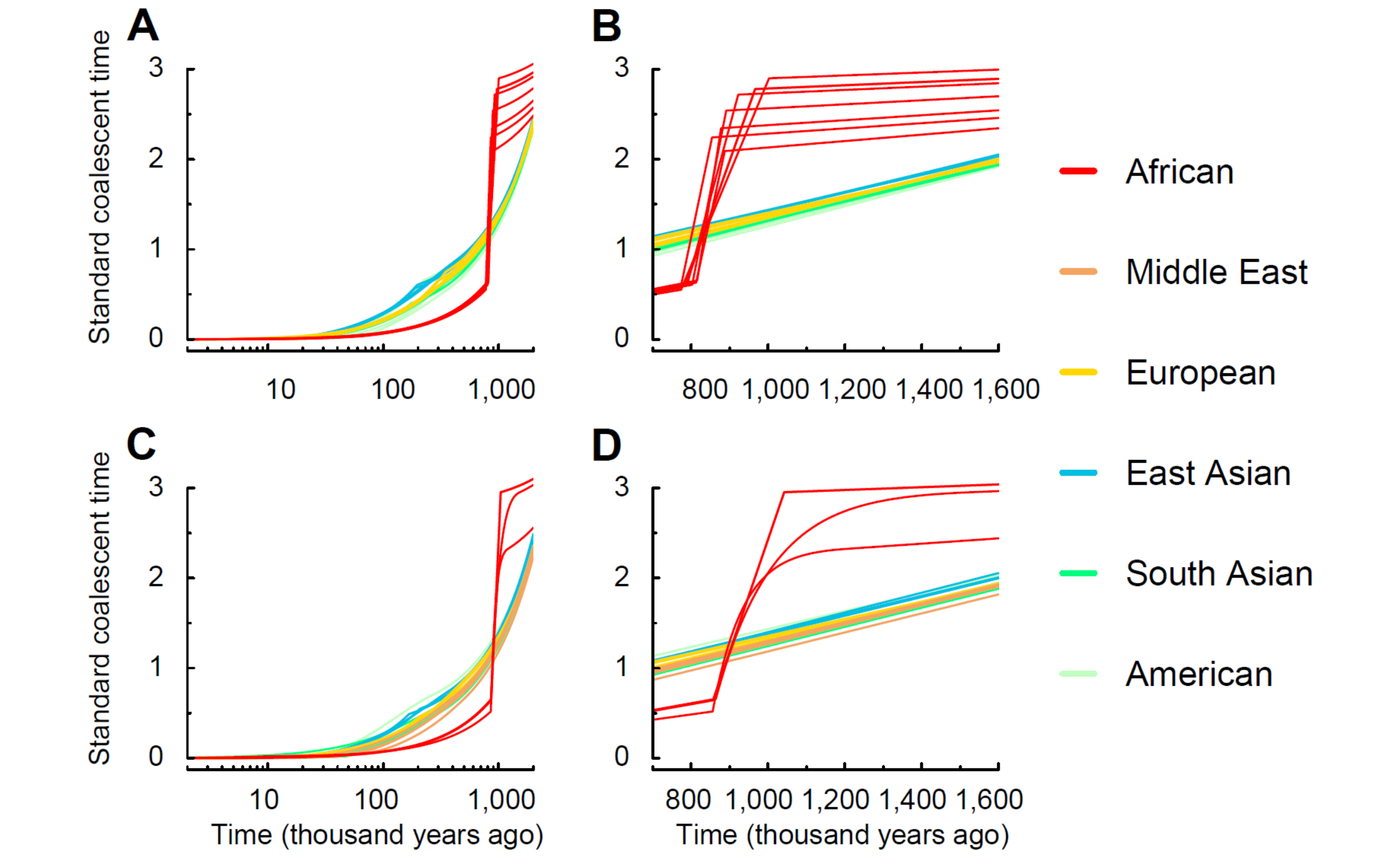
When the model was applied to African populations, the signal was unusually consistent. All 10 African populations examined showed evidence of the same severe bottleneck. This bottleneck began around 930,000 years ago and ended around 813,000 years ago. During that period, the average effective population size was estimated at 1,280, down from an ancestral size of about 98,130.
The direct signal was weaker in non-African populations, but the authors do not argue that these groups escaped the crash. Instead, they say later events, especially the out-of-Africa dispersal, obscured the older signal. After modifying the analysis, they found that all 19 non-African populations in the 1000 Genomes Project also appeared to pass through the same bottleneck. During this bottleneck, there were about 1,450 individuals between about 921,000 and 785,000 years ago.
The timing matters.
The bottleneck falls within the Early to Middle Pleistocene transition, a period when glacial cycles changed from shorter swings to longer and harsher intervals. The paper links the population collapse to those climatic shifts. These shifts include colder marine temperatures, prolonged drought, and broad turnover in African and Eurasian wildlife.
That environmental pressure may help explain why the hominin fossil record becomes so thin during this period. In Africa, the study points to only a few known finds from the interval. Examples include cranial fragments from Gombore in Ethiopia and fossil material from Tighenif in Algeria.
The scarcity has long posed a problem for paleoanthropologists. If populations were small, fragmented, and living under severe environmental stress, the lack of fossils begins to look less mysterious.
The study also places the bottleneck near another event that has drawn attention in human evolution: the fusion of two ancestral chromosomes into what is now human chromosome 2. The authors note that this fusion is thought to have occurred roughly between 900,000 and 740,000 years ago. They suggest the bottleneck may mark a speciation event tied to the last common ancestor shared by modern humans, Neanderthals, and Denisovans. The divergence of these groups has been dated to about 765,000 to 550,000 years ago.
Yi-Hsuan Pan, an evolutionary genomics expert at East China Normal University, said the finding “opens a new field in human evolution because it evokes many questions, such as the places where these individuals lived, how they overcame catastrophic climate changes, and whether natural selection during the bottleneck accelerated the evolution of the human brain.”
That last question remains open. The study does not claim to prove that the bottleneck drove changes in intelligence or behavior. But it does argue that a population this small, surviving for this long, would have faced intense evolutionary pressure.
What kept the lineage alive is still uncertain.
The authors point to early control of fire as one possible factor in the rebound that followed. Archaeological evidence from Israel suggests fire use by about 790,000 years ago, near the end of the bottleneck. This evidence coincides with the time the study detected a rapid population expansion.
In the model, that recovery was dramatic. Around 813,000 years ago, the ancestral population increased about twentyfold in African populations. The paper also notes that climate improvement may have helped fuel that rebound.
What the analysis cannot yet show is where these people lived, how they were distributed, or whether they survived in one refuge or several. The effective population size used in the study refers to breeding individuals, not a head count of every person alive. Furthermore, the authors note that hidden population structure could mean the estimate of 1,280 was still too high.
Even so, the picture is stark. For more than 100,000 years, the human lineage appears to have hovered close to extinction.
Li Haipeng, a computational biologist at the Shanghai Institute of Nutrition and Health, said, “Future goals with this knowledge aim to paint a more complete picture of human evolution during this period, unraveling the mystery that is early human ancestry and evolution.”
The study’s broader point is that this was not just a temporary dip in numbers. It was a turning point that reshaped the genetic inheritance of every human alive today.
By the authors’ estimate, nearly two-thirds of the lineage’s earlier genetic diversity was lost in the crash. That kind of loss can leave lasting signatures in modern genomes. As a result, it influences how variation is distributed across populations and how researchers interpret later chapters of human history.
It also sharpens the link between climate instability and biological survival. The authors frame the bottleneck as a case in which environmental disruption pushed an already vulnerable lineage to the edge. This event then left a mark still visible hundreds of thousands of years later.
For a long time, the missing fossils looked like an absence. This study suggests they may instead record a near-fatal bottleneck, one that nearly erased our ancestors before history took another turn. In addition, evolution continued.
This work gives anthropologists and geneticists a clearer target for future research into one of the least understood periods of human evolution.
It offers a possible explanation for a long gap in the fossil record. It also identifies a time window for closer archaeological and climate study. Moreover, the results show that present-day genomes can still preserve signals from a crisis nearly a million years old.
It also highlights how severe environmental change can shrink populations, strip away genetic diversity, and shape the long-term path of a species.
Research findings are available online in the journal Science.
The original story “Humans nearly went extinct 930,000 years ago, researchers find” is published in The Brighter Side of News.
Like these kind of feel good stories? Get The Brighter Side of News’ newsletter.
The post Humans nearly went extinct 930,000 years ago, researchers find appeared first on The Brighter Side of News.


Leave a comment
You must be logged in to post a comment.