An active region can grow on the Sun while remaining completely hidden from Earth. By the time rotation brings it into view, a magnetic-field model relying on Earth-facing observations may already be missing part of its history.
A Southwest Research Institute-led team has developed a way to reduce that blind spot without accepting every indirect detection as real. Its framework assigns probabilities to suspected far-side active regions, then incorporates selected detections into a model of the Sun’s surface magnetism.
The study, published in The Astrophysical Journal Supplement Series, was led by Bibhuti Kumar Jha, a research scientist in SwRI’s Boulder, Colorado, division. Co-author Lisa Upton is a lead scientist at the same office.
The work improves an important input for space-weather modeling. Its tests concern detecting active regions and reconstructing magnetic flux, rather than directly predicting when a particular eruption will strike Earth.
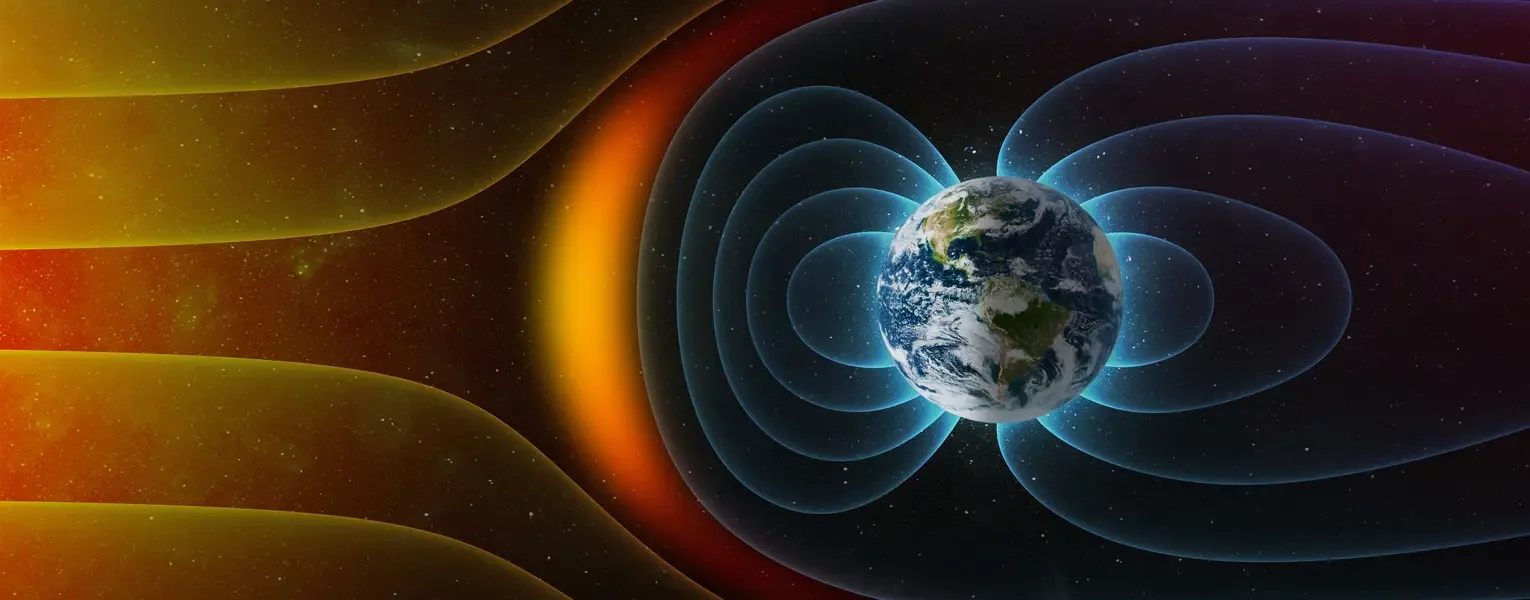
The Sun’s far side is simply the hemisphere facing away from Earth at a particular moment. Solar rotation brings different regions into view over approximately twenty-seven days, although rotation varies with latitude.
Traditional full-Sun maps combine observations gathered across a rotation. That approach helps describe large-scale magnetism, but stitches together measurements made at different times. Rapidly emerging or changing regions can therefore be poorly represented.
Surface flux transport models offer a more dynamic approach. They simulate how rotation, poleward flows and turbulent surface motions redistribute magnetic flux. The Advective Flux Transport model, or AFT, regularly incorporates direct magnetic observations from the visible hemisphere.
Yet evolving known regions is different from detecting new ones. A model cannot automatically account for magnetic flux that emerges or increases while a region is out of sight.
Those missing features affect the maps supplied to models of the corona and solar wind. Improving the hidden hemisphere’s representation can therefore strengthen the physical foundation of space-weather research.
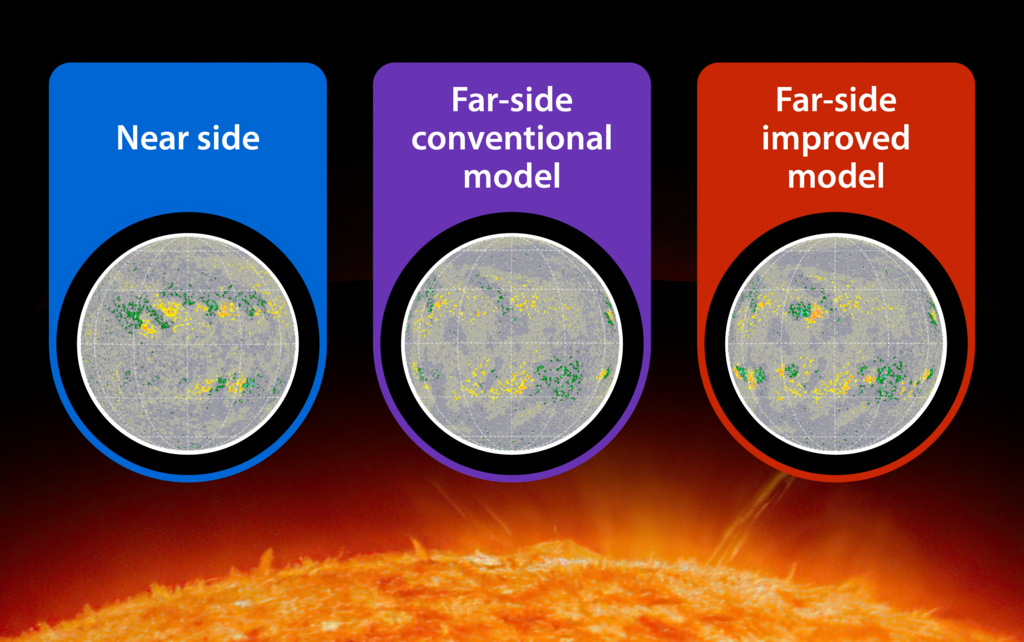
Helioseismology provides one route around the observational limitation. It uses measurements of solar oscillations to investigate conditions inside the Sun and infer activity beyond direct view.
Magnetic regions affect how waves propagate. Changes in their measured travel times help researchers identify possible active regions on the far side. These signals can also be converted into estimates of unsigned magnetic flux, which counts field contributions without cancellation between opposite polarities.
However, noise and limited spatial resolution complicate the interpretation. Some apparent regions have no corresponding feature in ultraviolet observations. Researchers call these false signals “ghost” active regions.
“Before we add this far-side helioseismology data into our model, we systematically evaluate the accuracy of active regions,” Upton said. The goal is to quantify confidence rather than treat every candidate equally.
The new framework uses far-side magnetic-flux estimates derived from Solar Dynamics Observatory measurements. Those estimates already employ machine-learning methods; the new probability filter is a separate statistical step.
The researchers examined data from May 13, 2010, through August 18, 2014. During that interval, NASA’s STEREO spacecraft provided extensive coverage of the Sun’s far side.
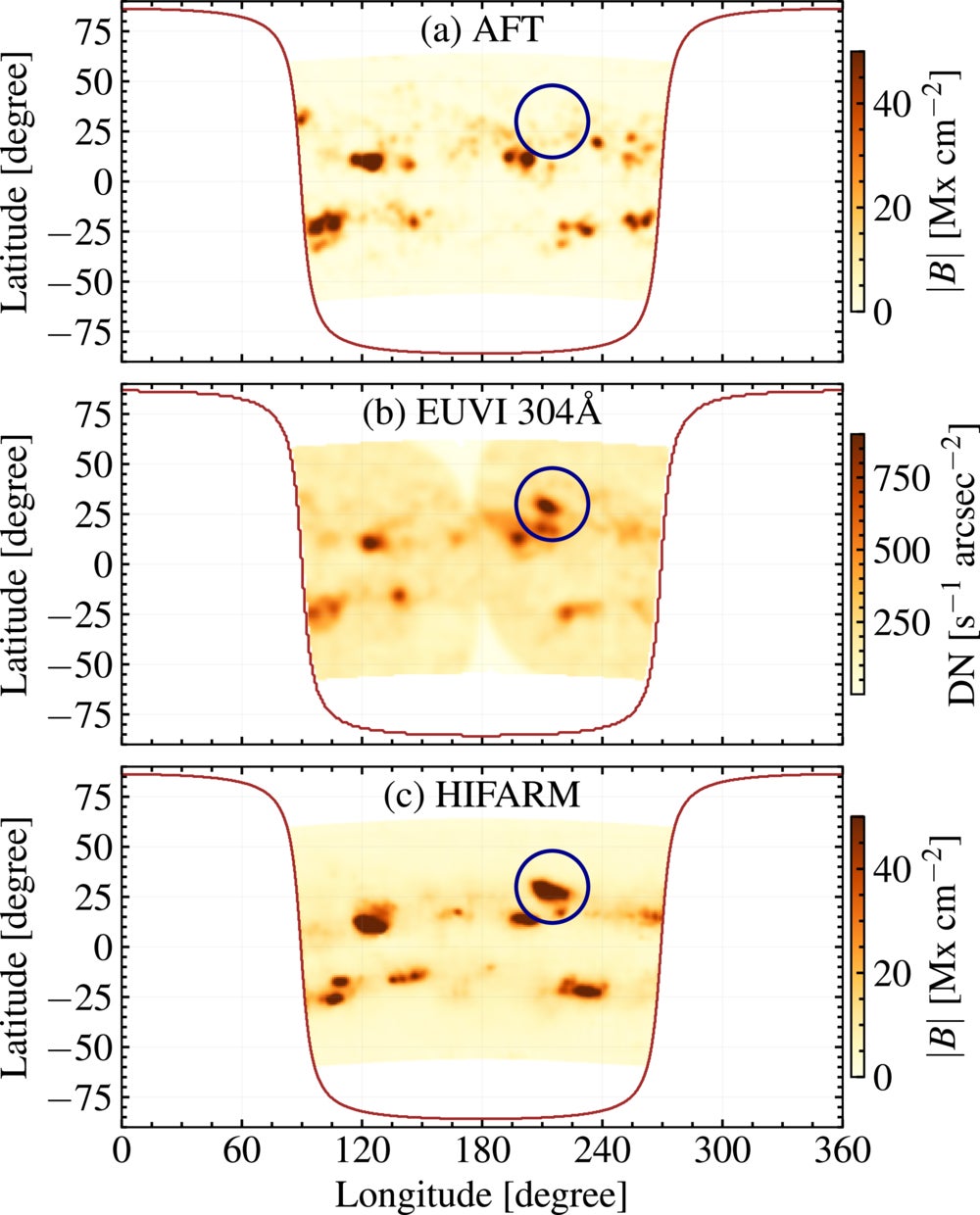
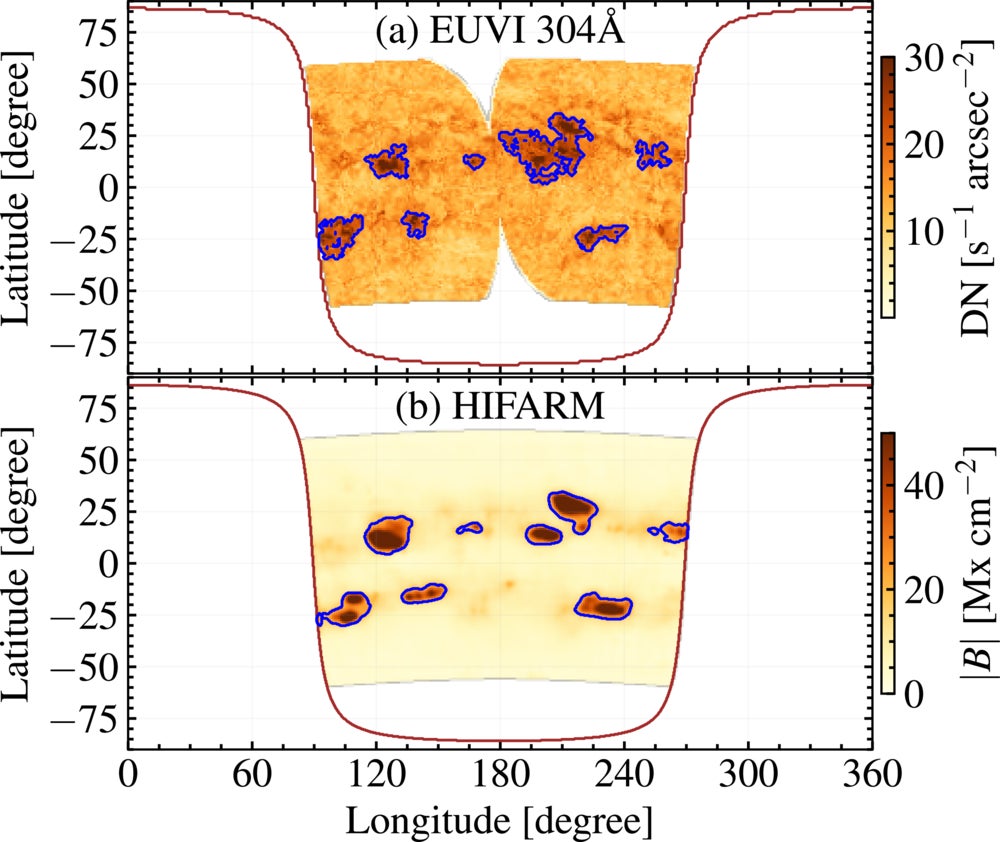
Near-simultaneous extreme-ultraviolet observations from STEREO and Solar Dynamics Observatory allowed construction of full-surface maps. The team used their far-side portions to check candidate regions inferred through helioseismology.
A candidate was labeled real when it overlapped an ultraviolet-detected region within a defined neighborhood. Without a matching ultraviolet feature, it was labeled a ghost. Detections lacking the necessary ultraviolet coverage were classified as unknown.
This establishes a practical reference, rather than a direct measurement of every region’s magnetic field. The analysis also excludes ultraviolet regions that have no helioseismic counterpart, so its results do not describe detection of all far-side activity.
The labeled dataset contained 10,227 detections. Researchers used 8,181 to fit a logistic-regression model and reserved 2,046 for testing. Its inputs included total inferred magnetic flux, average field strength and latitude.
Total flux was the strongest predictor. Stronger, more coherent magnetic regions generally produced more dependable signals than diffuse, low-intensity features.
The team selected a probability threshold of 0.73, chosen to reject approximately 90% of ghost detections. Among accepted candidates in the test set, 93% matched the ultraviolet reference.
That is precision: the proportion of accepted detections classified as real. It is not a 93% success rate for finding every active region or forecasting solar storms.
The corresponding recall was 52%. In other words, the filter retained roughly half the real detections in the test set, while rejecting the rest alongside the ghosts.
This trade-off reflects the chosen priority of limiting false additions to the magnetic map. Changing the threshold would alter the balance between admitting questionable regions and excluding genuine ones.
The result is therefore a quantified filtering strategy, not a perfect far-side detector. Future improvements could use additional information about detection sensitivity, region shape or earlier visible-side observations to reduce missed detections.
Even a credible detection cannot be inserted unchanged. Its inferred flux may differ from the amount needed to reproduce the region’s later behavior when direct magnetic observations become available.
The researchers developed an empirical correction using an earlier AFT version informed by STEREO ultraviolet observations. They then represented accepted regions as idealized pairs of opposite magnetic polarity.
Only missing flux was added. If the existing model already contained sufficient flux, the framework left the region unchanged, helping avoid duplicate or excessive additions.
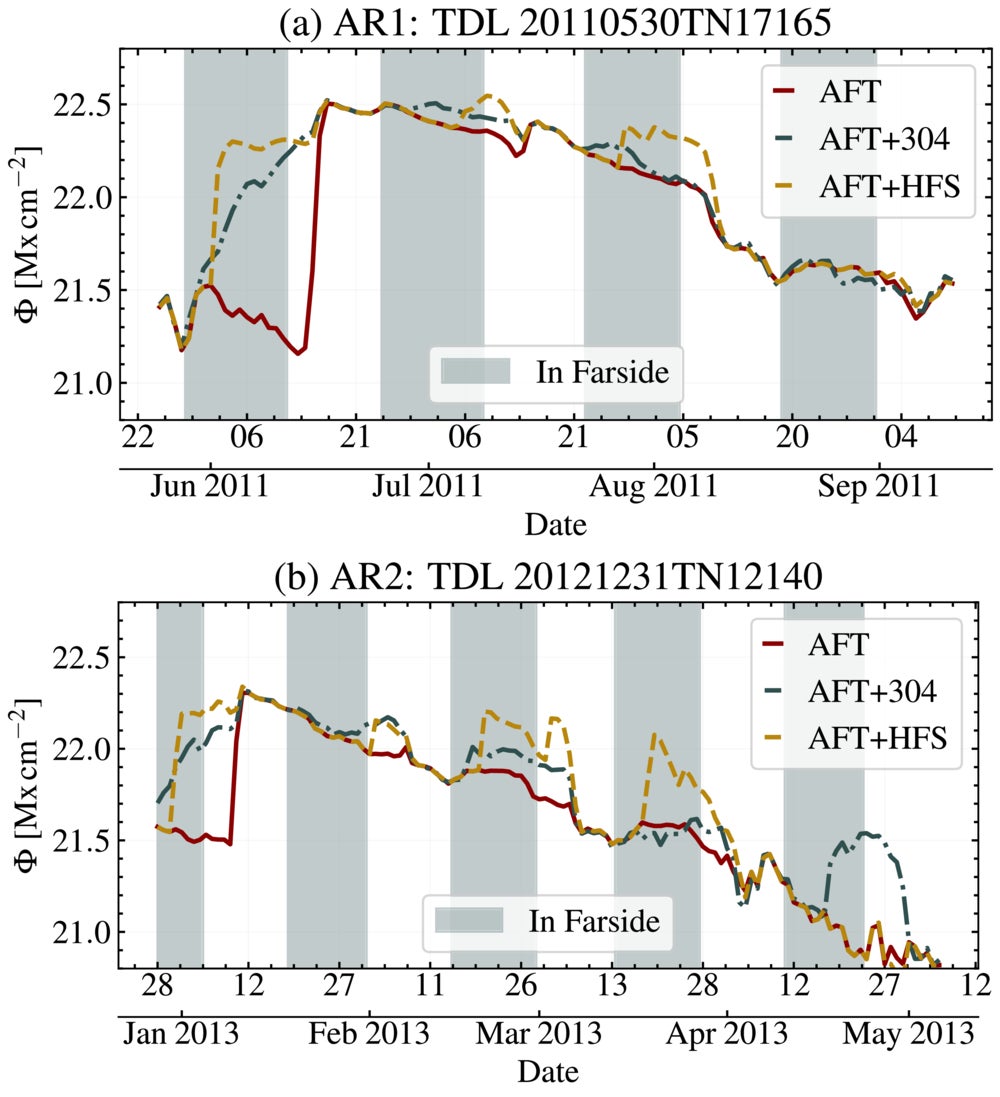
Examples followed active regions through multiple rotations, recovering growth that the baseline model missed. One region continued developing while hidden, then merged smoothly with direct observations after returning to the visible hemisphere.
Across the modeled interval, the baseline underestimated total unsigned flux by approximately 10%–20% relative to the far-side-informed simulation. This comparison concerns modeled magnetic-flux budgets, not a measured percentage improvement in forecasting.
Some regions still showed discrepancies. Ultraviolet brightness is an imperfect magnetic proxy, and the correction also carries uncertainty. Direct magnetic observations remained necessary to correct errors as regions rotated into view.
The study used AFT in its observation-assimilation mode, rather than testing a forecast of the next solar cycle. Its immediate contribution is a more complete reconstruction of surface magnetism with an explicit treatment of uncertain detections.
The probability filter could also be incorporated into other surface flux transport systems. Improved maps may support studies connecting the solar surface, corona and solar wind, and provide inputs for broader forecasting frameworks.
“This is a step toward a more realistic modeling of the magnetic field of both visible and invisible hemispheres of the Sun,” Jha said. Establishing how much those improvements benefit operational forecasts will require further testing.
These resources explain the transport models, indirect magnetic measurements and forecasting applications behind the new framework.
Surface Flux Transport on the Sun: Reviews how surface flows redistribute solar magnetic flux and how scientists model its evolution. (Space Science Reviews, 2023)
The Advective Flux Transport Model: Improving the Far Side with Active Regions Observed by STEREO 304 Å: Describes the ultraviolet-informed AFT model used as a reference for far-side magnetic-flux reconstruction. (The Astrophysical Journal, 2024)
Inferring Maps of the Sun’s Far-side Unsigned Magnetic Flux from Far-side Helioseismic Images Using Machine Learning Techniques: Explains how helioseismic images can be translated into magnetic-flux estimates. (The Astrophysical Journal, 2022)
Combined Surface Flux Transport and Helioseismic Far-Side Active Region Model (FARM): Presents another approach to combining magnetic transport simulations with far-side helioseismic information. (Solar Physics, 2024)
A 4π Framework for Forecasting Solar-Limb Flares Using the AFT Model and NSF-NOAA GONG Far-Side Helioseismic Maps: Describes a related forecasting framework addressing active regions near and beyond the Sun’s visible edges. (National Solar Observatory, 2026)
Research findings are available online in The Astrophysical Journal Supplement Series.
The original story “Improved magnetic field maps bring the Sun’s hidden hemisphere into focus” is published in The Brighter Side of News.
Like these kind of feel good stories? Get The Brighter Side of News’ newsletter.
The post Improved magnetic field maps bring the Sun’s hidden hemisphere into focus appeared first on The Brighter Side of News.


Leave a comment
You must be logged in to post a comment.