A reflective membrane thinner than a human hair has become a testing ground for one of space exploration’s hardest problems: reaching another star. Laboratory studies published in 2025 measured how laser light pushes miniature sails and demonstrated a method for making larger, exceptionally thin reflectors.
The results are early steps toward robotic interstellar missions, with substantial engineering still ahead. They also illustrate a distinction often lost in discussions of alien visitors: known physics imposes severe limits on travel, but does not prohibit every journey between stars.
Work from Caltech, Brown University and Delft University of Technology in Nature Communications, examines specific parts of that challenge. Alongside research on radiation exposure and astronomical detection, it offers evidence about what such journeys would require.
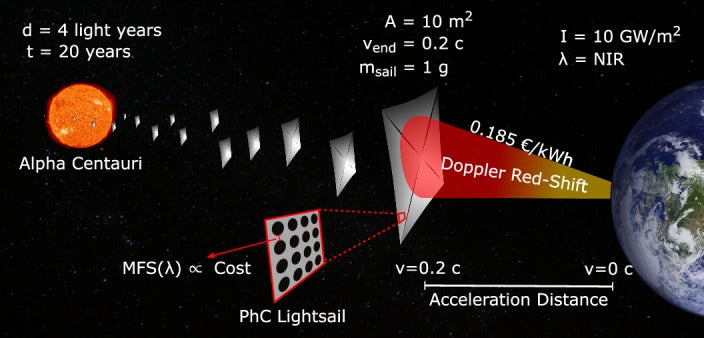
Proxima Centauri, the nearest star to the Sun, lies approximately 4.24 light-years away. Light itself needs more than four years to cross that gap, putting a minimum delay on any message sent between the two systems.
A spacecraft traveling at one-fifth of light speed would need about 21 years to cover that distance. That simple calculation excludes acceleration and braking. A reply transmitted immediately from the destination would take another 4.24 years to reach Earth.
Special relativity prevents an object with mass from accelerating to light speed because the required energy grows without bound. Traveling below that limit is allowed, although producing high speeds remains an enormous practical challenge.
The distinction matters when evaluating claims about extraterrestrial travel. A speed limit establishes how quickly a conventional spacecraft could arrive. It does not establish whether another civilization exists, what equipment it could build, or whether it would undertake a lengthy mission.
Conventional rockets carry propellant that must accelerate along with the vehicle. As a mission demands larger changes in velocity, its propellant requirements grow rapidly. Slowing down at another star adds a separate demand to the journey.
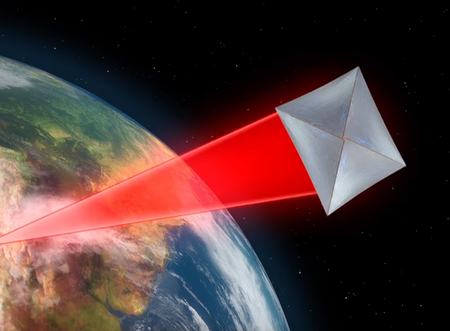
Laser-driven sails pursue a different approach. An external beam supplies momentum to a reflective membrane, reducing the need to carry propulsion fuel aboard the probe. The Breakthrough Starshot concept targets tiny robotic payloads traveling at roughly 20% of light speed.
In January 2025, Caltech researchers reported direct radiation-pressure measurements using a silicon nitride membrane just 50 nanometers thick. Their miniature sail measured 40 micrometers on each side and remained attached to springs during testing.
The team measured the membrane’s movement to determine the force exerted by laser light. Their approach separated that force from heating effects, which can otherwise obscure the measurement.
They also tested different illumination angles, an important concern for a sail that might tilt during acceleration. This was a laboratory measurement platform, rather than a freely flying spacecraft, but it provided a way to test materials and refine models.
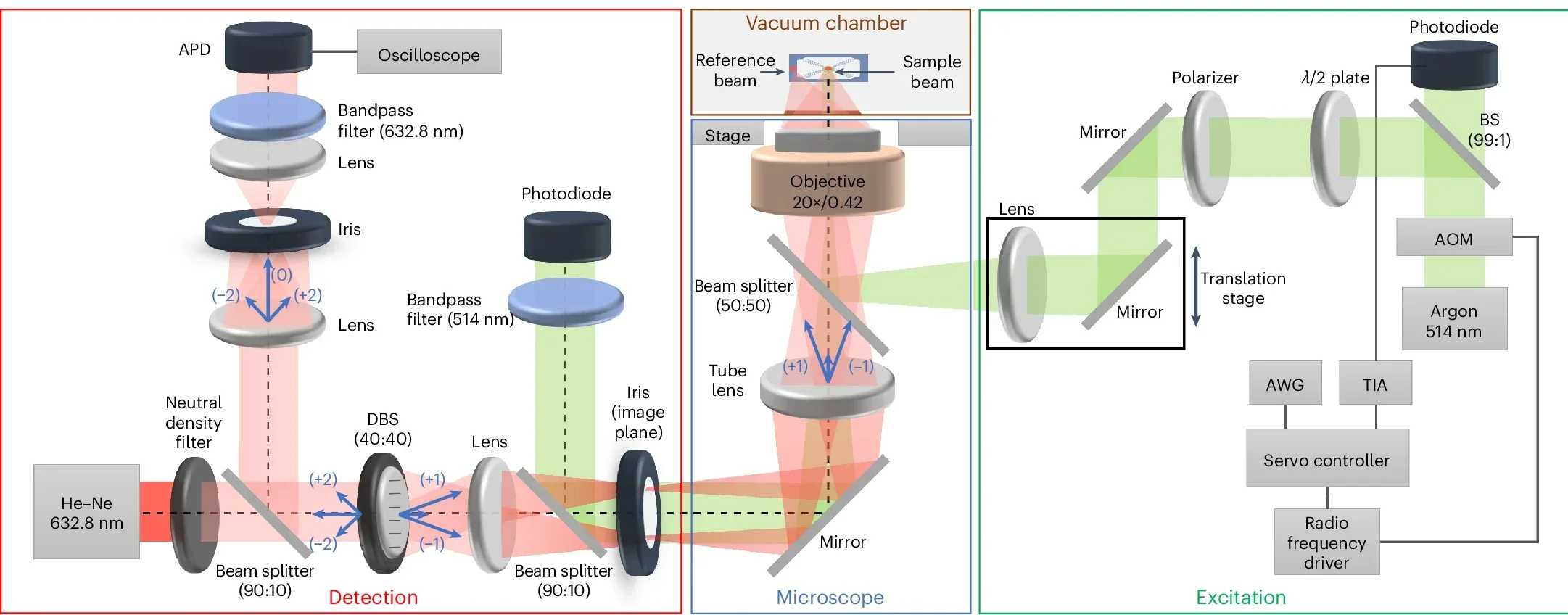
A separate study published in March 2025 addressed fabrication. Brown and Delft researchers produced a silicon nitride reflector measuring 60 millimeters on each side while remaining only 200 nanometers thick.
Its pattern contained more than a billion nanoscale features. The design used machine learning to optimize reflectivity and weight, while a fabrication process developed at Delft enabled production of the delicate membrane.
Those properties matter because a sail must reflect enough light to accelerate while absorbing very little. Absorbed laser energy heats the material, potentially damaging it under intense illumination.
The demonstration addressed an important component of a proposed propulsion system. It did not establish that a complete probe could survive acceleration, maintain its course and return useful observations from another star.
Earlier Caltech simulations, published in 2024, identified flexible sail designs that could remain stable while riding a laser beam. Beyond launch, interstellar gas and dust introduce another hazard: impacts become increasingly damaging at high speed. A mission would also need a plan for collecting data during a rapid flyby rather than assuming it could stop.
A probe carrying a microchip avoids the life-support needs of a crewed spacecraft. Human travelers require food, water, a habitable environment and protection from radiation throughout the mission.
Measurements published in Nature in 2024 show that spacecraft design can meaningfully change radiation exposure. Instruments aboard NASA’s uncrewed Artemis I mission recorded different doses at different locations inside the Orion capsule.
During passages through Earth’s proton radiation belt, dose rates differed by a factor of four between shielding locations. Changing the spacecraft’s orientation during a belt crossing reduced dose rates by approximately 50%.
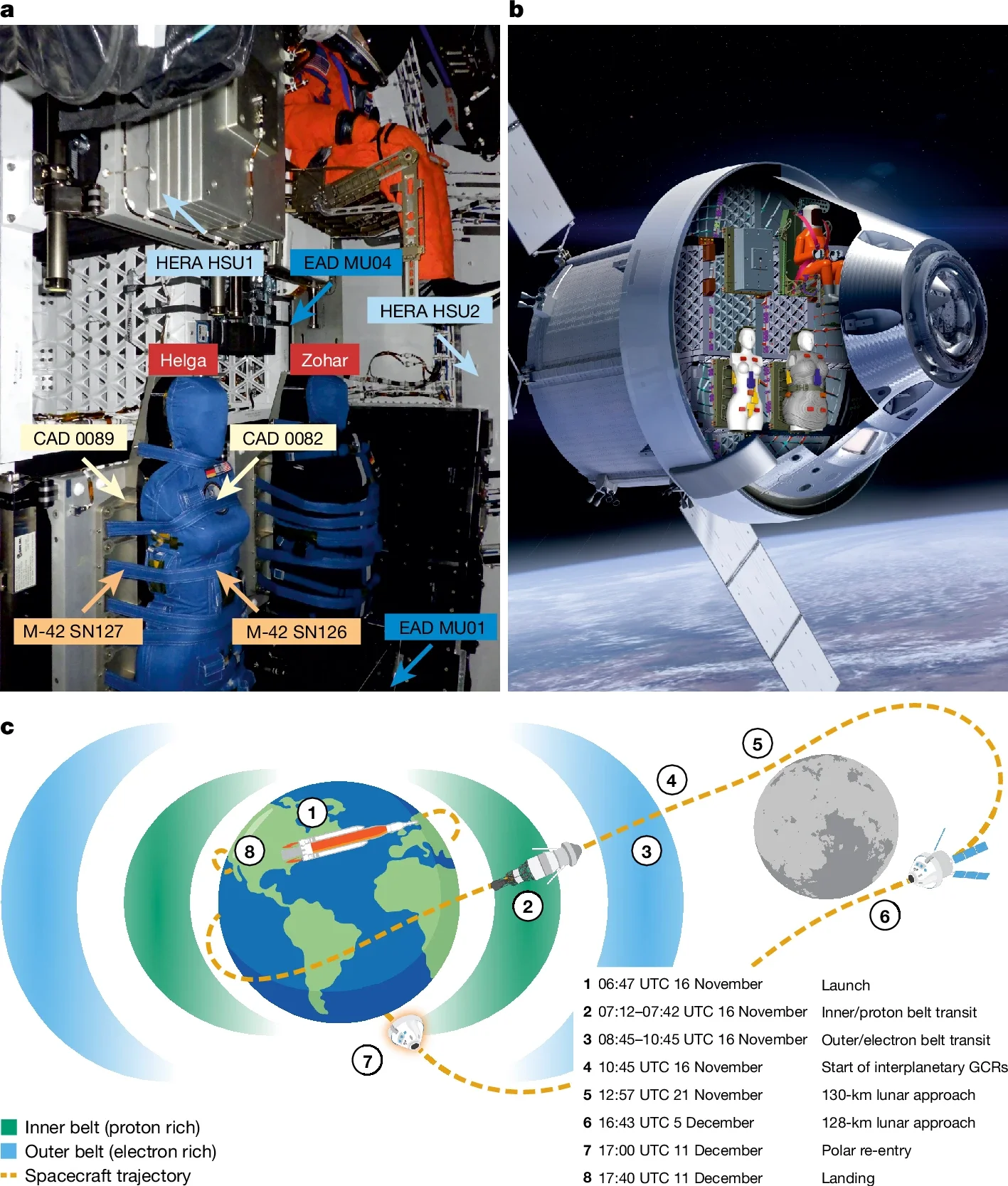
The study also reported interplanetary cosmic-ray dose-equivalent rates as much as 60% below earlier observations. These findings help inform protective design, but they do not demonstrate safety over an interstellar voyage lasting decades.
The evidence concerns human biology and spacecraft built for missions near Earth and the Moon. It cannot determine the limits of unknown extraterrestrial organisms. Nor do biological concerns apply equally to automated probes.
Some theoretical research investigates whether unusual arrangements of spacetime could offer alternative forms of motion. A 2024 paper in Classical and Quantum Gravity presented a constant-velocity warp model that satisfied the energy conditions examined by its authors.
The proposed solution combined a matter shell with a particular spacetime geometry. Crucially, it traveled below light speed. The work therefore did not demonstrate faster-than-light transportation.
It was a numerical solution within general relativity, rather than a functioning propulsion device. Describing a geometry mathematically leaves separate questions about creating it, controlling it and supplying the necessary matter and energy.
Research on extraterrestrial contact also examines signals that require no spacecraft to arrive. A 2025 study in The Astronomical Journal, led by SETI Institute scientist Sofia Sheikh, compared the detectability of several forms of Earth’s technology.
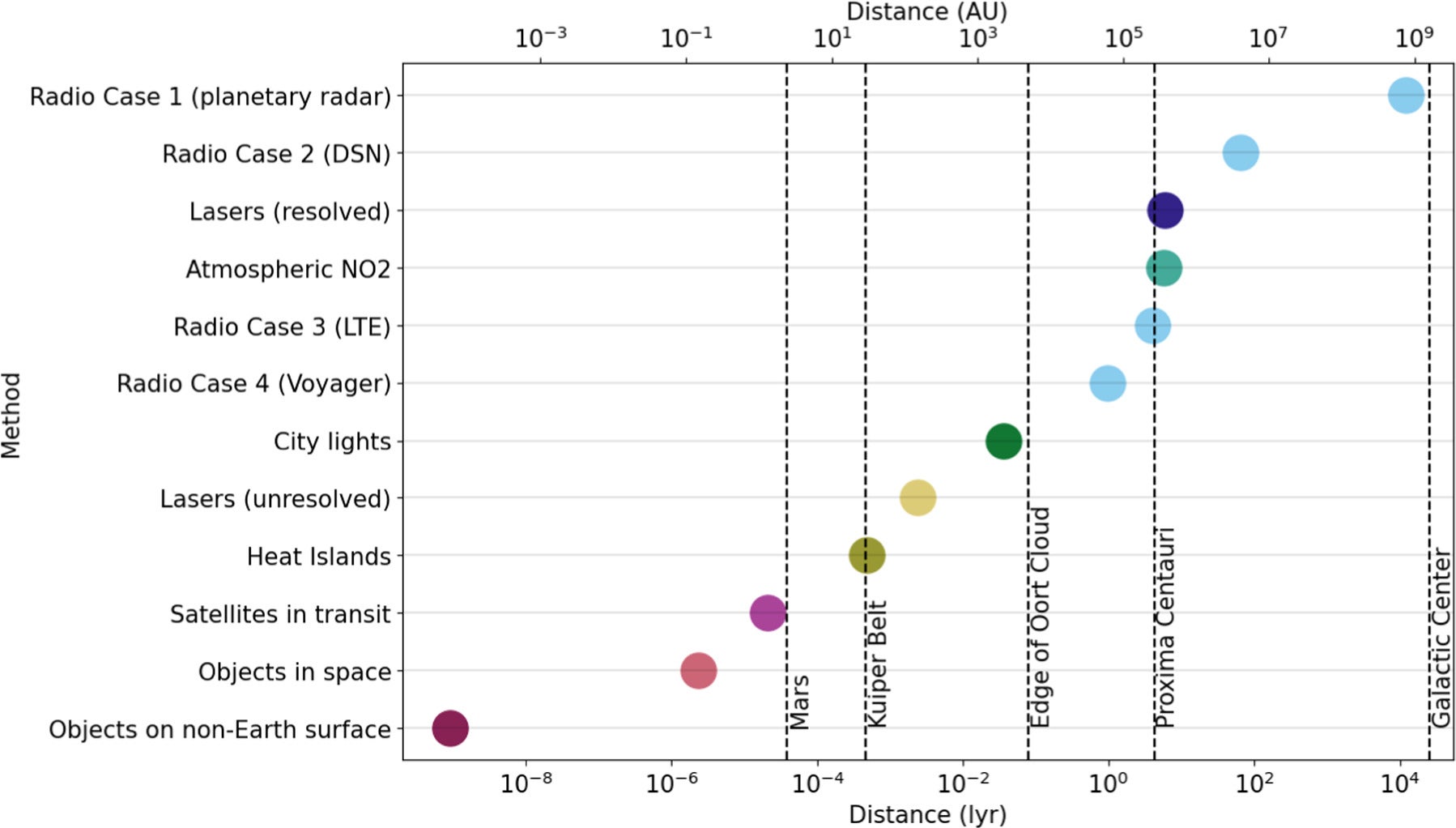
Powerful planetary radar transmissions were the most detectable signatures considered, potentially measurable from about 12,000 light-years away under the study’s assumptions. That range describes signal strength and receiving capability, not how far humanity’s transmissions have already traveled.
Such emissions are intermittent and directed, so another observer would need favorable timing and alignment. Detectability is therefore different from guaranteed detection, just as a missing signal cannot establish that no civilization exists.
The available research identifies demanding requirements for propulsion, materials, protection and observation. It does not establish that Earth will never receive an extraterrestrial visitor. Laboratory progress and theoretical limits leave that question open, while giving scientists specific problems they can measure and test.
These resources explore spacecraft stability, environmental hazards and the search for distant technology.
Dynamically stable radiation pressure propulsion of flexible lightsails for interstellar exploration: Simulations examine whether flexible laser sails can maintain stable motion during acceleration. (Nature Communications, 2024)
The Interaction of Relativistic Spacecrafts with the Interstellar Medium: Models quantify damage from gas and dust and assess possible protection strategies. (The Astrophysical Journal, 2017)
Detecting Extraterrestrial Civilizations That Employ an Earth-level Deep Space Network: Analysis of transmission logs explores how timing and planetary alignment affect detection opportunities. (The Astrophysical Journal Letters, 2025)
The Space Omics and Medical Atlas (SOMA) and international astronaut biobank: An integrated research resource documents biological changes associated with human spaceflight. (Nature, 2024)
Three Ways to Travel at (Nearly) the Speed of Light: NASA explains how particles reach extreme speeds and the role of special relativity. (NASA, 2019)
The original story “Interstellar travel faces steep hurdles, but recent research is paving a new path to the stars” is published in The Brighter Side of News.
Like these kind of feel good stories? Get The Brighter Side of News’ newsletter.
The post Interstellar travel faces steep hurdles, but recent research is paving a new path to the stars appeared first on The Brighter Side of News.


Leave a comment
You must be logged in to post a comment.