A spider resting beneath a silk platform may be doing more than waiting for its next meal. In laboratory recordings, Australian jumping spiders alternated between prolonged stillness and brief episodes of retinal movement, twitching and curled legs. When researchers disturbed their sleep, the spiders later increased their REM-like activity, suggesting that these episodes form part of a regulated biological need.
The findings come from a University of Bonn-led study published in Proceedings of the National Academy of Sciences. First author Nadja Geiger, Daniela C. Rößler and collaborators examined the spider Portia fimbriata using video recordings and behavioral experiments.
Their results strengthen the evidence that spider sleep has an organized structure, while leaving its underlying brain activity unresolved. The team housed individuals in 12-centimeter-wide plastic dishes and filmed their movements over several days and nights.
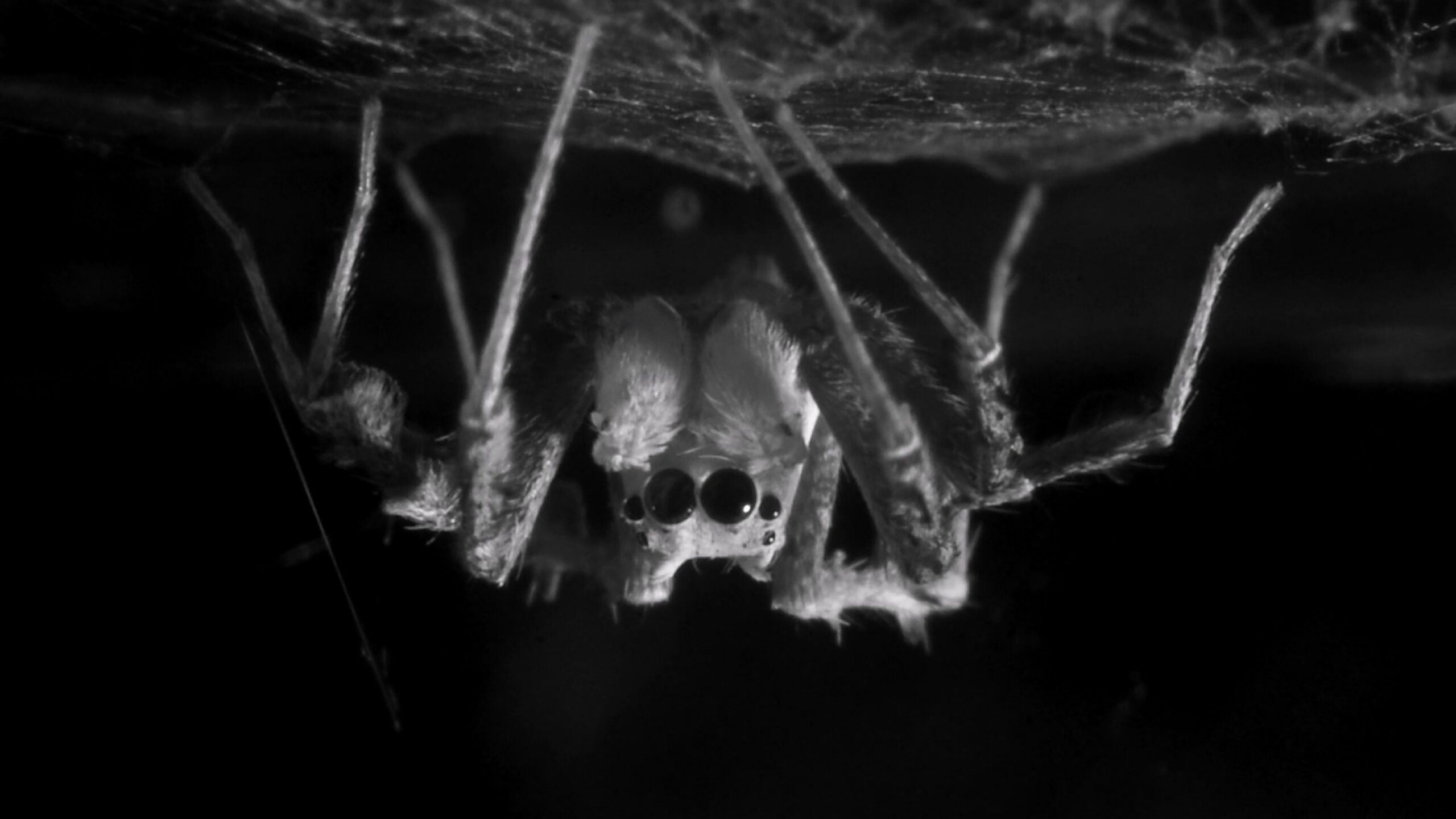
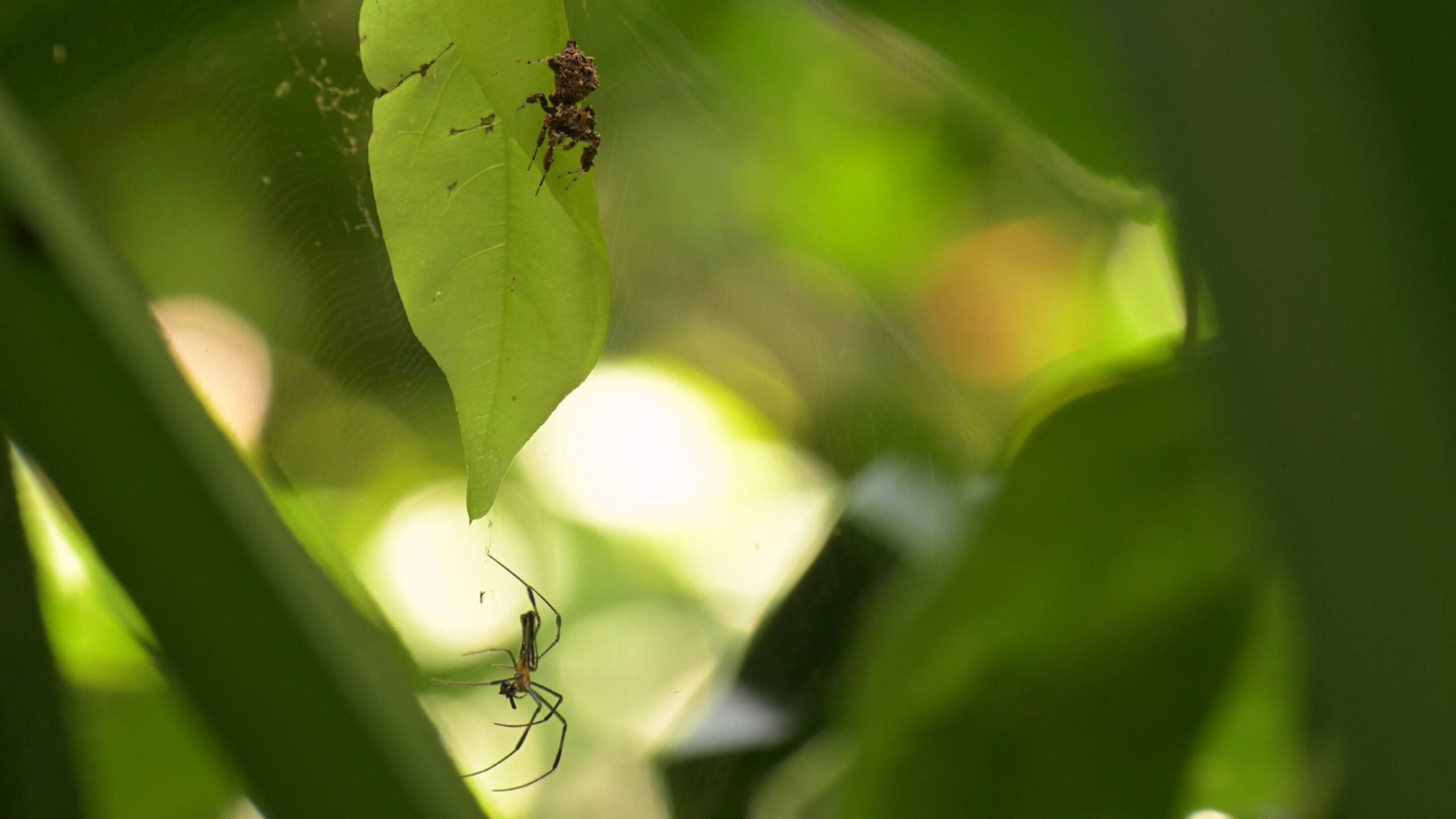
Portia spiders hunt other spiders, sometimes mimicking vibrations that lure web-building prey into reach. Their flexible hunting behavior has made them useful subjects for research on learning and decision-making. The Australian species studied here is a daytime predator with a highly developed visual system.
That lifestyle also makes stillness difficult to interpret. During the day, an apparently stationary spider may continue scanning, turning or adjusting its posture. Researchers therefore needed evidence that nighttime inactivity represented sleep, rather than an alert animal simply staying in one place.
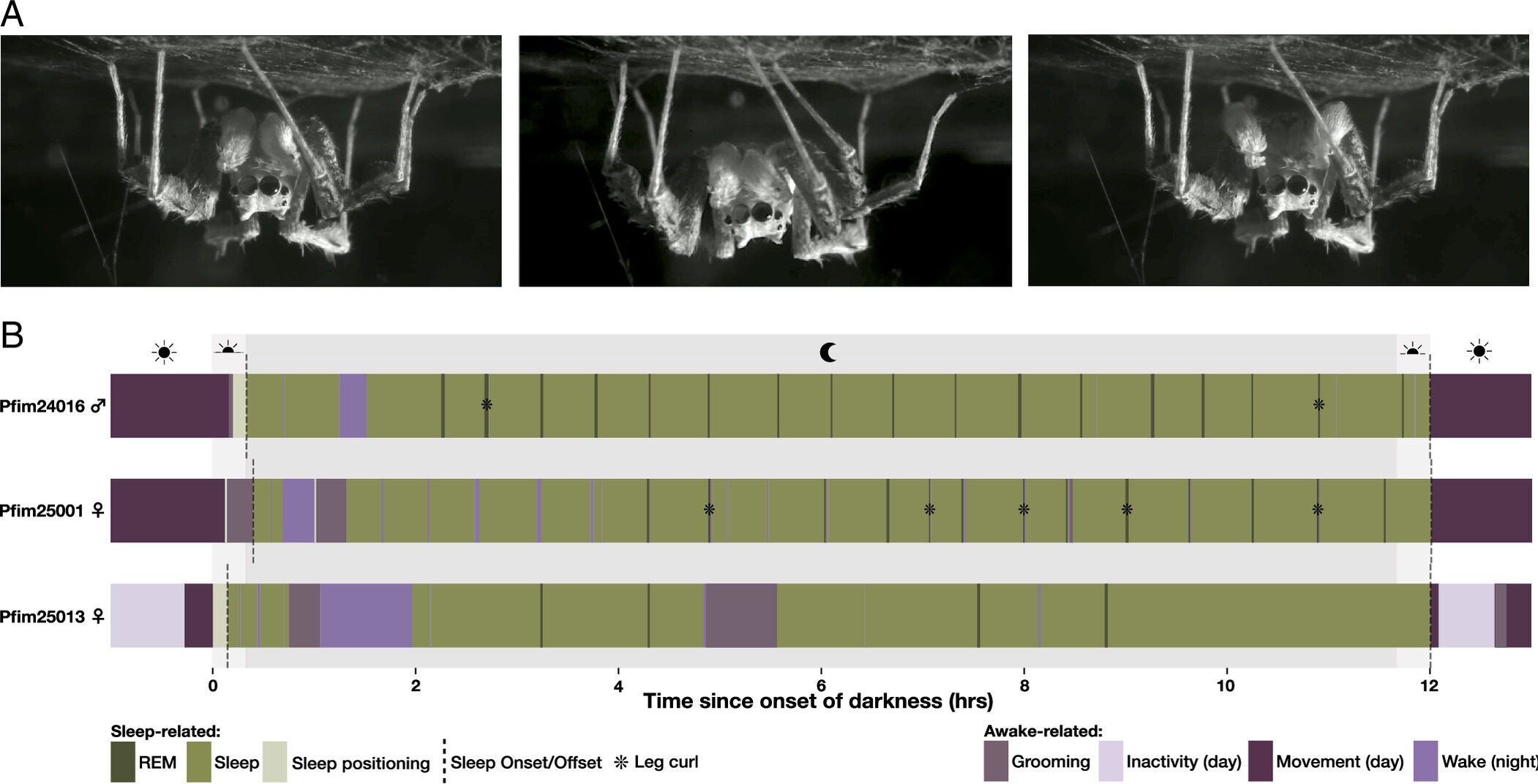
Infrared recordings revealed a characteristic transition as night approached. The spiders searched for sleeping sites, groomed and settled upside down beneath horizontal silk platforms. Their bodies gradually drooped, while the small appendages near their mouths, called pedipalps, drew inward.
In the detailed sleep-architecture analysis of 10 spiders, the average nighttime sleep window lasted about 10.7 hours. However, that window included brief waking periods and potentially quiet wakefulness, so it was not a measurement of uninterrupted sleep. Most spiders adopted their resting posture within the first half-hour after darkness began.
Behavioral sleep research uses several tests because inactivity alone can be misleading. An animal should enter a recognizable resting state, respond less readily to stimulation and remain capable of waking. A compensatory response after disrupted sleep provides further evidence that the state serves a regulated need.
The team also investigated daily timing by tracking activity under different lighting conditions over 60 hours. Spiders generally concentrated activity in the light phase of a daily light-and-near-dark cycle. A roughly daily pattern persisted under constant near-darkness, consistent with an internal timing mechanism.
Constant light produced a less orderly pattern, with more fragmented periods of low activity. The observations suggest that lighting conditions influence how rest is organized. They do not establish how streetlights or other outdoor illumination affect wild populations, which remains a question for future research.
Daily timing and sleep need are related but distinct. An internal clock helps organize when an animal rests, while sleep pressure reflects its recent history of wakefulness and disruption. Showing evidence for both processes makes a stronger case for regulated sleep than observing a daily period of immobility alone.
Together, posture, timing and responsiveness gave the researchers several independent ways to evaluate sleep. This approach matters for animals whose nervous systems are difficult to monitor directly. It also avoids requiring every species to display exactly the same outward signs as a sleeping mammal.
Across the 10 spiders in the detailed recordings, researchers identified 109 REM-like episodes. These bouts averaged about 83 seconds and included rapid retinal movements, muscular twitches and sometimes leg curling. Their timing varied substantially among individuals, rather than following one identical nightly schedule.
The first REM-like episode began an average of about four hours after the recorded sleep onset. Individual timings ranged from just over an hour to about 10 hours. Such variation highlights why researchers needed detailed recordings from multiple animals rather than one striking video of a twitching spider.
The term REM refers to rapid eye movement sleep, a state studied extensively in humans and other vertebrates. The spider episodes resemble some of its visible features. That resemblance does not establish that the same neural processes occur in both groups.
Earlier research had described comparable nighttime movements in another jumping spider, Evarcha arcuata. The new work tested whether such movements occur within a broader state that meets behavioral sleep criteria. Its contribution therefore extends beyond spotting twitching legs or moving retinas during apparent rest.
The distinction is especially important when considering dreams. Neither eye movements nor muscle twitches reveal whether an animal has subjective experiences during sleep. This study did not record brain activity, so it cannot demonstrate dreaming or identify a spider equivalent of human non-REM sleep.
To investigate responsiveness, the researchers presented a standardized acoustic stimulus while spiders were awake, quietly resting or in REM-like episodes. Each condition involved 10 tests, and all spiders responded within the 10-second testing period when awake or quietly resting. During REM-like episodes, four did not respond within that window.
Those initially unresponsive spiders reacted immediately when tested again while awake. This helped rule out a simple inability to detect the stimulus or move. Their reduced responsiveness depended on behavioral state, supporting the interpretation that the episodes occurred during sleep.
Among responding spiders, estimated reaction times averaged about 1.7 seconds when awake, 2.7 seconds during quiet rest and 4.3 seconds during REM-like episodes. Both resting conditions produced significantly slower responses than wakefulness. However, the difference between quiet rest and REM-like episodes did not reach the corrected statistical significance threshold.
That qualification limits claims about precisely how the two states differ in vigilance. Quiet rest also contained considerable variation, including responses resembling wakefulness and others resembling REM-like episodes. With small samples and no neural recordings, the boundaries between quiet waking and different depths of sleep remain uncertain.
A separate experiment disrupted sleep for one night using continuous disturbance from fruit flies. The researchers then compared baseline and recovery periods in 13 spiders. After disruption, the overall sleep window increased by about 8.5%.
The more pronounced change involved REM-like activity. Total time in these episodes rose from an average of 9.4 minutes to 16.9 minutes, an increase of roughly 80%. The spiders experienced more episodes, while individual bout duration did not increase significantly.
A control group of five undisturbed spiders did not show a general increase in sleep-window duration over successive nights. That comparison strengthened the interpretation that the recovery changes reflected previous disruption. The rebound supports sleep regulation, although the experiments did not establish what specific restorative functions the REM-like episodes perform.
The findings make Portia a promising subject for studying whether sleep interacts with learning, sensory processing or hunting performance. Researchers also plan to compare sleep across spider species and between laboratory and field conditions. Determining what happens in the arachnid brain during these episodes remains essential to explaining whether their resemblance to vertebrate REM reflects shared evolutionary roots or independently evolved solutions.
These resources explain earlier spider observations, comparative sleep research and evidence from other nervous systems.
More sleep for behavioral ecologists
This commentary explains why studying unfamiliar species and natural environments can broaden the questions asked in sleep research. (Journal of Experimental Zoology Part A: Ecological and Integrative Physiology, July 2024)
Wake-like skin patterning and neural activity during octopus sleep
This study combines behavior with brain recordings to investigate two sleep states in octopuses, offering a comparison with the behavioral evidence in spiders. (Nature, June 2023)
Regularly occurring bouts of retinal movements suggest an REM sleep–like state in jumping spiders
The earlier jumping-spider study documented retinal movements, twitching and leg curling that motivated further tests of sleep regulation. (Proceedings of the National Academy of Sciences, August 2022)
Hanging by a thread: unusual nocturnal resting behaviour in a jumping spider
Field and laboratory observations describe a different jumping spider’s suspended resting posture and examine possible sensory and protective functions. (Frontiers in Zoology, May 2021)
The Jellyfish Cassiopea Exhibits a Sleep-like State
Behavioral tests in jellyfish show why sleep research can extend to animals without centralized brains. (Current Biology, September 2017)
Research findings are available online in the journal PNAS.
The original story “Jumping spiders show REM-like sleep, but do they dream?” is published in The Brighter Side of News.
Like these kind of feel good stories? Get The Brighter Side of News’ newsletter.
The post Jumping spiders show REM-like sleep, but do they dream? appeared first on The Brighter Side of News.


Leave a comment
You must be logged in to post a comment.