WASP-94A b, a hot Jupiter nearly 700 light-years away, builds mineral cloud cover each morning and loses it by evening. This gives astronomers a rare clear view of its atmosphere and shows how cloud cycles can distort what distant worlds seem made of.
WASP-94A b spends each day under a strange routine. By morning, one side of the giant planet is wrapped in mineral clouds. By evening, those clouds are gone, burned off or dragged downward. This leaves a clearer view into an atmosphere that had long been blurred by haze-like interference.
That daily turnover, detected with the James Webb Space Telescope, gives astronomers one of their sharpest looks yet at how weather works on a hot Jupiter. This is the class of gas giant that orbits perilously close to its star. In addition, it fixes a major problem that had been skewing estimates of what this planet is actually made of.
The work, published in Science, focused on WASP-94A b, a gas giant in the constellation Microscopium, nearly 700 light-years from Earth. Researchers found that its leading edge, the side rotating from night into day, looked cloudy and muted. Meanwhile, its trailing edge, rotating from day into night, looked much clearer.
“I’ve been looking at exoplanets for 20 years, and general cloudiness has been a thorn in our side. We’ve known for quite a while that clouds are pervasive on Hot Jupiter planets, which is annoying because it’s like trying to look at the planet through a foggy window,” said co-author David Sing, a Bloomberg Distinguished Professor of Earth and Planetary Sciences at Johns Hopkins. “Not only have we been able to clear the view, but we can finally pin down what the clouds are made out of and how they’re condensing and evaporating as they move around the planet.”
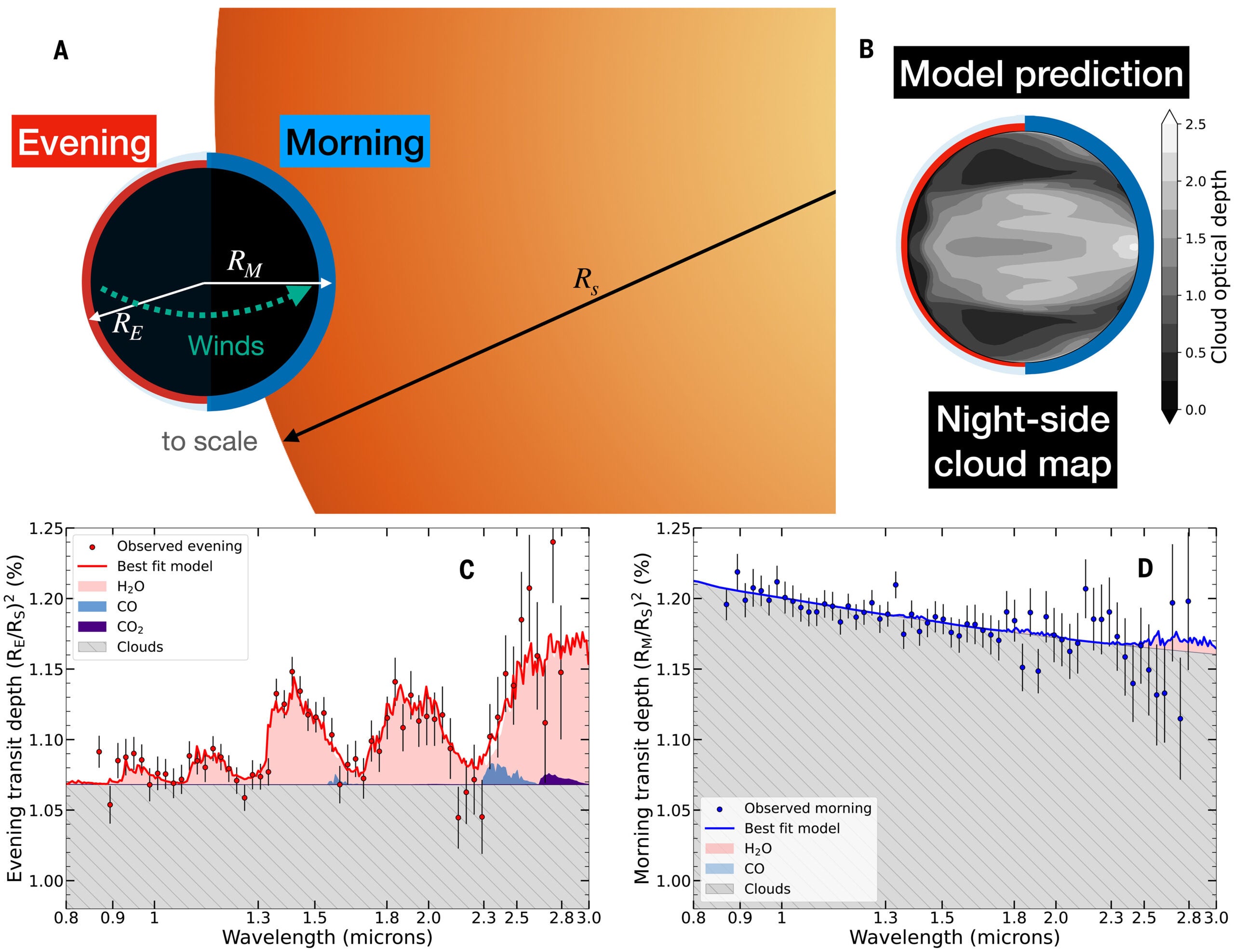
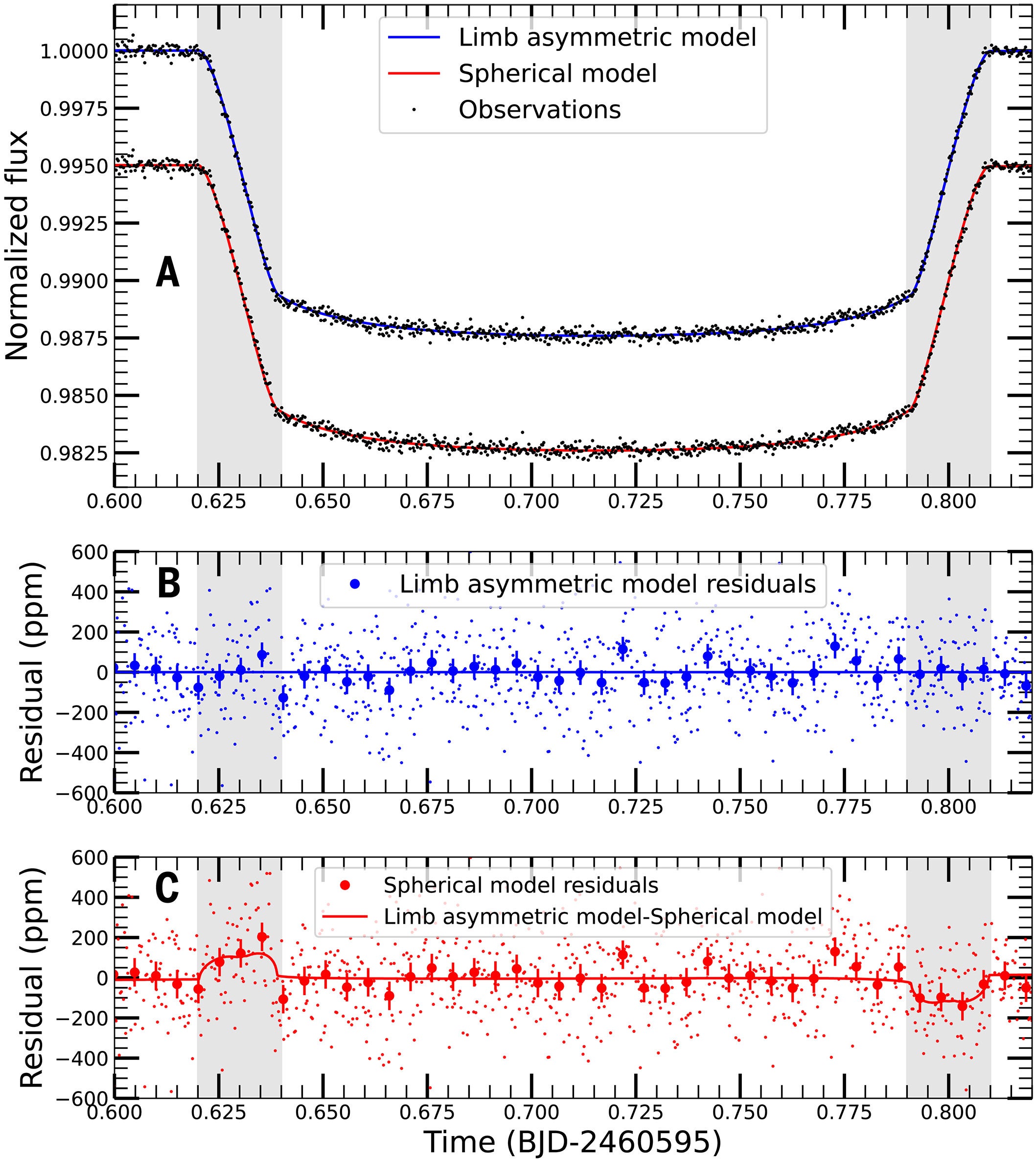
To catch that contrast, the team used JWST to observe a transit, the moment the planet crossed in front of its star. That let them measure the atmosphere at the start of the crossing and again at the end. This effectively separated the planet’s morning limb from its evening limb.
Because WASP-94A b is expected to be tidally locked, one side always faces its star and one side stays in darkness. Air moving from the nightside into daylight defines the morning side. In contrast, air flowing from the dayside back toward night marks the evening side.
The difference turned out to be stark.
The morning side showed no strong gas absorption features and instead displayed the sloped signature of high-altitude aerosols. The evening side, by contrast, showed clear water absorption and little evidence of aerosols. The researchers concluded that the dominant particles are clouds, not photochemical hazes.
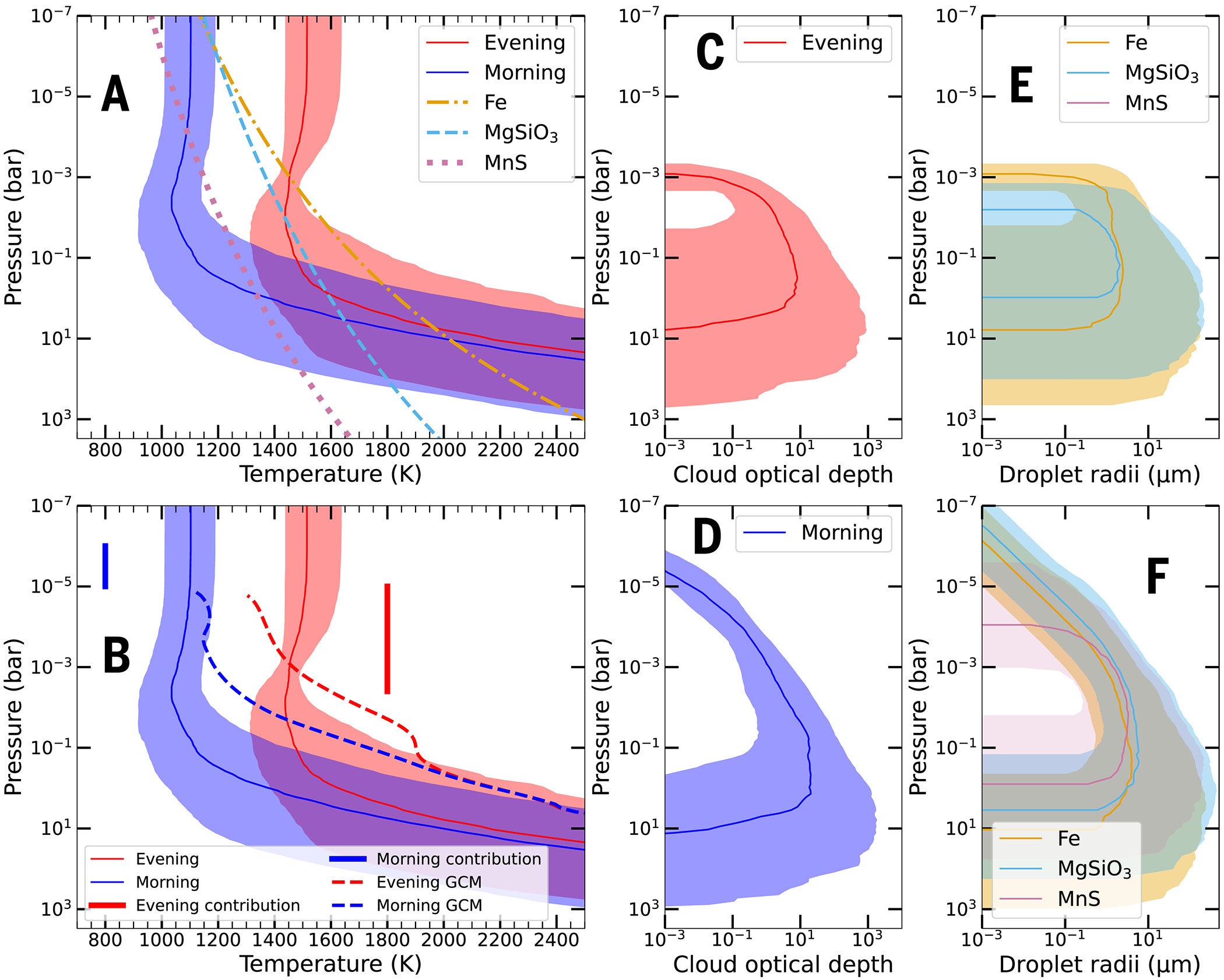
Their modeling points to magnesium silicate clouds, a mineral material common in rocky settings, forming high in the atmosphere on the cooler side of the planet. Those clouds then seem to vanish as they move into hotter conditions.
“It was a huge surprise. People have expected some differences, like its cooler in the morning than the evening, that’s something natural that we experience here on Earth,” Sing said. “But what we saw was a real dichotomy between the weather on both sides of the planet, and huge differences in cloud coverage, and that changes our whole picture of the planet.”
The team sees two main explanations. One is mechanical: strong winds may loft clouds high into the atmosphere on the cooler side, then force them downward on the hotter dayside. This could hide them deeper in the planet before sunset. The other is thermal: clouds may form on the cold nightside, drift into daylight, then evaporate as temperatures climb.
Either way, the numbers point to a powerful day-night contrast. The retrieved temperature difference between the two limbs was 449 ± 83 kelvin. The morning spectrum probed very high altitudes, at pressures of 0.01 millibar or less, where the clouds remained optically thick. The evening limb became transparent at pressures lower than about 1 millibar.
The cloud signal was strong. The team reported cloud absorption in the morning limb at 9σ significance and water absorption in the clearer evening limb at 10σ significance. Moreover, the asymmetric limb model was favored over a symmetric one at 6σ.
That matters because older observations often blended both limbs together into a single average. When that happens, clouds and gas features get mixed into one flattened picture.
“With the Hubble telescope, when we used to do this type of observation, we got an average view of the whole planet with data from the clouds and the atmosphere squished together and indistinguishable,” said first author Sagnick Mukherjee, a postdoctoral fellow at Arizona State University who was a student at Johns Hopkins and UC Santa Cruz at the time of the research. “This approach with the JWST lets us localize our observations, which helped us see the cloud cycle.”
That clearer evening view changed more than the weather forecast. It changed the chemistry.
Earlier measurements, based on blended data, had implied that WASP-94A b held hundreds of times more oxygen and carbon than Jupiter, an odd result that did not fit standard planet formation theory. Once the cloudy and clear limbs were separated, the picture shifted sharply.
The new study found the planet has only about five times the oxygen and carbon abundance of Jupiter. In the paper’s formal retrievals, the inferred metallicity from the limb-resolved data was far lower than the value derived from a spherical, blended spectrum. In fact, the two estimates differed at more than 4σ significance.
The lesson is broader than one world. If morning clouds and evening clarity are common on hot Jupiters, then many earlier atmospheric measurements may need to be revisited. The authors warn that failing to account for limb asymmetry can bias inferred metallicity, cloud properties, and other key atmospheric parameters.
The data also revealed an absorption feature from outflowing metastable helium at 1.083 micrometers in the planet-wide spectrum, a sign that WASP-94A b is rapidly losing atmosphere.
The researchers did not stop with one planet. Using WASP-94A b as a benchmark, they looked at eight other hot gas giants and found the same distinctive cloud-cycle pattern on two more, WASP-39 b and WASP-17 b.
That suggests the process may be common among strongly irradiated giant planets. These worlds are already useful as natural test beds because their extreme heat, close-in orbits, and intense radiation push atmospheric chemistry and circulation into regimes not seen in the Solar System.
The new observations add another layer: not just whether clouds exist, but where they sit, how they move, and how much they can distort the chemistry astronomers think they are measuring.
Next, Sing and his collaborators plan to use a larger JWST observing program to study cloud cycling across a broader range of exoplanets. This includes an eccentric gas giant that lies in the habitable zone of its system.
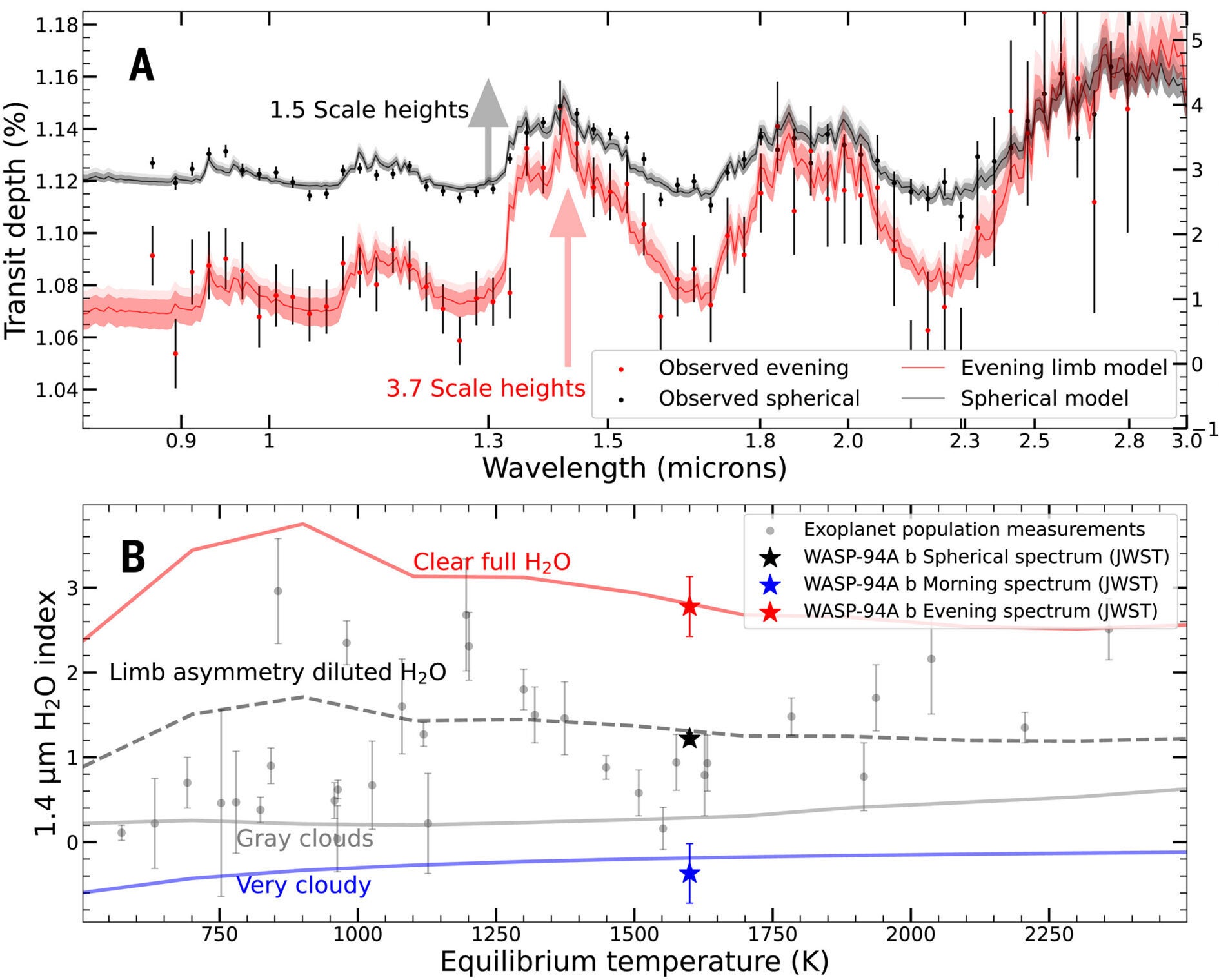
This study sharpens a basic tool of exoplanet science. Astronomers often infer a planet’s composition from starlight filtered through its atmosphere during transit. If cloud cover differs sharply from one limb to the other, those measurements can be biased, sometimes by a lot.
Resolving the morning and evening sides separately offers a way to correct that problem and produce more reliable estimates of atmospheric makeup.
It also gives scientists a better handle on cloud physics, circulation, and heat transport in extreme worlds, insights that could carry over to smaller and more temperate exoplanets where aerosols may also complicate the search for accurate atmospheric signatures.
Research findings are available online in the journal Science.
The original story “JWST catches mineral clouds forming and fading on ‘hot Jupiter’ exoplanet” is published in The Brighter Side of News.
Like these kind of feel good stories? Get The Brighter Side of News’ newsletter.
The post JWST catches mineral clouds forming and fading on ‘hot Jupiter’ exoplanet appeared first on The Brighter Side of News.

