Some of the James Webb Space Telescope’s strangest discoveries may not be traveling through the early universe alone.
Astronomers analyzing high-resolution infrared observations have identified four candidate pairs of “little red dots,” or LRDs, separated by only a few thousand to several tens of thousands of light-years. The compact objects existed when the universe was only about a billion years old.
The findings raise the possibility that some rapidly growing early black holes were being brought together by galaxy interactions, creating systems that could eventually end in black hole mergers.
The study, led by Takumi S. Tanaka of the Kavli Institute for the Physics and Mathematics of the Universe at the University of Tokyo, was published in the Publications of the Astronomical Society of Japan. Its title is “Hidden in Pixels. I. Discovery of dual ‘little red dots’ indicates excess clustering on kilo-parsec scales.”
The researchers emphasize that these are dual LRD candidates, not confirmed binary black holes. Two systems still lack spectroscopic confirmation, and even the nature of LRDs themselves remains an active area of research.
JWST began revealing large numbers of LRDs soon after science operations started.
They appear extremely compact in infrared images and typically combine a blue ultraviolet component with a sharply rising red optical spectrum, producing a distinctive V-shaped profile. Many also show broad hydrogen emission lines associated with gas near active black holes.
Evidence increasingly points toward at least many LRDs containing growing black holes surrounded by dense gas. A 2026 Nature analysis, for example, concluded that high-quality spectra from several objects could be explained by young supermassive black holes buried inside compact ionized gas cocoons.
Yet their unusual spectra, weak X-ray emission and other properties mean astronomers are still working out exactly what produces the LRD phenomenon.
Tanaka’s team approached the puzzle from a different direction. Instead of asking only what one LRD contains, they asked whether some objects previously classified as single dots might actually contain two closely separated components.
Traditional LRD searches often rely on the total brightness, color and apparent compactness of an object.
That creates a potential blind spot.
Two LRDs sitting very close together can blend into a more complicated source. Their combined light may no longer meet the compactness or color criteria normally used to find isolated dots. In effect, a search designed to find single compact objects could unintentionally reject pairs.
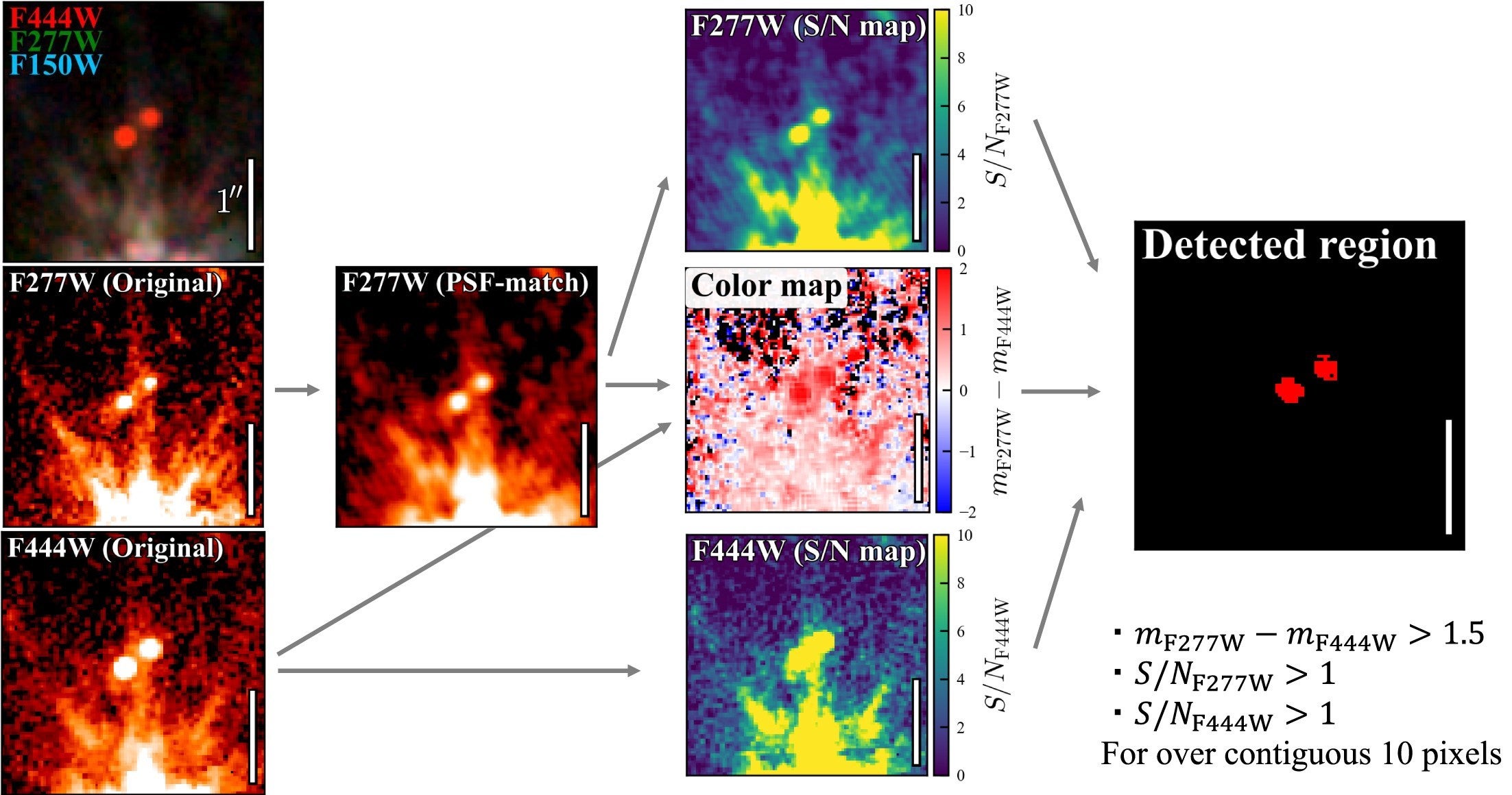
The researchers developed a pixel-by-pixel technique to overcome that problem. Rather than assigning one color measurement to an entire source, they examined the colors of individual image pixels in JWST NIRCam observations from the COSMOS-Web survey.
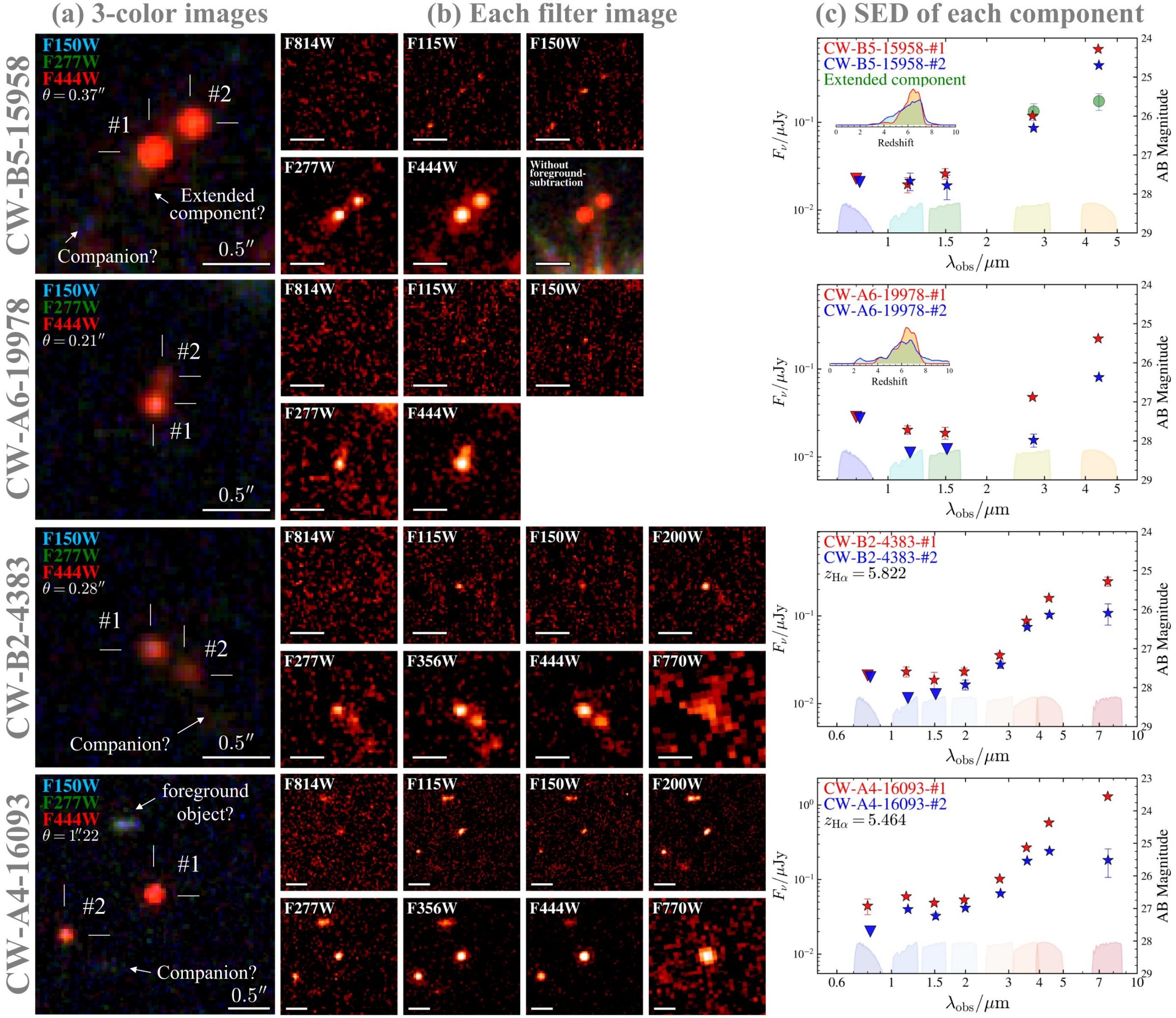
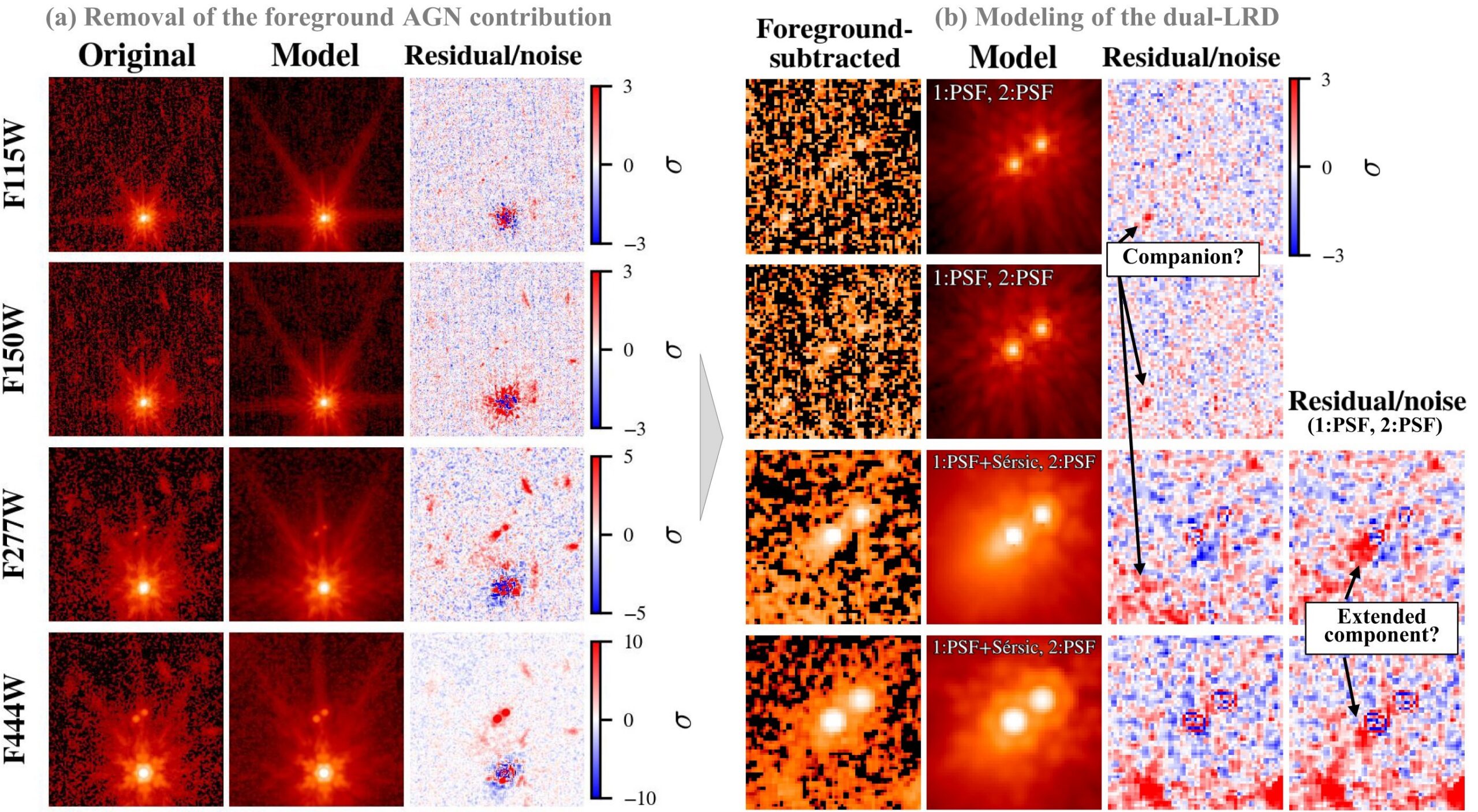
The method searched for neighboring regions that independently showed LRD-like colors. The team then used image modeling to determine whether each component was compact and compared their spectral energy distributions with models for LRDs and possible contaminants such as brown dwarfs.
Four systems survived the analysis.
Their projected separations span roughly 1 to 7 kiloparsecs. Three of the four are particularly close, with separations of only a few kiloparsecs or less.
For comparison, the Milky Way is roughly 100,000 light-years across.
Images alone cannot prove that two points of light are actually neighbors.
Objects separated by enormous distances can appear beside each other simply because they happen to line up along the same direction from Earth.
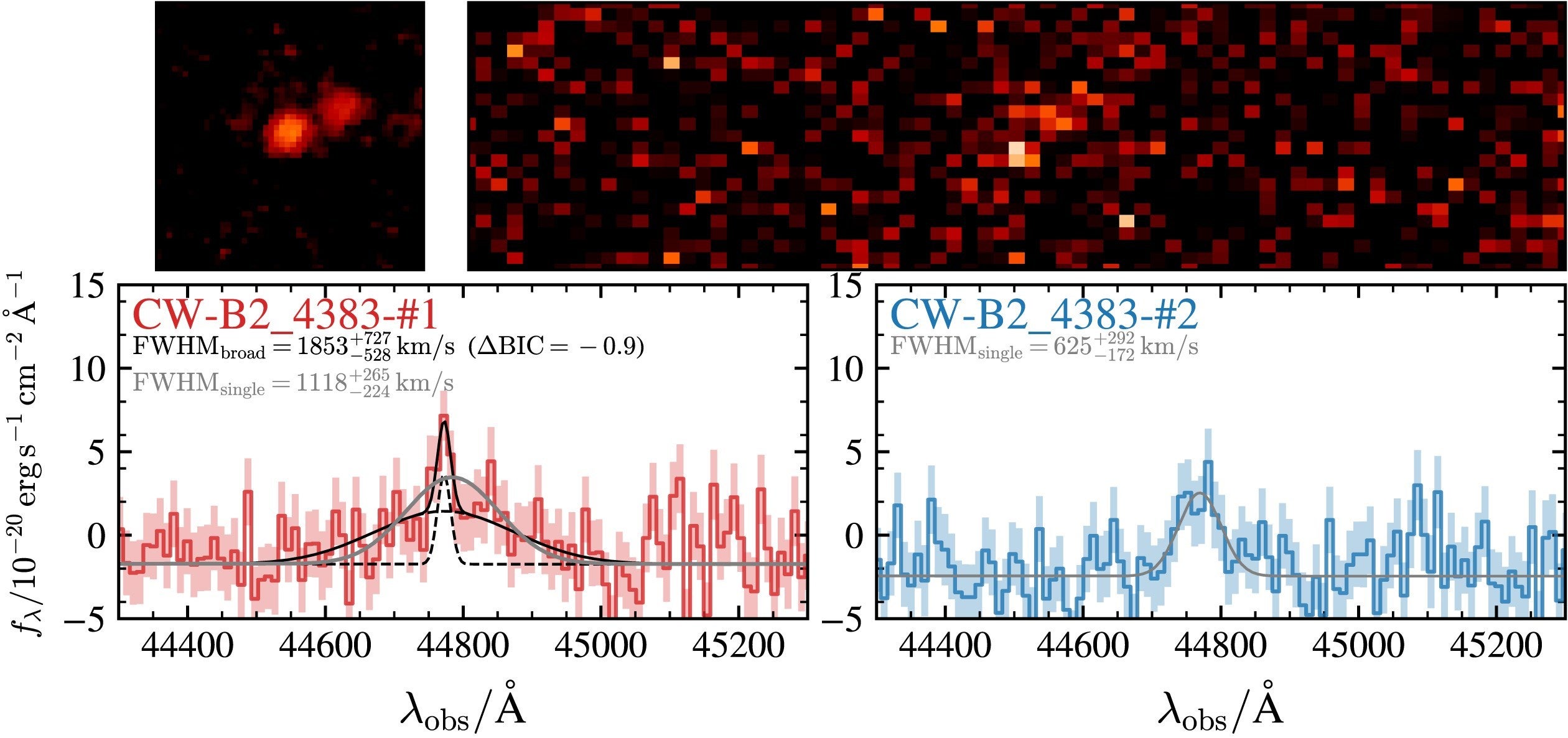
For two of the four candidate systems, however, JWST slitless spectroscopy provided an important additional clue.
Both components within each pair showed an emission line at essentially the same observed wavelength. If the lines are hydrogen-alpha, as the researchers argue, the systems lie at redshifts of 5.822 and 5.464. Their projected separations are about 1.64 and 7.36 kiloparsecs, respectively.
The team also generated mock populations of randomly distributed LRDs to test whether four such close pairs could emerge through chance projection.
The observed pairs proved difficult to reproduce randomly. If the candidates really occupy the same environments, the results suggest LRDs could be clustered roughly tens of times more strongly on kiloparsec scales than expected by extrapolating larger-scale clustering measurements.
That result could point toward galaxy interactions.
Galaxy mergers can funnel gas toward their centers. That gas can feed central black holes, potentially causing rapid accretion at the same time that gravitational interactions draw the black holes closer together.
The newly identified systems may capture an early part of that process.
For the two spectroscopically supported pairs, their separations place the components well inside the expected virial radii of their host dark matter halos. The paper therefore examines them as potential precursors to future black hole mergers rather than simple high-speed flybys.
If black holes inside LRDs eventually merge, the events could contribute directly to the rapid buildup of massive black holes early in cosmic history.
They would also produce gravitational waves. Depending on the black hole masses, future space-based observatories such as the Laser Interferometer Space Antenna, or LISA, could detect mergers from similar systems across enormous cosmic distances.
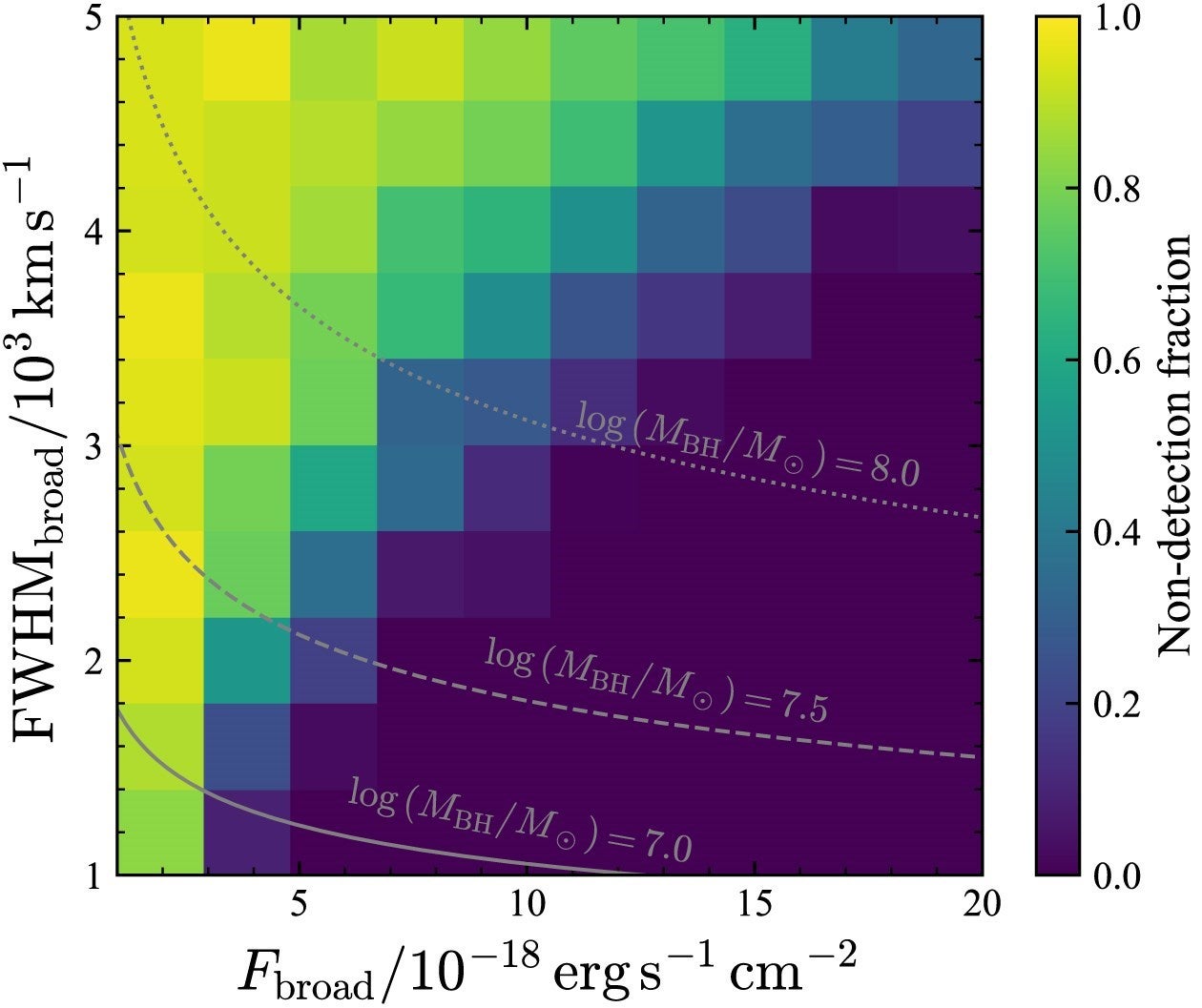
Much remains unresolved. Two candidate pairs are based only on photometric evidence, and deeper spectroscopy is needed to establish whether every component is an LRD containing an accreting black hole.
The team now plans to expand the pixel-based search to larger samples.
If more pairs appear, astronomers could begin measuring how often early black holes entered close partnerships. That statistic may reveal whether mergers were merely occasional events or an important ingredient in building the enormous black holes that appeared surprisingly early in the universe.
These five studies explore what little red dots may contain, how massive their black holes are and what their environments reveal about early black hole evolution.
Little red dots as young supermassive black holes in dense ionized cocoons: High-quality JWST spectra indicate that many LRDs can be explained as young supermassive black holes surrounded by extremely dense ionized gas, with inferred black hole masses of roughly 100,000 to 10 million solar masses. (Nature, 2026)
A direct black-hole mass measurement in a little red dot at high redshift: Gravitational lensing and deep spectroscopy allowed astronomers to dynamically measure a roughly 50-million-solar-mass black hole in an LRD at redshift 7.04, offering a rare direct test of black hole mass estimates in these objects. (Nature, 2026)
A little red dot at z = 7.3 within a large galaxy overdensity: This study found an LRD surrounded by eight nearby galaxies, providing direct evidence that at least some LRDs inhabit strongly overdense environments where interactions and mergers may be more likely. (Nature Astronomy, 2025)
The Rise of Faint, Red Active Galactic Nuclei at z > 4: A Sample of Little Red Dots in the JWST Extragalactic Legacy Fields: A sample of 341 LRDs across several major JWST surveys mapped their abundance from redshift 2 to 11 and strengthened the connection between these compact red sources and a widespread population of faint early active galactic nuclei. (The Astrophysical Journal, 2025)
The X-Ray Dot: Exotic Dust or a Late-stage Little Red Dot?: Researchers identified an unusual LRD-like source with strong X-ray emission that may represent a transitional stage between deeply buried little red dots and more conventional active galactic nuclei. (The Astrophysical Journal Letters, 2026)
Research findings are available online in the journal Publications of the Astronomical Society of Japan.
The original story “JWST finds mysterious red objects pairing up in the early universe” is published in The Brighter Side of News.
Like these kind of feel good stories? Get The Brighter Side of News’ newsletter.
The post JWST finds mysterious red objects pairing up in the early universe appeared first on The Brighter Side of News.


Leave a comment
You must be logged in to post a comment.